
Paula C. Brady1
(1)
Department of Obstetrics, Gynecology and Reproductive Biology, Brigham and Women’s Hospital, Boston, MA, USA
Paula C. Brady
Email: Pbrady2@partners.org
Keywords
Pregnancy of unknown locationEctopic pregnancyMethotrexateSalpingectomySalpingostomy
Definitions
Pregnancy of Unknown Location
Positive serum beta-human chorionic gonadotropin (hCG ) without evidence of an intrauterine or ectopic pregnancy by pelvic ultrasound. Approximately 30 % of these pregnancies will develop into intrauterine pregnancies, while the remainder will be diagnosed as miscarriages or ectopic pregnancies [1].
Protocols to diagnose pregnancy location vary by clinician preference and institutional guidelines. An important concept is the discriminatory zone , or the serum hCG level at which evidence of an intrauterine pregnancy is expected by transvaginal ultrasound. Due to improvements in ultrasound technology, the current discriminatory zone is 1500–2000 milli-international units per milliliter (mIU/mL) [2]. Of note, uterine visualization may be compromised by fibroids or uterine position ; the absence of a visualized pregnancy in patients with serum hCG above 2000 mIU/mL is concerning for ectopic pregnancy but not diagnostic, as intrauterine pregnancies (particularly multiple pregnancies) have been diagnosed in patients with initially negative pelvic ultrasounds despite serum hCG levels above the discriminatory zone [3].
Serial serum hCG levels, measured at 2-day intervals, are used to clarify pregnancy prognosis. The expected hCG rise over 2 days has been defined for normally progressing intrauterine pregnancies ; ectopic pregnancies and miscarriages demonstrate slower hCG rises or declines. Of note, clinical findings may often deviate from these guidelines, requiring close follow up and careful patient counseling. While older guidelines advocated for a doubling of hCG in 2 days for normal intrauterine pregnancies, a more recent study suggests the minimum expected hCG rise may be as low as 35 % in 2 days [4]. In stable asymptomatic patients with pregnancies of unknown location, checking additional values at 2-day intervals adds to the accuracy of this diagnostic technique.
Spontaneous abortions will demonstrate a decline in hCG, dependent on the starting value [5]. A decline of at least 12 % in 2 days is expected for a starting hCG of 50 mIU/mL, as compared to a decline of at least 21 % in 2 days for a starting hCG of 500 mIU/mL, and a decline of at least 35 % in 2 days in patients with a starting hCG of 5000 mIU/mL. Serial hCG values not rising or declining according to these cutoffs are considered “plateaued” and are concerning for ectopic pregnancy, requiring further assessment.
A serum progesterone level is sometimes used to clarify pregnancy prognosis, as nonviable pregnancies—ectopic pregnancies or miscarriages—often have abnormally low levels, though a progesterone level is less sensitive and specific than serial hCG testing. A serum progesterone level below 10 nanograms per milliliter (ng/mL) following a spontaneous conception is suggestive of nonviable pregnancy [6]. A progesterone threshold has not been identified in patients using assisted reproductive technologies, who also often receive progesterone supplementation [7].
Endometrial sampling can be used to clarify pregnancy location in patients with abnormal hCG trends and nondiagnostic pelvic ultrasounds [8]. Identification of chorionic villi (gestational tissue) by pathologic analysis of endometrial curettings and/or a decline in serum hCG by 15–20 % the day after endometrial sampling is consistent with a failing intrauterine pregnancy, while pregnancies with neither identification of villi nor adequate decline in hCG are diagnosed as ectopic pregnancies [10]. Endometrial sampling can be performed by dilation and curettage (D&C) or manual vacuum aspiration, using handheld suction attached to a Karman cannula; endometrial biopsy pipelle is insufficient for this purpose [9, 10]. Patients diagnosed with failing intrauterine pregnancies following endometrial sampling require just weekly serum hCG levels until the value is negative [9]. The assessment of pregnancies of unknown location is shown in Fig. 3.1.
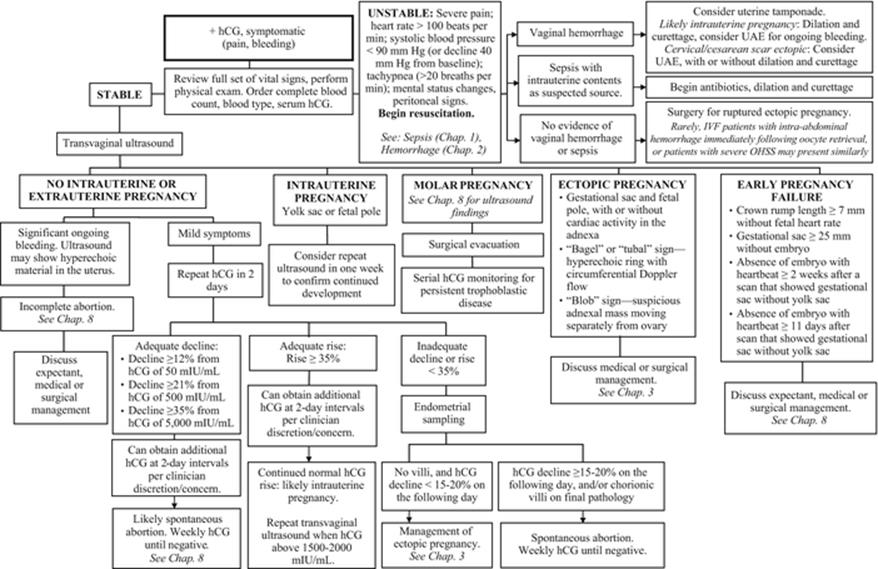
Fig. 3.1
Management algorithm for patients presenting with positive pregnancy tests and pain and/or bleeding
Ectopic Pregnancy
The implantation of one or more embryos outside of the uterus, occurring in 1–2 % of all pregnancies and up to 5 % of pregnancies conceived using assisted reproductive technology [5, 11]. Ectopic pregnancy can lead to intra-abdominal hemorrhage (or vaginal hemorrhage, in patients with cervical or cesarean scar ectopic pregnancies) due to separation or rupture of the ectopic gestation.
Ectopic pregnancies implant most commonly in the ampulla of the fallopian tube; rupture of tubal ectopic pregnancies usually occurs around 6–7 weeks of gestational age [12]. Ten percent of ectopic pregnancies implant in locations other than the fallopian tube , including the cervix, ovary, myometrium, cesarean section scar, interstitial portion of the fallopian tube (within the muscular wall of the uterus), or abdominal cavity [5]. One in 4000–30,000 women in the general population may have both an intrauterine and ectopic pregnancy, called a heterotopic pregnancy [5, 13]. Furthermore, though not uniformly referred to as an “ectopic pregnancy,” a pregnancy may also implant in the rudimentary or hypoplastic uterine horn of a patient with this müllerian anomaly, occurring in an estimated 1 in 100,000–140,000 pregnancies [14]. Fifty percent of rudimentary uterine horns containing pregnancies will rupture, most prior to the third trimester [15]. Patients with ectopic pregnancies in any of these locations may present with pelvic pain and/or vaginal bleeding.
Risk factors for a tubal ectopic pregnancy include age over 35 years, smoking, prior ectopic pregnancy, prior tubal surgery, prior pelvic infection (including Chlamydia trachomatis and pelvic inflammatory disease), and pregnancy conceived by assisted reproduction, particularly in patients with infertility attributed to fallopian tube obstruction [11, 16–19].Patients presenting with pregnancy in the setting of a prior tubal ligation or current use of an intrauterine device for contraception are at high risk of ectopic pregnancy. The failure rate across all methods of tubal sterilization is estimated at 18.5 per 1000, one-third of which are ectopic pregnancies [20]. Current IUD use does not predispose to ectopic pregnancy; pregnancies conceived with an IUD in place are simply more likely to be ectopic. In pregnant patients with an IUD in place, one-half of pregnancies are ectopic with a levonorgestrel device in place, compared to 1 out of 16 with a copper IUD in place [21].
When You Get the Call
Ask for a full set of the patient’s vital signs. Ensure that an hCG has been checked, either by blood or urine (which is faster). In patients with hemodynamic changes or extreme pain, request IV access, a complete blood count, blood type and antibody screen, and proceed immediately to assess the patient.
When You Arrive
Review the patient’s vital signs in detail to assess for tachycardia or hypotension, and assess the patient’s general appearance for signs of distress, including altered mental status or extreme pain. In such patients, confirm that IV access is present, and request a second IV. Tachycardia, hypotension, and/or lethargy requires immediate resuscitation and likely surgical planning.
History
The history may be abbreviated in clinically unstable patients. Ask the patient for the date of her last menstrual period, whether her menses occur regularly (roughly every 21-35 days, indicating whether menstrual dating is reliable), and whether the pregnancy was conceived using assisted reproduction. Inquire whether the patient is currently using a contraceptive method, namely, tubal ligation or an IUD. Review with the patient the time course of her presenting complaint (usually pain or vaginal bleeding) and any associated symptoms or inciting events.
The patient’s obstetric history should be reviewed, including prior deliveries, miscarriages, ectopic pregnancies, and whether management of prior ectopic pregnancies was medical or surgical. The patient’s medical history should be reviewed, including infertility, prior sexually transmitted infections, and endometriosis, which may result in pelvic adhesions. Review her surgical history, including prior tubal surgery.
Physical Examination
On abdominal examination, note the presence of peritoneal signs—including rebound (pain when abdominal pressure is quickly withdrawn), involuntary abdominal guarding, or shake tenderness (pain when shaking the patient’s abdomen or bed)—which may indicate the presence of hemoperitoneum (blood in the abdomen), intra-abdominal inflammation or infection. A gentle bimanual exam can be performed to assess for laterality of pain, though a bimanual exam is not necessary in cases highly suspicious for ectopic pregnancy, as the ectopic pregnancy can rupture. A bimanual exam may also reveal an open cervical os, which, in conjunction with heavy vaginal bleeding, is suggestive of an ongoing miscarriage.
Diagnosis
Hemodynamic Instability
Occasionally, a gynecology consult will be called before any clinical data has been obtained, in patients who report pregnancy and are hemodynamically unstable or have severe abdominal pain. Diagnosis of hemorrhagic shock is shown in Table 3.1. The first signs of hemorrhagic shock are often tachycardia or anxiety; hypotension only occurs once 30–40 % of the patient’s blood volume has been lost, often marking the onset of decompensated hypovolemic shock [22].
Table 3.1
Stages of hemorrhagic shock
|
Class I: blood volume lost <15 % Heart rate <100 beats per minute Blood pressure normal Respiratory rate 14–20 breaths per min Urine output >30 mL/h Mental status normal |
Class II: blood volume lost 15–30 % Heart rate >100 beats per minute Blood pressure normal Respiratory rate 20–30 breaths per min Urine output 20–30 mL/h Mental status mildly anxious |
|
Class III: blood volume lost 30–40 % Heart rate >120 beats per minute Blood pressure decreased Respiratory rate 30–40 breaths per minute Urine output 5–15 mL/h Mental status anxious/confused Often marks the onset of decompensated hypovolemic shock |
Class IV: blood volume lost >40 % Heart rate >140 beats per minute Blood pressure decreased Respiratory rate >35 breaths per min Urine output negligible Mental status confused/lethargic |
Committee on Trauma [22]
Pregnancy can be most quickly confirmed with a urine hCG test; the bladder can be catheterized to expedite this test result. In patients with an acute presentation, a focused assessment with sonography for trauma (FAST) scan can be performed, for the rapid assessment of hemoperitoneum. For gynecologic purposes, the FAST scan is a bedside ultrasound assessing for free fluid in the perihepatic, perisplenic, and pelvic spaces [23]. Pelvic free fluid is shown in Fig. 3.2. The combination of a confirmed positive hCG by urine or serum and suspected hemoperitoneum by FAST scan or other ultrasound in a patient with significant pain and/or hemodynamic changes requires expeditious surgical management, usually with diagnostic laparoscopy.
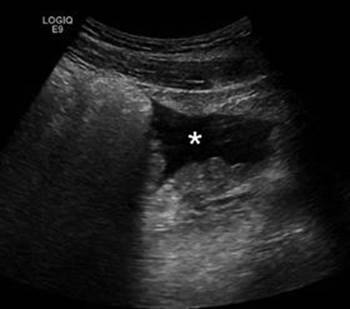
Fig. 3.2
Focused assessment with sonography for trauma (FAST) scan. Transabdominal ultrasound reveals moderate complex free fluid in the right lower quadrant, indicated with an asterisk (*), in a patient with a ruptured tubal ectopic pregnancy
Rarely, alternative explanations for this presentation arise (which should be readily identified by the patient history), with differing management. Patients may present with acute pain and hemoperitoneum following oocyte retrieval for in vitro fertilization (usually in the first 24 hours); their positive hCG is due to exogenous hCG administration, not pregnancy. Furthermore, patients in early pregnancy with severe ovarian hyperstimulation syndrome may present similarly with pain, hemodynamic changes and large ascites (though ectopic pregnancies are also possible in these patients). Please refer to Chap. 20, Reproductive Endocrinology and Infertility, for the diagnosis and management of these issues.
Stable Patients
In stable patients, a serum hCG, complete blood count, liver function tests, basic metabolic panel, and blood type and antibody screen should be obtained, in addition to a transvaginal ultrasound.
Ultrasound is a vital tool in the diagnosis of a patient in early pregnancy with pain or bleeding. An intrauterine pregnancy may be diagnosed by the presence of a gestational sac and a yolk sac, with or without a fetal pole. Identification of a gestational sac alone is insufficient, as patients with ectopic pregnancies may have a small fluid collection or “pseudosac” in the uterus, mimicking an intrauterine gestational sac (Fig. 3.3) [24].
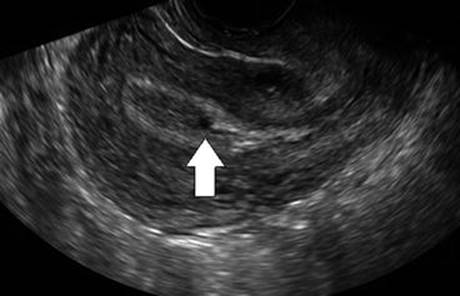
Fig. 3.3
Intrauterine pseudosac. The arrow indicates a small intrauterine fluid collection that was called a gestational sac, in a patient with a subsequent surgery-proven ectopic pregnancy
For reference, a normally progressing intrauterine pregnancy for which pregnancy dating is known—either by use of assisted reproduction or a reliable last menstrual period—is associated with ultrasound findings at certain gestational ages, though diagnosis of a failed pregnancy cannot be made by these guidelines [25]. At 5 weeks of gestation, an intrauterine gestational sac is expected, usually 2–3 millimeters (mm) in diameter at this point, while at 5.5 weeks of gestation, a yolk sac becomes visible. At 6 weeks of gestation, the embryo becomes visible, usually 1–2 mm in length.
Early pregnancy failure can be diagnosed by certain ultrasound criteria [26]. These include one of the following: (1) a fetal crown-rump length of 7 mm or greater without fetal cardiac activity, (2) gestational sac 25 mm or greater without presence of a fetal pole, (3) absence of an embryo with cardiac activity 2 weeks or more after an ultrasound documenting a gestational sac without a yolk sac, and (4) absence of embryo with cardiac activity 11 days or more after an ultrasound that showed a gestational sac and yolk sac [27]. Please see Chap. 8, Spontaneous Abortion, for more information on the diagnosis of early intrauterine pregnancies.
Evidence of a tubal ectopic pregnancy by transvaginal ultrasound includes (1) visualization of a gestational sac and fetal pole—with or without cardiac activity—in the adnexa; (2) a hyperechoic ring in the adnexa with circumferential Doppler flow, called the “bagel” or “tubal” sign (Fig. 3.4); or (3) the “blob” sign, in which a suspicious mass moves separately from the ovary with application of pressure with the transvaginal ultrasound probe [25, 28]. Patients with ruptured ectopic pregnancies are likely to have complex free fluid on imaging, reflecting hemoperitoneum; a small amount of simple free fluid in the pelvis is normal (Fig. 3.5).
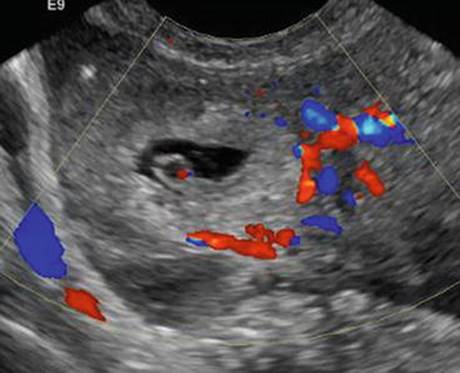
Fig. 3.4
Tubal ectopic pregnancy by transvaginal ultrasound. Transvaginal ultrasound shows a hyperechoic ring containing a gestational sac in the right adnexa, with circumferential Doppler flow
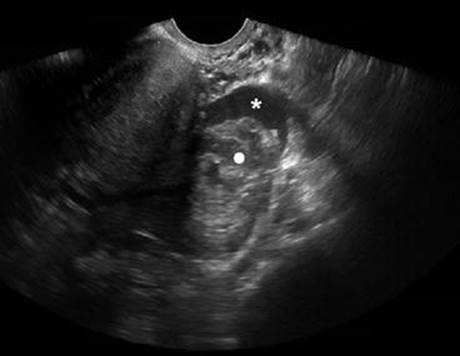
Fig. 3.5
Adnexal complex free fluid. Transvaginal ultrasound showing complex free fluid (*) around an adnexa (●) in patient with a ruptured tubal ectopic pregnancy
Rarely, ectopic pregnancies implant in locations other than the fallopian tube and are associated with ultrasound findings specific to each location. A cervical ectopic pregnancy will appear as a gestational sac within the cervical canal, below a closed internal cervical os, and with circumferential Doppler flow [29]. A cesarean scar ectopic pregnancy will appear as a gestational sac within a prior cesarean section scar with very thin overlying myometrium (<3 mm) and an empty intrauterine cavity [30]. Cervical and cesarean scar ectopic pregnancies must be differentiated from spontaneous miscarriages, which may slide down into the lower uterine segment; unlike a miscarriage, these ectopic pregnancies will not move when pressure is applied with the transvaginal probe. An interstitial ectopic pregnancy—implanted in the most proximal/intramuscular portion of the fallopian tube—will appear as an eccentrically located gestational sac in the cornual region with a thin (<5 mm) overlying myometrial layer [31]. An intramural ectopic pregnancy will appear completely surrounded by myometrium, with no pregnancy in the uterine cavity [32]. An ovarian pregnancy may appear as an echogenic ring in the ovary with peripheral Doppler flow and will not move separately from the ovary when pressure is applied with a transvaginal probe; these pregnancies can be difficult to differentiate from ovarian cysts, and definitive diagnosis is often made by laparoscopy [32, 33]. An abdominal pregnancy may appear as an extrauterine gestational sac or fetus without overlying myometrium, often surrounded by loops of bowel [34]. A heterotopic pregnancy is an ectopic pregnancy in any location coexisting with an intrauterine pregnancy.
In women with a unicornuate uterus and a rudimentary uterine horn, pregnancies implanted in the rudimentary uterine horn may be misdiagnosed as tubal, interstitial, or abdominal pregnancies by ultrasound. A pregnancy in a rudimentary horn may also be misdiagnosed as an intrauterine pregnancy in a bicornuate uterus; the latter can be expectantly managed with close follow-up by an obstetrician [35]. In a pregnant patient with a müllerian anomaly that has not been definitively diagnosed prior to pregnancy, an MRI should be obtained to clarify the patient’s uterine anatomy. A pregnancy in a rudimentary horn may be suspected when the myometrium of the horn containing the pregnancy is thinner than the other horn, and the horns are at a marked distance from one another; furthermore, the endometrial canal of the rudimentary horn is often not continuous with the cervical canal [36]. Please see Chap. 10, Acute Pelvic Pain in Pediatric and Adolescent Patients, for more information on the diagnosis of müllerian anomalies.
Management
Please see Fig. 3.1 for a flowchart of the diagnosis of patients with positive serum hCG and pain and/or bleeding. For management of spontaneous abortions, please refer to Chap. 8.
In general, in patients with significant pain and/or hemodynamic changes, with a confirmed positive hCG by urine or serum and hemoperitoneum by FAST scan or other ultrasound, expeditious surgical management is required. Resuscitation of severe intra-abdominal hemorrhage due to a ruptured ectopic pregnancy should be started while proceeding to the operating room. Please refer to Chap. 13, Preparing for Urgent or Emergent Surgery, for more information on emergent resuscitation of intra-abdominal hemorrhage. Patients presenting with vaginal hemorrhage attributed to cesarean scar or cervical ectopic pregnancies may require uterine artery embolization (UAE) and/or surgical management; please refer to Chap. 2, Vaginal Hemorrhage, for management of vaginal hemorrhage [37, 38].
Medical Management of Ectopic Pregnancy
Medical management of ectopic pregnancy is appropriate in hemodynamically stable, carefully selected, and well-counseled patients. Medical management entails use of methotrexate, a dihydrofolate reductase inhibitor, which targets rapidly dividing cells [39].
Before administration of methotrexate, a complete blood count, liver function tests, and creatinine should be obtained; a patient’s Rhesus factor (Rh) status should be verified, as Rh-negative women should receive Rho(D) immune globulin [11]. Patients with active pulmonary disease should have a chest radiograph.
Patients receiving methotrexate for treatment of ectopic pregnancy should be clearly counseled regarding the need for close clinical follow-up, ongoing risk of rupture of tubal ectopic pregnancy, and signs and symptoms—namely, worsening abdominal pain—concerning for rupture of ectopic pregnancy. Side effects of methotrexate include abdominal and pelvic pain, nausea, headaches, dermatitis, and less commonly alopecia and mucositis [40, 41].
Strict contraindications to the medical management of ectopic pregnancy are listed in Table 3.2. Relative contraindications include the presence of fetal cardiac activity or suspected ectopic pregnancy mass greater than 4 cm, serum hCG level greater than 5000 mIU/mL, patient refusal of blood transfusion, or patient inability to adhere to close outpatient follow-up [11].
Table 3.2
Strict contraindications to medical management of ectopic pregnancy (EP)
|
Clinical instability or significant pain suggestive of ruptured EP |
|
Heterotopic pregnancy |
|
Liver function tests > two times the upper limit of normal |
|
White blood cell count <1500/uL |
|
Platelet count <100,000/uL |
|
Creatinine >1.5 mg/dL |
|
Significant anemia |
|
Current breastfeeding |
|
Active peptic ulcer disease |
|
Active pulmonary disease |
Pisarska et al. [73], Practice Com-mittee of the American Society for Reproductive Medicine [11]
The most common regimen is a single weight-based dose of methotrexate (50 mg/m2 of body surface area), as shown in Table 3.3 [42]. Success is defined as a decline in hCG of 15 % or more between day 4 and day 7, calculated as the difference between the two values divided by the day 4 value. The regimen may be repeated up to three more times if the serum hCG level does not decline adequately, provided that the patient’s physical symptoms, complete blood count, liver function tests, and creatinine remain stable. If the hCG level does decline adequately, patients should have hCG levels checked weekly until the value is negative. The success rates of single-dose methotrexate vary by starting hCG value and are listed in Table 3.4 [43].
Table 3.3
Single-dose methotrexate (MTX) regimen for management of ectopic pregnancy
|
Protocol day |
Testing |
Action |
|
Day 1 |
hCG |
Administer methotrexate (MTX) (50 mg/m2 of body surface area IM) |
|
Day 4 |
hCG |
|
|
Day 7 |
1. hCG 2. Repeat complete blood count, liver function testing, creatinine |
1. hCG decline <15 %, day 4 to day 7: return to day 1 of protocol and administer MTX (50 mg/m2of body surface area IM) 2. hCG decline >15 %: repeat hCG weekly until negative |
Stovall et al. [42], Practice Committee of the American Society for Reproductive Medicine [11]
Table 3.4
Successful management of ectopic pregnancy with methotrexate by serum hCG
|
Serum hCG (mIU/mL) |
Success rate (%) |
|
Less than 1000 |
98.5 |
|
1000–1999 |
94.4 |
|
2000–4999 |
96.2 |
|
5000–9999 |
85.7 |
|
10,000–150,000 |
81.8 |
Adapted from Menon et al. [43], with permission from Elsevier
Alternative regimens include a two-dose regimen (Table 3.5) and a multiple-dose regimen (Table 3.6). The multiple-dose regimen utilizes leucovorin—a folic acid derivative—to counteract side effects of the methotrexate [44, 45]. Comparisons of single- and two-dose regimens have shown similar success; studies have variably shown increased efficacy of the multiple-dose regimen as compared to the single-dose regimens, though side effects are more common with the multiple-dose regimen [40, 46–48].
Table 3.5
Two-dose methotrexate (MTX) regimen for management of ectopic pregnancy
|
Protocol day |
Testing |
Action |
|
Day 0 |
hCG |
Administer MTX (50 mg/m2 of body surface area IM) |
|
Day 4 |
hCG |
Administer MTX (50 mg/m2 of body surface area IM) |
|
Day 7 |
1. hCG 2. Repeat complete blood count, liver function tests, and creatinine |
1. hCG decline <15 %, day 4 to day 7: administer MTX 2. hCG decline >15 %: stop protocol; weekly hCG until negative |
|
Day 11 |
hCG |
1. hCG decline <15 %, day 7 to day 11: administer MTX 2. hCG decline >15 %: stop protocol; weekly hCG until negative |
|
Day 14 |
1. hCG 2. Repeat complete blood count, liver function tests, and creatinine |
1. hCG decline <15 %, day 11 to day 14: surgical management 2. hCG decline >15 %: repeat hCG weekly until negative |
As described in Barnhart et al. [40]
Table 3.6
Multiple-dose methotrexate (MTX) regimen for management of ectopic pregnancy
|
Protocol day |
Testing |
Action |
|
Day 1 |
hCG |
Administer MTX (1.0 mg/kg IM) |
|
Day 2 |
Administer leucovorin (0.1 mg/kg IM or PO) |
|
|
Day 3 |
hCG |
1. hCG decline <15 %, day 1 to day 3: administer MTX 2. hCG decline >15 %: stop protocol; weekly hCG until negative |
|
Day 4 |
Administer leucovorin (0.1 mg/kg IM or PO) |
|
|
Day 5 |
hCG |
1. hCG decline <15 %, day 3 to day 5: administer MTX 2. hCG decline >15 %: stop protocol; weekly hCG until negative |
|
Day 6 |
Administer leucovorin (0.1 mg/kg IM or PO) |
|
|
Day 7 |
hCG |
1. hCG decline <15 %, day 5 to day 7: administer MTX 2. hCG decline >15 %: stop protocol; weekly hCG until negative |
|
Day 8 |
Administer leucovorin (0.1 mg/kg IM or PO) |
Goldstein et al. [45], Ory et al. [44]
Patients receiving methotrexate should stop folate supplementation (present in multivitamins and enriched foods), nonsteroidal anti-inflammatory medications, and alcohol and avoid vigorous physical activity, including intercourse and bimanual exams [49]. Following resolution of the ectopic pregnancy, patients are generally counseled to avoid conception for three months after exposure to methotrexate, which is a teratogen, though data are lacking for this recommendation [11].
Hemodynamically stable patients with nontubal ectopic pregnancies may be eligible for medical management. Cervical, cesarean scar, interstitial, or intramural ectopic pregnancies may be managed with single- or multiple-dose systemic methotrexate, with or without methotrexate or potassium chloride injection into the ectopic gestation, particularly in the presence of fetal cardiac activity; uterine artery embolization may be used prophylactically or in the event of hemorrhage [51, 55]. The use of single- or multiple-dose methotrexate for management of ovarian ectopic pregnancies has also been described, though management is most commonly surgical, in part because laparoscopy is often required for definitive diagnosis [11, 56]. Treatment of heterotopic pregnancies depends on the location, and potassium chloride injections into these ectopic gestations have been described; methotrexate, which is a teratogen, should not be used for heterotopic pregnancies if the patient wishes to preserve the intrauterine pregnancy, though the risk of miscarriage is overall higher in these patients [57, 58].
Surgical Management of Ectopic Pregnancy
Patients with tubal ectopic pregnancies who have failed medical management, are not candidates for medical management, prefer surgical management, or present with acute clinical instability as evidenced by unstable vital signs or severe pain, should be managed surgically.
Laparoscopy is the most common approach in stable patients with tubal ectopic pregnancy, with equal success but less blood loss and pain and shorter hospital stay as compared to laparotomy [59]. The tubal ectopic pregnancy can be removed either by salpingostomy (an incision in the fallopian tube) or salpingectomy, which entails excision of the fallopian tube [60]. Subsequent intrauterine and ectopic pregnancy rates are similar between the two methods, in the presence of a remaining contralateral fallopian tube [61]. Salpingostomy may be preferable in patients with prior contralateral salpingectomy. Salpingectomy is preferable in patients with extensive tubal damage or uncontrolled bleeding, prior tubal sterilization, or an ectopic gestation 5 cm or more in diameter [60]. Following salpingostomy, patients require weekly serum hCG measurements to monitor for persistent trophoblastic tissue, which occurs in approximately 7 % of cases and may require methotrexate [62]. Following salpingectomy, patients do not strictly require further hCG monitoring once the trophoblastic tissue is confirmed by pathology.
In patients with nontubal ectopic pregnancies , surgery may similarly be required in patients who have failed or cannot receive medical management, prefer surgical management, or present with evidence of bleeding from their ectopic pregnancies. Surgical management of nontubal ectopic pregnancy is tailored to the ectopic pregnancy location; uterine artery embolization may be performed preemptively or in the event of hemorrhage [51, 55]. For cervical and cesarean scar ectopic pregnancies, dilation and curettage alone is not recommended as first-line therapy given the high risk of hemorrhage; blood loss may be limited by injection of potassium chloride or methotrexate into gestations with fetal cardiac activity beforehand [37, 63]. In patients with cesarean scar implantations, laparoscopic resection of the cesarean scar ectopic pregnancy and scar revision has also been reported [64]. Ovarian ectopic pregnancies are commonly managed surgically, most commonly with ovarian wedge resection [65, 66]. Cornuostomy or cornual resection is the most common surgical procedure for interstitial ectopic pregnancies, particularly for ectopic gestations greater than 3–4 cm [67, 68]. Abdominal pregnancies are most commonly managed surgically, either by laparoscopy or laparotomy, with a high risk of hemorrhage; depending on implantation site, the placenta may be left in situ and treated with methotrexate, particularly in advanced pregnancies [69, 70]. If surgery is required, heterotopic tubal pregnancies are removed by laparoscopic salpingectomy; salpingostomy is not recommended as patients cannot be monitored for persistent trophoblastic tissue in the setting of an ongoing intrauterine pregnancy [7]. Patients with pregnancies diagnosed within a rudimentary horn should be counseled for prompt excision of the rudimentary uterine horn, given the high risk of uterine rupture and maternal morbidity and mortality [35, 71]. Laparotomy or laparoscopy is acceptable, depending on the patient’s clinical stability and surgeon preference [72].
References
1.
Kirk E, Condous G, Bourne T. Pregnancies of unknown location. Best Pract Res Clin Obstet Gynaecol. 2009;23:493–9.CrossRefPubMed
2.
Mehta TS, Levine D, Beckwith B. Treatment of ectopic pregnancy: is a human chorionic gonadotropin level of 2000 mIU/mL a reasonable threshold? Radiology. 1997;205:569–73.CrossRefPubMed
3.
Doubilet PM, Benson CB. Further evidence against the reliability of the human chorionic gonadotropin discriminatory level. J Ultrasound Med. 2011;30:1637–42.PubMed
4.
Morse CB, Sammel MD, Shaunik A, Allen-Taylor L, Oberfoell NL, Takacs P, et al. Performance of human chorionic gonadotropin curves in women at risk for ectopic pregnancy: exceptions to the rules. Fertil Steril. 2012;97:101–6.CrossRefPubMedPubMedCentral
5.
Barnhart K. Clinical practice. Ectopic pregnancy. N Engl J Med. 2009;361:379–87.CrossRefPubMed
6.
Verhaegen J, Gallos ID, van Mello NM, Abdel-Aziz M, Takwoingi Y, Harb H, et al. Accuracy of single progesterone test to predict early pregnancy outcome in women with pain or bleeding: meta-analysis of cohort studies. BMJ. 2012;345:e6077.CrossRefPubMedPubMedCentral
7.
Fernandez H, Gervaise A. Ectopic pregnancies after infertility treatment: modern diagnosis and therapeutic strategy. Hum Reprod Update. 2004;10:503–13.CrossRefPubMed
8.
Rubal L, Chung K. Do you need to definitively diagnose the location of a pregnancy of unknown location? The case for “yes.”. Fertil Steril. 2012;98:1078–84.CrossRefPubMed
9.
Brady P, Imudia AN, Awonuga AO, Wright DL, Styer AK, Toth TL. Pregnancies of unknown location after in vitro fertilization: minimally invasive management with Karman cannula aspiration. Fertil Steril. 2014;101:420–6.CrossRefPubMed
10.
Shaunik A, Kulp J, Appleby DH, Sammel MD, Barnhart KT. Utility of dilation and curettage in the diagnosis of pregnancy of unknown location. Am J Obstet Gynecol. 2011;204:130 e1–6.CrossRefPubMed
11.
Practice Committee of the American Society for Reproductive Medicine. Medical treatment of ectopic pregnancy: a committee opinion. Fertil Steril. 2013;100:638–44.CrossRef
12.
Job-Spira N, Fernandez H, Bouyer J, Pouly JL, Germain E, Coste J. Ruptured tubal ectopic pregnancy: risk factors and reproductive outcome: results of a population-based study in France. Am J Obstet Gynecol. 1999;180:938–44.CrossRefPubMed
13.
Barrenetxea G, Barinaga-Rementeria L, Lopez de Larruzea A, Agirregoikoa JA, Mandiola M, Carbonero K. Heterotopic pregnancy: two cases and a comparative review. Fertil Steril. 2007;82:9–15.
14.
Johansen K. Pregnancy in a rudimentary horn. Obstet Gynecol. 1983;61:565–7.
15.
Nahum GG. Rudimentary uterine horn pregnancy. The 20th-century worldwide experience of 588 cases. J Reprod Med. 2002;47:151–63.PubMed
16.
Li C, Meng CX, Zhao WH, Lu HQ, Shi W, Zhang J. Risk factors for ectopic pregnancy in women with planned pregnancy: a case-control study. Eur J Obstet Gynecol Reprod Biol. 2014;181:176–82.CrossRefPubMed
17.
Cooper MD, Rapp J, Jeffery-Wiseman C, Barnes RC, Stephens DS. Chlamydia trachomatis infection of human fallopian tube organ cultures. J Gen Microbiol. 1990;136:1109–15.CrossRefPubMed
18.
Bouyer J, Coste J, Shojaei T, Pouly JL, Fernandez H, Gerbaud L, et al. Risk factors for ectopic pregnancy: a comprehensive analysis based on a large case-control, population-based study in France. Am J Epidemiol. 2003;157:185–94.CrossRefPubMed
19.
Farquhar CM. Ectopic pregnancy. Lancet. 2005;366:583–91.CrossRefPubMed
20.
Peterson HB, Xia Z, Hughes JM, Wilcox LS, Tylor LR, Trussell J. The risk of pregnancy after tubal sterilization: findings from the U.S. Collaborative Review of Sterilization. Am J Obstet Gynecol. 1996;174:1161–8.CrossRefPubMed
21.
Furlong LA. Ectopic pregnancy risk when contraception fails. A review. J Reprod Med. 2002;47:881–5.PubMed
22.
Committee on Trauma. Advanced trauma life support 1 student manual. 8th ed. Chicago: American College of Surgeons; 2008.
23.
Scalea TM, Rodriguez A, Chiu WC, Brenneman FD, Fallon Jr WF, Kato K, et al. Focused Assessment with Sonography for Trauma (FAST): results from an international consensus conference. J Trauma. 1999;46:466–72.CrossRefPubMed
24.
Benacerraf B, Parker-Jones K, Schiff I. Decidual cast mimicking an intrauterine gestational sac and fetal pole in a patient with ectopic pregnancy. A case report. J Reprod Med. 1984;29:498–500.PubMed
25.
Doubilet PM. Ultrasound evaluation of the first trimester. Radiol Clin North Am. 2014;52:1191–9.CrossRefPubMed
26.
Hasan R, Baird DD, Herring AH, Olshan AF, Jonsson Funk ML, et al. Association between first-trimester vaginal bleeding and miscarriage. Obstet Gynecol. 2009;114:860–7.CrossRefPubMedPubMedCentral
27.
Doubilet PM, Benson CB, Bourne T, Blaivas M, Society of Radiologists in Ultrasound Multispecialty Panel on Early First Trimester Diagnosis of Miscarriage and Exclusion of a Viable Intrauterine Pregnancy, Barnhart KT, et al. Diagnostic criteria for nonviable pregnancy early in the first trimester. N Engl J Med. 2013;369:1443–51.
28.
Frates MC, Visweswaran A, Laing FC. Comparison of tubal ring and corpus luteum echogenicities: a useful differentiating characteristic. J Ultrasound Med. 2001;20:27–31.PubMed
29.
Hofmann HM, Urdl W, Höfler H, Hönigl W, Tamussino K. Cervical pregnancy: case reports and current concepts in diagnosis and treatment. Arch Gynecol Obstet. 1987;241:63–9.CrossRefPubMed
30.
Vial Y, Petignat P, Hohlfeld P. Pregnancy in a cesarean scar. Ultrasound Obstet Gynecol. 2000;16:592–3.CrossRefPubMed
31.
Timor-Tritch IE, Monteagudo A, Matera C, Veit CR. Sonographic evolution of cornual pregnancies treated without surgery. Obstet Gynecol. 1992;79:1044–9.
32.
Molinaro TA, Barnhart KT. Ectopic pregnancies in unusual locations. Semin Reprod Med. 2007;25:123–30.CrossRefPubMed
33.
Comstock C, Huston K, Lee W. The ultrasonographic appearance of ovarian ectopic pregnancies. Obstet Gynecol. 2005;105:42–5.CrossRefPubMed
34.
Allibone GW, Fagan CJ, Porter SC. The sonographic features of intra-abdominal pregnancy. J Clin Ultrasound. 1981;9:383–7.CrossRefPubMed
35.
Arslan T, Bilgiç E, Sentürk MB, Yücel N. Rudimentary uterine horn pregnancy: a mystery diagnosis. Fertil Steril. 2009;2037(92):e1–3.
36.
Tsafrir A, Rojansky N, Sela HY, Gomori JM, Nadjari M. Rudimentary horn pregnancy: first-trimester prerupture sonographic diagnosis and confirmation by magnetic resonance imaging. J Ultrasound Med. 2005;24:219–23.PubMed
37.
Rotas MA, Haberman S, Levgur M. Cesarean scar ectopic pregnancies: etiology, diagnosis, and management. Obstet Gynecol. 2006;107:1373–81.CrossRefPubMed
38.
Zakaria MA, Abdallah ME, Shavell VI, Berman JM, Diamond MP, Kmak DC. Conservative management of cervical ectopic pregnancy: utility of uterine artery embolization. Fertil Steril. 2011;95:872–6.CrossRefPubMed
39.
Sand PK, Stubblefield PA, Ory SJ. Methotrexate inhibition of normal trophoblasts in vitro. Am J Obstet Gynecol. 1986;155:324–9.CrossRefPubMed
40.
Barhart KT, Hummel AC, Sammel MD, Menon S, Jain J, Chakhtoura N. Use of “2 dose” regimen of methotrexate to treat ectopic pregnancy. Fertil Steril. 2007;87:250–6.CrossRef
41.
Alleyassin A, Khademia A, Aghahosseini M, Safdarian L, Badenoosh B, Hamed EA. Comparison of success rates in the medical management of ectopic pregnancy with single dose and multi dose administration of methotrexate: a prospective, randomized clinical trial. Fertil Steril. 2006;85:1661–6.CrossRefPubMed
42.
Stovall TG, Ling FW, Gray LA. Single-dose methotrexate for treatment of ectopic pregnancy. Obstet Gynecol. 1991;77:754–7.PubMed
43.
Menon S, Colins J, Barnhart KT. Establishing a human chorionic gonadotropin cutoff to guide methotrexate treatment of ectopic pregnancy: a systematic review. Fertil Steril. 2007;87:481–4.CrossRefPubMed
44.
Ory SJ, Villanueva AL, Sand PK, Tamura RK. Conservative treatment of ectopic pregnancy with methotrexate. Am J Obstet Gynecol. 1986;154:1299–306.CrossRefPubMed
45.
Goldstein DP, Goldstein PR, Bottomly P, Osathanondh R, Marean AR. Methotrexate with citrovorum factor rescue for nonmetastatic gestational trophoblastic neoplasms. Obstet Gynecol. 1976;46:321–3.
46.
Guvendag Guven ES, Dilbaz S, Dilbaz B, Aykan Yildirim B, Akdag D, Haberal A. Comparison of single and multiple dose methotrexate therapy for unruptured tubal ectopic pregnancy: a prospective randomized study. Acta Obstet Gynecol Scand. 2010;89:889–95.CrossRefPubMed
47.
Gungorduk K, Asicioglu O, Yildirim G, Gungorduk OC, Besimoglu B, Ark C. Comparison of single dose and two dose methotrexate protocols for the treatment of unruptured ectopic pregnancy. J Obstet Gynaecol. 2011;31:330–4.CrossRefPubMed
48.
Barnhart KT, Gosman G, Ashby R, Sammel M. The medical management of ectopic pregnancy: a meta-analysis comparing “single dose and multidose” regimens. Obstet Gynecol. 2003;101:778–84.PubMed
49.
American College of Obstetricians and Gynecologists. ACOG practice bulletin no. 94: medical management of ectopic pregnancy. Obstet Gynecol. 2008;111:1479–85.CrossRef
50.
Hung TH, Shau WY, Hsieh TT, Hsu JJ, Soong YK, Jeng CJ. Prognostic factors for an unsatisfactory primary methotrexate treatment of cervical pregnancy: a quantitative review. Hum Reprod. 1998;13:2636–42.CrossRefPubMed
51.
Wang Y, Xu B, Dai S, Zhang Y, Duan Y, Sun C. An efficient conservative treatment modality for cervical pregnancy: angiographic uterine artery embolization followed by immediate curettage. Am J Obstet Gynecol. 2011;204:31e1–7.
52.
Timor-Trisch IE, Monteagudo A, Santos R, Tsymbal T, Pineda G, Arslan AA. The diagnosis, treatment, and follow-up of cesarean scar pregnancy. Am J Obstet Gynecol. 2012;207:44e1–13.
53.
Lau S, Tulandi T. Conservative medical and surgical management of interstitial ectopic pregnancy. Fertil Steril. 1999;72:207–15.CrossRefPubMed
54.
Bannon K, Fernandez C, Rojas D, Levine EM, Locher S. Diagnosis and management of intramural ectopic pregnancy. J Minim Invasive Gynecol. 2013;20:697–700.CrossRefPubMed
55.
Wang S, Dong Y, Meng X. Intramural ectopic pregnancy: treatment using uterine artery embolization. J Minim Invasive Gynecol. 2013;20:241–3.CrossRefPubMed
56.
Di Luigi G, Patacchiola F, La Posta V, Bonitatibus A, Ruggeri G, Carta G. Early ovarian pregnancy diagnosed by ultrasound and successfully treated with multidose methotrexate. A case report. Clin Exp Obstet Gynecol. 2012;39:390–3.PubMed
57.
Clayton HB, Schieve LA, Peterson HB, Jamieson DJ, Reynolds MA, Wright VC. Ectopic pregnancy risk with assisted reproductive technology procedures. Obset Gynecol. 2006;107:595–604.CrossRef
58.
Goldstein JS, Ratts VS, Philpott T, Dahan MH. Risk of surgery after use of potassium chloride for treatment of tubal heterotopic pregnancy. Obstet Gynecol. 2006;107:506–8.CrossRefPubMed
59.
Hajenius PJ, Mol F, Bossuyt PMM, Ankum WM, van der Veen F. Interventions for tubal ectopic pregnancy. The Cochrane Library. 2007;(1):CD000324.
60.
Alkatout I, Honemeyer U, Strauss A, Tinelli A, Malvasi A, Jonat W, et al. Clinical diagnosis and treatment of ectopic pregnancy. Obstet Gynecol Surv. 2013;68:571–81.CrossRefPubMed
61.
de Bennetot M, Rabischong B, Aublet-Cuvelier B, Belard F, Fernandez H, Bouyer J, et al. Fertility after tubal ectopic pregnancy: results of a population-based study. Fertil Steril. 2012;98:1271–6.e1–3.CrossRefPubMed
62.
Mol F, van Mello NM, Strandell A, Strandell K, Jurkovic D, Ross J, et al. Salpingostomy versus salpingectomy in women with tubal pregnancy (ESEP study): an open-label, multicentre, randomised controlled trial. Lancet. 2014;383:1483–9.CrossRefPubMed
63.
Jurkovic D, Hacket E, Campbell S. Diagnosis and treatment of early cervical pregnancy. A review and a report of two cases treated conservatively. Ultrasound Obstet Gynecol. 1996;8:373–80.CrossRefPubMed
64.
Jurkovic D, Hillaby K, Woelfer B, Lawrence A, Salim R, Elson CJ. First trimester diagnosis and management of pregnancies implanted into the lower uterine segment cesarean section scar. Ultrasound Obstet Gynecol. 2003;21:220–7.CrossRefPubMed
65.
Joseph RJ, Irvine LM. Ovarian ectopic pregnancy: aetiology, diagnosis, and challenges in surgical management. J Obstet Gynaecol. 2012;32:472–4.CrossRefPubMed
66.
Kraemer B, Kraemer E, Guengoer E, Juhasz-Boess I, Solomayer EF, Wallwiener D, et al. Ovarian ectopic pregnancy: diagnosis, treatment, correlation to Carnegie stage 16 and review based on a clinical case. Fertil Steril. 2009;92:392.e13–5.CrossRefPubMed
67.
Jermy K, Thomas J, Doo A, Bourne T. The conservative management of interstitial pregnancy. BJOG. 2004;111:1283–8.CrossRefPubMed
68.
Ng S, Hamontri S, Chua I, Chern B, Siow A. Laparoscopic management of 53 cases of cornual ectopic pregnancy. Fertil Steril. 2009;92:448–52.CrossRefPubMed
69.
Shaw SW, Hsu JJ, Chueh HY, Han CM, Chen FC, Chang YL, et al. Management of primary abdominal pregnancy: twelve years of experience in a medical centre. Acta Obstet Gynecol Scand. 2007;86:1058–62.CrossRefPubMed
70.
Bertrand G, Le Ray C, Simard-Emond L, Dubois J, Leduc L. Imaging in the management of abdominal pregnancy: a case report and review of the literature. J Obstet Gynaecol Can. 2009;31:57–62.CrossRefPubMed
71.
Jayasinghe Y, Rane A, Stalewski H, Grover S. The presentation and early diagnosis of the rudimentary uterine horn. Obstet Gynecol. 2005;105:1456–67.CrossRefPubMed
72.
Kadan Y, Romano S. Rudimentary horn pregnancy diagnosed by ultrasound and treated by laparoscopy–a case report and review of the literature. J Minim Invasive Gynecol. 2008;15:527–30.CrossRefPubMed
73.
Pisarska MD, Carson SA, Buster JE. Ectopic pregnancy. Lancet. 1998;351:1115–20.CrossRefPubMed