
The importance of training specific body systems to improve health, fitness, and function has been discussed in the previous chapters. When trained properly, the cardiorespiratory and muscular systems provide individuals with the strength and stamina needed to perform a variety of simple and complex activities ranging from sitting, standing, and stepping to skipping rope, walking down stairs, or even running a marathon. Historically, the emphasis of health and fitness programs has been on challenging the cardiorespiratory and muscular systems and improving aerobic capacity, muscular fitness, and flexibility. However, over the past few decades, the importance of training another essential body system known as the neuromuscular system has been established.
The neuromuscular system is a complex and interconnected network that links the brain, spinal cord, and extremity nerves with sensory receptors and muscles located throughout the body. The role of the neuromuscular system is to integrate sensory information and, based on this information, to coordinate the appropriate muscle actions needed to produce a desired movement. The relationship between the various components of the neuromuscular system is similar to that of a musical conductor and the musicians in an orchestra. The conductor (the brain and spinal centers) is charged with directing the musicians (the muscles) in order to perform a specific musical piece. The conductor communicates with the musicians and directs them on how and when to play their instruments so that the correct notes are played with sufficient clarity, pitch, precision, and tempo (sensory information). If conducted effectively, the musicians execute a highly complex and precisely orchestrated musical performance (the desired motor task). Like the conductor directing musicians, the neuromuscular system uses sensory cues to control the muscles’ actions with sufficient precision, coordination, and speed.
The neuromuscular system coordinates every motor task completed throughout the day, and the amazing part is that the majority of these tasks are performed with little to no conscious effort. Even a simple task like getting dressed requires coordinated muscle activity. While getting dressed, did you consider engaging the muscles of your trunk, hips, and legs as you leaned forward to put on your shoes? Most likely you did not put a lot of thought into engaging all the muscles that were needed to carry out this activity. You simply considered the task that needed to be completed, and the right muscles were activated at precisely the right time. This is your neuromuscular system at work, and it has the extraordinary job of coordinating every muscle action for every movement you perform throughout the day.
The neuromuscular system helps people navigate their surroundings efficiently, effectively, and safely. Whether you are training for sport or for general health, this system is essential to maintaining balance, agility, coordination, and body awareness. Improving neuromuscular function may significantly reduce the risk for future falls and some musculoskeletal injuries (2, 15). Muscular fitness, cardiorespiratory endurance, and flexibility are important for long-term health and fitness; however, it would be difficult or even impossible to coordinate the thousands of muscle actions required to perform activities such as standing, walking, running, or jumping without a fully functional neuromuscular system. Fortunately, like the other body systems, the neuromuscular system can be trained to help the body respond more rapidly and economically to the physical demands faced in everyday life. The most effective means of training the neuromuscular system requires a targeted exercise strategy, which for the purposes of this chapter is referred to generally as neuromotor training. Neuromotor training, sometimes also referred to as functional fitness or sensorimotor training, involves specific exercises that challenge the neuromuscular system and are aimed at improving balance, agility, coordination, reaction time, and proprioception. This chapter outlines some of the important health and fitness benefits that can be derived from neuromotor training and details useful training tips to help you develop a personalized neuromotor training program based on your individual goals and needs.
Health and Fitness Benefits of Neuromotor Training
All movement requires a specific sequence of muscle actions, and the neuromuscular system coordinates and produces these muscle actions based on information learned from previous movement experiences. From infancy to adulthood, your neuromuscular system is continuously learning, processing, and storing new pieces of movement-related information that can be recalled at any time to help coordinate future motor tasks. Aging, deconditioning, musculoskeletal injury, and various neurological injuries and conditions can negatively affect neuromuscular function and movement quality. Neuromuscular function may begin to decline after the age of 30, resulting in diminished coordination and muscle control (24). Fortunately, emerging evidence suggests that neuromotor training can be an effective strategy for improving various skill-related components of fitness and may positively affect the structure and function of key brain and spinal centers involved in movement (1, 4, 27). The benefits of neuromotor training have been examined in aging and athletic populations and have been reported to improve balance, muscle strength, and agility and to reduce the risk of falls and some lower limb injuries (6, 11, 13, 14).
A number of underlying mechanisms have been attributed to neuromotor training including improved speed and efficiency of muscle recruitment, enhanced muscle force production, and improved reaction time in response to changes in environmental conditions and body position (12). In addition, because of the highly dynamic and multidimensional nature of neuromotor training, it is likely that this type of training may induce greater changes in the nervous system, resulting in improved skill acquisition and retention, when compared to more stationary, one-dimensional exercises (2).
Multifaceted physical activities such as tai chi and yoga involve varying combinations of neuromotor, resistance, and flexibility exercise and have become popular training methods for individuals ranging from professional athletes to the aging population. Tai chi and yoga provide individuals with low-impact and relatively safe forms of neuromotor exercise that can directly benefit balance, motor control, and proprioception (11, 25). In recent years, the term functional training has become popular within health, fitness, and athletic training settings and is used to refer to a specific form of exercise training. Historically, functional training was used as a rehabilitation strategy to engage patients in exercises that closely resembled, if not entirely replicated, normal activities of daily living. Over the past decade, functional training, as a form of neuromotor training, has become a very popular training method. Although the exercises prescribed for athletes and healthy adults may require greater function and skill compared to those used in clinical settings, the principles of functional training, when used among healthy adults, still retain their clinical roots by basing exercise strategies on movement patterns that mimic activities in daily life or athletic competition.
A more detailed description of some of these activities is provided later in this chapter. Some of the possible benefits of functional training are improved agility, reaction time, muscle force production, and body control (3). Improvements in these areas can directly affect how well people react to changes in their environment, especially when faced with rapidly changing conditions such as those experienced when one trips, stumbles, or loses balance.
Despite the potential value of participating in neuromotor training activities in nonclinical settings, much still needs to be learned about the optimal duration, frequency, and intensity of training for long-term, sustainable health and fitness benefits. Definitive exercise recommendations for neuromotor training across all ages and ability levels have not been established; however, it is likely that benefits exist for anyone participating in physical activities that require agility, balance, and other motor skills or anyone who may be deficient in any of these areas (11).
Neuromotor Assessments
Similar to developing training programs for other components of fitness, it is helpful to first establish baseline measures of neuromotor function. There are a number of assessments that have been developed and that can be used to establish your starting point. These assessments range from very sophisticated laboratory measures to tests you can perform in your own home with minimal equipment. This section provides simple assessments you can perform at home or with a qualified exercise professional, including the 4-stage balance test, standing reach test, Edgren side-step test, agility T-test, and the 8-foot up and go (this is typically used for older adults only). Additional assessments within this book, such as the chair-stand test for muscular fitness included in chapter 6, may also be helpful for older adults (16). A selection of two or three tests should be sufficient to track functional neuromotor improvements over time, including balance, agility, coordination, and body awareness.
The 4-Stage Balance Test
This test assesses static balance and proprioception (5). You will need a stopwatch. The test includes four progressively more challenging standing positions. The following steps outline the setup and results:
· Stand near a wall or by a fixed object in the event that you lose balance and need to support yourself using your hands. Start by standing with shoes off and feet together (see figure 8.1a).
· Stand and hold this position for 10 seconds without holding on to anything for support. If you are able to maintain the position without losing your balance, shift your feet so the instep of one foot is touching the big toe of the other foot (see figure 8.1b).
· Stand and hold this position for 10 seconds without holding on to anything for support. If you are able to maintain the position without losing your balance, shift your feet into the tandem position in which your feet are place heel-to-toe (see figure 8.1c). Repeat this until you are unable to balance for at least 10 seconds without moving your feet or needing to hold on to something for support.
· The goal is to advance to single-leg stance (see figure 8.1d).
· Once you are able to maintain the single-leg stance, use table 8.1 to determine your standing balance capacity (22). If you reach the “above average” range for your age group while standing with your eyes open, attempt the single-leg standing position with your eyes closed. Record the maximum time you can hold the single-leg stance position with eyes closed.
Figure 8.1 Four-stage balance test sequence.


Standing Reach Test
This test assesses standing balance and postural control (7, 26). You will need a measuring stick and masking tape. The following steps outline the setup and results:
· Tape a leveled measuring stick on a wall horizontally at shoulder height.
· Stand with your right shoulder next to, but not touching, the measuring stick.
· Raise your arm to shoulder height (arm parallel to the ground), make a fist with your right hand, and note the number (in inches or centimeters) on the measuring stick that corresponds to the location of your knuckles (see figure 8.2a).
· When ready, with your arm outstretched, reach as far forward as you can without taking a step or losing balance (see figure 8.2b).
· Note the number (in inches or centimeters) on the measuring stick that corresponds to the location of your knuckles at the reaching position.
· Calculate the difference between the start and end reaching position.
· Use table 8.2 to determine your standing balance range (7). If you used a yardstick, convert your reach noted in inches to centimeters by multiplying by 2.54 (for example, a 6 inch reach would be 15 cm). A standing reach score less than 6 inches (15 cm) indicates a significant increased risk for falls, and a score of 6 to 10 inches (15-25 cm) indicates a moderate risk for falls.
Figure 8.2 Standing reach test.


Edgren Side-Step Test
This test assesses sidestepping agility, quickness, and balance (8). You will need masking tape or cones, a tape measure, and a stopwatch. The following steps outline the setup and results:
· Find a flat, nonslip floor for your test location.
· Mark five lines using masking tape or place five cones in a line 3 feet (0.9 m) apart as illustrated in figure 8.3.
· Start the test standing at the center line or cone number 3.
· When ready, begin sidestepping to the right until your right foot touches or crosses the far right line or cone.
· Then, sidestep to the left until the left foot touches or crosses the far left line or cone.
· Continue to sidestep between lines or cones for 10 seconds and count the total number of lines or cones crossed when the test is complete.
· The test is scored based on the total number of line or cones crossed after 10 seconds. Since normal ranges are not available, use this assessment to track your score over time to see improvement. A better score is a higher number of lines or cones crossed during the 10-second period.
Figure 8.3 Edgren side-step test.

Adapted from H. Edgren, 1932.
Agility T-Test
This test assesses agility in a forward, side, and backward direction (18). You will need a tape measure, cones, and a stopwatch. The following steps outline the setup and results:
· Set out four cones as illustrated in figure 8.4: 5 yards (4.6 m) and 10 yards (9.1 m) apart (21).
· Start at cone A.
· When ready, start the stopwatch and move as quickly as possible to cone B and touch the cone with your right hand.
· Then, sidestep left to cone C and touch the cone with your left hand.
· Then, sidestep to the right to cone D and touch the cone with your right hand.
· Sidestep to cone B, touch the cone with your left hand, and step backward to the start position at cone A. Stop the stopwatch and record the total time taken to complete the test.
· Use table 8.3 to compare results and track progress.
Figure 8.4 Agility T-test.

Adapted from K. Pauole, K. Madole, J. Garhammer, et al., 2000.

8-Foot Up and Go Test for Older Adults
This test assesses agility and dynamic balance in older adults (19). You will need a standard-height chair (seat approximately 17 inches [43 cm] high) and a stopwatch. Steps to perform this test:
· Place the chair against a wall, and measure and mark a line 8 feet (2.4 m) away on the floor (see figure 8.5a).
· When ready, stand up from the chair.
· Walk to the line on the floor at a comfortable pace.
· Once both feet are past the line, turn around (see figure 8.5b).
· Walk back to the chair at a comfortable pace, and sit down again.
· Record the total time it takes you to stand from the chair, walk 8 feet (2.4 m), turn around, and sit back down.
· Normal ranges are found in table 8.4 (20). If your score is over the range listed, consider yourself above normal; if your score is below the range listed, consider yourself below normal. With this score, the shorter the time, the better (i.e., showing a faster completion of the test).
Figure 8.5 Eight-foot up and go for older adults.


Neuromotor Training Workout Components
Developing a safe and effective neuromotor training program requires consideration of the frequency, intensity, time, type, volume, and progression of exercises being performed. These training components vary depending on individual levels of physical conditioning, the presence of any preexisting injuries, and personal goals and needs. Because using exercise to specifically target the neuromuscular system in nonclinical populations is a relatively new training approach, there is no consensus concerning the optimal number of repetitions, intensity, or methods of progression for neuromotor exercise. This is due, in part, to the various types of training often included within neuromotor training. As a result, when research scientists and fitness professionals attempt to communicate the effectiveness of neuromotor training, it becomes difficult to identify whether improvements in health and function are associated with positive changes in neuromuscular function or are the result of improvements in some other body systems. However, there are some general exercise recommendations for frequency and duration that provide a good starting point for creating your own neuromotor training program (11). The general recommendations for neuromotor training presented in this chapter are based on the best and most recently available evidence.
Frequency
Neuromotor training exercise is recommended at least two to three days per week to improve balance and mobility (11). Note that this is only a suggested minimum; individuals who regularly participate in low-impact neuromotor training exercises such as tai chi, qigong, or yoga may be capable of performing these activities more frequently and may obtain additional health and fitness benefits without increasing the risk of injury (25). Neuromotor training exercises involving weighted resistance and explosive, high-impact activities (i.e., jumping, bounding, high-speed multidirectional agility) may place a greater physical stress on muscles, joints, and connective tissues. Under these training conditions, less frequent sessions of two or three days per week may be needed to allow for adequate recovery between sessions and to reduce risk of musculoskeletal injury. You may also consider fewer neuromotor training sessions if you are performing high-impact neuromotor exercises in conjunction with other forms of fitness training such as maximal strength training or high-volume aerobic training.
Intensity
The principle of overload states that in order to provide benefits from training, the intensity of exercise must be above and beyond that which is demanded of the body on a day-to-day basis. To date, the intensity prescription for many neuromotor exercises, especially those targeting balance, has not been clearly established or adequately measured in research studies (9). Attempts at increasing neuromotor training intensity for the purposes of overloading the neuromuscular system have included increasing the duration of training and increasing the difficulty of the exercises (i.e., single- versus double-leg stance, narrow versus wide base of support, unstable versus stable surface) (9). The challenge is that the way in which people experience the intensity of balance, agility, coordination, and proprioceptive exercise can vary greatly. Monitoring movement quality may be helpful for assessing how demanding an activity is on your neuromuscular system. For example, if you are unable to maintain good form on any given exercise, then the exercise may be too advanced or your neuromuscular system may have become overwhelmed by the demands of the activity. In either case, if you are unable to maintain proper posture, body segment alignment, or balance while exercising, this may be a good indicator that your body has been challenged above and beyond its normal capabilities, and a short rest period may be needed before continuing.
Time
Current recommendations suggest that approximately 30 to 45 minutes should be devoted to neuromotor training for each session throughout the week (17). This should provide you with enough time to perform between 6 and 10 exercises depending on the demands of the specific activities you choose. Keep in mind that the neuromuscular system responds best to high-quality repetitive movements, so as your training progresses you may need to increase your training time as long as movement quality and body control are not compromised.
Type
Because the neuromuscular system is so heavily involved in the body’s capacity to learn new activities, the principle of specificity may be one of the most important components to consider when developing a neuromotor training program. To illustrate this point, consider the task of learning to ride a bicycle. Riding a bicycle requires the development and coordination of a specific set of skills. You may have used or heard the saying “It’s like riding a bike.” This comparison reflects the neuromuscular system’s ability to adapt to the specific demands of an activity and to easily recall motor skills related to that activity at a later time. It may take many hours or even days to develop the skills needed to effectively ride a bicycle. Yet the more you challenge your neuromuscular system, the more proficient your body becomes at the task of riding. Eventually, your neuromuscular system commits to memory the specific muscle actions needed to pedal, balance, and steer; and what started off as a challenging activity becomes very easy. The neuromuscular system is so proficient at learning and retaining information that even after many months or years have passed, you can climb back onto a bicycle and begin riding as if no time had passed at all.
Adhering to the specificity principle is critical to the development of an effective individualized neuromotor training program. Improvements in neuromotor function are specific to the types of activities you perform. If you want to reduce your risk for falling, then you must perform activities that challenge your upright stability and balance. If your goal is to improve coordination and agility for athletic competition, then your training program must include sport-specific activities that challenge your neuromuscular system in this way. Lower extremity muscle strength can be improved through performance of repeated bouts of the seated leg press; however, improvements in seated leg strength may not translate to improved athletic performance if the neuromuscular demands of seated exercise are dramatically different from those experienced while evading tackles on the football field. Consequently, a multicomponent program involving task-specific neuromotor exercise may provide greater functional and performance benefit than one-dimensional exercise programs that focus on individual components of muscular strength, aerobic fitness, and flexibility (23). In addition, those forms of training that use various movements with and without visual feedback may be the most beneficial for improving specific components of neuromotor function such as proprioception and body awareness (2).
Volume
One of the most important aspects of neuromotor training is ensuring that you perform each exercise with the best form and technique possible. Your neuromuscular system learns from your repeated movement patterns. If you consistently perform an exercise incorrectly or in a way that does not engage the appropriate muscles in the right sequence or pattern, you may run the risk of “wiring” your neuromuscular system with the wrong series of muscle recruitment strategies. If you are new to exercise, knowing your physical limits and recognizing how your body responds to fatigue may be a challenge. Consulting a qualified exercise professional, even if only for a few sessions, may be helpful to guide you through proper exercise technique and form. This may better prepare you to recognize the signs of muscular fatigue and breakdown in movement performance and put you in a better position to optimize the benefits of your neuromotor training program.
Progression
Exercise progression and progressive overload are important concepts for all training. In order to maximize the potential benefits of neuromotor training, it is important to consistently and continuously challenge your neuromuscular system with activities that exceed the demands of your daily activities. For example, if sitting predominates in your day, then simple standing activities may be sufficient to challenge many neuromotor fitness domains. However, if your day involves significant time on your feet and possibly lifting, carrying, or moving objects, then it is likely that you will need to begin your neuromotor training program with more dynamic standing activities and possibly incorporate various standing surface conditions to optimize your benefits.
Although there is currently no clear consensus as to the most effective strategy for improving neuromuscular function through progressive neuromotor training, some logical progressions have been proposed. These progressions can be employed to ensure that your neuromotor training program effectively challenges your balance, coordination, agility, and proprioception (10). Table 8.5 provides a few examples of ways in which your neuromotor training program can be progressed through increasing degrees of difficulty. You can advance your neuromotor training program in almost an infinite number of ways, and no one way is necessarily better than another.

Progression of your exercise program will be based on your baseline level of physical conditioning and your personal comfort with performing different neuromotor exercises. For example, you may find it more difficult to perform dynamic tasks (such as sidestepping or braided walking) and therefore need to begin your training with less dynamic stationary standing exercises. Likewise, you may find that stationary standing activities on firm, flat ground are very easy and therefore would need to begin with more difficult neuromotor activities like balancing on one foot while standing on an unstable surface. The focus of progression is to select exercises and levels of difficulty based on activities that are challenging but can be completed safely without increasing your risk of injury.
Your Neuromotor Training Program
A sample program for various levels is provided in figure 8.6. The time frame for the activities increases as the program is advanced. Sample exercises for each of the areas are provided in table 8.6 with pictures and descriptions later in this chapter.


Neuromotor Training Exercises
The neuromotor exercises you might wish to incorporate into your personalized training program are almost limitless. Your neuromotor training plan should be based on your individual needs and goals. Although these exercises are a great starting point, it is always helpful to consult a qualified exercise professional if you have any questions or concerns about developing a neuromotor training plan that is right for you.
Stationary Balance Exercises
Your ability to maintain balance affects many routine aspects of daily life. These simple exercises provide a number of options to help improve balance.
Single-Leg Standing Balance
Stand near a wall or by a fixed object in the event that you lose balance and need to support yourself. Begin with both feet on the ground (a). When ready, lift one knee toward the ceiling in a marching position (b). Hold the lifted leg in the air with the upper thigh parallel to the ground. Hold this position, without holding on to anything for support if you can, for the desired time. Repeat on the other leg. Once you become proficient at standing on one leg without support for 30 to 45 seconds, increase the proprioceptive challenge by eliminating your sight perception by closing your eyes.


Single-Leg Forward Reach
Begin by standing with both feet on the ground; then lift your right foot in the air behind you (a). With your right foot in the air, slowly bend forward at the waist, maintaining your balance, and reach your right hand toward the ground while keeping the right foot in the air the entire time (b). Once the limits of your stability have been reached, stand back up while making sure to continue to balance on the left foot only. Repeat this movement for the desired time or number of repetitions. Alternate your feet, standing on the right foot and lifting the left foot in the air. Bend forward while reaching your left hand toward the ground, and then once again return to the starting standing position without placing the left foot on the ground.


Semi-Tandem Standing With Diagonal Reach
Stand in a semi-tandem position with your left foot forward. Reach both arms in the direction of the back leg (a) and then reach up and across the body toward the direction of the forward leg (b). Switch to the opposite side.


Tandem Standing Balance
Start in a standing position with feet together and arms by your side. Slowly step forward with your left foot so that you are standing heel to toe with your left foot in front. Hold this position for 30 to 45 seconds and then step back to the starting position with feet together. Repeat this same sequence but with the right foot forward and the left foot back. Repeat this exercise for the desired time or number of repetitions. You can advance this exercise by performing the same sequence with eyes closed.

Agility Exercises
Agility exercises are used to challenge your body’s ability to move and respond to changes in direction.
T-Drill
Follow the instructions for the Agility T-Test assessment earlier in this chapter. You will set up four cones in a T-shaped configuration (see figure 8.7) and then move from one cone to another by stepping forward, sideways, and backward. Complete as many circuits as possible following this movement pattern for the desired length of time.
Figure 8.7

Lateral Side Step
Find a flat, nonslip floor for your exercise location. Mark two lines using masking tape or place two cones in a line, 15 feet (4.6 m) apart. You will sidestep toward your left (a) in order to touch or cross the line (b) and then repeat by sidestepping to your right (c). Continue to sidestep, without crossing your feet, as quickly as possible, but safely, between the lines or cones for the desired length of time.


Braided Side Step
For the braided side step, follow the setup and execution as described in the lateral side-step exercise; the only difference is that your foot positions vary as you move from one line or cone to the other. In the braided side step, one foot crosses in front and then behind the other as you move from side to side (a and b). Move your feet as quickly as possible while still maintaining balance and body control.


4-Square Agility
Begin by cutting two pieces of tape and placing them on the floor, one crossing the other through the center. Label the squares 1, 2, 3, and 4. Begin with both feet in square 1. When you are ready, work your way from square 1 to square 2 to square 4 to square 3 and back to square 1 by stepping with both feet to the side, backward, to the side, and forward, respectively (a-d). Complete this sequence 10 times consecutively. Make it your goal to complete each circuit as quickly as you possibly can but safely. To increase the challenge of this exercise, transition from stepping to jumping from square to square, making sure not to touch the lines in the center with your feet. Additionally, you can an increase the challenge by varying the number sequence (e.g., 4-1-3-2, 4-2-3-1, 1-4-2-3, 1-3-4-2).


Push Exercises
The exercises in this section range from simple movements (e.g., push-ups) to more complex movements (e.g., up–down plank) that may be more appropriate once you have established a foundation of neuromotor training. Chapter 6 includes a number of these exercises (e.g., push-up options and prone plank).
Up–Down Prone Plank
This exercise combines and advances the full push-up and prone plank. Begin in the prone plank position (a). Shift your body weight to the left elbow and shoulder while simultaneously transitioning: moving from your right elbow to your right hand (b). Next, transition your weight to the right hand and shoulder, pushing up through the right arm and placing your left hand on the ground and pushing into full push-up position (c). Repeat the steps in reverse until you return to the prone plank position on your elbows. Repeat the sequence for the desired number of repetitions or time. Be sure to alternate sides on which you are pushing up from the prone plank position so as not to work one arm and shoulder more than the other.


Pull Exercises
In addition to push exercises, the opposing movement—pulling—should be included in your neuromotor training program. Chapter 6 presents a number of options such as row exercises. Another option including the push-up position with the row movement is described in this section.
Push-Up Hold With Dumbbell Row
Assume a full push-up position but do so with hands holding two dumbbells (a). Lower yourself down to the floor, and when the limits of your range of motion have been achieved, push up and lift one dumbbell off the floor toward your side (b). Slowly lower the dumbbell back to the floor. Repeat this process for the desired amount of time or number of repetitions, remembering to alternate dumbbell lifts between the left and right arms.


Dynamic Balance Exercises
In addition to the stationary balance exercises, dynamic balance exercises include the additional challenge of movement.
Step-Over Hurdle
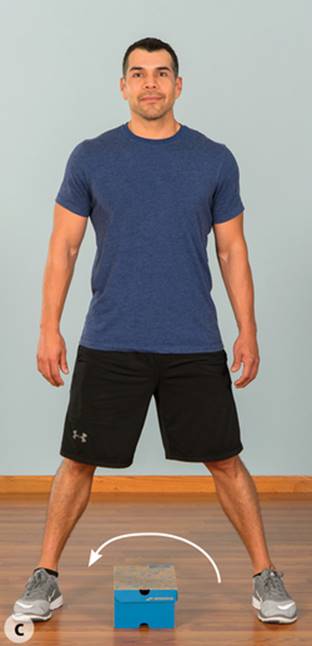
Place a small box (e.g., shoe box) or taped line on the floor. Stand with your right shoulder facing the box (a). When ready, lift your right knee toward the ceiling and step over the box to your right (b). Place your right foot on the ground (c), and lift your left foot over the box so that your left shoulder is now facing the box (d and e). Repeat this exercise from side to side until the desired time or number of repetitions has been completed.




Lunge With Forward Reach
Begin in a standing position with both feet together and arms by your side (a). Take a stride-length step forward with the left foot. In the lunge position, bend both knees so that the back knee moves downward toward the floor. As your knees bend, ensure that your trunk remains upright with the right shoulder, hip, and knee aligned. Once in this position, reach your arms out in front of you in order to further challenge your balance and limits of stability (b). Once you have reached your maximum range of motion with the knees bent, push off the left foot, return to the start position with both feet together, and return your arms to your sides. Repeat this with your right foot stepping forward. Reach your arms out in front while maintaining your balance, and then return to the start position. Continue to alternate lunges between the left and right leg until the desired time or number of repetitions has been achieved.


Step-Up With Overhead Reach
Stand in front of a step (a). Begin by stepping up with the right foot (b). Push yourself into a standing position on the step as you reach your arms overhead to the limits of your shoulder range of motion (c). Step backward and down off the step, returning your arms to your side. Continue by stepping up with the left foot and reaching overhead as you come to a standing position on the step. Repeat until the desired time or number of repetitions has been reached. For an additional challenge when stepping up onto the bench with the right foot, keep the left foot elevated. Maintain this position with arms overhead for a moment before stepping back down with the left foot, followed by the right foot to return to the starting position. Continue, alternating feet.


Although researchers are still seeking to identify the optimal frequency, intensity, time, type, and progression of neuromotor exercise, one thing is clear: Whether one is training for sport or for general health, neuromotor training is a recognized and necessary component of a comprehensive exercise training program. In the coming years, with advances in research and professional practice, exercise professionals and the broader exercise community will gain a much better understanding of the important role that neuromotor training plays in helping individuals of all ages and ability levels maintain optimal health, fitness, function, and quality of life.