
Rheum palmatum
Rhubarb
Originating from Northwest China and Tibet, rhubarb has been used in medicine for more than 2,000 years. Its use gradually spread through India reaching Europe via Asia Minor, hence its common name of Turkey rhubarb. The plant was a favorite with early Persian and Arabian physicians and was adopted in Europe at the Renaissance. The variety grown for cooking in pies is usually R. rhabarbarum, an eighteenth-century cultivar.
Character: Bitter, cold and dry.
Constituents: Anthroquinones, tannins, calcium oxalate, resins, minerals.
Actions: Laxative, digestive remedy, astringent.
PARTS USED
ROOT
This is known as da huang in China, which translates literally as “big yellow,” an accurate description of the color of rhubarb tinctures and decoctions. It is used in very similar ways in both East and West as a purgative and liver cleanser. Rhubarb root is intrinsically cold, and the Chinese use it to clear pathogenic heat from the stomach and liver in such cases as acute jaundice and appendicitis. It is also added to remedies used to clear heat from the blood and is believed to move stagnant blood. Harvest in winter after the aerial parts have died down.

APPLICATIONS
Root
Tincture: The action of rhubarb root varies considerably depending on the dose. Low doses (5–10 drops) are astringent and can be used in diarrhea. A slightly higher dose (1 ml) acts as a good liver stimulant and gentle laxative while very high doses (up to 2.5 ml) have a strong cooling and purgative effect. Use increasing doses of carminatives such as fennel or mint with higher doses of rhubarb to prevent griping pains.
Decoction: A weak decoction (up to 0.5 g of root per dose) can be used for diarrhea while a strong decoction (3 g of root per dose) is effective for chronic constipation or period cramps associated with delayed menstruation.
Wash: Rhubarb root is also antibacterial and astringent and a strong decoction can be used on boils and suppurating skin diseases.
CAUTIONS
• Avoid in pregnancy.
• Contains oxalates – best avoided in arthritic conditions and gout.
• Do not use the leaves which are toxic and can cause fatal oxalate poisoning.
Rosa spp.
Rose
There is a saying that roses are good for “the skin and the soul,” and they have a long tradition of medicinal use in all cultures for an enormous variety of ailments. In Roman times the wild or “dog” rose (R. canina) was recommended for the bites of rabid dogs. Roses continued as an official medicine well into the 1930s, when tincture of apothecary’s rose (R. gallica var. officinalis) was still prescribed for sore throats. Today roses are still highly prized: the oil is expensive and is one of the most important oils in aromatherapy. The plant was originally held sacred to Venus, but by the Middle Ages it had become symbolically associated with the Virgin Mary.
Character: Sweet, astringent, and generally either neutral or slightly cooling.
Constituents: Volatile oil, vitamins C, B, E and K, tannins. Rose oil contains some 300 chemical constituents of which only around 100 have as yet been identified.
Actions: Antidepressant, antispasmodic, aphrodisiac, astringent, sedative, digestive stimulant, choleretic, cleansing, expectorant, antibacterial, antiviral, antiseptic.
PARTS USED
FRUITS
R. x laevigata
In China, the hips from this rose are known as jin ying zi and are mainly used as a kidney qi tonic prescribed for urinary dysfunction. Like other rose remedies, these are also astringent and are recommended for chronic diarrhea. Harvest when ripe in winter.
R. canina
Valued as an important source of vitamin C during and after the Second World War, rosehips from the dog rose are still used in commercial teas, syrups, and fruit drinks. The leaves were once used as a substitute for tea. Harvest when ripe in winter.
FLOWERS
R. rugosa
The hardy Japanese rose is popular in European gardens, but the Chinese use the flower-buds (mei gui hua) as a qi stimulant and blood tonic, to relieve stagnant liver energies. They are used for digestive irregularities or with motherwort for heavy periods. Harvest before the flowers are fully open.
ESSENTIAL OIL
R. x damascena
Unlike modern hybrid roses the damask rose blooms for only a couple of weeks when the petals are collected and steam distilled to produce true Bulgarian rose oil used in around 96% of all women’s perfumes. Medicinally it is an important nervine used for depression and anxiety and can be helpful for those who lack love in their lives. It can be added to many skin remedies or used for digestive problems. Recent research also suggests that the oil has anti-HIV activity.
Rosewater: This is a by-product of the steam distillation of rose oil and is a good skin remedy.
R. centifolia
The cabbage rose is used to produce French rose oil which differs significantly in its chemical composition from the damask rose oil. It contains considerably more phenyl ethanol, for example, which has a narcotic action and could account for the reputation of French rose oil as an aphrodisiac.
PETALS
R. gallica var. officinalis
Red rose petals were listed in the official British Pharmacopoeia until the 1930s when they were widely as mild astringents and to flavor other medicines.
R. indica
Roses are known as shatapatra in Ayurvedic medicine and are cooling and a good tonic for the mind. The “temperature” of rose preparations can be varied in Eastern tradition by leaving them in moonlight to cool the mixture or in sunshine to produce a more heating brew.

R. canina

R. centifolia

R. rugosa
APPLICATIONS
Essential oil
R. x damascene & R. centifolia
Baths: Add two drops of rose oil to bath-water for depression, sorrows or insomnia. Massage oil: Use up to 10% rose oil in a carrier oil to relieve stress and exhaustion or for a sluggish digestion.
Cream: Add a few drops of rose oil to creams for dry or inflamed skin conditions. Lotion: Use rosewater with 10% lady’s mantle tincture for vaginal itching. The same combination can be made into a cream using a standard base. Use 50:50 rosewater and distilled witch-hazel as a cooling, moisturising lotion for skin prone to spots or acne.
Petals
R. gallica var. officinalis
Tincture: Use up to 3 ml, three times a day for diarrhea or sluggish digestion. Can be combined with other herbs for irregular menstruation or heavy periods (such as lady’s mantle. white deadnettle, or shepherd’s purse).
Gargle: Use a standard infusion as a gargle for sore throats, could also be combined with sage.
Flower buds
R. rugosa
Decoction: Use with motherwort for heavy menstrual bleeding (mild cases). Combine with bai shao and xiang fu for liver qi dysfunction.
Fruits
R. canina
Syrup: Used to flavor other medicines and added to cough mixtures or as a source of vitamin C.
Tincture: Use a standard tincture as an astringent for diarrhea, to relieve colicky pains, or as a component in cough remedies.
R. laevigata
Decoction: Use with dang shen, bai zhu, and shan yao for chronic diarrhea associated with stomach weakness. Also used with other herbs for kidney weakness.
CAUTIONS:
• Because of the high price of rose oils adulteration is commonplace and only the best quality, genuine oils should be used medicinally.
• Rose oil is non-toxic and can be taken internally – but seek professional advice first if you are new to herbs.
• Use only the rose species listed here and not garden hybrids.
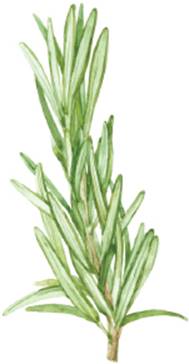
Rosmarinus officinalis
Rosemary
A favorite herb both medicinally and as a symbol for remembrance, rosemary is a Mediterranean shrub that gradually spread north and was reputedly first grown in England by Philippa of Hainault, wife of Edward III in the fourteenth century. The plant is an excellent tonic and stimulant for the nervous system and has always been regarded as uplifting and energzing. Gerard said that it “comforteth the harte and maketh it merrie.”
Character: Warming and dry with a pungent, slightly bitter taste.
Constituents: Volatile oil (inc. borneol), bitter principle, tannin.
Actions: Leaves/aerial parts: astringent, digestive remedy, nervine, carminative, antiseptic, diuretic, diaphoretic, antidepressant, circulatory stimulant, antispasmodic, restorative tonic for nervous system; cholagogue, cardiac tonic.
Essential oil: topically – rubefacient, analgesic, antirheumatic.
PARTS USED
LEAVES/AERIAL PARTS
Ideal in exhaustion, debility, and depression, the aerial parts invigorate the circulation, stimulate the digestion and are good in any “cold” conditions including chills and rheumatism. They are useful for headaches that are eased by warm towels rather than ice packs. It is evergreen and can be gathered fresh throughout the year although avoid cutting in frosty conditions.
ESSENTIAL OIL
This makes a good stimulating rub for arthritic conditions and has also traditionally been used for hair problems – to stimulate growth in premature baldness and restore the color to gray hair. Extracts are a common ingredient in commercial shampoos.
APPLICATIONS
Leaves and aerial parts
Infusion: For colds and flu or for rheumatic pains use a standard infusion and drink while hot. Also as a general stimulating drink for fatigue or headaches. Also has a gentle carminative action for indigestion.
Hair rinse: Use an infusion as the final rinse for dandruff.
Compress: A pad soaked in hot rosemary infusion can be used for sprains. Alternate 2–3 minutes of the hot compress with 2–3 minutes applying an ice pack to the injury.
Tincture: Use whenever a stimulant tonic is needed (up to 5 ml three times a day). Combines well with oats, skullcap, or vervain in depression.
Essential oil
Massage rub: For arthritis and rheumatism dilute 1 ml of rosemary oil in 25 ml of sunflower or almond oil and massage a little into aching joints and muscles. The same oil can be massaged into the scalp to stimulate hair growth or used on the temples for headaches.
Baths: Use 10 drops of oil in the bath for aching limbs or as a stimulant in nervous exhaustion.
Rubus idaeus
Raspberry
The raspberry plant was a favorite household remedy with raspberry vinegars used for sore throats or to “cut the phlegm” in coughs; the leaves were used in infusions for diarrhea or as poultices for piles; and raspberry syrup was used to prevent a build up of tartar on teeth. Gerard considered the fruit “of a temperate heat” and so it was easier on the stomach than strawberries which could cause excess phlegm and chilling. Today raspberry leaf tea is still taken to prepare for childbirth.
Character: Dry and astringent with a generally cooling nature.
Constituents: Leaves: fragarine (uterine tonic), tannins, polypeptides;
Fruit: vitamins A, B, C and E, sugars, minerals, volatile oil.
Actions: Astringent, partus preparator, stimulant, digestive remedy, tonic, diuretic, laxative.
PARTS USED
LEAVES
Used for period cramps and discomfort, the leaves, taken during late pregnancy, also help to prepare the womb for childbirth. They are also astringent so are useful for diarrhea, wounds, sore throats, and mouth ulcers. They have also been used as a cleansing diuretic, included in rheumatic remedies, and in France they are regarded as a tonic for the prostate. Harvest in summer before and during fruiting.
BERRIES
Traditionally recommended for indigestion and rheumatism, the berries are rich in vitamins and minerals and highly nutritious. The juice has been used in folk medicine as a cooling remedy in for fevers, childhood illnesses, and cystitis. Harvest when ripe in summer or autumn.

APPLICATIONS
Leaves
Infusion: To ease childbirth, take one cup daily of the standard infusion in the last six to eight weeks of pregnancy and drink plenty of the warm tea during labor. The infusion can also be used for mild diarrhea.
Mouthwash: Use a standard infusion for mouth ulcers or as a gargle for sore throats.
Wash: The infusion can be used for bathing wounds or regularly on varicose ulcers and sores. In eye baths it can ease conjunctivitis and other eye inflammations.
Tincture: This is more astringent than the infusion and is useful, diluted, on wounds or inflammations or used as a mouthwash for ulcers or gum inflammations.
Berries
Vinegar: Steep 500 g fruit in 1 liter of wine or cider vinegar for two weeks to produce a thick red liquid that can be added to cough mixtures as an expectorant or used in gargles for sore throats. It tastes quite pleasant and can help disguise the flavor of other herbal expectorants.
CAUTIONS:
• Avoid raspberry leaf tea in early pregnancy as it can stimulate the uterus.