
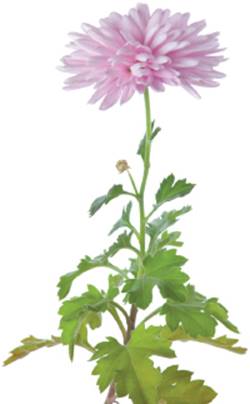
Dendranthema x grandiflorum
Ju hua
Florist’s chrysanthemums have been used in Chinese medicine since the days of Shen Nong (c. 2500 BC) and are specifically associated with the liver and eyes. The leaves have been used medicinally since around 500 AD and the stems and root are used in folk medicine. In China, the herb is drunk as a tonic in chrysanthemum wine and is sold as a cooling tea in ready-made cartons like fruit juice. The flowers were first introduced into Europe in the seventeenth century, but it took another 100 years for them to become a familiar garden ornamental.
Character: Flowers: pungent, sweet, biter, cool.
Leaves: hot, wet, neutral.
Stems: sweet, bitter, cool.
Constituents: Essential oil (including camphor, carvone and borneol), alkaloids (including stachydrine and adenine), sesquiterpene lactones, flavonoids.
Actions: Cooling, anti-inflammatory, antimicrobial, reduces fevers, promotes sweating, antiseptic, lowers blood pressure, dilates coronary artery and stimulates blood flow.
PARTS USED
FLOWER HEADS
In China, the flower heads are always steamed before drying to reduce their inherent bitterness. They are used to clear wind and heat, which may be causing feverish colds, as well as to cool and calm the liver, clear toxins, and soothe eye inflammations. Modern research has also shown that ju hua can reduce raised blood pressure, especially when associated with headaches and dizziness. As a relaxant for the coronary arteries it can also relieve the pain of angina pectoris.
LEAVES
The leaves (ju hua ye) are more heating than the flowers but are also strongly antimicrobial. They are used for boils, sores and blurred vision. The fresh leaves are mainly used in juices, decoctions, or poultices, or they can simply be eaten fresh as a salad.
STEMS
The young stems (ju hua miao) are used in China to clear liver fire, which can be a cause of vertigo, and to treat eye problems.
APPLICATIONS
Flower heads
Infusion: Take regular cups to ease eye strain and headaches associated with over-work, stress, irritability and emotional upsets.
Decoction: Use with an equal amount of jin yin hua in a standard decoction to help reduce high blood pressure. Ju hua can also be combined with mulberry leaf, mint, and apricot seeds for common colds and coughs.
Tincture: Use up to 50 drops per dose for headaches and irritability.
Powder: Add half a teaspoon of powder to a small glass of rice wine to relieve vertigo.
Poultice: Use a few of the once-infused flowers on gauze as eye pads to relieve the pain of eye strain, conjunctivitis, and other red or painful eye conditions.
Pillows: Sleep on a pillow stuffed with flowers to relieve colds and headaches.
Leaves
Poultice: Use the crushed fresh leaves soaked in a little warm water or alcohol as a poultice for boils, acne pustules, and skin sores.
Decoction: Take a regular decoction of dried leaves to relieve symptoms of vertigo or dizziness.
CAUTION:
• Ju hua is traditionally avoided in diarrhea and debility.
Dioscorea spp.
Yam
Used to make the original contraceptive pills when synthetic hormone production was not a commercial proposition, Mexican wild yam (D. villosa) contains hormonal substances very similar to progesterone. It also relaxes smooth muscle – hence another of its common names: colic root. Many other yams are used as a starting material to produce the hydrocortisones for orthodox eczema creams. Several related species are used in Chinese medicine: D. hypoglauca (bei xie) is used for urinary disorders, while D. opposita (shan yao) is an important tonic for the spleen and stomach.
Character: Neutral and generally drying. Most varieties are bitter tasting but D. opposita is sweet.
Constituents: Alkaloids, steroidal saponins, tannins, phytosterols, starch.
Actions
D. villosa: Relaxant for smooth muscle, antispasmodic, cholagogue, anti-inflammatory, diaphoretic.
D. opposita: Expectorant, digestive stimulant, kidney tonic.
D. hypoglauca: antibacterial, anti-inflammatory, soothes urinary tract.
PARTS USED
RHIZOME
D. villosa
Mexican wild yam is an important muscle relaxant and antispasmodic used for colicky pains. It can also be taken for acute rheumatic conditions.
D. opposita
The Chinese yam, shan yao, is an important tonic herb in Chinese medicine. Its main action is on the kidneys, lungs, and stomach, and it is included in remedies for asthma, menopausal syndrome, urinary disorders, and weak kidney energies.
D. hypoglauca
In China, bei xie, or seven-lobed yam, is used mainly for urinary tract infections such as cystitis. Antibacterial and anti-inflammatory, it has also been used for rheumatoid arthritis. Extracts of bei xie are used in the synthesis of contraceptive pills.

APPLICATIONS
D. villosa
Decoction: Use a standard decoction for the colicky pains associated with irritable bowel syndrome (spastic bowel) or diverticulosis. Can also be used for menstrual pains or drunk frequently once labor has started. Decoct with willow bark for arthritic pains.
Tincture: Take regular drop doses for labor or post-partum pains. Can be combined with arthritic remedies, such as celery seed, angelica, meadowsweet, bog bean, or willow, for the acute stages of rheumatoid arthritis.
D. opposita
Decoction: Combine with herbs such as shu di huang, shan zhu yu, fu ling, gou qi zi, and licorice for menopausal symptoms associated with kidney yin deficiency.
Tincture: Use standard doses for dry asthmatic coughs – can combine with elecampane, hyssop, and ma huang.
D. hypoglauca
Decoction: Use around 10–15 g with other herbs – such as fu ling, sweet flag, and licorice – for urinary infections and prostatitis, or with huai niu xi for rheumatic pains.
Tincture: Use up to 10 ml daily for urinary infections or in combination with other herbs for inflammatory arthritic conditions.
CAUTIONS:
• Avoid high doses of D. opposita or D. hypoglauca in pregnancy or if trying to conceive.