
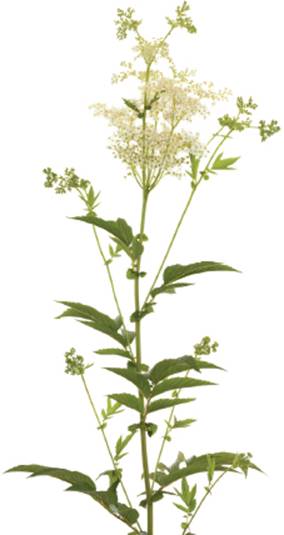
Filipendula ulmaria
Meadowsweet
A popular Elizabethan strewing herb, meadowsweet was also used to flavor wine and taken to ease fevers and pain. Anti-inflammatory chemicals called salicylates were first extracted from it in the early nineteenth century. In 1899, the German pharmaceutical company Bayer succeeded in synthesizing acetylsalicylic acid, a similar chemical. They called this new wonder drug aspirin, after Spiraea ulmaria, the old botanical name for meadowsweet.
Character: Cold and astringent but can be both moist and drying.
Constituents: Salicylates, flavonoids, tannins, volatile oil, citric acid, mucilage.
Actions: Anti-inflammatory, antirheumatic, soothing digestive remedy, diuretic, diaphoretic.
PARTS USED
AERIAL PARTS
Cooling to reduce both fevers and inflammations, meadowsweet also contains mucilages and tannins, which protect the digestive tract and modify the action of salicylic acid. Long use of aspirin can often damage the gastric mucosa leading to ulceration and bleeding but meadowsweet does not show these side effects and is a gentle digestive remedy for acidity and some types of diarrhea. Harvest while flowering in the summer.
FLOWERS
Russian research suggests that the flowers can be effective in treating cervical dysplasia.
APPLICATIONS
Aerial parts
Infusion: Use a standard infusion for feverish colds, children’s stomach upsets, or for rheumatic pains.
Tincture: Generally has a stronger action than the infusion: can be added to remedies for gastric ulceration or excess acidity, such as licorice and sweet flag, and is also used for arthritis with herbs like angelica, bogbean, willow, or devil’s claw.
Compress: A pad soaked in the dilute tincture can be applied to painful arthritic joints, for rheumatism or neuralgia.
Eye bath: The cooled infusion can be used in an eye bath for conjunctivitis and other eye complaints.
CAUTIONS:
• Avoid in cases of salicylate sensitivity.
Foeniculum officinalis
Fennel
The Romans believed that serpents sucked the juice of fennel to improve their eyesight, and Pliny recommends it for “dimness of human vision.” The plant was also regarded as an early slimming aid, and its Greek name, marathron, is reputedly derived from a verb meaning “to grow thin.” In the past, chewing the seeds was a favorite way to stop gastric rumbles during lengthy sermons in church on Sundays.
Character: Warming and dry with a pungent but sweet taste.
Constituents: Volatile oil (inc. estragole, anethole), essential fatty acids, flavonoids (inc. rutin), vitamins, minerals.
Actions: Carminative, circulatory stimulant, anti-inflammatory, galactagogue, mild expectorant, diuretic.
PARTS USED
SEEDS
Carminative for the digestive system, the seeds are also to promote milk flow in breastfeeding, while if the nursing mother drinks fennel tea the baby will get a colic remedy with meals. In Chinese medicine, fennel seeds (hui xiang) are considered tonifying for the spleen and kidney and are used for urinary and reproductive disharmonies. Gather in late autumn when ripe.
ROOT
The root is not as effective as the seeds, but was once used in similar ways. It can be gathered in late autumn when the bulbous stems are collected as a vegetable.
ESSENTIAL OIL
Distilled from the seeds, the oil is mainly used as a carminative for digestive problems. It is also a mild expectorant and sometimes used in chest rubs for coughs and respiratory complaints.

APPLICATIONS
Seeds
Infusion: A useful and palatable digestive remedy ideal for drinking after meals for flatulence, indigestion, colic, and other digestive upsets. Can also be taken by nursing mothers to increase milk flow.
Mouthwash: For gum disorders and loose teeth.
Decoction: Used in Chinese medicine for abdominal pain, colic, and stomach chills.
Tincture: Used mainly for digestive problems. Often combined with laxatives to prevent griping. Reputedly reduces the toxic effects of alcohol on the body.
Gargle: Use the infusion as a gargle for laryngitis or sore throats.
Root
Decoction: Used mainly for urinary problems such as gravel, or disorders associated with high uric acid content.
Essential oil
Chest rub: Can be combined with thyme and eucalyptus oil in a vegetable oil base (total 25 drops of essential oil to 25 ml of carrier) for bronchitis and other chest complaints.
CAUTIONS:
• Essential oils should not be taken internally without professional advice.
• Uterine stimulant: avoid high doses in pregnancy, although small amounts used in cooking are safe.
Fragaria vesca
Strawberries
The berries, leaves, and root of the wild or alpine strawberry have all been used medicinally in the past. The root was once a popular household remedy for diarrhea and the stalks were used for wounds. The berries were also considered very cooling, or as Gerard put it: to “quench thirst, cooleth heate of the stomicke and inflammation of the liver,” although he also warned that although eating them in winter or on a “cold stomicke” was risking an increase in phlegmatic humor and digestive upsets.
Character: Cool and moist with a sweet and sour taste.
Constituents: Tannins, mucilage, sugars, fruit acids, salicylates, minerals, vitamins B, C, and E.
Actions: Astringent, wound herb, diuretic, laxative, liver tonic, cleansing.
PARTS USED
LEAVES
A gentle astringent for diarrhea and digestive upsets, the leaves are also a cleansing diuretic for rheumatism, gout, and arthritis. Wild strawberry plants can be found from late spring to autumn and the leaves used fresh or dried.
BERRIES
A popular cosmetic remedy for centuries, strawberries were used in face packs to whiten the complexion and remove freckles. They also make an emergency treatment for mild sunburn and are a good liver tonic. Strawberry juice shows antibacterial properties and was used in typhoid epidemics. Rich in sugars and mucilage, strawberries are also laxative.

APPLICATIONS
Leaves
Infusion: Use a standard infusion for diarrhea. Combine with meadowsweet and St. John’s wort for mild arthritic pains.
Berries
Poultice: Crushed berries can be used on sunburn or to soothe skin inflammations.
Wine: The berries steeped in wine were a traditional remedy for “reviving the spirits and making the hart merrie.”
Fresh fruit: Eat strawberries for gastritis and as a liver tonic – good in convalescence after hepatitis.
Fucus vesiculosis
Bladderwrack
Several varieties of seaweed have been used therapeutically in different cultures. In the eighteenth century, iodine was first isolated by distilling the long ribbons or thalli of bladderwrack, which became the main source of the element for more than fifty years. A preparation made by reducing the herb to a charcoal was used to treat goiter caused by thyroid deficiency related to lack of iodine. In the 1860s it was claimed that bladderwrack could counter obesity by increasing the metabolic rate, and since then the herb has featured in numerous slimming remedies.
Character: Salty, cool, and moist.
Constituents: Mucilage, iodine and other minerals, mannitol, volatile oil.
Actions: Metabolic stimulant, nutritive, thyroid tonic, antirheumatic, anti-inflammatory.
PARTS USED
THALLI
As a gentle metabolic stimulant, the thalli are useful in debility and convalescence. They also show antirheumatic properties used both internally and in topical oils and creams. Bladderwrack is rich in iodine, which, if lacking from the diet, can lead to thyroid deficiency. It is also a good nutritive source of many trace elements. The plant is commonly called kelp, although this is also the name given to various Laminaria spp. of seaweed, which can lead to confusion. It should be collected at sea in a healthy, live state, rather than gathered from beaches.

APPLICATIONS
Thalli
Tincture: Use standard doses as a thyroid stimulant in cases of deficiency or as a gentle metabolic stimulant for those with a sluggish constitution. Combine with arthritic remedies – such as willow, meadowsweet, or bogbean – for chronic inflammatory conditions like rheumatoid arthritis.
Tablets/capsules: Available commercially – use 3–6 tablets/capsules daily as a metabolic stimulant. Can help reduce obesity related to thyroid under-activity.
Infused oil: Use 500 g of dried bladderwrack to 500 ml of vegetable oil. Macerate overnight and then heat on a water-bath for two hours. Strain. Use the oil for arthritic joint pains or rheumatism – add a few drops of rosemary or thyme oil if available.
Infusion: Use a standard infusion as the tincture or as part of a weight-reducing program, especially if obesity is linked to slow metabolism.
CAUTIONS:
• Like many sea creatures, bladderwrack is at risk from heavy metal pollution. It should not be collected where the levels of cadmium, mercury, and similar pollutants are high.
• Avoid if you suffer from hyperthyroidism.