
Galium aparine
Cleavers
Cleavers, also known as goosegrass (because geese like to eat it), is regarded by gardeners as a vigorous weed that twines through hedges and shrubs producing long sticky stems and burr-like seeds. The young shoots are among the first of the annual weeds to appear in spring and make an excellent cleansing tonic at that time of year – a remedy still widely used in many parts of Europe.
Character: Cold, slightly dry, and salty.
Constituents: Coumarins, tannins, glycosides, citric acid.
Actions: Diuretic, lymphatic cleanser, mild astringent.
PARTS USED
WHOLE HERB
Best used fresh, when the herb is a potent diuretic and lymphatic cleanser, effective in many cases involving swollen or enlarged lymph nodes. It is often described as a blood purifier or depurative, and is used for skin problems and other conditions where the body is failing to rid itself of toxins. It can also be used as a vegetable – gently sweated in the pan like spinach. Harvest throughout the growing season.

APPLICATIONS
Whole plant
Juice: Juice or pulp the fresh plant to make an effective diuretic and lymphatic cleanser for a range of conditions including glandular fever, tonsillitis, and prostate disorders. Prepare daily and take in tablespoon doses.
Infusion: Generally less strong than the juice, used for urinary problems like cystitis and grave or as a cooling drink in fevers.
Tincture: Use as the tincture or combine with other lymphatic and detoxifying herbs like poke root or lian qiao.
Compress: A pad soaked in the infusion can be useful for burns, grazes, ulcers, and other skin inflammations.
Cream: Cleavers cream can be helpful for psoriasis if used regularly.
Hair rinse: The infusion can be used as a hair rinse for dandruff or scaling scalp problems.
Gentiana spp.
Gentian
The gentians reputedly take their name from a king of Illyria, who, according to Pliny, first discovered their ability to reduce fevers. In medieval times, gentian was an ingredient of the alchemical brew “theriac,” a cure-all made to a highly secret recipe – “a misterie” according to Gerard – that was used as an antidote to poisons and as an elixir of life. G. lutea is the main variety used in the West, while the Chinese use both the large-leaved varieties, usually G. macrophylla or G. dahurica (qin jiao) and G. scabra (long dan cao).
Character: Very bitter and cold, astringent and drying.
Constituents: Bitter glycosides, alkaloids, flavonoids.
Actions: Bitter, tonic, appetite and gastric stimulant, anti-inflammatory, used in fever management.
PARTS USED
ROOT
G. lutea
A strong digestive stimulant, the root is effective for conditions involving poor appetite or sluggish digestion. It is also used in fever management to both cool the system and ensure that digestive function is maintained so stomach contents do not stagnate. Harvest in the late summer and autumn.
G. macrophylla and G. scabra
Bitter remedies, these roots are used for digestive and feverish conditions. In Chinese medicine, they are usually described as clearing “heat and damp” and may be prescribed for some types of hypertension related to heat in the liver or for urinary infections and rheumatic disorders.

G. macrophylla
APPLICATIONS
G. lutea
Tincture: Use up to 2 ml, three times a day, of a standard tincture as a digestive stimulant. Can be helpful in liver disease, including hepatitis, and gallbladder inflammations and where jaundice is a symptom. Drop doses can allay cravings for sweet foods.
Decoction: Use 10 g to 500 ml of water and decoct for 20 minutes. Take a standard dose before meals for abdominal distension or feelings of fullness and stomach pains.
G. scabra Long dan cao
Decoction: Used in combination with other Chinese herbs for liver disorders, hypertension, and urinary infections. Long Dan Xie Gan Wan is a standard formula available in tablet form to clear heat from the liver and gall-bladder where symptoms can include sore eyes, headaches, and constipation.
G. macrophylla Qin jiao
Decoction: Used in combination with other Chinese herbs for rheumatic pains, fevers, and allergic inflammations. Often used with du huo and cinnamon.
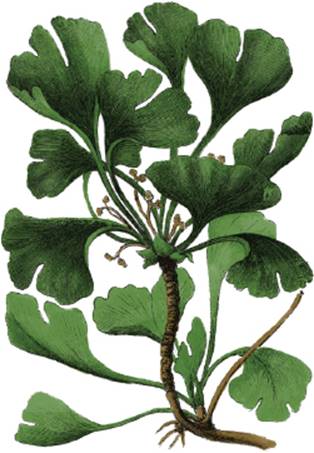
Ginkgo biloba
Ginkgo
Dating back at least 200 million years and extinct in the wild for centuries, the ginkgo or “maidenhair tree” survived as a sacred plant growing in temple gardens in Japan and Eastern China. The tree, a deciduous conifer with separate male and female forms, was introduced in Europe in 1730 and became a favorite ornamental in city parks and gardens. Since the 1980s, Western medical interest in the plant has grown dramatically as its potent actions on the cardiovascular system have been identified.
Character: Sweet, bitter, astringent, and neutral.
Constituents: Leaves: Flavonoid glycosides, bioflavones, sitosterol, lactones, anthocyanin; Seeds: Fatty acids, minerals, bioflavones.
Actions: Leaves: Vasodilator, circulatory stimulant.
Seeds: Astringent, antifungal, antibacterial.
PARTS USED
LEAVES
Part of the herbal repertoire since the 1980s, the leaves are now used for various circulatory diseases, including Raynaud’s, and are particularly effective at improving the blood flow to the brain as in cerebral arteriosclerosis in the elderly. Research has also shown that ginkgolide (a glycoside) can be as effective as standard pharmaceutical drugs in treating severely irregular heartbeats. The leaves also used for venous disorders including varicose veins, hemorrhoids, and leg ulcers, while recent studies have suggested that it can help to reduce the symptoms of dementia in Alzheimer’s disease. Gather fresh leaves in summer.
SEEDS
In China, the seeds, called bai gou, are considered to act on the lung and kidney acupuncture meridians and are traditionally used for asthmatic disorders and chesty coughs with thick phlegm. They also have a tonifying effect on the urinary system and are also used for incontinence and excessive urination. The seeds are of course only found on the female plants.
APPLICATIONS
Leaves
Fluid extract: An extract of the fresh leaves is marketed in Europe as Tebonin and is used for treating cerebral arteriosclerosis in the elderly and for diseases of the peripheral circulation.
Tincture: This can usefully be combined with other herbs for the cardiovascular systems such as periwinkle and linden flowers for circulatory problems or melilot for venous disorders.
Seeds (bai gou)
Decoction: The seeds are combined with herbs like ma huang, coltsfoot, and mulberry leaves for treating asthma and severe or persistent coughs. Usually no more than 3–4 seeds will be added to the decoction (enough for three doses).
CAUTIONS:
• High doses of the seeds can lead to skin disorders and headaches.
• Cases of contact dermatitis with the fruit pulp (not used medicinally) have been recorded.
• Long term and excessive use may increase bleeding time and cause spontaneous hemorrhage.
Glycyrrhiza spp.
Licorice
Licorice has been used medicinally since at least 500 BC and today still has a place in official pharmacopoeia as a “drug” for stomach ulceration. G. glabra originates in the Mediterranean region and Middle East, but has been cultivated in Europe since at least the sixteenth century. In China, G. uralensis or gan cao is used: it is called the “great detoxifier” and is thought to drive poisons from the system and eliminate harmful side effects of other herbs. It is also an important tonic, often called “the grandfather of herbs.”
Character: Very sweet, neutral, and moist.
Constituents: Saponins, glycosides (inc. glycyrrhizin), estrogenic substances, asparagine, coumarins, flavonoids, sterols, choline (amines), volatile oil.
Actions: Anti-inflammatory, antiarthritic, tonic stimulant for adrenal cortex, lowers cholesterol levels, soothing for gastric mucosa, possibly anti-allergenic, antipyretic, expectorant.
PARTS USED
ROOT
G. glabra
Licorice contains a substance called glycyrrhizin which is 50 times sweeter than sucrose and encourages the production of hormones like hydrocortisone. This helps to explain its anti-inflammatory action in conditions such as rheumatoid arthritis and also its role in re-stimulating the adrenal cortex after steroid therapy. It produces a protective mucus coating for the stomach which can help heal ulceration and is also a potent expectorant for dry coughs or asthma.
G. uralensis
An energy tonic, particularly for the spleen and stomach encouraging growth and vigor, the root is added to many Chinese herbal formulas to balance other herbs. It is used for asthmatic coughs as an antispasmodic and ulcer remedy and to cool hot conditions. The dried root can be chewed like candy and is popularly given to children to encourage muscle growth.
JUICE STICKS
G. glabra
The solidified extract is sold in sticks and forms the basis of many proprietary laxative preparations as licorice stimulates bile flow and has a gentle action in constipation.

APPLICATIONS
Root
G. glabra
Tincture: Used for lung disorders, gastric inflammation, or to encourage adrenal function after steroid therapy. Also used as an anti-inflammatory in arthritic and allergic conditions. Helps to disguise the flavor of other medicines.
Fluid extract: Slowly dissolving the juice sticks by macerating in cold water produces a strong extract which can be conveniently used as the decoction or in syrups. For stomach ulceration, pieces of juice stick can be dissolved in chamomile tea.
Decoction: Useful for reducing stomach acidity in cases of ulceration.
Syrup: Combine the decoction with honey to make a soothing and expectorant cough syrup. Combines well with thyme, hyssop, or elecampane. Useful for asthma, bronchitis, etc.
Wash: Use the dilute tincture for skin inflammations and itching.
G. uralensis
Decoction: Combine with ginseng as a daily tonic drink.
Tonic wine: Macerating piece of Chinese licorice root in gin or vodka for a few weeks produces a tonic wine to be drunk in small doses after meals.
CAUTIONS:
• Avoid in hypertension as licorice is believed to cause fluid retention.
• Should not be used by people taking digoxin-based drugs.
• Excessive use of licorice-containing sweets and chewing gums has been linked to hypertension and abnormally high blood potassium levels.