
DOORWAY INFORMATION
Opening Scenario
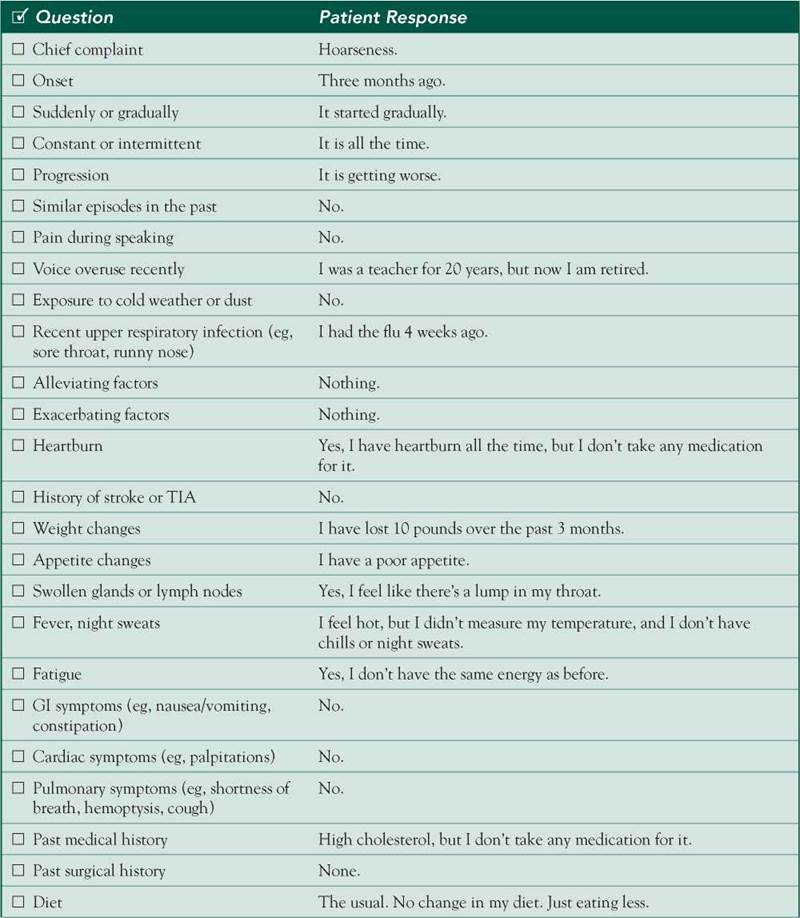
Oliver Jefferson, a 62-year-old male, comes to the office complaining of hoarseness.
Vital Signs
BP: 115/75 mm Hg Temp: 99.9°F (37.7°C)
RR: 16/minute HR: 74/minute, regular
Examinee Tasks
1. Take a focused history.
2. Perform a focused physical exam (do not perform rectal, genitourinary, or female breast exam).
3. Explain your clinical impression and workup plan to the patient.
4. Write the patient note after leaving the room.
Checklist/SP Sheet
Patient Description
Patient is a 62 yo M, married with 4 children.
Notes for the SP
Speak slowly and in a hoarse voice.
Challenging Questions to Ask
“Am I going to get my voice back?”
Sample Examinee Response
“I see that you are very concerned about your voice, and I am concerned too. I am not yet sure what has caused your hoarseness. We will need to do some tests to find out what the problem is and decide on your treatment.”
Examinee Checklist
Building the Doctor-Patient Relationship Entrance
□ Examinee knocked on the door before entering.
□ Examinee introduced self by name.
□ Examinee identified his/her role or position.
□ Examinee correctly used patient’s name.
□ Examinee made eye contact with the SP.
Reflective Listening
□ Examinee asked an open-ended question and actively listened to the response.
□ Examinee asked the SP to list his/her concerns and listened to the response without interrupting.
□ Examinee summarized the SP’s concerns, often using the SP’s own words.
Information Gathering
□ Examinee elicited data efficiently and accurately.

Connecting with the Patient
□ Examinee recognized the SP’s emotions and responded with PEARLS.
Physical Examination
□ Examinee washed his/her hands.
□ Examinee asked permission to start the exam.
□ Examinee used respectful draping.
□ Examinee did not repeat painful maneuvers.
Closure
□ Examinee discussed initial diagnostic impressions.
□ Examinee discussed initial management plans:
□ Follow-up tests.
□ Examinee asked if the SP had any other questions or concerns.
Sample Closure
Mr. Jefferson, there are a few things that could be causing your hoarseness, such as an infection or a benign or cancerous growth. To find out, I need to do a laryngoscopy, which is a procedure to view the inside of your throat, and a CT scan of your neck. These tests will likely reveal the underlying problem. Since cigarette smoking is dangerous to your health, I advise you to quit smoking; we have many ways to help you if you are interested. I also recommend that you stop drinking, as alcohol and smoking are associated with laryngeal cancer. Do you have any questions for me?
History
HPI: 62 yo M c/o hoarseness x 3 months.
■ Painless, gradually getting worse.
■ Mild fever, fatigue, and "lump in my throat.”
■ Poor appetite; lost 10 lbs in 3 months.
■ History of flu 4 weeks ago.
ROS: Negative except as above in addition to heartburn.
Allergies: None.
Medications: None.
PMH: High cholesterol.
PSH: None.
SH: Drinks 3 glasses of wine/day/30 years; smoked 30 packs/year; CAGE (0/4). History of voice overuse (worked as a teacher for 20 years).
FH: Mother with hypothyroidism, father with lung cancer.
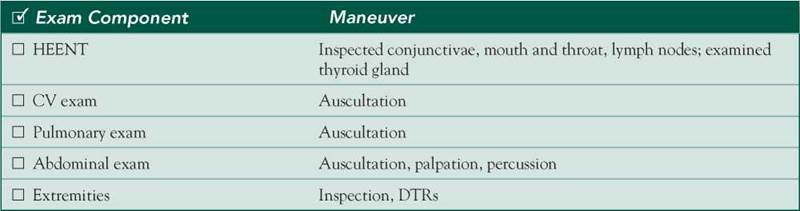
Physical Examination
Patient is in no acute distress.
VS: WNL except for low-grade fever.
HEENT: Nose, mouth, and pharynx WNL.
Neck: Right anterior cervical chain with lymphadenopathy. No lymphadenopathy on the left.
Chest: Nontender, bilateral clear BS.
Heart: PMI not displaced, regular rhythm, no murmurs or rubs.
Abdomen: © BS, nondistended, no organomegaly.
Extremities: DTRs are equal.
Differential Diagnosis

CASE DISCUSSION
Patient Note Differential Diagnoses
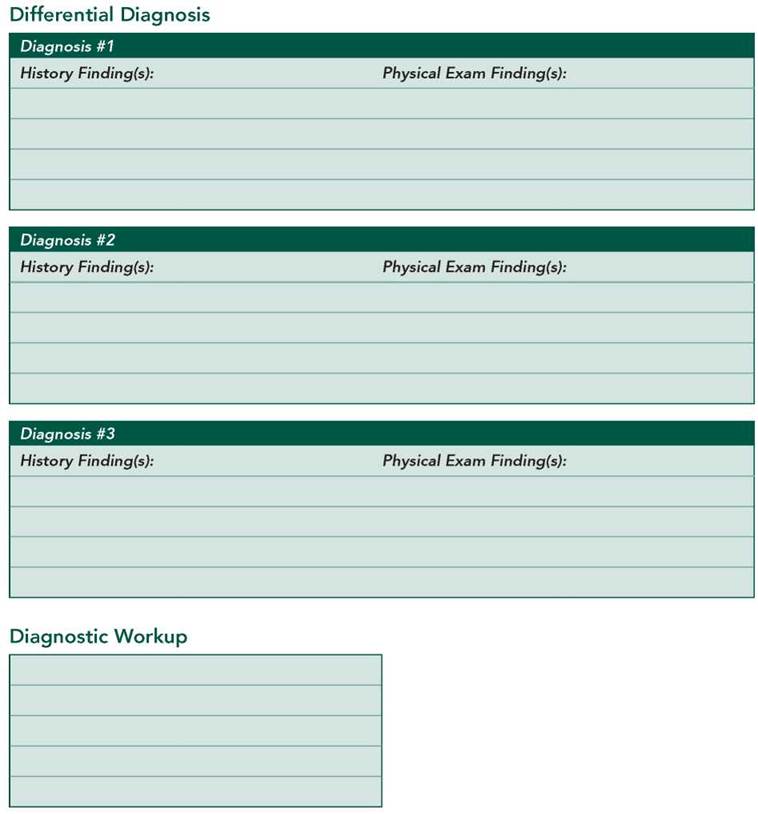
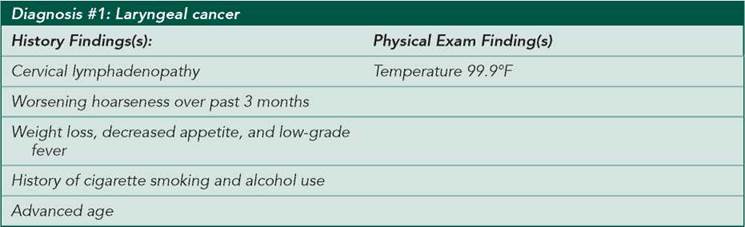
■ Laryngeal cancer: This is the most likely diagnosis given the patient’s constitutional symptoms (low-grade fever, weight loss, fatigue, poor appetite) and long history of smoking and drinking.
■ Laryngitis: This is a common condition of the larynx and can be acute or chronic. The acute form is most likely viral and is self-limited. Common causes of the chronic form are cigarette smoke, polluted air, and GERD. This patient has a long history of untreated GERD, so it could be a sign of chronic laryngitis.
■ Vocal cord polyps/nodules: Benign vocal fold lesions are sometimes related to overuse of the voice and can be easily identified by means of laryngoscopy. However, this diagnosis does not explain the constitutional symptoms that the patient describes.
Additional Differential Diagnoses
■ Hypothyroidism: Hoarseness is one of the manifestations of hypothyroidism. Hypothyroidism can explain some of the patient’s complaints, such as loss of appetite and fatigue, but does not explain all his symptoms.
■ Mitral valve stenosis (MVS): Hoarseness in MVS is due to enlargement of the left atrium and compression of the recurrent laryngeal nerve. MVS is more common in women and usually presents with a history of rheumatic fever. Other symptoms include palpitations and easy fatigue. The physical exam findings include diastolic murmur and tachycardia.
■ Gastroesophageal reflux disease (GERD): Longstanding acid reflux can cause chronic irritation and inflammation of the vocal cords, leading to hoarseness.
Diagnostic Workup
■ Laryngoscopy: The gold standard for evaluating the larynx; allows direct visualization of the vocal cords. It also allows biopsy of suspicious lesions for pathologic evaluation.
■ ESR: Will be increased in infectious and malignant causes.
■ CT—chest and neck: Can identify the location and extent of most laryngeal lesions.
■ U/S—neck: To identify the presence of lymphadenopathy.
■ Esophageal pH monitoring: To diagnose GERD as a cause of laryngitis.
■ CBC: Anemia can be associated with hypothyroidism, and an elevated WBC count is common in infections.
■ TSH: To diagnose thyroid disease.
■ Cardiac echocardiography: Essential in diagnosing cardiac valvular diseases.