EQUIPMENT
 Otoscope with pneumatic attachment
Tuning fork (512-1024 Hz)
Nasal speculum
Tongue blades
Gloves
Gauze
Penlight, sinus transilluminator, or light from otoscope
EXAMINATION
Have patient sit.
|
TECHNIQUE |
FINDINGS |
|
EARS |
|
|
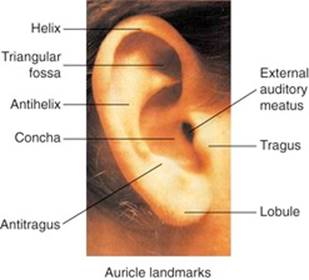
Inspect auricles and mastoid area |
|
|
Examine lateral and medial surfaces and surrounding tissue. |
|
|
|
|
|
|
EXPECTED:Familial variations. Auricles of equal size and similar appearance. Darwin tubercle. |
|
UNEXPECTED:Unequal size or configuration. Cauliflower ear and other deformities. |
|
|
|
UNEXPECTED:Moles, cysts or other lesions, nodules, or tophi. |
|
|
EXPECTED:Same color as facial skin. |
|
UNEXPECTED:Blueness, pallor, or excessive redness. |
|
|
Draw imaginary line between inner canthus and most prominent protuberance of occiput. Draw imaginary line perpendicular to first line and anterior to auricle. |
EXPECTED:Top of auricle touching or above horizontal line. Vertical position. |
|
UNEXPECTED:Auricle positioned below line (low-set); unequal alignment. Lateral posterior angle greater than 10 degrees. |
|
|
|
EXPECTED:Preauricular pits, skin tags, or smooth skin. |
|
UNEXPECTED:Openings in preauricular area, discharge. |
|
|
|
EXPECTED:No discharge, no odor; canal walls pink. |
|
UNEXPECTED:Serous, bloody, or purulent discharge; foul smell. |
|
|
Palpate auricles and mastoid area |
|
|
EXPECTED:Firm and mobile, readily recoils from folded position; no tenderness in postauricular or mastoid area. |
|
|
UNEXPECTED:Tenderness, swelling, nodules. Pain when pulling on lobule. |
|
|
Inspect auditory canal with otoscope |
|
|
EXPECTED:Minimal cerumen in varying color and texture. Uniformly pink canal. Hairs in outer third of canal. |
|
|
UNEXPECTED:Cerumen obscures tympanic membrane, odor, lesions, discharge, scaling, excessive redness, foreign body. |
|
|
Inspect tympanic membrane |
|
|
Vary light direction to observe entire membrane and annulus. |
EXPECTED:Visible landmarks (umbo, handle of malleus, light reflex). |
|
UNEXPECTED:Perforations, landmarks not visible. |
|
|
|
EXPECTED:Translucent, pearly gray. |
|
UNEXPECTED:Amber, yellow, blue, deep red, chalky white, dull, white flecks, or dense white plaques; air bubbles or fluid level. |
|
|
Tympanic membrane. From Barkauskas et al, 2001.
|
|
|
Contour |
EXPECTED:Slightly conical with concavity at umbo. |
|
UNEXPECTED:Bulging (more conical, usually with loss of bony landmarks and distorted light reflex) or retracted (more concave, usually with |
|
|
accentuated bony landmarks and distorted light reflex). |
|
|
Mobility Seal canal with speculum, and gently apply positive (squeeze) and negative (release) pressure with pneumatic attachment. |
EXPECTED:Movement in and out. |
|
UNEXPECTED:No movement. |
|
|
Assess hearing |
|
|
|
EXPECTED:Responds to questions appropriately. |
|
UNEXPECTED:Excessive requests for repetition. Speech with monotonous tone and erratic volume. |
|
|
Have patient mask hearing in one ear by inserting a finger in ear canal. Stand 1 to 2 feet from other ear and softly whisper three letter and number combinations (e.g., 3, T, 9 or 5, M, 2). Use a different letter number combination in other ear. |
EXPECTED:Patient repeats numbers and letters correctly more than 50% of time. |
|
UNEXPECTED:Patient unable to repeat whispered words. |
|
|
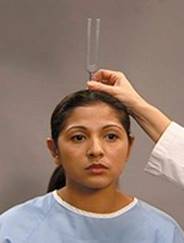
Place base of vibrating tuning fork on midline vertex of head. Repeat with one ear occluded. |
EXPECTED:Sound heard equally in both ears (unoccluded). Sound heard better in occluded ear. |
|
UNEXPECTED:See table on p. 84. |
|
|
Weber test.
|
|
|
Interpretation of Tuning Fork Tests |
||
|
Weber Test |
Rinne Test |
|
|
Expected findings |
No lateralization but will lateralize to ear occluded by patient |
Air conduction heard longer than bone conduction by 2 : 1 ratio (Rinne positive) |
|
Conductive hearing loss |
Lateralization to deaf ear unless sensorineural loss |
Bone conduction heard longer than air conduction in affected ear (Rinne negative) |
|
Sensorineural hearing loss |
Lateralization to better-hearing ear unless conductive loss |
Air conduction heard longer than bone conduction in affected ear, but less than 2 : 1 ratio |
|
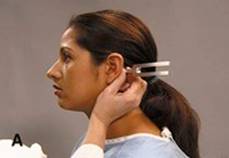
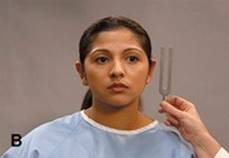
Place base of vibrating tuning fork against mastoid bone, note seconds until sound is no longer heard; then quickly move fork 1 to 2 cm ( |
EXPECTED:Measurement of air-conducted sound twice as long as measurement of bone- conducted sound. |
|
UNEXPECTED:See table below. |
|
|
Rinne test. A, Tuning fork against mastoid bone. B, Tuning fork near ear.
|
|
TECHNIQUE |
FINDINGS |
|
NOSE AND SINUSES |
|
|
Inspect external nose |
|
|
|
EXPECTED:Smooth. Columella directly midline, width is not greater than diameter of naris. |
|
UNEXPECTED:Swelling or depression of nasal bridge. Transverse crease at junction of nose cartilage and bone. |
|
|
|
EXPECTED:Conforms to face color. |
|
|
EXPECTED:Oval. Symmetrically positioned |
|
UNEXPECTED:Asymmetry, narrowing, discharge, nasal flaring on inspiration. |
|
|
Palpate ridge and soft tissues of nose |
|
|
Place one finger on each side of nasal arch and gently palpate from nasal bridge to tip. |
EXPECTED:Firm and stable structures. |
|
UNEXPECTED:Displacement of bone and cartilage, tenderness, or masses. |
|
|
Evaluate patency of nares |
|
|
Occlude one naris with finger on side of nose, ask patient to breathe through nose. Repeat with other naris. |
EXPECTED:Noiseless, easy breathing. |
|
UNEXPECTED:Noisy breathing; occlusion. |
|
|
Inspect nasal mucosa and nasal septum |
|
|
Tilt patient’s head toward opposite shoulder. Gently insert speculum without overdilating naris. |
|
|
|
EXPECTED:Mucosa and turbinates deep pink and glistening. |
|
UNEXPECTED:Increased redness of mucosa or localized redness and swelling in vestibule. Turbinates bluish gray or pale pink. |
|
|
|
EXPECTED:Septum close to midline and fairly straight, thicker anteriorly than posteriorly. Inferior and middle turbinates visible. |
|
UNEXPECTED:Asymmetry of posterior nasal cavities, septal deviation. |
|
|
|
EXPECTED:Possibly film of clear discharge on septum. Possibly hairs in vestibule. Turbinates firm consistency. |
|
UNEXPECTED:Discharge, bleeding, crusting, masses, or lesions. Swollen, boggy turbinates. Perforated septum. Polyps. |
|
|
SENSE OF SMELL |
|
|
See Chapter 18. |
|
|
Inspect frontal and maxillary sinus area |
|
|
UNEXPECTED:Swelling. |
|
|
Sinuses.
|
|
|
TECHNIQUE |
FINDINGS |
|
Palpate frontal and maxillary sinuses |
|
|
Press thumbs up under bony brow on each side of nose. Palpate with thumbs or index and middle fingers under zygomatic processes. |
EXPECTED:Nontender on palpation. |
|
UNEXPECTED:Tenderness or pain, swelling. |
|
|
MOUTH |
|
|
Inspect and palpate lips with mouth closed |
|
|
Have patient remove lipstick (if applicable). |
|
|
|
EXPECTED:Symmetric vertically and horizontally at rest and while moving. |
|
UNEXPECTED:Asymmetric. |
|
|
|
EXPECTED:Pink in whites, bluish in individuals of darker skin, distinct border between lips and facial skin. |
|
UNEXPECTED:Pallor, circumoral pallor, bluish purple, or cherry red. |
|
|
|
EXPECTED:Smooth. |
|
UNEXPECTED:Dry, cracked; deep fissues in mouth corners, swelling; lesions; plaques; vesicles; nodules, ulcerations; or round, oval, or irregular bluish gray macules. |
|
|
Inspect teeth |
|
|
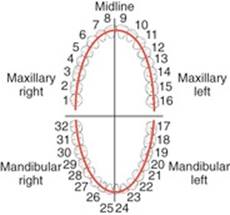
Have patient clench teeth and smile with lips spread. |
EXPECTED:Upper molars interdigitate with groove on lower molars. Premolars and canines interdigitate fully. Upper incisors slightly override lower incisors. |
|
UNEXPECTED:Malocclusion. Protrusion of lower incisors. Problems with bite. |
|
|
Teeth occlusion line. From Miyasaki-Ching, 1997.
|
|
|
|
EXPECTED:Ivory, stained yellow or brown. |
|
UNEXPECTED:Discolorations on crown may indicate caries. |
|
|
|
EXPECTED:32 teeth, firmly anchored. |
|
UNEXPECTED:Caries and loose or missing teeth. |
|
|
Inspect buccal mucosa |
|
|
Have patient remove any dental appliances and then partially open mouth. Use tongue blade and bright light to assess. |
|
|
|
EXPECTED:Pinkish red, patchy pigmented mucosa in individuals with dark skin. |
|
UNEXPECTED:Deeply pigmented. Whitish or pinkish scars. |
|
|
|
EXPECTED:Smooth and moist. Whitish yellow or whitish pink Stensen duct. Fordyce spots. |
|
UNEXPECTED:Adherent thickened white patch; white, round, or oval ulcerative lesions; red spot at opening of Stensen duct; stones or exudate from Stensen duct. |
|
|
Inspect and palpate gingiva |
|
|
Use gloves to palpate. |
|
|
|
EXPECTED:Slightly stippled and pink, may be more hyperpigmented in individuals with dark skin. |
|
UNEXPECTED:Blue-black line about 1 mm from gum margin. |
|
|
|
EXPECTED:Clearly defined, tight margin at each tooth. Gingival enlargement with pregnancy and puberty. |
|
UNEXPECTED:Inflammation, swelling, bleeding, or lesions under dentures or on gingiva; induration, thickening, masses, or tenderness. Enlarged crevices between teeth and gum margins. Pockets containing debris at tooth margins. |
|
|
Inspect tongue |
|
|
Ask patient to extend tongue. |
EXPECTED:Midline, no fasciculations. |
|
UNEXPECTED:Atrophied, deviation to one side. |
|
|
|
EXPECTED:Dull red. |
|
Have patient extend tongue and hold extended. |
EXPECTED:Moist and glistening. Anterior: Smooth yet roughened surface with papillae and small fissures. Posterior: Smooth, slightly uneven or rugated surface with thinner mucosa than anterior. Possibly geographic. |
|
UNEXPECTED:Smooth, red, slick; hairy; swollen; coated; ulcerated; fasciculations; or limitation of movement. |
|
|
Have patient touch tip of tongue to palate behind upper incisors. |
EXPECTED:Ventral surface pink and smooth with large veins between frenulum and fimbriated folds. Wharton ducts apparent on each side of frenulum. |
|
UNEXPECTED:Difficulty touching hard palate. Swelling, Varicosities, ranula (mucocele). |
|
|
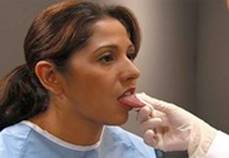
Wrap tongue with gauze and pull to each side. Scrape white or red margins to remove food particles. |
UNEXPECTED:Any fixed white or red margins. Leukoplakia, ulceration, induration. |
|
Inspecting lateral border of tongue.
|
|
|
Palpate tongue and floor of mouth |
|
|
EXPECTED:Smooth and even texture. |
|
|
UNEXPECTED:Lumps, nodules, induration, ulcerations, or thickened white patches. |
|
|
Inspect palate and uvula |
|
|
Have patient tilt head back. |
|
|
|
EXPECTED:Hard palate (whitish and dome shaped with transverse rugae) contiguous with pinker soft palate. Uvula at midline. Bony protuberance of hard palate at midline (torus palatinus). |
|
UNEXPECTED:Nodule on palate, not at midline. |
|
|
Ask patient to say “ah” while observing soft palate. (Depress tongue if necessary.) |
EXPECTED:Soft palate rises symmetrically, with uvula remaining in midline. |
|
UNEXPECTED:Failure of soft palate to rise bilaterally. Uvula deviation. Bifid uvula. |
|
|
Inspect oropharynx |
|
|
Depress tongue with tongue blade. |
|
|
Inspect the tonsillar pillars and size of tonsils. |
EXPECTED:Tonsils, if present, blend into pink color of pharynx. Possible crypts in tonsils where cellular debris and food particles collect. |
|
UNEXPECTED:Tonsils projecting beyond limits of tonsillar pillars. Tonsils red, enlarged, covered with exudate. |
|
|
|
EXPECTED:Smooth, glistening, pink mucosa with some small, irregular spots of lymphatic tissue and small blood vessels. |
|
UNEXPECTED:Red bulge adjacent to tonsil extending beyond midline. Yellowish mucoid film in pharynx. |
|
|
Elicit gag reflex |
|
|
Prepare patient and touch posterior wall of pharynx on each side. |
EXPECTED:Bilateral response. |
|
UNEXPECTED:Unequal response or no response. |
|
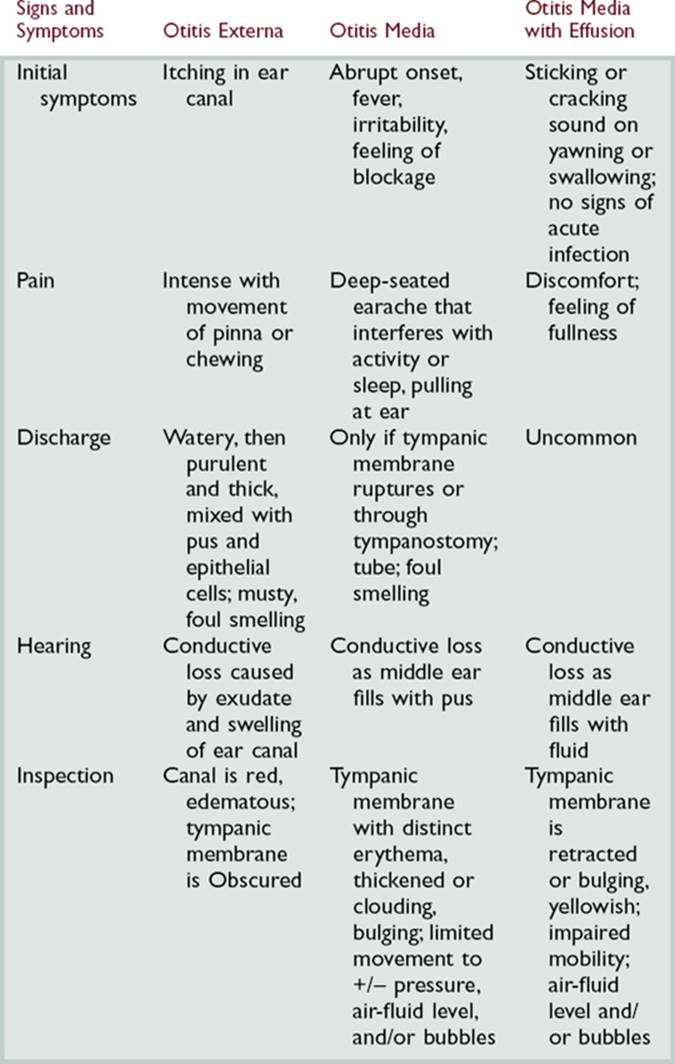
AIDS TO DIFFERENTIAL DIAGNOSIS
Pediatric Variations
EXAMINATION
|
TECHNIQUE |
FINDINGS |
|
EARS |
|
|
Inspect tympanic membrane |
|
|
In infants, pull auricle downward and back to straighten canal. |
EXPECTED:Tympanic membrane may be red from crying. If red from crying, it will be mobile. |
|
Assess hearing |
|
|
|
EXPECTED:For infants, see table on p. 95. Young children should turn toward sound consistently. |
Sequences of Expected Hearing and Speech Response in Infants
|
Age |
Response |
|
Birth to 3 months |
Startles, wakes, or cries when hearing a loud sound; quiets to parent’s voice; makes vowel sounds “oh” and “ah.” |
|
4 to 6 months |
Turns head toward interesting sound; moves eyes in direction of sound but may not always recognize location of sound; responds to parent’s voice; enjoys sound-producing toys; starts babbling with many speech sounds |
|
7 to 12 months |
Responds to own name, telephone ringing, and person’s voice, even if not loud; begins localizing sounds above and below; turns eyes and head toward sound; babbles with short and long strings of sounds; begins to imitate speech sounds; correctly uses mama and dada. |
Modified from American Speech Language and Hearing Association (2008). Birth to one year: How does your child hear and talk, retrieved June 23, 2008, from www.asha.org/public/speech/development/01.htm.
|
TECHNIQUE |
FINDINGS |
|
NOSE AND SINUSES |
|
|
Evaluate patency of nares With infant’s mouth closed or with infant sucking on bottle or pacifier, occlude one naris and then the other. Observe respiratory pattern. |
EXPECTED:Breathes easily; obligatory nose breathing until 2 to 3 months of age. |
|
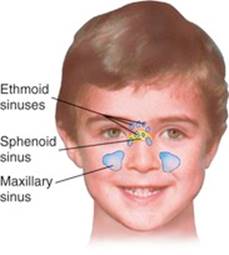
Pediatric sinuses.
|
|
|
MOUTH |
|
|
Inspect and palpate lips with mouth closed |
|
|
EXPECTED:Drooling in infants ages 6 weeks to 6 months, sucking calluses in newborns. |
|
|
UNEXPECTED:Drooling persistent after age 6 months not associated with teething. |
|
|
Inspect teeth |
|
|
|
EXPECTED:0 to 20 teeth until age 6 years. Permanent teeth start erupting around age 6 years. |
|
UNEXPECTED:Natal teeth. |
|
|
Inspect buccal mucosa |
|
|
|
EXPECTED:In infants, nonadherent white patches (milk). |
|
UNEXPECTED:In infants, adherent white patches. |
|
|
Inspect and palpate gingiva |
|
|
|
EXPECTED:In infants up to 2 months, pearl-like retention cysts. |
|
Inspect and palpate hard palate |
|
|
|
EXPECTED:Strong suck and Epstein pearls in young infants. |
|
UNEXPECTED:No cleft of hard or soft palate. |
|
AIDS TO DIFFERENTIAL DIAGNOSIS
|
ABNORMALITY |
DESCRIPTION |
|
Cleft lip and palate |
Subjective Data:Difficulty sucking, failure to gain weight. |
|
Objective Data:Unilateral or bilateral fissure or cleft in lip, hard palate, or soft palate that extends into the nasal cavity. |
SAMPLE DOCUMENTATION
Subjective.A 55-year-old man has concerns about hearing loss for the past few months; it is particularly difficult to hear people talking. He has difficulty hearing on phone and when in conversations with multiple people talking. He hears “noise” in both ears when trying to go to sleep at night. There is no ear pain or discharge, no nasal discharge or sinus pain, no mouth lesions or masses, no recent dental problems, no sore throat and no head trauma or exposure to ototoxic medications.
Objective.Ears: Auricles in alignment; lobes without masses, lesions, or tenderness. Canals totally obstructed by cerumen bilaterally. After irrigation, tympanic membranes are pearly gray, noninjected, intact, with bony landmarks and light reflex visualized bilaterally. No evidence of fluid or retraction. Conversational hearing appropriate. Able to hear whispered voice. Weber—lateralizes equally to both ears; Rinne—air conduction greater than bone conduction bilaterally (30 seconds/15 seconds).
Nose: No discharge or polyps, mucosa pink and moist, septum midline, patent bilaterally. No edema over frontal or maxillary sinuses. No sinus tenderness to palpation.
Mouth: Buccal mucosa pink and moist without lesions. Twenty-six teeth present in various states of repair. Lower second molars (18, 30) absent bilaterally. Gingiva pink and firm. Tongue midline with no tremors or fasciculation. Pharynx clear without erythema; tonsils 1+ without exudate. Uvula rises evenly, and gag reflex is intact. No hoarseness.
 Size/shape/symmetry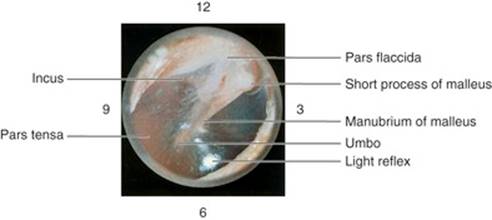
 to 1 inch) from auditory canal and note seconds until sound is no longer heard. Repeat with other ear.