
John R. Balmes, MD
The dramatic air pollution episodes that occurred in the early part of the twentieth century in Belgium’s Meuse Valley, Donora, Pennsylvania, and London, England, are not likely to occur in the world today. These episodes were caused by the large-scale burning of coal in the presence of “ideal” meteorologic conditions—atmospheric inversion leading to a stagnant air mass. A clearly evident excess mortality was observed during and after these episodes. Current air quality standards in North America preclude the development of episodes of this magnitude today. However, certain environmental air pollutants, such as ozone and respirable particles, do reach levels that may cause acute and chronic respiratory effects. Furthermore, in some eastern European and Asian countries, where sulfur-containing fuels are burned without adequate air quality regulations, air pollution levels may be attained similar to those that were associated with excess mortality.
REGULATION OF OUTDOOR AIR POLLUTANTS
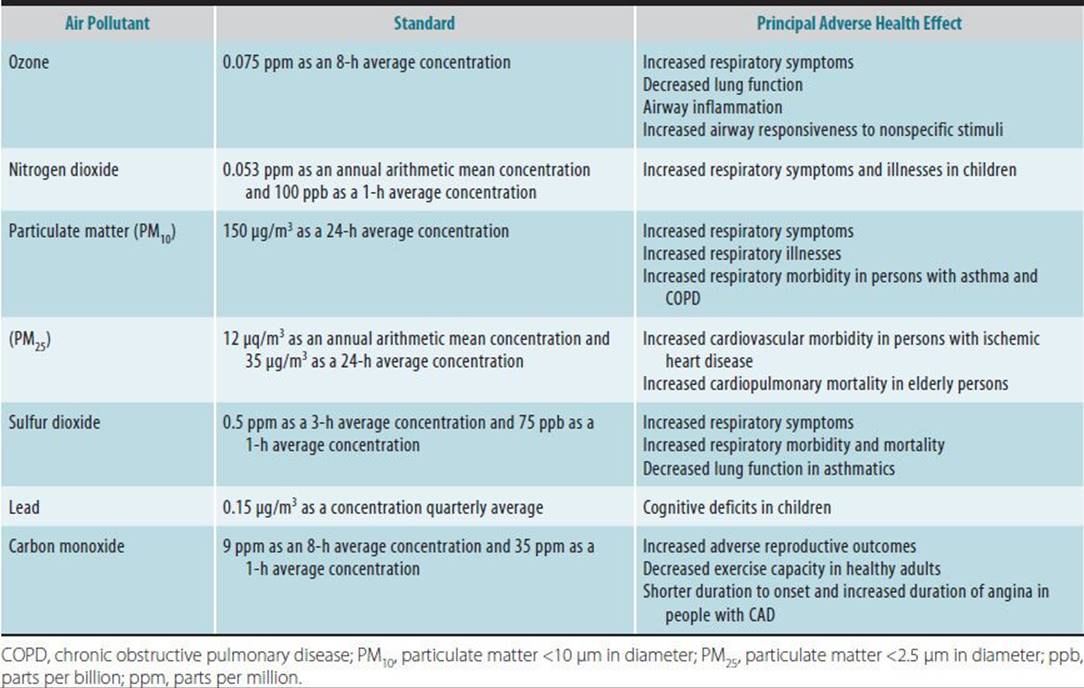
The Clean Air Act (CAA) was passed by the U.S. Congress in 1970 and last amended in 1990. It is the principal federal standard addressing outdoor air quality. It requires the Environmental Protection Agency (EPA) to list those pollutants for which there is sufficient scientific evidence documenting the risk to public health from unregulated exposure. To achieve this, the EPA periodically reviews a large body of scientific research dealing with the adverse health effects of pollutants. The subsequently produced documents are used in the development of a National Ambient Air Quality Standard (NAAQS) for each of the so-called criteria pollutants. Table 46–1 lists the six criteria air pollutants, their NAAQSs, and their principal adverse health effects.
The CAA mandates that the primary NAAQS be set to protect the health of all sensitive groups within the population. The EPA has identified children, people with a chronic respiratory disease such as asthma, and people with ischemic heart disease as constituting sensitive groups (ie, that demonstrate a response to a pollutant at a lower level or to a greater degree than the average response of the general population).
TYPES & SOURCES OF EXPOSURE
Outdoor air contains an array of naturally occurring pollutants, including soil, dust, pollens, and fungi. In addition, human activity generates complex mixtures of pollutants. Much of the regulatory effort and scientific research have concentrated on the individual components of these complex mixtures. This chapter discusses the criteria pollutants (see Table 46–1) and acidic aerosols, a yet unregulated pollutant. It does not discuss highly toxic air pollutants, so-called air toxics, that are emitted from point sources and that are present in low concentrations in the environment (see Chapter 45).
Table 46–1. Criteria air pollutants.
The sources of outdoor air pollution usually are categorized as stationary or mobile. Stationary sources are primarily power or manufacturing plants and are responsible for most sulfur dioxide (SO2) emissions, as well as considerable amounts of nitrogen oxides (NOx) and particulate matter. In the eastern United States and Canada, atmospheric acidity is caused largely by the oxidation of SO2 to sulfuric acid (H2SO4) and other acid sulfate species. The combustion of fossil fuel is the most important cause of stationary-source emissions, although release of volatile organic compounds (VOCs) by various industrial facilities can contribute to the generation of ozone (O3) in the atmosphere.
In contrast with the pollution from stationary sources that characterizes eastern North America, southern California “smog” is derived primarily from automotive, or mobile-source, emissions. A large fraction of ambient O3 is the product of complex photochemical reactions involving NOx and VOCs emitted from automotive tailpipes. Nitric acid (HNO3) is a more important contributor to atmospheric acidity than H2SO4 in southern California and is formed in the atmosphere from the reaction of NOx with the hydroxyl radical (OH−). Motor vehicle emissions are also responsible for much carbon monoxide and particulate pollution. A major success story in the control of the criteria pollutants involves the markedly decreased concentrations of lead in the ambient air of US cities achieved as a result of removal of tetraethyl lead from gasoline.
PERSONAL EXPOSURE
Central stations monitor the ambient air for concentrations of the criteria pollutants. However, the regional average concentrations measured at such stations may not characterize personal exposures adequately. For example, local conditions will affect pollutant concentrations to the extent that areas downwind from major traffic congestion may have higher levels than those in the immediate vicinity of the congestion. How much time is spent outdoors is an important determinant of personal exposure. Most people spend most of their time indoors, where the concentrations of pollutants generally are lower than in the outdoor air. The concentration of NO2, however, may be higher in indoor air largely as a result of natural gas–burning stoves. Individuals who spend a lot of time outdoors, especially if they are increasing their effective dose by means of increased minute ventilation from exercise, may sustain relatively high exposures to pollutants such as O3 and particulate matter. Therefore, total personal exposure should be considered; this is estimated by the summation of the products of the concentrations of the pollutant in various microenvironments with the duration spent in each.
 Principles of Inhalational Injury
For any one individual, the total potential dose of a pollutant can vary depending on the preceding factors. Furthermore, pollutants in inhaled air are either gases or aerosols—droplets of liquid or particles suspended in gas—and their site of deposition after inhalation is determined largely by their water solubility. Gases that are extremely water soluble, such as SO2 and HNO3 vapor, are deposited and removed primarily by the upper respiratory tract. Therefore, these water-soluble gases mainly induce toxic effects on the proximal airways and only damage the distal lung when inhaled in high concentrations. In contrast, gases that are of relatively low water solubility, such as NOx and O3, may injure the distal lung predominantly. The less soluble the gas, the greater is the potential for damage at the level of the terminal respiratory unit.
The deposition of aerosols is determined by a number of factors, including the size and chemical characteristics of the aerosol, the anatomy of the respiratory tract, and the breathing pattern of the exposed person. The size of the droplet or particle usually is the primary factor affecting deposition, although the chemical nature of the inhaled pollutant can be important, especially if it is a water-soluble acid aerosol that can be neutralized by oral ammonia, such as a H2SO4 mist.
The majority of inhaled particles with a mass median aerodynamic diameter (MMAD) of more than 10 μm are deposited in the nasopharynx and will not penetrate below the larynx. Particles in the range of 2.5–6 μm deposit primarily in the conducting airways below the larynx, and particles in the range of 0.5–2.5 μm deposit primarily in the distal airways and alveoli. Many particles with a MMAD of less than 0.5 μm do not deposit in the alveoli and actually are exhaled. Particles less than 0.1 μm are called ultrafine; these particles are of considerable interest because there is evidence that they are especially toxic.
The site of particle deposition also is influenced by hygroscopic growth in the humidified environment of the airways, the shape and dimensions of the respiratory tree, the ventilatory pattern (respiratory rate and tidal volume), oral versus nasal breathing, and the amount and nature of respiratory tract secretions. Respiratory tract disease can affect particle deposition by altering airway dimension, airflow pattern, or respiratory secretions. Exercise increases oral breathing, bypassing the nasal scrubbing mechanism, and increases minute ventilation, thereby increasing particle velocity and inertial impaction. Both these changes result in greater particle deposition in the lower airways.
Clearance of inhaled pollutants occurs by several mechanisms. In general, highly water-soluble particles and gases are absorbed through the epithelial layer into the bloodstream near where they have been deposited. The clearance of insoluble particles depends on where they impact. Those deposited in the anterior nasal cavity are expelled by sneezing or rhinorrhea, whereas the remainder of particles deposited in the nose are cleared posteriorly to the pharynx. Particles deposited in the trachea, bronchi, or bronchioles, where there is ciliated epithelium and a layer of mucus, are transported up the mucociliary escalator to be expelled by coughing or swallowing. Particles deposited distal to the terminal bronchioles are cleared by alveolar macrophages and/ or dissolution. Alveolar macrophages will ingest particles and migrate to the mucociliary escalator or into lymphatics. A small fraction of particles deposited in the alveoli will migrate through the alveolar epithelial layer directly into the lymphatic circulation.
SPECIFIC OUTDOOR AIR POLLUTANTS
In 2006–2009, approximately 33% of the US population lived in counties with measured air quality above the primary NAAQSs and/or in areas with exposures to heavy traffic. Therefore, from a clinical and public health perspective, such exposures continue to be of relevance. The health effects of outdoor air pollutants have been compiled by the interpretation of toxicologic studies (ie, animal studies, in vitro studies, and controlled human exposure studies) and epidemiologic studies (ie, ecologic, cross-sectional, and longitudinal designs). This section discusses each of the major air pollutants individually; however, it should be understood that exposures often occur to a mixture of pollutants, and separating out the individual contribution of each pollutant frequently is not possible.
Ozone
O3 is a colorless, pungent, relatively water-insoluble gas that occurs with other photochemical oxidants and fine particles to form “smog.” Tropospheric O3, or ground-level O3, is an environmental air pollutant and is distinct from the stratospheric O3 that occurs at altitudes of greater than 10 km (6.2 mi) above the earth’s surface. O3 is generated by a series of sunlight-driven reactions involving NOx and VOCs from predominantly mobile (ie, motor vehicle) but sometimes stationary sources. The meteorologic conditions that tend to foster the generation of ozone typically are present from late spring to early fall. Peak concentrations of O3 typically occur in midafternoon, after both the morning rush hour and several hours of bright sunlight. Indoor sources of O3 include office equipment with electric motors or ultraviolet light, such as photocopy machines, and electrostatic devices, such as air purifiers and ion generators.
While O3 has long been associated with southern California smog, many other areas of North America also experience high concentrations of this pollutant, especially Houston, Mexico City, and cities in the eastern United States and Canada during the summer months. In these areas, there are many days each year when the current NAAQS for O3 is not attained.
Ozone is a potent oxidant and is capable of reacting with a variety of extracellular and intracellular molecules. When these molecules are unsaturated lipids, free radicals and toxic intermediate products are generated and can lead to cellular damage or cell death. Although direct cytotoxicity is clearly a necessary mechanism of O3-induced tissue injury, secondary damage from the inflammatory response also may play a role.
Dosimetric studies indicate that much of the inhaled O3 is deposited in the upper and proximal lower airways. However, because of its relative water insolubility, a considerable fraction does penetrate to the distal airways and alveoli, and the dose at the tissue level is highest at these sites. Increased inspiratory flow, such as with exercise, may overcome the upper airway “scrubbing mechanisms” and cause greater deposition of O3 in the distal lung.
Most of the research on the health effects of O3 has focused on short-term exposure. O3 inhalation by healthy subjects causes mean decrements in forced expiratory volume in 1 second (FEV1) and forced vital capacity (FVC) that correlate with concentration, exposure duration, and minute ventilation. These decrements in lung function are primarily a result of decreased inspiratory capacity rather than airways obstruction. The mechanism of the decreased inspiratory capacity appears to be neurally mediated involuntary inhibition of inspiratory effort involving stimulation of C-fibers in the lungs. Somewhat surprisingly, older subjects and those who are cigarette smokers demonstrate lower O3-induced decrements in pulmonary function than healthy subjects. In contrast, individuals who lack the antioxidant enzyme, glutathione S-transferase mu1 (GSTM1) appear to have increased sensitivity to the acute lung function effects of O3. These acute decrements in lung function usually resolve within 24 hours.
Respiratory symptoms appear to be associated with these mean decrements in pulmonary function. There is a correlation between the decline in FEV1 and the probability of developing lower respiratory tract symptoms (eg, substernal chest discomfort, cough, wheeze, and dyspnea). Another adverse effect of short-term exposure to O3 is enhanced airway responsiveness to nonspecific stimuli such as methacholine and histamine. This effect may persist longer than the acute decrements in lung function and may occur in individuals who do not experience a decline in their FEV1.
Nasal inflammatory changes, type I alveolar and ciliated airway epithelial cell injury, infiltration of the airway mucosa by neutrophils, and increased bronchoalveolar lavage (BAL) fluid neutrophils and inflammatory mediators also have been observed after exposure. BAL evidence of inflammation has been demonstrated at effective doses allowable under the current NAAQS for O3. Evidence of increased airway inflammation has been reported for GSTM1-null individuals.
The effects of chronic O3 exposure in humans have not been as well studied as acute effects from short-term exposures. It has been hypothesized that chronic exposure would lead to emphysematous or fibrotic parenchymal changes; however, to date, animal toxicologic studies have failed to substantiate the induction of diffuse disease after long-term exposure to ambient concentrations. Studies in neonatal Rhesus monkeys have shown that chronic ozone exposure leads to abnormal development of conducting airways, especially with coexposure to house dust mite. In addition, there are several epidemiologic studies of young adults suggesting that long-term residence of children in a high ambient O3 environment can lead to remodeling of the small airways. Finally, in a study of the American Cancer Society cohort, chronic exposure to O3 was reported to increase risk of death due to primarily respiratory disease.
Because of their tendency to experience bronchoconstriction on inhalation of noxious stimuli, persons with asthma usually are more sensitive to inhaled irritants. Although studies of asthmatic and atopic subjects have failed to show enhanced spirometric responses to short-term O3 inhalation, there are indications that asthmatics may experience a greater inflammatory response to exposure. Furthermore, there are several epidemiologic studies that show that high ambient O3 concentrations are associated with an increased rate of asthma attacks and increased hospital admissions/ emergency department visits for respiratory disease, including asthma. In addition to the exacerbation of preexisting asthma, there is also evidence that playing outdoor sports in a high ambient O3 environment can lead to the onset of asthma.
In the last two decades, several epidemiological studies in both Europe and the United States that have linked ambient with daily mortality have been reported. However, the mechanism underlying this association is unclear. Limited evidence from controlled human exposure studies suggests that exposure to O3 can decrease heart rate variability and increase systemic oxidative stress and inflammation.
Ozone toxicity may be enhanced by coexposure to other pollutants such as other oxidants, particulates, and atmospheric acidity commonly seen in urban smog. The mechanisms by which these cofactors may potentiate O3 toxicity are poorly understood.
In summary, tens of millions of persons in the United States are exposed to levels of O3 above the current NAAQS. This exposure is capable of inducing both acute decrements in lung function and respiratory symptoms. Although these effects are transient, acute respiratory tract inflammation also can be induced by short-term exposure to ambient concentrations of O3 with exercise. The long-term consequences of this type of acute inflammatory response are not well understood, but there is epidemiologic evidence consistent with airway remodeling. Because O3 inhalation can induce both airway inflammation and enhanced airway responsiveness, it is reasonable to expect persons with asthma to have greater susceptibility to this pollutant. Evidence is accumulating that exposure to ambient levels of O3 is associated with increased risk of mortality. Ozone is rarely the sole pollutant of concern in urban smog, and it is likely that environmental cofactors enhance its toxicity.
Nitrogen Dioxide
Most ambient nitrogen dioxide (NO2) is generated by the burning of fossil-derived fuels, during which oxygen and nitrogen react to form nitrogen oxide (NO), which further reacts to form NO2 and other NOx. The principal source of NO2 in outdoor air is motor vehicle emissions, but power plants and fossil fuel–burning industrial facilities also contribute. In most US urban areas, ambient levels of NO2 vary with traffic intensity. Annual average concentrations range from 0.015 to 0.035 ppm, below the current annual NAAQS. A 1-hour NAAQS was promulgated in 2010 to protect people with asthma from experiencing acute exacerbations.
In contrast to other criteria pollutants, NO2 is a common contaminant of indoor air, and indoor levels often exceed those found outdoors. Indoor sources of NO2 include gas cooking stoves, gas furnaces, and kerosene space heaters. Because the majority of homes in the United States have gas cooking stoves and Americans spend a large proportion of time in their homes, the home environment is an important contributor to total NO2 exposure. High concentrations may be generated in a kitchen with a gas stove in use. Nitrous acid (HONO) and other NOx are emitted by gas stoves, so health effects associated with the use of such appliances may not be a result of NO2 alone.
Nitrogen dioxide, like O3, is an oxidant, but it is less chemically reactant and therefore usually is considered less potent. Although both pollutants are relatively insoluble in water, the solubility of NO2 is somewhat higher. When NO2 is absorbed onto the moist surfaces of the respiratory tract, it can be hydrolyzed to evolve acidic species such as HONO and HNO3. The potential for NO2 to cause the local generation of hydrogen ions in the airways may be an important feature of its toxicity. Nitrogen dioxide and O3 are frequent copollutants in southern California smog.
The results of controlled human exposure studies have demonstrated no significant decrements in pulmonary function in normal, healthy subjects after exposure to NO2 at low concentrations. Controlled exposure studies of subjects with asthma, however, have demonstrated that NO2 exposure can enhance airway responsiveness. Perhaps the most intriguing finding from controlled studies of asthmatic subjects is that of enhanced bronchoconstrictor responses to inhaled allergen following NO2 exposure. There are also animal studies that support an adjuvant effect of NO2 exposure on allergic airway responses.
The toxic effects of NO2 exposure have been studied extensively. There are abundant animal toxicologic data and reports of accidental human exposure that indicate that short-term inhalation of high concentrations of NO2 can produce terminal bronchiolar and diffuse alveolar injury; exposure of humans to very high concentrations (ie, >150 ppm NO2) typically results in death. However, in contrast to what is seen with O3, short-term exposure to NO2 at concentrations in the ambient range does not induce airways inflammation.
Chronic exposure of animals to high concentrations of NO2 has been shown to cause structural damage to alveoli with airspace enlargement, which is somewhat analogous to human emphysema. The terminal lung unit is the site of greatest NO2-induced injury. Animal infectivity studies after NO2 exposure have shown that high concentrations may impair respiratory tract defenses against some bacteria and viruses. The mechanisms of NO2-induced enhanced microbial infectivity are not clearly understood but likely are caused by alveolar macrophage dysfunction. While some epidemiologic studies have shown a positive association between indoor NO2 and respiratory illness, others have failed to demonstrate this finding. A meta-analysis using 11 cross-sectional and prospective studies of residential NO2 concentrations in children estimated a 20% increase in risk of respiratory illness per 15-ppb increments in long-term NO2 exposure. A more recent study of indoor NO2 levels and respiratory symptoms failed to show an association between these factors. The inconsistency of this association in epidemiologic studies may be partly a result of methodologic factors such as different statistical power, confounding, and misclassification.
Somewhat surprisingly, given its lower potency than ozone as an oxidant gas, ambient NO2 was significantly associated with a slower rate of growth of lung function in a large longitudinal study of school children living in 12 communities in southern California. As described previously for ozone, several epidemiologic studies have shown associations between ambient NO2 and hospital admissions and emergency department visits for asthma.
In summary, NO2 is a pollutant that is a ubiquitous component of urban smog. It is generated by combustion of fossil-derived fuels from both mobile and stationary sources. Indoor exposures are also important because of the use of gas stoves. Inhaled NO2 penetrates to the deep lung because of the relatively low water solubility of the gas. Perhaps the most important effect seen in controlled human exposure studies of NO2 is enhanced bronchoconstriction to inhaled allergen in specifically sensitized asthmatic subjects. Chronic exposure of experimental animals to high concentrations of NO2 has caused emphysema-like changes and decreased resistance to bacterial infection. The applicability of these findings to ambient exposure of humans is not straightforward. Multiple epidemiologic studies show associations between asthma exacerbations or reduced growth of lung function and ambient NO2 levels. Some investigators currently feel that these associations reflect the adverse health effects of traffic-related pollution and that NO2 is merely a good marker of such pollution.
Particles, Sulfur Dioxide, & Acid Aerosols
Particles, sulfur oxide(s), and acid aerosols are discussed as a group because they usually occur together as components of a complex pollutant mixture. Their production is primarily a result of sulfur-containing fossil fuel combustion. Particles and sulfur dioxide (SO2) are the primary products of combustion, and acid aerosols are formed by subsequent atmospheric chemical reactions. This mixture of solid and liquid particles suspended in the air is termed particulate matter (PM); the constituent particles differ in size and composition. Particles with an aerodynamic diameter of more than 10 μm (PM10) are the focus of regulatory interest because particles of this diameter may penetrate into and be deposited in the airways of the lower respiratory tract and the gas-exchanging portions of the lung. Acid aerosols usually are a complex and variable mixture and include dissolved gaseous pollutants.
Sulfur dioxide is a major air pollutant in many urban areas. The gas is emitted by coal- and oil-fired power plants and by industrial processes involving fossil fuel combustion. It leads to the secondary formation of acid aerosols. Because high-sulfur-content coal has remained a relatively cheap fuel in regions where it is mined, SO2 emissions generally have been more of a problem in the eastern United States than in southern California, where smog is primarily a result of photochemical reactions involving motor vehicle emissions. Unfortunately, the building of tall smokestacks to reduce the local concentrations of SO2 around midwestern and eastern US power plants led to the long-distance transport of sulfur oxide pollutants and their progeny, acid sulfates, to New England and Canada (so-called acid rain). Fortunately, major progress has been made over the past several decades in reducing sulfur oxide emissions from US power plants.
Sulfur oxide emissions in the United States increased steadily during the twentieth century to a peak of 32 million tons in 1970. Exposure to high concentrations of SO2 is highly localized to the vicinity (within 20 km [12.4 mi]) of major stationary sources. The initial clues that SO2 might be an air pollutant capable of causing adverse respiratory effects came from the severe pollution episodes occurring earlier in this century. During these episodes, high ambient concentrations of SO2, particles, and acid aerosols occurred and clearly were associated with increased mortality, primarily among persons with preexisting cardiopulmonary disease. During the 1952 air pollution episode in London, there were an estimated 4000 excess deaths. More recently, multiple epidemiologic studies have demonstrated an association between lower levels of particulate pollution and increased daily mortality from cardiopulmonary disease. The consistent finding of this association in studies conducted at various times and in diverse geographic locations makes it likely that there is a true causal relationship between respirable PM and daily mortality. However, the biologic mechanism underlying this association remains obscure, especially given the lack of toxicity of ambient levels of PM in animal studies.
Acute morbidity associated with lower-level particulate pollution has been examined using a variety of indicators, including measures of health care utilization by exposed populations, health status of exposed individuals, symptom questionnaires, and lung function tests. Use of these indicators has demonstrated that particle exposure has been associated with increased emergency room visits for respiratory illness, such as asthma and pneumonia; higher rates of hospital admissions for respiratory and cardiovascular illnesses; and increased daily mortality as a result of cardiovascular and respiratory diseases in elderly people.
Epidemiologic studies also show associations between exposure to particles and reports of respiratory symptoms severe enough to restrict activity. In smokers with COPD, declines in pulmonary function and daily emergency room visits for acute exacerbations have been positively associated with particulate air pollution. In children, studies have shown associations with particulate concentrations at levels commonly encountered today with respiratory illnesses, declines in pulmonary function, and aggravation of asthmatic attacks. In elderly people or patients with ischemic heart disease, decreased heart rate variability (a negative prognostic indicator), increased angina, and increased arrhythmias have been associated with ambient PM.
The chronic health effects of particulate air pollution are a more difficult endpoint to study. Despite this, a number of studies show an association between PM levels and the following: reports of chronic bronchitis, doctors’ diagnoses of asthma, and in several prospective US studies, an increase in city-specific cardiopulmonary mortality rates. The same study of southern California school children that found an effect of NO2 on growth of lung function also showed similar effects of PM and nitric acid vapor. A recent report of a prospective US study also showed an increased risk of lung cancer to be related to residence in metropolitan areas with higher particulate pollution.
From a toxicologic viewpoint, SO2, particles, and acid aerosols have different mechanisms of action. Sulfur dioxide is highly soluble in water and is absorbed mostly in the upper airways. Although the nose effectively removes much of the inhaled gas, significant amounts may penetrate to the large airways. Here, the irritant molecules may act directly on smooth muscle or via sensory afferent nerve fibers to cause reflex bronchoconstriction. At high concentrations, SO2 can cause epithelial sloughing in the trachea and proximal airways, leading to a bronchitis-like pathology. Despite the irritant potential of SO2, studies fail to demonstrate effects on respiratory mechanics (at levels up to 1.0 ppm) in healthy people. However, in asthmatics, low-level exposure causes bronchoconstriction. This acute bronchoconstriction is observed within minutes of exposure and resolves within 1 hour after exposure ceases. While the mechanism of SO2-induced bronchoconstriction is not fully understood, a reflex mechanism involving vagal afferent and cholinergic efferent nerves is postulated.
The toxicity of inhaled particles is determined by the physical and chemical nature of the particles, the physics of their deposition and distribution in the respiratory tract, and the biologic effect(s) of exposure. Particle toxicity often is complicated by the presence of other air pollutants that may cause interactive effects. Particle size is thought to be a critical determinant of toxicity. After exposure of animals to ultrafine particles (those with a diameter of 0.2 μm or less), acute lung inflammation has been noted. In vitro studies of the cytotoxicity of particles collected from polluted urban air also have demonstrated that such particles can be highly toxic to alveolar macrophages. The relative toxicity of the particles studied depended on both the metal and the combustion-derived organic content of the particles.
A particular type of ambient particles, diesel exhaust particles (DEPs), has been the focus of considerable research attention. Several studies involving animal models of allergic airways disease document an adjuvant effect of DEPs on both inhaled antigen-induced airway hyperresponsiveness and airway inflammation. Nasal instillation of DEPs in humans with allergic rhinitis confirms enhancement of antigen-induced inflammation. A recent study also showed that a common genetic variation of an antioxidant enzyme (GSTM1) resulting in absence of the protein is a major determinant of this effect of DEPs. What is not clear about DEPs is the importance of exposure to ambient concentrations regarding allergies and asthma among the general population. In addition, there is considerable evidence that exposure to diesel exhaust can cause acute cardiovascular effects, such as myocardial ischemia and endothelial dysfunction.
In summary, particles, SO2 and acid aerosols are a complex group of air pollutants that share a common origin. Epidemiologic studies consistently have shown that they exert adverse health effects on both respiratory and cardiovascular morbidity and mortality. In vitro and in vivo studies have attempted to study the mechanism(s) of these effects, but their interpretation is complicated by the difficulty in separating out the individual contributions and the potential synergistic interactions of the components.
Lead
Lead continues to be recognized as a significant toxicant and is known to have adverse health effects on humans of all ages (see Chapter 30). However, the phaseout of the additive tetraethyl lead from gasoline in the United States as a result of the CAA has been associated with declines in ambient lead concentrations and blood lead levels in the population. Thus, widespread airborne exposure to lead has ceased to be a major health problem in the United States. Airborne lead remains a serious problem in many developing countries.
Carbon Monoxide
Carbon monoxide (CO) is a colorless, odorless, nonirritating gas that is generated by the incomplete combustion of carbon-containing fuels such as oils, gasoline, coal, and wood. Because of these described properties, exposure to CO may be insidious; in fact, exposure to high levels of CO is the leading cause of poisoning deaths in the United States. Ambient environmental air pollution levels are unlikely to cause acute toxicity and death, although low-dose exposure may be associated with adverse health effects. The most common source of exposure in nonsmoking individuals is from vehicle emissions. Engine exhaust may cause local accumulation of CO, especially during periods of heavy traffic. In transit exposure assessments, commuting individuals have been shown to be exposed to high levels. In fact, in one study of commuters, levels as high as 50 ppm with mean values of 10–12 ppm were recorded. Emissions from non-vehicular sources such as lawn mowers, chain saws, space heaters, and charcoal briquettes also contribute to ambient CO exposure.
The toxicity of CO lies in its ability to bind strongly to hemoglobin and interfere with the transport of oxygen from the alveoli to tissues (see Chapter 33). The degree of exposure to CO may be determined by measuring the blood carboxyhemoglobin level. Normal levels in non-smokers range from 0.3% to 0.7%. The NAAQS is 9 ppm as an 8-hour average, not to be exceeded more than once a year.
Because CO has no direct effect on the lungs, its principal adverse health effects are through its ability to cause or exacerbate diseases associated with impaired oxygen delivery. Effects on fetal development, cardiovascular disease, chronic respiratory diseases, and nervous system disease have been described.
Animal studies show that low-level CO exposure during pregnancy may have developmental effects on the fetus. Low birth weight, fewer successful pregnancies, and increased fetal and neonatal mortality have been observed. A series of epidemiologic studies conducted in the Los Angeles area demonstrated associations between ambient CO concentrations and adverse birth outcomes (eg, low birth weight, preterm delivery, and cardiac malformations).
In healthy human subjects, controlled-exposure studies have shown that low-level CO exposure decreases exercise capacity. In individuals with ischemic heart disease, a shorter duration to onset and an increased duration of angina, as well as earlier ST-T changes (an objective measure of myocardial ischemia), have been observed with low-level CO exposure. Ambient levels of CO have not been shown consistently to cause ventricular arrhythmias. Several epidemiologic studies show an association between high ambient levels of CO and cardiorespiratory hospital admissions and cardiac deaths.
In summary, CO at ambient levels of exposure may exacerbate ischemic heart disease, increase cardiorespiratory morbidity and cardiac mortality, and lead to increased adverse reproductive outcomes.
REFERENCES
Alexis NE: The glutathione-S-transferase mu 1 (GSTM1) null genotype and increased neutrophil response to low-level ozone (0.06 ppm). J Allergy Clin Immunol 2013;131:610 [PMID: 22921799].
American Lung Association. State of the Air. http://www. stateoftheair.org.
Belanger K: Household levels of nitrogen dioxide and pediatric asthma severity. Epidemiology 2013;24:320 [PMID: 23337243].
Brook RD: Particulate matter air pollution and cardiovascular disease. Circulation 2010;121:2331 [PMID: 20458016].
EPA: National air quality standards. http://www.epa.gov/air/criteria.html.
Jerrett M: Spatial analysis of air pollution and mortality in California. Am J Respir Crit Care Med 2013;118:593 [PMID: 23805824].
Kim CS: Lung function and inflammatory responses in healthy young adults exposed to 0.06 ppm ozone for 6.6 hours. Am J Respir Crit Care Med 2011;183:1215 [PMID: 21216881].
Lim SS: A comparative risk assessment of burden of disease and injury attributable to 67 risk factors and risk factor clusters. Lancet 2012;380:2224 [PMID: 23245609].
Nishimura KK: Early life air pollution and asthma risk in minority children. Am J Respir Crit Care Med 2013;188:309 [PMID: 23750510].
Yip FY: Unhealthy air quality—United States. MMWR Surveill Summ 2011;60:28 [PMID: 21430616].
 SELF-ASSESSMENT QUESTIONS
Select the once correct answer for each question.
Question 1: The Clean Air Act (CAA)
a. is the principal international standard addressing outdoor air quality
b. requires all countries to list pollutants for which there is sufficient scientific evidence documenting the risk to public health from unregulated exposure
c. applies to countries with environmental protection agencies
d. is the principal federal standard addressing outdoor air quality in the United States
Question 2: The National Ambient Air Quality Standard (NAAQS)
a. is produced by the US Environmental Protection Agency for all pollutants
b. protects the health of all sensitive groups within the population
c. limits protection to sensitive groups (ie, that demonstrate a response to a pollutant at a lower level or to a greater degree than the average response of the general population)
d. is set to protect the health of all sensitive groups within the population
Question 3: Stationary sources of air pollution
a. are primarily power or manufacturing plants
b. are responsible for a small portion of sulfur dioxide (SO2) emissions
c. are responsible for trace quantities of nitrogen oxides (NOx) and particulate matter
d. directly release ozone (O3) into the atmosphere
Question 4: Ozone
a. is a colorless, pungent, relatively water-insoluble gas
b. reacts with other photochemical oxidants and fine particles to form “smog”
c. if found only in the stratosphere at altitudes greater than 10 km (6.2 mi) above the earth’s surface
d. is released primarily by stationary sources
Question 5: Nitrogen Dioxide
a. is a common contaminant of indoor air, and indoor levels often exceed those found outdoors
b. indoor sources may include electric stoves, furnaces, and space heaters
c. is an oxidant more potent than ozone
d. water solubility is somewhat lower than ozone
Question 6: Sulfur dioxide
a. is a major air pollutant in rural areas
b. is solely emitted by coal- and oil-fired power plants
c. leads to the secondary formation of acid aerosols
d. emissions from US power plants are steadily increasing
Question 7: Carbon monoxide
a. is a colorless, odorless, and irritating gas
b. has no direct effect on the lungs
c. causes or exacerbates diseases associated with hypertension
d. has no effect on fetal development