
Definition
• CHF: State where heart’s ability to pump is insufficient to meet metabolic needs; can be L-sided or R-sided & systolic or diastolic (ie, failure w/ nl EF)
• Acute pulmonary edema: Fluid in pulmonary interstitium & alveoli 2° L-sided failure/↑ pressure
Approach
• Determine & tx underlying cause
• Intubate immediately for respiratory failure, but consider CPAP/BiPAP if possible

History
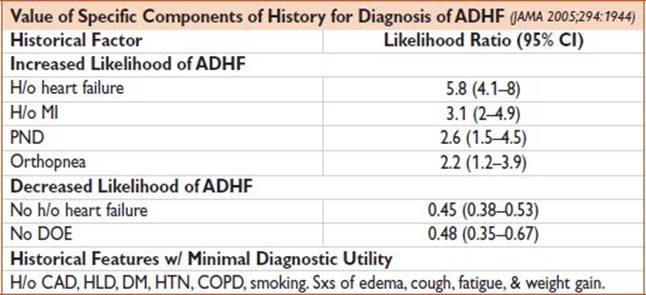
• SOB, DOE, CP, cough, orthopnea, PND; if severe, may have severe respiratory distress w/ pink/white sputum, altered mental status (AMS)
Findings
• ↑ BP, ↑ HR, ↑ RR, cardiac dysrhythmia
• +S3 (systolic failure) +S4 (diastolic failure)
• L-sided: +rales; R-sided: Leg edema, JVD, ↑ liver size, +hepatojugular reflex

Evaluation
• Primary Dx is clinical
• POC thoracic/cardiac ultrasound: B-lines (“lung rockets”), decreased EF
• ECG: LVH, tachyarrhythmia, L-heart strain, ischemia, e/o old infarction(s)
• CXR (perform @ bedside if unstable): Pulmonary edema, pl effusion, ↑ heart size
• Labs: CBC, lytes, Cr, cardiac markers, BNP or NT-proBNP
• BNP: If dyspnea & BNP >100 → CHF (sens 90%, spec 76%, NEJM 2002;347:161)
• False +: Large PE, cor pulmonale, ESRD; in chronic CHF must compare to “dry weight BNP”
• NT-proBNP: If dyspnea & NT-proBNP >300 → CHF (sens 99%, spec 60%); ↑ cutoff w/ ↑ age; same false+ as BNP

Treatment “LMNOP”
• L: Lasix (2× pts home oral dose given IV, or 80 IV)
• Furosemide PO to IV conversion 2:1 (ie, 40 mg PO equiv to 20 mg IV)
• Furosemide 40 mg = torsemide 10 mg = bumetanide 1 mg
• No difference in IV to PO conversions for torsemide or bumetanide
• If allergy to furosemide/torsemide/bumetanide, can use ethacrynic acid
• M: Morphine: Venodilator, ↓ dyspnea, ↓ afterload – caution w/ dosing in elderly
*Caution: May be a/w greater frequency of mechanical ventilation, prolonged hospitalization, ICU admission & mortality (Emerg Med J 2008;25(4)205)
• N: Nitrates (0.4 mg SL or 10–100 mcg/min IV): Caution in pts w/ AS → ↓ BP 2° preload dep; Nitroprusside if NTG ineffective; nesiritide may ↑ Cr/mortality compared to noninotropic tx (JAMA2005;293:1900)
• O: O2: 100% NRB
• P: PPV: CPAP or BiPAP for ↓ SaO2 or NRB; ↓ mort/need for intubation (JAMA 2005;294:3124; Lancet 2006;367:1155), ? ↑ effect CPAP c/w BiPAP. Intubate for unconsciousness, severe respiratory distress or visibly tiring after LMNOP tx.
• Inotropes: Only for cardiogenic shock. Routine use is a/w increased mortality. Dopamine, dobutamine, milrinone.
• Other: Sit pt up, Foley (assess ins/outs), IABP/LVAD (for severe cardiogenic shock)
Disposition
• D/C: If mild exacerbation of chronic CHF, benign etiology (ie, dietary indiscretion), & pt has close f/u
• EDOU: Selected HF pts can be managed by a rapid tx protocol in the OU w/ fewer bed days & similar readmission rates to admitted pts (Acad Emerg Med 2013;20(6)554)
• Tele: Most pts require admission/Δs to tx regimen before d/c home
• ICU: All intubated pts & those who w/ significant respiratory distress
Pearls
• Ask about or measure increase above dry body weight as in indication of volume overload
• Look for underlying cause; ask about dietary indiscretion, change in meds

