
Approach
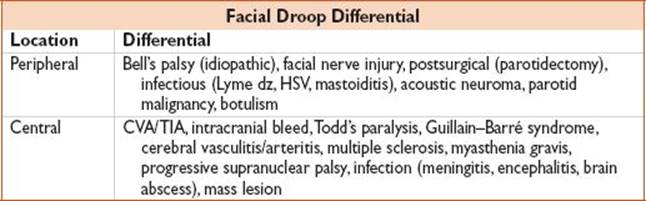
• Quickly distinguish UMN (central) from LMN (peripheral) lesion by testing strength of eye closure & eyebrow elevation
• Central etiology spares forehead due to bilateral innervation → w/u for stroke
• Bedside fingerstick blood glucose early b/c hypoglycemia can cause this
BELL’S PALSY
History
• Acute (over hours) onset painless unilateral facial droop; no other neuro signs or sxs
• RFs: Adult, diabetics, pregnancy. Recent hiking in endemic area suggests Lyme dz.
• Accounts for ∼50% of all facial palsies. Can be bilateral, but this requires further w/u.
Findings
• Paralysis must include forehead. Inability to smile or close eye, drooling, hyperacusis.
• No other neuro findings, but speech affected due to weakness
• Look for findings of spec etiology; eg, erythema migrans (Lyme), vesicles (HSV)
Evaluation
• Full neuro exam, pay special attention to CNs. No labs if typical presentation.
• If atypical presentation, other signs, systemic sxs: Neuroimaging & neuro consult
Treatment (Neurology 2012;79(22):2209)
• Artificial tears, tape eyelid before sleeping to prevent corneal injury (cannot close lids)
• Prednisone 60 mg QD × 5, then slow taper (10–14 d)
• No empiric abx, but consider if concerned or severe: Acyclovir (HSV), doxycycline (Lyme)
Disposition
• Home w/ reassurance, neuro f/u if paralysis persists for months
• Prognosis: 80–90% complete recovery in 2–3 mo. 10% permanent. 14% recurrence.