
Approach
• Must differentiate life-threatening HA from vast majority of benign HAs
• Evaluate associated sxs: Photophobia, vomiting, visual changes, eye pain, focal neuro sxs
• Assess for head or neck trauma, medications, substance abuse
• Red flags requiring neuroimaging: Sudden/rapid onset (<1 h to peak), exertional onset, worst of life, AMS, 1st severe HA >age 35, fever, neck stiffness, immune compromise, daily HA, no similar prior HAs, abnl neuro exam, meningismus, papilledema
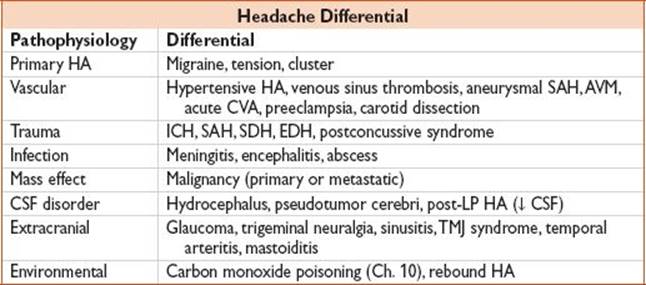
PRIMARY HEADACHE SYNDROMES
Migraine
History
• Slow in onset, unilateral throbbing or pulsatile, often w/ N/V, photophobia
• Usually lasts 4–72 h, visual aura or prodrome may precede HA (15%)
Findings
• nl neuro exam or stereotypical neuro deficit that may last hours (complex)
Evaluation
• No studies or consults indicated unless need to exclude other cause w/ CT/LP
Treatment
• Prophylaxis: TCAs, BB, anticonvulsants
• Abortive: “Migraine cocktail” of dopamine antagonist (eg, prochlorperazine, metoclopramide) w/ diphenhydramine (↓ extrapyramidal sxs), IVF, NSAIDs, or APAP
• Other options include triptans, dihydroergotamine (DHE), & dexamethasone
• DHE, sumatriptan contraindicated in pregnancy & pts w/ CAD
Disposition
• Home if migraine improved, admit if HA unresponsive to tx
Pearl
• Be wary of diagnosing a 1st-time migraine in pts of age >35
Tension Headache
History: Dull, aching pressure HA a/w muscle tension in neck or lower head, sometimes a/w depression, anxiety, worsens at end of the day
Findings: nl neuro exam
Evaluation: No studies or consults indicated unless need to exclude other cause w/ CT/LP
Treatment: NSAIDs or APAP, neck massage & heat, relaxation techniques, not narcotics
Disposition: Home once HA improved, admit if HA unchanged w/ meds
Pearl: Most common cause of benign HA
Cluster
History: Sudden onset unilateral, paroxysmal, sharp, stabbing eye pain that may awaken from sleep; clusters of several episodes/week for up to 6–8 wk, more common in men
Findings: ± ipsilateral lacrimation, flushing, rhinorrhea or nasal congestion, conjunctival injection or Horner syndrome (30% of pts)
Evaluation: No studies indicated unless need to r/o other cause (eg, 1st time worst HA)
Treatment: High-flow O2 (7–10 L/min) by mask, sumatriptan (avoid in pregnancy or CAD), intranasal lidocaine, NSAIDs. Prophylaxis: Prednisone 60 mg ×10 d then taper, ± verapamil or valproic acid.
Pearl: Make sure to distinguish from acute angle-closure glaucoma
VASCULAR
Subarachnoid Hemorrhage (Nontraumatic)
Approach
• This is considered one of the most difficult diagnoses in Emergency Medicine.
• Note that ruptured aneurysms are generally not subtle, present like a hemorrhagic stroke
• Goal of working up “worst HA of life” is actually to identify sentinel bleed (leak), which occurs in 30–50% of pts, so that we can look for an aneurysm in hopes that it is amenable to intervention.
• 20% of SAH are nonaneurysmal (eg, AVM) & these have good prognosis
• Low threshold to work this up. Know that even SAH HA often improves w/ meds.
Presentation
• Classically sudden “thunderclap” HA, maximal pain <1 h, “worst HA of life”
• Additional historical red flags for SAH: Onset w/ exertion/Valsalva, neck stiffness, arrival by ambulance, LOC, vomiting
• RFs: Age >60, FH (4× risk), HTN, smoking, alcohol, cocaine, amphetamine use, PCKD, collagen/connective tissue disorders
• Neuro exam is often nl. May have ocular motor palsy 2/2 aneurysm compression.
Evaluation
• CTH: In pts who are low risk by hx & nl neuro exam, sens 100% w/i 6 h, 86% after 6 h (BMJ 2011;343:d4277).
• Some sources recommend no LP in this pt population w/ negative CTH <6 h after onset
• LP (gold standard for bleed): Xanthochromia is 100% sens after 12 h
• No established “lower limit” for RBCs
• CTA: Reaches sens of 98% for bleed, but is improving & will likely play greater role
• Conventional angiography is the gold standard for identifying an actual aneurysm, if LP +
Management
• If LP +, consult neurosurgery/IR & see Hemorrhagic Stroke section below
Disposition
• Admit
Hypertensive Headache
History
• Untreated HTN or other precipitants (pregnancy, drug use, serotonin syndrome)
Findings
• BP often >240/140 (unlikely w/ DBP <120)
• Papilledema, encephalopathy, ± focal neuro abnormalities or sz
Evaluation
• Head CT to eval for edema or ICH; consider A-line for frequent & accurate BP checks
• Look for other end-organ damage (hypertensive emergency): EKG for AMI, signs of aortic dissection, pulmonary edema, renal failure
Treatment
• Goal is ↓ MAP by 25% over 1 h (↓ BP too quickly could lead to ischemia)
• May use nitroprusside (except in pregnancy) 0.5 μg/kg/min or Labetalol 1–2 mg/min
Venous Sinus Thrombosis
History
• Hypercoagulable state, (eg, 73% are pregnant/postpartum)
• Gradual onset HA (average time to Dx is 7 d), visual changes, nausea, vomiting
Findings
• Papilledema, leg weakness, focal neuro deficits
• Cavernous sinus: CN III, IV, & VI compromise
• Lateral sinus thrombosis: Middle ear infection sxs
Evaluation
• Commonly start w/ CTH/CTV, but MRV is most sens
Treatment
• Anticoagulation (heparin) ± direct infusion of thrombolytics
Pearl
• Results from the occlusion of venous sinus causing congestion & then ischemia
CNS INFECTIONS
Meningitis
History
• HA, fever, neck stiffness, lethargy, AMS; ask about recent illness, travel, immunosuppressive medications, head trauma, or surgery
• Bacterial: Typically acute (<1 d), high-grade fever, HA, nuchal rigidity, ill appearing
• Viral: Typically subacute (1–7 d), also w/ HA, fever, photophobia
• Fungal/TB: Subacute (>1 wk), HA, low-grade fever, weight loss, night sweats
Findings
• Fever (very sens), HA, nuchal rigidity (in 50%), often photophobia, AMS
• Brudzinski sign (hip flexion elicited by passive neck flexion) & Kernig sign (inability or reluctance to extend knee when hip is flexed to 90) are only 5% sens
• Petechial rash suggests meningococcus
• Expect subtle presentation in elderly or immunocompromised pts; may be AMS only
Evaluation
• If bacterial etiology suspected by hx/exam, abx should be given immediately, before LP
• Blood cultures, full infectious w/u (CBC, CXR, UA). ↓ PLT suggests meningococcus.
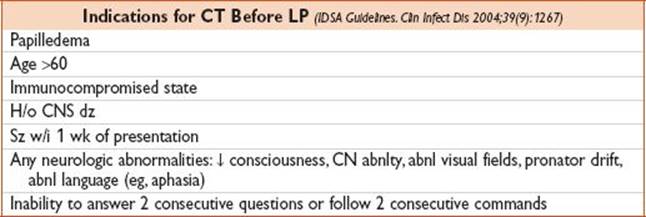
• See table below for indications for CT prior to LP
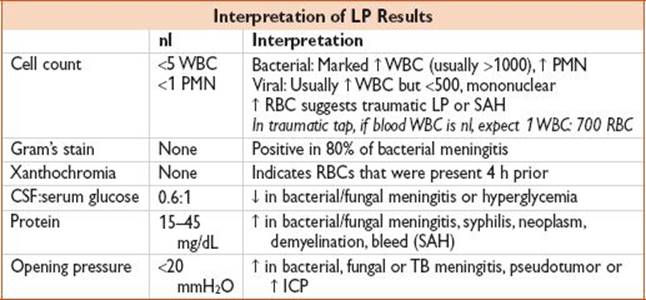
• LP tubes: (1 & 4) cell count & diff, (2) glucose & protein, (3) Gram stain, cx ± HSV PCR
Treatment
• Respiratory precautions if suspect bacterial
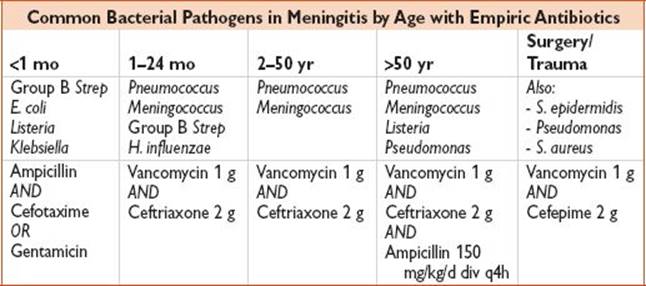
• Empiric abx (see table). Add acyclovir 10 mg/kg q8h if concern for HSV.
• Dexamethasone 0.15 mg/kg if + CSF Gram stain or ↑ ICP
• Exposure ppx: Ciprofloxacin 500 mg PO × 1. Ceftriaxone 250 mg IM (peds), or Ceftriaxone 150 mg IM (pregnancy).
• If viral: Supportive care only, prophylaxis not needed
Pearls
• High mortality if not treated appropriately & expeditiously, worse if AMS, ↓ BP, or sz
• Consider toxoplasmosis if HIV+
Encephalitis
Definition: Infection of the brain itself. Usually viral (HSV, HHV, WNV, measles).
History: Tick or mosquito bite, hepatic dz
Findings: Fever, HA, vomiting, AMS, hallucinations, change in behavior. More likely to have focal neuro deficits than meningitis. May progress to paralysis, sz, ataxia, coma.
Evaluation: CSF may show elevated WBC & protein levels. CT nl or hypodensities.
Treatment: Supportive ± anticonvulsants, steroids. Acyclovir if HSV encephalitis.
Abscess
Definition
• Purulent collections w/i the CNS (intraparenchymal, epidural, subdural, spinal)
• Most common: Strep. milleri, Bacteroides, S. aureus, Enterobacteriacea
• Form by contiguous spread (sinus, dental) or hematogenous seeding (PNA, endocarditis)
History: HA, low-grade fever, recent infection, focal neuro deficit or sz, N/V
Findings: Low-grade fever, AMS, nuchal rigidity in 25%, focal neuro findings, ±papilledema
Evaluation: ↑ WBC, ↑ ESR, blood cultures. CT will show abscess “ring-enhancing lesion.”
Management: Low threshold for intubation, abx, neurosurgery consultation
BRAIN TUMOR
Differential
• Meningioma, medulloblastoma, glioma (astrocytoma, astroblastoma, glioblastoma), ependymoma, craniopharyngioma, lymphoma, metastasis
Presentation
• Often daily morning HAs, signs of ↑ ICP, N/V, localizing deficits, sz
• Look for signs of herniation:
• Uncal (most common): ↓ mental status, blown unilateral pupil, decerebrate posturing
• Central: AMS, yawning, Cheyne–Stokes breathing, miosis. Decorticate → decerebrate.
• Tonsillar (posterior): Bradycardia, coma, respiratory arrest
• Cushing reflex (due to ↑ ICP): HTN, bradycardia, irregular breathing
Evaluation
• Neuroimaging w/ CT, usually followed by MRI
• Also check electrolytes, cortisol, TSH in those w/ suspected pituitary locations
Management
• Treat HA & nausea. Dexamethasone 4 mg TID for mass effect, antiseizure medications, neurosurgical consultation.
CSF DISORDERS
Pseudotumor Cerebri (Idiopathic Intracranial Hypertension)
History: Classically young obese females on OCPs/steroids, w/ moderate intensity daily/constant HA & visual complaints, worse in the morning, ±N/V
Findings: May have nl exam, or papilledema, visual field deficits, CN VI palsy
Evaluation
• LP diagnostic (opening pressure >20 in lateral decubitus position, o/w nl)
• CT will show small or nl ventricles
Management
• Neuro consult if new Dx or refractory to tx
• Decrease ICP: Acetazolamide 1 mg PO QD
• Repeated high-volume LPs to drain CSF, possibly VP shunt
• Prednisone 60–100 mg PO w/ slow taper
Low CSF (Post-LP)
History
• Recent LP or other penetration of dura (myelogram, spinal anesthesia)
• Usually present 48–72 h post-LP
• Occipital HA radiating to shoulders & neck; ±N/V, photophobia, tinnitus
Findings: Nonfocal neuro exam; HA improved w/ lying flat, worse w/ sitting up
Evaluation: None spec; evaluate for other causes of HA, if indicated
Treatment: Methylxanthine derivatives (caffeine IV, aminophylline), IVF, epidural blood patch
Pearls
• Most common complication after penetration of the dura
• Thought to be caused by ongoing CSF leak from dural defect (intracranial hypotension)
• ∼70% will resolve spontaneously in 1 wk
• Use of smaller caliber spinal needle (24–27G), shape of needle ↓ incidence of post-LP HA
TRIGEMINAL NEURALGIA
History
• Unilateral paroxysmal pain in sensory distribution of CN V
• Commonly involves the maxillary (V2) or mandibular (V3) branches
• Often accompanied by a brief facial spasm or tic (“tic douloureux”)
• No e/o CN Dysfxn or other neurologic abnlty
• May be triggered by light touch or vibration, shaving, face washing, chewing
Findings: nl physical exam
Evaluation: Can be treated w/o w/u if characteristic hx; MRI if atypical features present (neuro deficit, age <40). Refer to neurology for outpt w/u.
Treatment: Carbamazepine 100 mg BID, increase by 200 mg/d up to 1200 mg/d
Pearl: Most common cause is compression of the nerve root by an aberrant vessel
EXTRACRANIAL
Acute Sinusitis
Definition
• Inflammation of the paranasal sinuses. Most commonly viral or allergic.
• Common bacterial etiologies: S. pneumo, nontypable H. influenzae, M. catarrhalis
• Pseudomonas is seen in HIV, cystic fibrosis, or after instrumentation
• Mucormycosis is invasive fungal sinusitis (Rhizopus) in diabetics or immunocompromised
Presentation
• Mucopurulent d/c, postnasal drip, sinus pressure, tap tenderness, HA
• ± fever; if febrile, more likely to be bacterial
• Typically progresses over 7–10 d & resolves spontaneously
• Sxs >7 d, worsening course, or worsening after improving, all suggest bacterial dz
• Consider sinusitis w/ positional HA that is worse when bending forward
• Sphenoid sinusitis is a difficult Dx, often presents late; classically worse w/ head tilt
Evaluation
• Clinical. Imaging not routinely indicated. CT sens but not spec.
Treatment
• Supportive (analgesics, antipyretics, decongestants, antihistamines if allergic)
• Decongestants: Neo-Synephrine nasal spray TID × 3 d, Afrin nasal spray BID × 3 d
• Abx not routinely indicated. Reserve for pts w/ sxs >7 d, worsening sxs, fever, purulent d/c, or high risk for severe infection or cx.
• Amoxicillin 500 mg PO TID × 10 d, or TMP–SMX or azithromycin
• If no improvement: Amoxicillin–clavulanate, fluoroquinolone, clindamycin
Disposition
• Vast majority are managed outpt
• Admit if toxic, severe HA, high fever, immunocompromised, poor f/u
Pearl
• Sphenoid/ethmoid sinusitis is less common than maxillary sinusitis but has significant potential cx (eg, orbital cellulites, cavernous sinus thrombosis)
Temporal Arteritis (Giant Cell Arteritis)
Definition: Granulomatous inflammatory vasculitis of medium/large arteries
History
• Unilateral HA, jaw/tongue claudication, malaise, low-grade fevers, visual impairment
• Usually >50 y/o (90% >60 y/o), F > M, h/o PMR (50% of pts)
Physical Findings: Tenderness over temporal artery, decreased visual acuity
Evaluation: ↑ ESR, ↑ CRP, temporal artery biopsy
Management
• Prednisone 80 mg/d (if vision threatened do not await biopsy results)
• If no visual sxs: Biopsy w/i 2 wk. Consult rheumatology, optho.
Disposition: Admit only for visual deficits
Pearl: Failure to diagnose & tx may result in permanent blindness