
HEMATOLOGY-ONCOLOGY
LYMPHOMA
Definition
• Malignant disorder of lymphoid cells that reside predominantly in lymphoid tissues
• Hodgkin lymphoma (HL) is distinguished from non-Hodgkin lymphoma (NHL) by
the presence of Reed-Sternberg (RS) cells
Clinical manifestations
• Lymphadenopathy (nontender)
HL: superficial (usually cervical/supraclavicular) ± mediastinal lymphadenopathy; nodal disease with orderly, anatomic spread to adjacent nodes
NHL: diffuse; nodal and extranodal disease with noncontiguous spread; symptoms reflect involved sites (abdominal fullness, bone pain)
• Constitutional (“B”) symptoms: fever (>38°), drenching sweats, ↓ weight (>10% in 6 mo)
HL: periodic, recurrent “Pel-Ebstein” fever; 10–15% have pruritus; ~35% “B” symptoms
NHL: “B” symptoms vary between types, ~15–50%
Diagnostic and staging evaluation
• Physical exam: lymph nodes, liver/spleen size, Waldeyer’s ring, testes (~1% of NHL), skin
• Pathology: excisional lymph node bx (not FNA b/c need surrounding architecture) with immunophenotyping and cytogenetics; BM bx (except in HL clinical stage IA/IIA with favorable features or CLL clone by flow); LP if CNS involvement clinically suspected
• Lab tests: CBC, BUN/Cr, LFTs, ESR, LDH, UA, Ca, alb; ✓ HBV & HCV (and must ✓ HBsAg & anti-HBc if planning rituximab Rx as can lead to HBV reactivation); consider HIV, HTLV, & EBV serologies and connective tissue diseases autoAbs
• Imaging: chest/abd/pelvic CT, but doesn’t reliably detect spleen/liver involvement
consider PET-CT scans (esp. in HL, DLBCL). PET response to Rx can be prognostic (Blood 2006;107:52; JCO 2007;25:3746); has role to assess PR/CR after treatment.
Head CT/MRI only if neurologic symptoms.
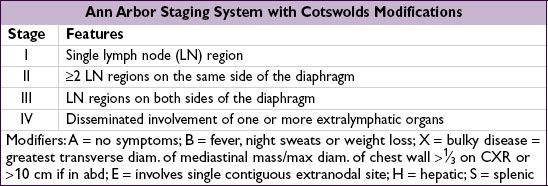
HODGKIN LYMPHOMA (HL) (NEJM 2010;363:653)
Epidemiology and risk factors
• ~9,000 cases/y; bimodal distribution (15–35 & >50 y); ↑  ; role of EBV in subsets of HL, esp. immunocompromised patients
Pathology
• Affected nodes show RS cells (<1%) in background of non-neoplastic inflammatory cells
• Classic RS cells: bilobed nucleus & prominent nucleoli with surrounding clear space (“owl’s eyes”). RS cells are clonal B-cells: CD15+, CD30+, CD20– (rarely +).

• Nonclassical (5%): nodular lymphocyte predominant (NLP); involves peripheral LN
80% present in stages I–II and Rx can be RT alone or combination chemo + RT w/ 80% 10-y progression-free survival, 93% overall survival ( JCO 1997;15:3060)
Consider rituximab as most NLP RS cells are CD20+
Stages III–IV treated with combination chemo (see below)
Treatment (Lancet 2012;380:836)
• Stages I–II: ABVD (doxorubicin, bleomycin, vinblastine, dacarbazine) ± RT
Lower intensity regimens comparable efficacy if favorable prognosis (NEJM 2010;363:640)
• Stages III–IV: ABVD × 6 cycles or escalated BEACOPP (bleomycin, etoposide, doxorubicin, cyclophosphamide, vincristine, procarbazine and prednisone)
• Refractory/relapsed disease: salvage chemo + auto HSCT, ± RT
• Late effects include ↑ risk for:
second cancers: breast (if RT), ∴ annual screening at age 40 or 8–10 y post RT; lung, ? role of screening CXR or CT (controversial); acute leukemia/MDS; NHL
cardiac disease (if RT or anthracycline), ? role of echo/stress at 10 y (controversial)
pulmonary toxicity (if bleomycin)
hypothyroidism (if RT), ∴ annual TSH (if neck RT)
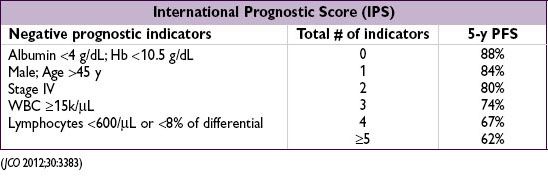
NON-HODGKIN LYMPHOMA (NHL)
Epidemiology and risk factors
• ~70,000 new cases/y; median age at dx ~65 y; predominance; 85% B-cell origin
• Associated conditions: immunodeficiency (eg, HIV, posttransplant); autoimmune disorders (eg, Sjögren’s, RA, SLE); infection (eg, EBV, HTLV-I, H. pylori)
• Burkitt’s lymphoma: (1) endemic or African (jaw mass, 80–90% EBV-related); (2) sporadic or American (20% EBV-related); (3) HIV-related

Treatment (Lancet 2012;380:848)
• Treatment and prognosis determined by histopathologic classification rather than stage
• Rituximab (antibody to CD20; NEJM 2012;366:2008) if CD20+; no role if tumor is CD20–
• Indolent: goal is sx management (bulky dis., cytopenias, “B” sx); not curable w/o allo HSCT
Options include radiation for localized disease, rituximab ± chemo (bendamustine, CVP, fludarabine)
For MALT → treat H pylori if 
Rituximab maintenance ↑ survival in relapsed disease (JNCI 2009:101:248); growing role for rituximab maintenance in indolent and aggressive disease (Lancet 2011;377:42)
• Aggressive (DLBCL, 30–40% of NHL): goal is cure (JCO 2005;23:6387)
R-CHOP (rituximab, cyclophosphamide, doxorubicin = hydroxydaunorubicin, vincristine = Oncovin, prednisone) (NEJM 2002;346:235 & 2008;359:613) 10-y progression-free survival = 45%; overall survival = 55% (Blood 2010;116:2040)
? R-ACVBP (ritux, doxorubicin = Adriamycin, cyclophosph, vindesine, bleo, prednisone) ↑ 3-y OS vs. R-CHOP, but ↑ adverse events (Lancet 2011;378:1858)
+ Radiation for localized or bulky disease
Consider CNS prophylaxis w/ intrathecal or systemic high-dose methotrexate if paranasal sinus, testicular, breast, periorbital, paravertebral or bone marrow involved; ≥2 extranodal site + ↑ LDH may also warrant
Refractory/relapsed disease: salvage chemo; high-dose chemo + auto-HSCT (NEJM 1995;333:1540); allo-HSCT if beyond 2nd relapse
• Highly aggressive
Burkitt’s: intensive short-course chemotherapy (Blood 2004;104:3009)
Low risk defined as nl LDH & single focus of disease <10 cm; all others high risk
Low risk Rx = CODOX-M (cyclophosphamide, vincristine, doxorubicin, high-dose methotrexate ± rituximab) (Leuk Lymph 2004;45:761)
High risk Rx = CODOX-M/IVAC (above w/ ifosfamide, etoposide, high-dose cytarabine), hyper-CVAD (cyclophosphamide, vincristine, doxorubicin, dexamethasone)
All Pts receive CNS prophylaxis & tumor lysis syndrome prophylaxis
Lymphoblastic lymphoma (B or T cell): treated like ALL (see “Acute Leukemia”)
Prognosis
• Indolent: typically incurable, but long median survival

• Aggressive: ↑ chance of cure, but overall worse prognosis

HIV-associated NHL (Blood 2006;107:13)
• HIV imparts 60–100× relative risk
• NHL is an AIDS-defining malignancy along with Kaposi’s, cervical CA, anal CA
• Concurrent HAART & chemotherapy likely provide survival benefit
• DLBCL & immunoblastic lymphoma (67%): CD4 <100, EBV-associated Treat as immunocompetent (CHOP-R), but avoid rituximab if CD4 <100 Alternative regimens include R-EPOCH (etop, pred, vincristine, cyclophos, doxorubicin)
• Burkitt’s (20%): can occur with CD4 >200 Treat as immunocompetent; prognosis is not significantly worse
• Primary CNS lymphoma (16%): CD4 <50, EBV-associated (also seen in Pts w/o HIV) Treat with high-dose methotrexate + steroids ± RT
• Primary effusion lymphoma (<5%): HHV8 driven; also can be seen in other immuno- supp. Pts such as s/p solid organ transplant or w/ chronic HBV. Treat with standard CHOP (often CD20–), but poor prognosis.