
Definition
• Infection by nontuberculous mycobacterial (NTM) species
Pathogenesis
• Infection occurs by aerosolization of NTM species from sources such as natural water supplies, soil, food, and animals, where these organisms are ubiquitously found
• No persuasive evidence of human-to-human or animal-to-human transmission exists
• Infection most commonly occurs in the immunocompromised or the elderly patient
• Associated conditions include AIDS, cystic fibrosis, and immune suppression secondary to transplantation or chemotherapy
Clinical features
Epidemiology
• NTM lung diseases unlike tuberculosis are not reported to public health authorities and epidemiological data are imprecise
• Statistical analysis reveals worldwide distribution with steadily increasing incidence
• Mycobacterium avium complex (MAC) is the most common atypical mycobacterial agent of human infection (other species that cause lung disease include M. fortuitum, M. xenopi, M. malmoense, M. szulgai, M. simiae, M. asiatica, and M. abscessus)
Presentation
• Similar to tuberculosis, presentation ranges from asymptomatic infection to nonspecific pulmonary symptoms such as cough or dyspnea, chest pain, hemoptysis, fever, malaise, night sweats, and asthenia
• Hilar and mediastinal lymphadenopathy not as common as in tuberculosis
• About 80% of cases of rapidly growing mycobacteria (RGM) are due to M. abscessus and 15% are due to M. fortuitum
Prognosis and treatment
• Good prognosis when antibiotic regimens are strictly followed
• Multidrug resistant organisms more common than in M. tuberculosis infections and are associated with poorer outcomes
Pathology
Gross
• Nodular and cavitary lesions resembling M. tuberculosis are seen
• Multiple nodules in the right middle lobe or lingula may be seen in nonimmunocompromised women
• About 50% of HIV patients with MAC infection and 90% of HIV patients with M. kansasii infection have cavitary lesions in the upper lobes
Histology
• Granulomatous inflammation (with or without necrosis) similar to tuberculosis is the most common finding
• Some cases are associated with an impressive neutrophilic infiltrate
• Acid-fast stains reveal long, beaded, thin, red bacilli
• Auramine-rhodamine stains may outline organisms in sputum and tissue
Main differential diagnoses
• Sarcoidosis
• Wegener granulomatosis
• Nocardiosis
• Hypersensitivity pneumonitis
• Malakoplakia
• Silicotic nodule

Fig 1 Atypical mycobacterial infections. Disseminated MAC infection was seen at autopsy in this untreated AIDS patient. Although the majority of the organisms are intracellular, extracellular organisms are also easily identifiable on this acid-fast (Ziehl-Neelsen) stain.
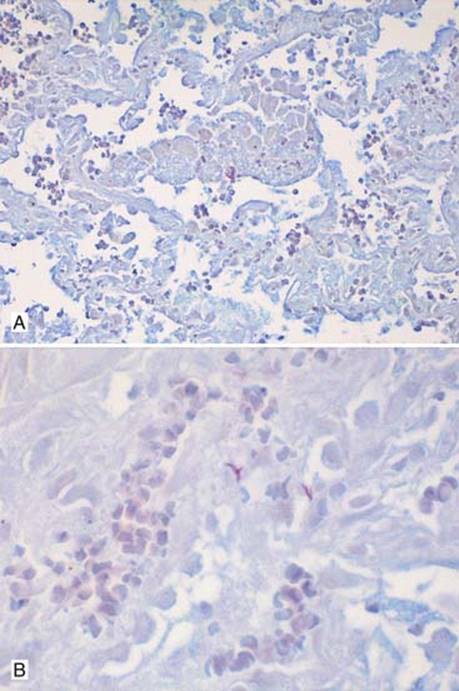
Fig 2 Atypical mycobacterial infections. A 9-year-old female after stem cell transplantation for acute lymphoblastic leukemia presented with shortness of breath and bilateral lung infiltrates. Sputum was 4+ for acid-fast bacilli (AFB) on direct staining; however, the AFB stain on wedge biopsy shown here (A and B) demonstrated only a few organisms.