
CANCER
Karnofsky performance scale (KPS): Table 34-1, often used for grading functional status in patients with cancer. A KPS score < 70 (particularly with brain tumors) often identifies patients with a worse prognosis for any given treatment.
Table 34-1 Karnofsky performance status scale (modified1, 2)
|
Score |
Criteria |
General category |
|
100 |
normal: no complaints, no evidence of disease |
Able to carry on normal activity and work. No special care is needed |
|
90 |
able to carry on normal activity: minor signs or symptoms |
|
|
80 |
normal activity with effort: some signs or symptoms |
|
|
70 |
cares for self: unable to carry on normal activity or to do active work |
Unable to work. Able to live at home, care for most personal needs. Variable assistance is required |
|
60 |
requires occasional assistance: cares for most of needs |
|
|
50 |
requires considerable assistance and frequent care |
|
|
40 |
disabled: requires special care and assistance |
Unable to care for self. Requires equivalent of institutional or hospital care. Disease may be rapidly progressing |
|
30 |
severely disabled: hospitalized; death not imminent |
|
|
20 |
very sick: hospitalized; active supportive care needed |
|
|
10 |
moribund: fatal processes are progressing rapidly |
|
|
0 |
dead |
HEAD INJURY
The Ranchos Los Amigos scale (Table 34-2) is often used in rating disability following head injury. The Glasgow outcome scale (Table 34-3) is frequently employed in outcome assessment.
Table 34-2 Ranchos Los Amigos cognitive scale
|
Level |
Meaning |
|
I |
No response to pain, touch, sight or sound. |
|
II |
Generalized reflex responses to pain. |
|
III |
Localized response. Blinks to strong light, turns towards/away from sound, responds to physical discomfort, inconsistent responses to commands. |
|
IV |
Confused - Agitated Alert, very active, agitated, aggressive, or bizarre behaviors. Performs motor activities but behavior is non-purposeful, extremely short attention span. |
|
V |
Confused - Non agitated Gross attention to environment, easily distracted, requires continual redirection, difficulty learning new tasks, agitated by excess stimulation. May converse socially but with inappropriate verbalizations. |
|
VI |
Confused - Appropriate Inconsistent orientation to time and place. Retention span and recent memory impaired. Begins to recall past, consistently follows simple commands, goal directed behavior with assistance. |
|
VII |
Automatic - Appropriate Performs daily routine in highly familiar environment in a non-confused but automatic “robot-like” fashion. Skills deteriorate in unfamiliar environment. Lacks realistic planning for future. |
|
VIII |
Purposeful - Appropriate |
Table 34-3 Glasgow outcome scale3
|
Score |
Meaning |
|
5 |
good recovery – resumption of normal life despite minor deficits (“return to work” not reliable) |
|
4 |
moderate disability (disabled but independent) – travel by public transportation, can work in sheltered setting (exceeds mere ability to perform “activities of daily living”) |
|
3 |
severe disability (conscious but disabled) – dependent for daily support (may be institutionalized, but this is not a criteria) |
|
2 |
persistent vegetative state – unresponsive & speechless; after 2-3 weeks, may open eyes & have sleep/wake cycles |
|
1 |
death – most deaths ascribable to primary head injury occur within 48 hrs |
CEREBROVASCULAR EVENTS
Several outcome grading scales have come to be favored for use following CVAs or SAH. Each emphasizes different aspects of outcome. The Barthel Index (see below) places weight on activities of daily living (ADLs), while others, such as the modified Rankin scale4 (Table 34-4) assess levels of independence and includes a comparison to previous activity levels. While it does measure functional status, the modified Rankin is not sensitive to subtle neurologic deficits such as dysphasia or visual field defects.
Table 34-4 The modified* Rankin scale
|
Grade |
Description |
|
0 |
no symptoms at all |
|
1 |
no significant disability despite symptoms: able to carry out all usual duties & activities |
|
2 |
slight disability: unable to carry out all previous activities. Able to look after own affairs without assistance |
|
3 |
moderate disability: requiring some help, but able to walk without assistance |
|
4 |
moderately severe disability: unable to walk without assistance, and unable to attend to own bodily needs without assistance |
|
5 |
severe disability: bedridden, incontinent, and requiring constant nursing care and attention |
* the original Rankin scale 5: did not have Grade 0, Grade 1 did not include the words “despite symptoms” and “& activities”, and it defined Grade 2 as “unable to carry out some of previous activities…”
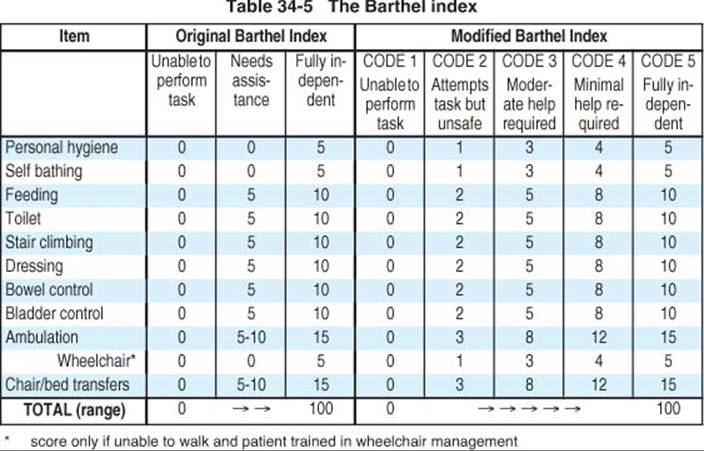
Barthel index: The original Barthel index6, 7 assigns one of three scores to 10 ratable ADLs, and then the individual scores are summed (see Table 34-5). The modified Barthel index (MBI) with a 5-step scoring system as shown in Table 34-5 appears to have greater sensitivity8. The total ranges from 0 to 100 (a score of 100 implies functional independence, not necessarily normality).
Of all the factors, independence in bathing was the most difficult. Abilities on the Barthel index tend to return in a fairly consistent order, and so most patients with the same score will have similar patterns of disability.
SPINAL CORD INJURY
Functional Independence Measure™9-11 (FIM™): developed to provide uni-form evaluation of disability for spinal cord injuries. Rates 18 items shown in Table 34-6 (13 motor, 5 cognitive) on the 7 level scale shown in Table 34-7.
The FIM™ has high internal consistency and is a good indicator of burden of care12, 13.
Table 34-6 The Functional Independence Measure™ (FIM)
|
Classification |
Item |
|
Motor |
|
|
Self-care |
1. Eating |
|
2. Grooming |
|
|
3. Bathing |
|
|
4. Dressing - upper body |
|
|
5. Dressing - lower body |
|
|
6. Toileting |
|
|
Sphincter control |
7. Bladder management |
|
8. Bowel management |
|
|
Mobility |
9. Bed, chair, wheelchair |
|
10. Toilet |
|
|
11. Tub, shower |
|
|
Locomotion |
12. Walk or wheelchair |
|
13. Stairs |
|
|
Cognitive |
|
|
Communication |
14. Comprehension |
|
15. Expression |
|
|
Social cognition |
16. Social interaction |
|
17. Problem solving |
|
|
18. Memory |
|
Table 34-7 The 7 FIM™ rating levels of disability
|
Degree of dependency |
Level of function |
Score |
|
No helper |
Complete independence |
7 |
|
Modified independence |
6 |
|
|
Modified dependenc on a helper |
Supervision |
5 |
|
Minimal assist (≥ 75% independent) |
4 |
|
|
Moderate assist (≥ 50% independent) |
3 |
|
|
Complete dependenc on a helper |
Maximal assist (≥ 25% independence) |
2 |
|
Total assist (< 25% independence) |
1 |
34.1. References
1. Karnofsky D A, Burchenal J H: In Evaluation of chemotherapy agents, Macleod C M, (ed.). Columbia University Press, New York, 1949: pp 191-205.
2. Karnofsky D, Burchenal J H, Armistead G C, et al.: Triethylene melamine in the treatment of neoplastic disease. Arch Intern Med 87: 477-516, 1951.
3. Jennett B, Bond M: Assessment of outcome after severe brain damage: A practical scale. Lancet i: 480-4, 1975.
4. UK-TIA Study Group: The UK-tia aspirin trial: Interim results. Br Med J 296: 316-20, 1988.
5. Rankin J: Cerebral vascular accidents in patients over the age of 60. 2. Prognosis. Scott Med J 2: 200-15, 1957.
6. Mahoney F I, Barthel D W: Functional evaluation: The Barthel index. Maryland State Med J 14: 61-5, 1965.
7. Wade D T, Hewer R L: Functional abilities after stroke: Measurement, natural history and prognosis. J Neurol Neurosurg Psychiatry 50: 177-82, 1987.
8. Shah S, Vanclay F, Cooper B: Improving the sensitivity of the Barthel index for stroke rehabilitation. J Clin Epidemiol 42 (8): 703-9, 1989.
9. Forer S, Granger C, et al.: Functional independence measure. The Buffalo General Hospital, State University of New York at Buffalo, Buffalo, NY, 1987.
10. Ditunno J F, Jr.: New spinal cord injury standards, 1992. Paraplegia 30 (2): 90-1, 1992.
11. Ditunno J F, Jr.: Functional assessment measures in CNS trauma. J Neurotrauma 9: S301-5, 1992.
12. Dodds T A, Martin D P, Stolov W C, et al.: A validation of the functional independence measurement and its performance among rehabilitation inpatients. Arch Phys Med Rehabil 74 (5): 531-6, 1993.
13. Linacre J M, Heinemann A W, Wright B D, et al.: The structure and stability of the functional independence measure. Arch Phys Med Rehabil 75 (2): 127-32, 1994.