
Christopher J. Kirk, Brian B. Tuch, Shirin Arastu-Kapur, and Lawrence H. Boise
BIOCHEMISTRY OF THE UBIQUITIN-PROTEASOME PATHWAY
The ubiquitin proteasome system is involved in the degradation of more than 80% of cellular proteins, including those that control cell-cycle progression, apoptosis, DNA repair, and the stress response.1 A key step in this process is the tagging of proteins targeted for degradation with multiple copies of ubiquitin, a 76–amino acid protein whose primary sequence and structure is highly conserved in organisms ranging from yeasts to mammals.2,3 Once polyubiquitinated, proteins targeted for degradation bind to the 26S proteasome, a holoenzyme composed of two 19S regulatory complexes capping a central 20S proteolytic core. The 20S core is a hollow “barrel” consisting of four stacked heptameric rings. The subunits of the rings are classified as either β subunits (outer two rings) or β subunits (inner two rings). The 19S regulatory complex consists of a lid that recognizes ubiquitinated protein substrates with high fidelity, and a base that contains six adenosine triphosphatases, unfolds protein substrates, removes the polyubiquitin tag, and threads them into the catalytic chamber of the 20S particle in an adenosine triphosphate–dependent manner.4,5 Unlike typical proteases, the 20S proteasome in eukaryotic cells contains multiple proteolytic activities resulting in the cleavage of protein targets after many different amino acids. In most cells, the 20S core particle contains the catalytic subunits β5 (PSMB5), β1 (PSMB1), and β2 (PSMB2), accounting for chymotrypsin-like (CT-L), caspaselike (C-L), and trypsinlike (T-L) activities, respectively, each differing in their substrate preference.6However, in cells of hematopoietic origin, such as lymphocytes and monocytes, the proteasome catalytic subunits are encoded by homologous gene products: LMP7 (PSMB8), LMP2 (PSMB9), and MECL-1 (PSMB10).7 These immunoproteasome subunits are also induced in nonhematopoietic cells following exposure to inflammatory cytokines such as interferon-γ (IFN-γ) and tumor necrosis factor alpha (TNF-α).8 In the immunoproteasome, the 19S regulatory complex can be replaced with proteasome activators such as PA28, whose expression is also induced in cells following exposure to IFN-γ. Hybrid proteasomes, both for the catalytic subunits and regulatory particles, have been described.9
Given its key role in maintaining cellular homeostasis, the ubiquitin proteasome system appeared to be an unlikely target for pharmaceutical intervention. However, a variety of groundbreaking studies in the 1990s suggested that inhibitors of proteasome function might prove to be viable therapeutic agents.10 Initial studies used substrate-related peptide aldehydes to investigate the proteolytic functions and specificity of the proteasome.11 In vitro and in vivo studies with these inhibitors demonstrated their ability to induce apoptosis as well as inhibit tumor growth.12–15 It was subsequently discovered that several natural products with antitumor activity exert their action via proteasome inhibition, providing additional rationale for the development of selective proteasome inhibitors (PIs).16,17
PROTEASOME INHIBITORS
Chemical Classes of Proteasome Inhibitors in Clinical Development
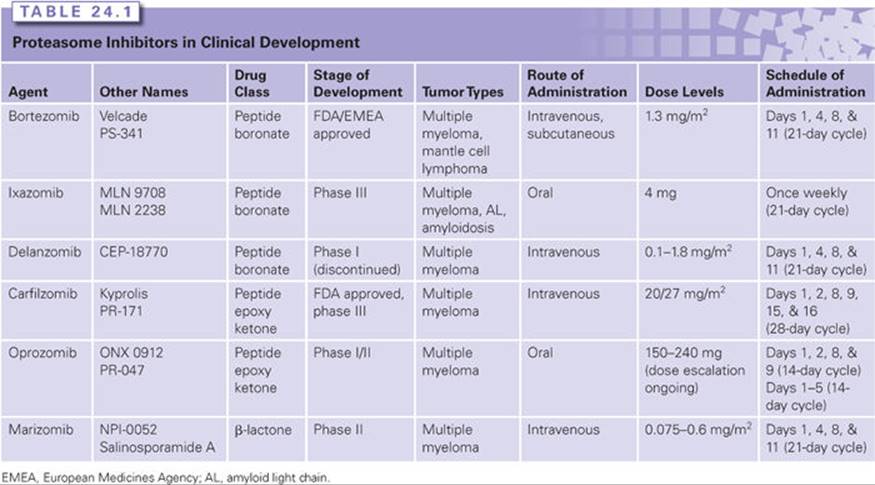
As of the writing of this overview, six different proteasome inhibitors comprising three distinct chemical classes have been tested in clinical trials (Table 24.1) and include: (1) dipeptide boronic acids, (2) peptide epoxy ketones, and (3) β-lactones.18,19 Bortezomib (PS-341, Velcade), a dipeptide boronic acid, was developed by Millennium Pharmaceuticals (Cambridge, MA) and was the first PI approved for clinical use.20 Two additional dipeptide boronic acids have entered clinical development, ixazomib/MLN 9708 (Millennium), currently in phase III studies, and delanzomib/CEP-18770 (Teva Pharmaceuticals; Frazer, PA), the clinical development of which has been halted. Carfilzomib (Onyx Pharmaceuticals; San Francisco, CA), a tetrapeptide epoxy ketone, received U.S. Food and Drug Administration (FDA) approval in 2012.21 A second peptide epoxy ketone proteasome inhibitor, oprozomib (Onyx), entered clinical study in 2010. The third class of proteasome inhibitors, β-lactones, is represented by NPI-0052 (salinosporamide A [Marizomib]) and is currently being developed by Nereus Pharmaceuticals, Inc. (San Diego, CA). The initial approvals for both bortezomib and carfilzomib were in multiple myeloma (MM), a plasma cell neoplasm and the second most common hematologic cancer. However, the activity of PIs in other B-cell neoplasms has resulted in an expansion of the clinical utilization of this drug class.
Preclinical Activity of Proteasome Inhibitors
Each of the three classes of inhibitors has a distinct chemical mechanism of proteasome inhibition.22 Peptide boronates form stable but reversible tetrahedral intermediates with the γ-hydroxyl (γ-OH) group of the catalytic N-terminal threonine of the proteasome active sites.23,24 β-lactones also interact with this γ-OH, but form a completely irreversible interaction.25 Similarly, peptide epoxy ketones form irreversible covalent adducts with the active site threonine but do so via a dual covalent adduction of γ-OH group and the free amine.26 This interaction is highly specific for N-terminal threonine-containing hydrolases and renders peptide epoxy ketones the most selective proteasome inhibitors yet described.27,28
The primary targets of these PIs within the constitutive and immunoproteasomes are the CT-L subunits, β5 and LMP7, respectively. Despite accounting for less than 50% of total protein turnover by the proteasome, these subunits are essential for cell survival.29 In MM cell lines, inhibiting both subunits (β5 and LMP7) is necessary and sufficient for tumor cell death.30 Cytotoxicity of other tumor cell types requires the inhibition of multiple active sites beyond the CT-L activity. The combination of inhibitors specific for either the T-L or C-L activities, which have no cytotoxic activity on their own, augments the cytotoxic potential of the CT-L–specific inhibitors.31,32
Given its status as the first proteasome inhibitor approved for marketed use, the antitumor potential and preclinical activity of other proteasome inhibitors have generally been compared to bortezomib.19Carfilzomib showed equivalent antitumor activity to bortezomib in vitro against a panel of tumor cell lines under standard culture conditions but was >10-fold more potent at inducing tumor cell death when cells were exposed to drug for a 1-hour pulse, which mimics the pharmacokinetics of both compounds.33 MLN2238 (the active agent of ixazomib) was active in the same mouse models of human tumors as bortezomib, but demonstrated greater levels of proteasome inhibition in the tumors.34 In biochemical assays of proteasome activity, delanzomib had an identical potency and subunit activity profile to bortezomib, but in tumor cytotoxicity assays, potency relative to bortezomib was 2- to 10-fold less.35 In addition, delanzomib appeared to be less cytotoxic than bortezomib to normal cells and had a differential effect on cytokine release in bone marrow stromal cells, suggesting a different pharmacologic activity. Oprozomib is 10-fold less potent than carfilzomib in proteasome activity assays, but showed similar antitumor activity in mouse tumor models.36,37 Marizomib displayed greater potency against the non–CT-L active sites of the proteasome than bortezomib.38 Interestingly, this agent synergized with bortezomib in killing tumor cells in vitro.39 All of the second-generation inhibitors have shown activity in tumor cells made resistant to bortezomib and/or MM cells isolated from patients relapsed from bortezomib-based therapies35,36,40–42
The inhibition of tumor cells with proteasome inhibitors induces cell death via the induction of apoptosis through death effector caspase activation.10 Although the mechanism underlying the induction of cell death remains to be fully elucidated, extensive research suggests a complex interplay of multiple pathways. PIs have been shown to affect the half-life of the BH3-only members of the Bcl-2 family, specifically BH3–interacting-domain death agonist (Bid) and Bcl-2 interacting killer (Bik).43 Moreover the BH3-only protein NOXA is upregulated at the transcription level by PIs.44–48 Proteasome inhibition also upregulates the expression of several key cell-cycle checkpoint proteins that include p53 (an inducer of G0/G1 cell-cycle arrest through accumulation of the cyclin-dependent kinase [CDK] inhibitor p27); the CDK inhibitor p21; mammalian cyclins A, B, D, and E; and transcription factors E2F and Rb.49,50The transcription factor nuclear factor kappa B (NF-κB), an important regulator of cell survival and cytokine/growth factor production,51 is also affected by proteasome inhibition in multiple ways. The net effect on NF-κB signaling is not consistent across various assays and cell lines, and its relative importance in the antitumor effects of PIs remains unclear. Although it is interesting to note that patients whose myeloma harbor NF-κB–activating mutations (~20%) respond better to bortezomib than those without NF-κB–activating mutations.52–54 In MM cell lines, there is growing evidence that the major determinant of sensitivity to proteasome inhibition is the relative load of protein flux to the proteasome.55–57These data suggest that induction of the terminal unfolded protein response may drive cell death. Whether proteotoxic stress induced cell death reflects sensitivity to proteasome inhibitors in other tumor types remains to be determined.
Pharmacokinetics and Pharmacodynamics of Proteasome Inhibitors in Animals
Following intravenous (IV) administration to animals and humans, proteasome activity is inhibited in a dose-dependent fashion within minutes; however, PIs such as bortezomib and carfilzomib are also rapidly cleared from circulation.55,56,58–61 Recovery of proteasome activity in animals occurs in tissues with a half-life of approximately 24 hours, mirroring the recovery time of cells exposed to sublethal concentrations of PIs in vitro and likely reflecting new protein synthesis.33,62
PROTEASOME INHIBITORS IN CANCER
Clinical Activity of Bortezomib
Bortezomib is typically administered on days 1, 4, 8, and 11 of a 3-week cycle either as an IV bolus or subcutaneous administration. Increasing doses of bortezomib inhibit proteasome activity in blood in a dose-dependent fashion, reaching a maximum of 74% inhibition at a dose of 1.38 mg/m2. Daily dosing schedules in animal studies have been associated with severe toxicity and have not been attempted in humans. In clinical trials, thrombocytopenia and peripheral neuropathy (PN) were common adverse events.20,63,64 Bortezomib has shown remarkable single-agent antitumor activity in a wide range of B-cell neoplasms, including MM, non Hodgkin lymphoma (NHL), and Waldenström macroglobulinemia (WM). In 2003, bortezomib was approved by the FDA for use as a single agent for the treatment of patients with MM following two prior therapies and who demonstrated disease progression with their most recent therapy. The primary efficacy data for this approval was derived from the SUMMIT trial in which 202 patients with heavily pretreated disease were treated with bortezomib at 1.3 mg/m2.65 In this trial, the overall response rate (ORR), defined as patients achieving at least a 50% reduction in serum or urine levels of the myeloma M protein, was 35%. This clinical trial was supported by the CREST trial, in which the activity of 1.3 mg/m2 dose was determined to be superior to a dose of 1.0 mg/m2.66 Bortezomib is also active as a single agent in earlier stage MM patient populations. A single-agent ORR of 38%, with a 6% complete response (CR) rate, was seen in the phase III APEX study in early relapsed MM, with a time to progression (TTP) of 6.2 months and a median duration of response of 8 months.67 In this study, the major grade 3 and 4 toxicities were PN, 12%; dysesthesia and related symptoms, 8% to 10%; anemia, 8%; diarrhea, 8%; neutropenia, 14%; and fatigue, 12%. In the frontline setting, bortezomib demonstrated a single-agent response rate of 41% (5% CR rate).68
Bortezomib is also approved for newly diagnosed MM in combination with velcade, melphalan and prednisone (VMP). The phase III VISTA trial evaluated VMP in patients with untreated MM who were ineligible for high-dose therapy.69 The addition of bortezomib to the melphalan prednisone (MP) backbone significantly improved response rates in this setting with an ORR of 71% for VMP (including 30% CR) versus 35% (with only 4% CR) for MP. 52VMP was associated with a TTP of ~24 months, compared with ~16.6 months with MP. After a 5-year follow-up, there was a 31% reduced risk of death for the VMP group versus MP-treated patients.70
Bortezomib has also shown promise when combined with other agents in relapsed and refractory MM patients. The combination of bortezomib with pegylated doxorubicin (Doxil, Centocor Ortho Biotech Products, L.P.; Horsham, PA) resulted in an ORR of 79% in relapsed patients, and toxicities were similar to those observed with each agent administered separately.71 A phase III study in 646 patients with relapsed and refractory MM compared this treatment with bortezomib alone; the combination produced a 44% ORR and extended the TTP from 6 to 9.3 months.72,73 The combination of bortezomib with revlimid, lenalidomide and dexamethasone (Rd), a standard of care in the treatment of MM, resulted in an ORR of 64% and a median duration of response of 8.7 months.74 This activity is striking given that 53% of patients had received prior bortezomib and 75% of patients had received prior thalidomide, a closely related analog of lenalidomide. Other agents tested in combination with bortezomib include vorinostat, the anti-CS1 mAb, elotuzumab, the Hsp90 inhibitor tanespimycin, and the Akt inhibitor perifosine.75
Frontline combinations with bortezomib in MM patients have shown high ORRs with a notable improvement in CR rates. In longer term studies, CR rates with bortezomib-based combinations have been shown to be associated with improved clinical outcomes.63,64 A community-based phase IIIb study evaluating bortezomib + dexamethasone (VD) versus bortezomib + thalidomide + dexamethasone (VTD) versus VMP found similar ORR (60%, 70%, and 52%, respectively) and CR rates (13%, 18%, and 15%, respectively).63 Bortezomib + melphalan + prednisone + thalidomide (VMPT) followed by bortezomib + thalidomide (VT) maintenance resulted in a superior CR rate compared with VMP with no maintenance (34% versus 21%) and improved 2-year progression-free survival (70% versus 58.2%).64 A protocol modification in this trial involved changing from twice weekly to weekly bortezomib administration, which yielded similar TTP but reduced the incidence (21% versus 43%) and severity of PN (2% grade 3/4 versus 14%).64 The bortezomib, lenalidomide, and dexamethasone combination in newly diagnosed MM resulted in a ORR of 100% in 66 patients, 29% of whom achieved a CR.76
Bortezomib has also shown activity in other hematologic cancers, most notably mantle cell lymphoma (MCL).77,78 As a single agent in 155 relapsed and refractory MCL patients, bortezomib yielded an ORR of 33% (8% CR), a median duration of response of 9.2 months, and a TTP of 6.2 months.78 Toxicities observed were similar to those seen in patients with MM and included thrombocytopenia, PN, and fatigue. When bortezomib was used to treat both newly diagnosed and refractory MCL, a response rate of 46% was observed in both populations,77 leading to FDA approval late in 2006.
Bortezomib has been tested in a variety of solid tumors in phase I and II studies.79 Partial responses (PR) were reported in 8% of patients with refractory non–small-cell lung cancer (NSCLC), although the TTP was 1.5 months.80Exacerbation of PN was common. Bortezomib was subsequently tested in combination with paclitaxel, irinotecan, and gemcitabine/carboplatin; however, results have not been encouraging. Bortezomib continues to be tested in combination with other agents in a variety of tumor types.81,82
Recent clinical activity and preclinical data suggest that proteasome inhibition may extend to nononcology applications. Single-agent bortezomib therapy in kidney transplant patients undergoing antibody-mediated rejection resulted in a reduction of donor-specific antibodies and improved renal function.83 In mouse models of lupus nephritis, bortezomib resulted in a reduction of pathogenic plasma cells and the prevention of disease progression.84 These data suggest that PIs may be useful in a wide range of B-cell–mediated diseases. However, toxicities with bortezomib, particularly PN, may prevent wider application of this particular agent.
Carfilzomib
Parallel phase I studies of carfilzomib have been conducted in patients with multiple tumor types, and two phase I dose-finding studies targeting B-cell malignancies have been completed. The first study used daily IV bolus dosing with doses up to 20 mg/m2 for 5 consecutive days followed by 9 days of rest and resulted in substantial inhibition of proteasome activity.85 In the second study, carfilzomib was administered daily for 2 days for 3 consecutive weeks (days 1, 2, 8, 9, 15, and 16), followed by 12 days of recovery.86 Hematologic toxicities were the most frequent adverse events, observed along with transient, noncumulative elevations in serum creatinine, usually with increases in serum urea nitrogen and consistent with a prerenal etiology. New onset PN was infrequent. Among 20 evaluable patients (including bortezomib-refractory patients), 4 PRs and 1 minor response were seen. Responses were also durable, lasting more than 1 year in some cases. Although the maximum tolerated dose of carfilzomib was not established in this study, a dose of 20 mg/m2 was initially selected for the phase II studies.
Based on the phase I studies, an open-label, single-arm, phase II study of single-agent carfilzomib in relapsed and refractory MM was initiated in 2007.87,88 Carfilzomib was administered as an IV bolus on the twice-weekly dose schedule. Patients enrolled in the initial phase of the study (003-A0) had received a median of five prior therapies, and 78% of patients had grade 1/2 PN at entry.87 Among 39 evaluable patients in 003-A0, 10 (26%) achieved a minor response or better, including 5 PRs, and 16 additional patients with stable disease. Based on new safety information from phase I studies, the protocol was amended and the carfilzomib dose was escalated to 27 mg/m2 after the first cycle (003-A1).89 In this trial, 266 patients were enrolled and all patients had previously been treated with an immunomodulatory agent (IMiD) and bortezomib and were refractory to their last therapy. An ORR of 24% with a median duration of response of 8 months was reported. Adverse events were predominantly hematopoietic (thrombocytopenia, lymphopenia, and anemia) and there was a <1% rate of grade 3 PN, despite 77% having a history of PN. Based on these findings, carfilzomib was granted conditional approval by the FDA in 2012 for the treatment of patients with relapsed and refractory myeloma who had received prior bortezomib and IMiD therapy.
The parallel PX-171-004 trial enrolled patients with relapsed MM following one to three prior treatments and who may have been refractory to one or more of these therapies.90,91 Of the 155 patients enrolled in this trial, 120 had not received prior bortezomib-based therapy. In patients with relapsed disease, nonhematologic and hematologic toxicity profiles were similar. Despite high rates of baseline PN, reports of worsening neuropathic symptoms were infrequent (2% incidence of grade 3 and no grade 4 events). Carfilzomib demonstrated considerable activity in bortezomib-naïve patients, inducing PR or better in 46% of 54 evaluable patients at 20 mg/m2 and 53% of patients at 27 mg/m2.91 The response rate in patients previously exposed to bortezomib was lower (18%).90 Responses across groups are durable, typically 8 to 9 months.90,91
Based on findings in animal studies in which a 30-minute infusion of carfilzomib resulted in reduced toxicities,61 the effect of infusional administration was tested in patients with relapsed and refractory myeloma. In a dose escalation study, PX-171-007, the MTD dose of carfilzomib was determined to be 56 mg/m2, more than twice the dose used in the studies described previously. In a cohort of 24 patients receiving this dose and who had received a median of five prior lines of therapy (including two prior bortezomib-containing regimens), the ORR was 60%.92 This enhanced efficacy also correlated with a greater level of inhibition of all three subunits of the immunoproteasome measured in isolated peripheral blood mononuclear cells (Lee S, et al., unpublished).93 This same dose and infusion time is currently being explored in a phase III trial of nearly 900 patients comparing carfilzomib plus low-dose dexamethasone (Cd) to bortezomib plus low-dose dexamethasone (Vd) in MM patients with relapsed disease.
Trials of carfilzomib in combination with other agents in MM have been initiated, including a phase Ib/II safety and efficacy study of carfilzomib in combination with lenalidomide and low-dose dexamethasone (CRd) in relapsed and/or refractory MM. At the maximum planned dose, the ORR was 77% with a median duration of response of 22 months.94 The CRd combination is now being tested in an international, multicenter, randomized, open-label phase III study in comparison with lenalidomide and low-dose dexamethasone (Rd) in approximately 780 patients with relapsed MM following one to three prior therapies. The CRd regimen has also been explored in newly diagnosed MM patients.95 When carfilzomib is combined with Rd at a dose of 36 mg/m2, 62% of the 53 patients treated achieved a CR. In addition, 20 of 21 patients analyzed for signs of minimal residual disease (MRD), utilizing multiparameter flow cytometry were determined to be free of MRD.
Ixazomib
Initial clinical studies of ixazomib involved dose escalation studies in patients with hematologic malignancies and explored both weekly and twice weekly dosing schedules.96,97 Oral administration resulted in potent proteasome inhibition of ~65%. Clinical activity in patients with relapsed MM was 16%.98 In patients with newly diagnosed MM, ixazomib plus lenalidomide and low-dose dexamethasone resulted in an ORR of 93% with 24% achieving a CR.99This combination is also being investigated in a phase III trial comparing this to Rd in patients with relapsed MM.
Oprozomib
Initial clinical testing of oprozomib in patients with solid tumors investigated a dosing schedule consisting of a 14-day cycle with once daily administration for 5 consecutive days.100 In patients with relapsed and/or refractory B-cell neoplasms, two dosing schedules are being utilized: the schedule described previously and one involving 2 consecutive days of dosing repeated weekly.101 Proteasome inhibition following the administration of oprozomib reached >80% and clinical activity was noted in patients with MM and WM. In patients receiving the 5 consecutive day schedule, 5 of 19 MM patients (26%) and 8 of 10 WM patients (80%) achieved a partial response or better. Exploration of the dose and schedule continues as a single agent and in combination with other anti-MM therapies.
Biomarkers for Proteasome Inhibitors
As described previously, PI-based therapies have proven highly effective in the treatment of MM and other B-cell neoplasms. Given that response rates in single-agent trials are generally <50%, there would be a distinct clinical benefit to identify those patients most likely to respond to proteasome inhibition prior to treatment initiation. Gene expression analysis from bone marrow–derived MM tumor cells from 169 bortezomib-treated patients and 70 dexamethasone-treated patients revealed a 100-gene signature that provided a stratification for patients likely to respond that performed better than standard staging systems.102 However, this signature provided only a modest increase in predictive power for treatment with bortezomib versus dexamethasone. More recently, Keats et al.54 reanalyzed this dataset based on a pathway analysis of NF-κB and the realization that TRAF3, a key regulatory of the noncanonical NF-κB pathway, is a tumor suppressor in MM cell lines. They found a dramatic enrichment for response to bortezomib in patients with low levels of TRAF3 expression. However, these data remain to be validated in a separate sample set. A transcriptomic analysis of samples derived from single-agent carfilzomib trials suggest that patients with the highest level of immunoglobulin heavy chain expression were the most sensitive to carfilzomib therapy.103 Similar findings were noted in the expression data from bortezomib-treated patients described previously.103 These data are supported by phenotypic data from patients progressing on bortezomib-based therapy, in which resistance to bortezomib was associated with a dedifferentiated (and lower immunoglobulin expressing) B-cell phenotype.104 Taken together, these findings suggest that biomarkers, potentially those involving an analysis of protein load of immunoglobulin expression, may be developed to predict those patients most likely to respond to PIs.
REFERENCES
1. Ciechanover A. Intracellular protein degradation: from a vague idea thru the lysosome and the ubiquitin-proteasome system and onto human diseases and drug targeting. Biochim Biophys Acta 2012;1824:3–13.
2. Kopp F, Hendil KB, Dahlmann B, et al. Subunit arrangement in the human 20S proteasome. Proc Natl Acad Sci U S A 1997;94:2939–2944.
3. Wilkinson KD. Ubiquitination and deubiquitination: targeting of proteins for degradation by the proteasome. Semin Cell Dev Biol 2000;11:141–148.
4. Braun BC, Glickman M, Kraft R, et al. The base of the proteasome regulatory particle exhibits chaperone-like activity. Nat Cell Biol 1999;1:221–226.
5. Groll M, Ditzel L, Lowe J, et al. Structure of 20S proteasome from yeast at 2.4 A resolution. Nature 1997;386:463–471.
6. Borissenko L, Groll M. 20S proteasome and its inhibitors: crystallographic knowledge for drug development. Chem Rev 2007;107:687–717.
7. Kloetzel PM, Ossendorp F. Proteasome and peptidase function in MHC-class-I-mediated antigen presentation. Curr Opin Immunol 2004;16:76–81.
8. Griffin TA, Nandi D, Cruz M, et al. Immunoproteasome assembly: cooperative incorporation of interferon gamma (IFN-gamma)-inducible subunits. J Exp Med 1998;187:97–104.
9. Tanahashi N, Murakami Y, Minami Y, et al. Hybrid proteasomes. Induction by interferon-gamma and contribution to ATP-dependent proteolysis. J Biol Chem 2000;275:14336–14345.
10. Adams J. The proteasome: a suitable antineoplastic target. Nat Rev Cancer 2004;4:349–360.
11. Vinitsky A, Michaud C, Powers JC, et al. Inhibition of the chymotrypsin-like activity of the pituitary multicatalytic proteinase complex. Biochemistry 1992;31:9421–9428.
12. Orlowski RZ, Eswara JR, Lafond-Walker A, et al. Tumor growth inhibition induced in a murine model of human Burkitt’s lymphoma by a proteasome inhibitor. Cancer Res 1998;58:4342–4348.
13. Imajoh-Ohmi S, Kawaguchi T, Sugiyama S, et al. Lactacystin, a specific inhibitor of the proteasome, induces apoptosis in human monoblast U937 cells. Biochem Biophys Res Commun 1995;217:1070–1077.
14. Shinohara K, Tomioka M, Nakano H, et al. Apoptosis induction resulting from proteasome inhibition. Biochem J 1996;317:385–388.
15. Delic J, Masdehors P, Omura S, et al. The proteasome inhibitor lactacystin induces apoptosis and sensitizes chemo- and radioresistant human chronic lymphocytic leukaemia lymphocytes to TNF-alpha-initiated apoptosis. Br J Cancer 1998;77:1103–1107.
16. Meng L, Mohan R, Kwok BH, et al. Epoxomicin, a potent and selective proteasome inhibitor, exhibits in vivo antiinflammatory activity. Proc Natl Acad Sci U S A 1999;96:10403–10408.
17. Meng L, Kwok BH, Sin N, et al. Eponemycin exerts its antitumor effect through the inhibition of proteasome function. Cancer Res 1999;59:2798–2801.
18. Dick LR, Fleming PE. Building on bortezomib: second-generation proteasome inhibitors as anti-cancer therapy. Drug Discov Today 2010;15:243–249.
19. Kirk CJ. Discovery and development of second-generation proteasome inhibitors. Semin Hematol 2012;49:207–214.
20. Bross PF, Kane R, Farrell AT, et al. Approval summary for bortezomib for injection in the treatment of multiple myeloma. Clin Cancer Res 2004;10:3954–3964.
21. Herndon TM, Deisseroth A, Kaminskas E, et al. U.S. Food and Drug Administration approval: carfilzomib for the treatment of multiple myeloma. Clin Cancer Res 2013;19:4559–4563.
22. Bennett MK, Kirk CJ. Development of proteasome inhibitors in oncology and autoimmune diseases. Curr Opin Drug Discov Devel 2008;11:616–625.
23. Adams J, Behnke M, Chen S, et al. Potent and selective inhibitors of the proteasome: dipeptidyl boronic acids. Bioorg Med Chem Lett 1998;8:333–338.
24. Groll M, Berkers CR, Ploegh HL, et al. Crystal structure of the boronic acid-based proteasome inhibitor bortezomib in complex with the yeast 20S proteasome. Structure 2006;14:451–456.
25. Groll M, Huber R, Potts BC. Crystal structures of Salinosporamide A (NPI-0052) and B (NPI-0047) in complex with the 20S proteasome reveal important consequences of beta-lactone ring opening and a mechanism for irreversible binding. J Am Chem Soc 2006;19:5136–5141.
26. Groll M, Kim KB, Kairies N, et al. Crystal structure of epoxomicin: 20S proteasome reveals a molecular basis for selectivity of a’ b’-epoxyketone proteasome inhibitors. J Am Chem Soc 2000;122:1237–1238.
27. Kisselev AF, van der Linden WA, Overkleeft HS. Proteasome inhibitors: an expanding army attacking a unique target. Chem Biol 2012;19:99–115.
28. Arastu-Kapur S, Anderl JL, Kraus M, et al. Nonproteasomal targets of the proteasome inhibitors bortezomib and carfilzomib: a link to clinical adverse events. Clin Cancer Res 2011;17:2734–2743.
29. Kisselev AF, Callard A, Goldberg AL. Importance of the different proteolytic sites of the proteasome and the efficacy of inhibitors varies with the protein substrate. J Biol Chem 2006;281:8582–8590.
30. Parlati F, Lee SJ, Aujay M, et al. Carfilzomib can induce tumor cell death through selective inhibition of the chymotrypsin-like activity of the proteasome. Blood 2009;114:3439–3447.
31. Britton M, Lucas MM, Downey SL, et al. Selective inhibitor of proteasome’s caspase-like sites sensitizes cells to specific inhibition of chymotrypsin-like sites. Chem Biol 2009;16:1278–1289.
32. Mirabella AC, Pletnev AA, Downey SL, et al. Specific cell-permeable inhibitor of proteasome trypsin-like sites selectively sensitizes myeloma cells to bortezomib and carfilzomib. Chem Biol 2011;18:608–618.
33. Demo SD, Kirk CJ, Aujay MA, et al. Antitumor activity of PR-171, a novel irreversible inhibitor of the proteasome. Cancer Res 2007;67:6383–6391.
34. Kupperman E, Lee EC, Cao Y, et al. Evaluation of the proteasome inhibitor MLN9708 in preclinical models of human cancer. Cancer Res 2010;70:1970–1980.
35. Piva R, Ruggeri B, Williams M, et al. CEP-18770: A novel, orally active proteasome inhibitor with a tumor-selective pharmacologic profile competitive with bortezomib. Blood 2008;111:2765–2775.
36. Chauhan D, Singh AV, Aujay M, et al. A novel orally active proteasome inhibitor ONX 0912 triggers in vitro and in vivo cytotoxicity in multiple myeloma. Blood 2010;116:4906–4915.
37. Zhou HJ, Aujay MA, Bennett MK, et al. Design and synthesis of an orally bioavailable and selective peptide epoxyketone proteasome inhibitor (PR-047). J Med Chem 2009;52:3028–3038.
38. Chauhan D, Catley L, Li G, et al. A novel orally active proteasome inhibitor induces apoptosis in multiple myeloma cells with mechanisms distinct from Bortezomib. Cancer Cell 2005;8:407–419.
39. Chauhan D, Singh A, Brahmandam M, et al. Combination of proteasome inhibitors bortezomib and NPI-0052 trigger in vivo synergistic cytotoxicity in multiple myeloma. Blood 2008;111:1654–1664.
40. Chauhan D, Tian Z, Zhou B, et al. In vitro and in vivo selective antitumor activity of a novel orally bioavailable proteasome inhibitor MLN9708 against multiple myeloma cells. Clin Cancer Res 2011;17:5311–5321.
41. Kuhn DJ, Chen Q, Voorhees PM, et al. Potent activity of carfilzomib, a novel, irreversible inhibitor of the ubiquitin-proteasome pathway, against preclinical models of multiple myeloma. Blood 2007;110:3281–3290.
42. Suzuki E, Demo S, Deu E, et al. Molecular mechanisms of bortezomib resistant adenocarcinoma cells. PLoS One 2011;6:e27996.
43. Zhang HG, Wang J, Yang X, et al. Regulation of apoptosis proteins in cancer cells by ubiquitin. Oncogene 2004;23:2009–2015.
44. Fernandez Y, Verhaegen M, Miller TP, et al. Differential regulation of noxa in normal melanocytes and melanoma cells by proteasome inhibition: therapeutic implications. Cancer Res 2005;65:6294–6304.
45. Nikiforov MA, Riblett M, Tang WH, et al. Tumor cell-selective regulation of NOXA by c-MYC in response to proteasome inhibition. Proc Natl Acad Sci U S A 2007;104:19488–19493.
46. Qin JZ, Ziffra J, Stennett L, et al. Proteasome inhibitors trigger NOXA-mediated apoptosis in melanoma and myeloma cells. Cancer Res 2005;65:6282–6293.
47. Wang Q, Mora-Jensen H, Weniger MA, et al. ERAD inhibitors integrate ER stress with an epigenetic mechanism to activate BH3-only protein NOXA in cancer cells. Proc Natl Acad Sci U S A 2009;106:2200–2205.
48. Mannava S, Zhuang D, Nair JR, et al. KLF9 is a novel transcriptional regulator of bortezomib- and LBH589-induced apoptosis in multiple myeloma cells. Blood 2012;119:1450–1458.
49. Koepp DM, Harper JW, Elledge SJ. How the cyclin became a cyclin: regulated proteolysis in the cell cycle. Cell 1999;97:431–434.
50. Pagano M, Tam SW, Theodoras AM, et al. Role of the ubiquitin-proteasome pathway in regulating abundance of the cyclin-dependent kinase inhibitor p27. Science 1995;269:682–685.
51. Wan F, Lenardo MJ. The nuclear signaling of NF-kappaB: current knowledge, new insights, and future perspectives. Cell Res 2010;20:24–33.
52. Annunziata CM, Davis RE, Demchenko Y, et al. Frequent engagement of the classical and alternative NF-kappaB pathways by diverse genetic abnormalities in multiple myeloma. Cancer Cell 2007;12:115–130.
53. Chapman MA, Lawrence MS, Keats JJ, et al. Initial genome sequencing and analysis of multiple myeloma. Nature 2011;471:467–472.
54. Keats JJ, Fonseca R, Chesi M, et al. Promiscuous mutations activate the noncanonical NF-kappaB pathway in multiple myeloma. Cancer Cell 2007;12:131–144.
55. Meister S, Schubert U, Neubert K, et al. Extensive immunoglobulin production sensitizes myeloma cells for proteasome inhibition. Cancer Res 2007;67:1783–1792.
56. Obeng EA, Carlson LM, Gutman DM, et al. Proteasome inhibitors induce a terminal unfolded protein response in multiple myeloma cells. Blood 2006;107:4907–4916.
57. Shabaneh TB, Downey SL, Goddard AL, et al. Molecular basis of differential sensitivity of myeloma cells to clinically relevant bolus treatment with bortezomib. PLoS One 2013;8:e56132.
58. Papadopoulos KP, Burris HA III, Gordon M, et al. A phase I/II study of carfilzomib 2-10-min infusion in patients with advanced solid tumors. Cancer Chemother Pharmacol 2013;72:861–868.
59. Papandreou CN, Daliani DD, Nix D, et al. Phase I trial of the proteasome inhibitor bortezomib in patients with advanced solid tumors with observations in androgen-independent prostate cancer. J Clin Oncol 2004;22:2108–2121.
60. Wang Z, Yang J, Kirk C, et al. Clinical pharmacokinetics, metabolism, and drug-drug interaction of carfilzomib. Drug Metab Dispos 2013;41:230–237.
61. Yang J, Wang Z, Fang Y, et al. Pharmacokinetics, pharmacodynamics, metabolism, distribution, and excretion of carfilzomib in rats. Drug Metab Dispos 2011;39:1873–1882.
62. Meiners S, Heyken D, Weller A, et al. Inhibition of proteasome activity induces concerted expression of proteasome genes and de novo formation of mammalian proteasomes. J Biol Chem 2003;278:21517–21525.
63. Lonial S, Waller EK, Richardson PG, et al. Risk factors and kinetics of thrombocytopenia associated with bortezomib for relapsed, refractory multiple myeloma. Blood 2005;106:3777–3784.
64. Richardson PG, Briemberg H, Jagannath S, et al. Frequency, characteristics, and reversibility of peripheral neuropathy during treatment of advanced multiple myeloma with bortezomib. J Clin Oncol 2006;24:3113–3120.
65. Richardson PG, Barlogie B, Berenson J, et al. A phase 2 study of bortezomib in relapsed, refractory myeloma. N Engl J Med 2003;348:2609–2617.
66. Jagannath S, Barlogie B, Berenson J, et al. A phase 2 study of two doses of bortezomib in relapsed or refractory myeloma. Br J Haematol 2004;127:165–172.
67. Richardson PG, Sonneveld P, Schuster MW, et al. Bortezomib or high-dose dexamethasone for relapsed multiple myeloma. N Engl J Med 2005;352:2487–2498.
68. Jagannath S, Brian D, Wolf JL, et al. A phase 2 study of bortezomib as first-line therapy in patients with multiple myeloma. Blood 2004;104:333.
69. San Miguel JF, Schlag R, Khuageva NK, et al. Bortezomib plus melphalan and prednisone for initial treatment of multiple myeloma. N Engl J Med 2008;359:906–917.
70. San Miguel JF, Schlag R, Khuageva NK, et al. Persistent overall survival benefit and no increased risk of second malignancies with bortezomib-melphalan-prednisone versus melphalan-prednisone in patients with previously untreated multiple myeloma. J Clin Oncol2013;31:448–455.
71. Orlowski RZ, Voorhees PM, Garcia RA, et al. Phase 1 trial of the proteasome inhibitor bortezomib and pegylated liposomal doxorubicin in patients with advanced hematologic malignancies. Blood 2005;105:3058–3065.
72. Orlowski RZ, Nagler A, Sonneveld P, et al. Randomized phase III study of pegylated liposomal doxorubicin plus bortezomib compared with bortezomib alone in relapsed or refractory multiple myeloma: combination therapy improves time to progression. J Clin Oncol2007;25:3892–3901.
73. Sonneveld P, Hajek R, Nagler A, et al. Combined pegylated liposomal doxorubicin and bortezomib is highly effective in patients with recurrent or refractory multiple myeloma who received prior thalidomide/lenalidomide therapy. Cancer 2008;112:1529–1537.
74. Richardson PG, Xie W, Jagannath S, et al. A phase II trial of lenalidomide, bortezomib and dexamethasone in patients with relapsed and relapsed/refractory myeloma. Blood 2014;123:1461–1469.
75. Kapoor P, Ramakrishnan V, Rajkumar SV. Bortezomib combination therapy in multiple myeloma. Semin Hematol 2012;49:228–242.
76. Richardson PG, Weller E, Lonial S, et al. Lenalidomide, bortezomib, and dexamethasone combination therapy in patients with newly diagnosed multiple myeloma. Blood 2010;116:679–686.
77. Belch A, Kouroukis CT, Crump M, et al. A phase II study of bortezomib in mantle cell lymphoma: the National Cancer Institute of Canada Clinical Trials Group trial IND.150. Ann Oncol 2007;18:116–121.
78. Fisher RI, Bernstein SH, Kahl BS, et al. Multicenter phase II study of bortezomib in patients with relapsed or refractory mantle cell lymphoma. J Clin Oncol 2006;24:4867–4874.
79. Milano A, Iaffaioli RV, Caponigro F. The proteasome: a worthwhile target for the treatment of solid tumours? Eur J Cancer 2007;43:1125–1133.
80. Fanucchi MP, Fossella FV, Belt R, et al. Randomized phase II study of bortezomib alone and bortezomib in combination with docetaxel in previously treated advanced non-small-cell lung cancer. J Clin Oncol 2006;24:5025–5033.
81. Ramaswamy B, Phelps MA, Baiocchi R, et al. A dose-finding, pharmacokinetic and pharmacodynamic study of a novel schedule of flavopiridol in patients with advanced solid tumors. Invest New Drugs 2012;30:629–638.
82. Luu T, Chow W, Lim D, et al. Phase I trial of fixed-dose rate gemcitabine in combination with bortezomib in advanced solid tumors. Anticancer Res 2010;30:167–174.
83. Everly MJ, Everly JJ, Susskind B, et al. Bortezomib provides effective therapy for antibody- and cell-mediated acute rejection. Transplantation 2008;86:1754–1761.
84. Neubert K, Meister S, Moser K, et al. The proteasome inhibitor bortezomib depletes plasma cells and protects mice with lupus-like disease from nephritis. Nat Med 2008;14:748–755.
85. O’Connor OA, Stewart AK, Vallone M, et al. A phase 1 dose escalation study of the safety and pharmacokinetics of the novel proteasome inhibitor carfilzomib (PR-171) in patients with hematologic malignancies. Clin Cancer Res 2009;15:7085–7091.
86. Alsina M, Trudel S, Furman RR, et al. A phase I single-agent study of twice-weekly consecutive-day dosing of the proteasome inhibitor carfilzomib in patients with relapsed or refractory multiple myeloma or lymphoma. Clin Cancer Res 2012;18:4830–4840.
87. Jagannath S, Vij R, Stewart AK, et al. An open-label single-arm pilot phase II study (PX-171-003-A0) of low-dose, single-agent carfilzomib in patients with relapsed and refractory multiple myeloma. Clin Lymphoma Myeloma Leuk 2012;12:310–318.
88. Siegel DS, Martin T, Wang M, et al. A phase 2 study of single-agent carfilzomib (PX-171-003-A1) in patients with relapsed and refractory multiple myeloma. Blood 2012;120:2817–2825.
89. Siegel DS, Martin T, Wang M, et al. Results of PX-171-003-A1, an open-label, single-arm, phase 2 (Ph 2) study of carfilzomib (CFZ) in patients (pts) with relapsed and refractory multiple myeloma (MM). Blood 2012;120:2817–2825.
90. Vij R, Siegel DS, Jagannath S, et al. An open-label, single-arm, phase 2 study of single-agent carfilzomib in patients with relapsed and/or refractory multiple myeloma who have been previously treated with bortezomib. Br J Haematol 2012;158:739–748.
91. Vij R, Wang M, Kaufman JL, et al. An open-label, single-arm, phase 2 (PX-171-004) study of single-agent carfilzomib in bortezomib-naive patients with relapsed and/or refractory multiple myeloma. Blood 2012;119:5661–5670.
92. Papadopoulos K, Capua Siegel DS, Singhal SB, et al. Phase 1b evaluation of the safety and efficacy of a 30-minute IV infusion of carfilzomib in patients with relapsed and/or refractory multiple myeloma. Blood 2010;116:3024.
93. Lee SJ, Levitsky K, Parlati F, et al. Clinical activity of carfilzomib correlates with inhibition of multiple proteasome subunits: application of a novel pharmacodynamics assay. (In press).
94. Wang M, Martin T, Bensinger W, et al. Phase 2 dose-expansion study (PX-171-006) of carfilzomib, lenalidomide, and low-dose dexamethasone in relapsed or progressive multiple myeloma. Blood 2013;122:3122–3128.
95. Jakubowiak AJ, Dytfeld D, Griffith KA, et al. A phase 1/2 study of carfilzomib in combination with lenalidomide and low-dose dexamethasone as a frontline treatment for multiple myeloma. Blood 2012;120:1801–1809.
96. Richardson PG, Baz R, Wang L, et al. Investigational agent MLN9708, an oral proteasome inhibitor, in patients (Pts) with relapsed and/or refractory multiple myeloma (MM): results from the expansion cohorts of a phase 1 dose-escalation study. Blood 2011;118:301.
97. Richardson PG, Spencer A, Cannell P, et al. Phase 1 clinical evaluation of twice-weekly marizomib (NPI-0052), a novel proteasome inhibitor, in patients with relapsed/refractory multiple myeloma (MM). Blood 2011;118:302.
98. Roy V, Reeder C, LaPlant BR, et al. Phase 2 trial Of single agent MLN9708 in patients with relapsed multiple myeloma not refractory to bortezomib. Blood 2013;122:1944.
99. Hofmeister CC, Rosenbaum CA, Htut M, et al. Twice-weekly oral MLN9708 (ixazomib citrate), an investigational proteasome inhibitor, in combination with lenalidomide (len) and dexamethasone (dex) in patients (pts) with newly diagnosed multiple myeloma (MM): final phase 1 results and phase 2 data. Blood 2013;122:535.
100. Papadopoulos KP, Mendelson DS, Tolcher AW, et al. A phase I, open-label, dose-escalation study of the novel oral proteasome inhibitor (PI) ONX 0912 in patients with advanced refractory or recurrent solid tumors. Blood 2011;29:3075.
101. Kaufman JL, Siegel DS, Vij R, et al. Clinical profile of single-agent modified-release oprozomib tablets in patients (pts) with hematologic malignancies: updated results from a multicenter, open-label, dose escalation phase 1b/2 study. Blood 2013;122:3184.
102. Mulligan G, Mitsiades C, Bryant B, et al. Gene expression profiling and correlation with outcome in clinical trials of the proteasome inhibitor bortezomib. Blood 2007;109:3177–3188.
103. Loehr A, Degenhardt JD, Kwei KA, et al. Immunoglobulin expression is a major determinant of patient sensitivity to proteasome inhibitors. Blood 2013;122:1903.
104. Leung-Hagesteijn C, Erdmann N, Cheung G, et al. Xbp1s-negative tumor B cells and pre-plasmablasts mediate therapeutic proteasome inhibitor resistance in multiple myeloma. Cancer Cell 2013;24:289–304.