
Jean K. Lee and Ghassan Abou-Alfa
Epidemiology
5th most common CA worldwide (626000/y) & 3rd leading cause of worldwide CA mortality (598000/y)
>80% cases of HCC occur in sub-Saharan Africa, eastern & southeastern Asia, & Melanesia 9th leading cause of CA mortality in US Recent ↑ in the incidence of HCC (7/100000) & HCC-related mortality in US
Risk Factors
Viral hepatitis: Caused by HBV & HCV are leading RFs for HCC & accounts for 75% cases worldwide; HCV infxn predominant in Europe, North America, & Japan; HBV in Asia & Africa
Acquired RFs: Excessive EtOH → alcoholic cirrhosis (1/3 of cases of HCC in US), environmental exposure to aflatoxin from Aspergillus fungus, tobacco, autoimmune hepatitis
Metabolic disorders: Metabolic syn, DM, NASH, hereditary hemochromatosis (Mts in HFE gene) & other rare metabolic disorders
Screening and Prevention
Screening w/ultrasonography & AFP testing every 6–12 mos recommended for pts w/hepatitis B and/or C who are at risk for HCC: Additional imaging (at least 3-phase contrast-enhanced CT or MRI in setting of rising serum AFP or identification of liver mass on US
Pathophysiology
Hepatocarcinogenesis begins w/an acute or chronic insult to hepatocytes → induces liver remodeling that results in liver cirrhosis or fibrosis → stepwise accumulation of genetic & molecular aberrations
Up to 20% of HCC cases develop in pts w/o cirrhosis
HBV-induced hepatocarcinogenesis may occur through direct viral DNA insertion
Histopathologic markers of HCC: Granular HepPar-1 staining, positive AFP
Dysplastic nodules evolve into HCC w/loss of IGF-2 receptor oncogene & tumor suppressors p53, PTEN, & p16
Clinical Manifestations
S/s: No pathognomonic s/s for HCC
Exam: Usu. unremarkable, hepatomegaly, & ascites, jaundice & encephalopathy in the setting of adv cirrhosis
Labs: Usu. nonspecific & reflects level of liver dysfunction. ↑ Total bili., low albumin (<30 g/dL), & elevated INR in the setting of adv cirrhosis
Paraneoplastic syn are rare
Diagnostic Workup
Includes imaging, pathologic confirmation of HCC, tumor markers, & LFTs
Imaging: At least 3-phase contrast-enhanced CT scan (arterial, portal venous, & parenchymal phase) or gadolinium-enhanced or contrast-enhanced MRI. U/S primarily used as screening modality. PET/CT not considered adequate
Bx: Core needle bx preferred, or FNA recommended for adv stages. However, bx confirmation may not be required for early stages, as per noninvasive diagnostic guidelines by AASLD
Lab: Hepatitis B & C serologies; tumor markers: Serum AFP; however, not sensitive nor specific
Classification systems for assessment of hepatic dysfunction: Child–Pugh classification
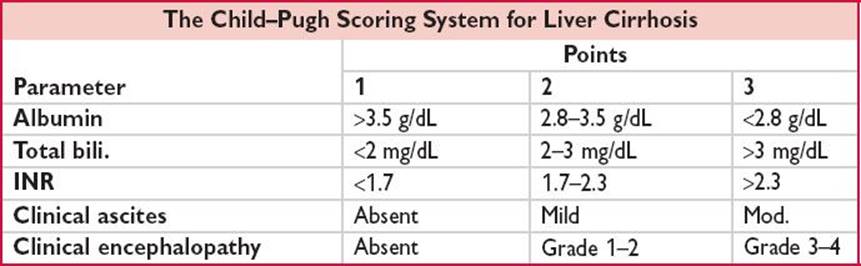
Staging and Prognosis
No unified international classification system. The BCLC system serves as a road map to guide Rx; however, it has its limitations & not been validated in the setting of adv disease
Curative Management
Surgical Resection
<25% of tumors are resectable b/c of underlying liver disease, multifocal nature of disease in the liver, & late detection of disease
Generally for pts w/preserved liver function & low-volume disease, w/o major vessel involvement: AJCC stage I–III A, Child–Pugh class A & no evidence of portal HTN. Highly selected cases of pts w/Child–Pugh class B
5-y OS resected pts range 40–50%, but rates >80% reported. However, tumor recurrence rates high, at 5 y >70%
Ablation: Most common methods are RFA by direct exposure of tumor to alteration in temperature
Liver Transplantation
Potentially curative Rx for pts w/early HCC, w/multinodular disease and/or adv cirrhosis
The Milan Criteria established guidelines for eligibility of liver transplantation: Solitary lesion ≤5 cm or up to 3 lesions each ≤3 cm, no gross vascular invasion, no LN or distant mets
4-y overall & RFS rates at 85% & 92%
MELD score used as measure of liver function & pretransplant mortality to prioritize pts for liver transplantation (MELD = 3.8 [Ln serum bili. (mg/dL)] + 11.2 [Ln INR] + 9.6 [Ln serum Cr (mg/dL)] + 6.4)
Bridging therapies used including RFA, TACE, radioembolization used to control or downstage tumor prior to transplantation
Palliative Management
Locoregional Therapies
Embolization: Bland TAE or TACE used to reduce blood flow to tumor resulting in tumor ischemia & necrosis
Radioembolization, a newer method delivers high-dose radiation to tumor-associated vessels, using yttrium-90 to induce tumor necrosis, indicated in the setting of vascular involvement
Systemic Therapies
Sorafenib, an oral multikinase inhibitor has shown to improve OS (median OS 10.7 mos sorafenib arm vs. 7.9 mos in placebo in 2 phase III trials (SHARP trial, NEJM 2008;359:378; Lancet Oncol 2009;10:25)
Multiple clinical trials are underway in 1st & beyond 1st-line setting. MSKCC carries an extensive portfolio of HCC clinical trials
Best Supportive Care
Best supportive care measures for pts w/unresectable disease who are not candidates for other therapies