
Approach to the Problem
Misalignment of the eyes is one of the most common eye problems encountered in childhood, affecting approximately 4% of children younger than 6 years of age. This condition is usually referred to by the terms, strabismus or abnormal ocular alignment. Misalignment of the eyes may cause vision loss (amblyopia) and result in important and lifelong psychological effects. Misalignment of the eyes involves a number of clinical entities. Orthophoria is the condition of exact ocular balance. A convergent deviation, crossing, or turning in of the eyes is referred to as esotropia. Divergent deviation or turning outward of the eyes is referred to as exotropia. Hyperdeviation or hypodeviation, or hypotropia, refers to an upward or downward misalignment of the eyes, respectively. Misalignment of the eyes may be constant in all fields of gaze (comitant) or may change depending on where the child is looking (incomitant). Misalignments of the eyes prior to 3 months of age may not necessarily indicate an abnormality. However, if a misalignment of the eyes is present beyond 3 months of age, pediatricians must develop the clinical skill to detect the condition and refer the child for further evaluation and treatment. Early detection of a misalignment of the eyes is essential for restoring proper alignment and to prevent vision loss.
Key Points in the History
• When a parent informs a pediatrician of their concern about the possibility of a misalignment of the eyes of their child, there are a number of important questions to be asked:
• Is there a family history of strabismus? Strabismus is commonly found in families.
• How long have the eyes been misaligned? Different types of strabismus tend to occur at different ages. For example, congenital esotropia occurs by 6 months of age.
• Any history of significant head trauma? Injury to the brain can result in a nerve palsy.
• In what direction do the eyes appear to deviate? It is important for the parents to note the direction of the strabismus to determine whether it is consistent with the findings of the health care provider.
• Is the deviation noted intermittently or constantly? Different strabismus conditions may present as a manifest deviation as with congenital esotropia, or as an intermittent deviation as with intermittent exotropia.
• Does the child commonly close one eye when focusing? Closing one eye may indicate intermittent diplopia, or double vision.
• Does the child tilt his/her head or assume an abnormal face turn? Strabismus may be incomitant, forcing a child to turn or tilt his/her head to reduce the deviation.
• Do the eyes appear to move together in all directions of gaze? Asymmetric eye movements may indicate a nerve palsy or a strabismus disorder, such as Brown syndrome.
• Acute onset of a misalignment of the eyes may indicate a more ominous concern such as an intracranial abnormality.
• A variable misalignment of the eyes associated with intermittent ptosis may suggest myasthenia gravis.
Key Points in the Physical Examination
• If there is a concern that a child has a misalignment of the eyes, there are a number of methods to evaluate for strabismus:
• Observation of the child is an important first step.
• Corneal light (also known as Hirschberg) reflex is a rapid test, and the most easily performed diagnostic test for strabismus. This test is performed by projecting a light source onto the corneas of both eyes simultaneously as the child looks directly at the light. Comparison should be made of the placement of the corneal light reflex in each eye. The light reflex should be symmetrical in each eye. If not, strabismus is present.
• Cover tests for a misalignment make up a more accurate and detailed method, but requires a child’s attention and cooperation and reasonably good vision in both eyes.
• In the cover–uncover test, a child looks at an object at a distance and then at near fixation. As the child looks at an object, the examiner covers one eye and observes for movement of the uncovered eye. If no movement occurs, there is no apparent misalignment of that eye. After one eye is tested, the same procedure is performed on the other eye.
• In the alternate cover test, the examiner rapidly covers and uncovers each eye. If the child has a misalignment of the eyes, the eye rapidly moves as the cover is shifted to the other eye.
• By approximately 6 weeks to 2 months of age, children can usually follow objects in order to evaluate whether there are any abnormalities in their eye movements. Each eye should move symmetrically with the other eye. Any asymmetry in the eye movements may indicate a muscle weakness.
• Prior to age 3, evaluating visual acuity may be difficult because of poor cooperation and ability of the child to communicate. Therefore, covering each eye and observing the child’s behavior in response is important. If a child objects asymmetrically to this technique, it may indicate that the uncovered eye has less than normal vision. If a deviation is constant and the child fixates more with one eye than with the other, the nonfixating eye may have less than normal vision (amblyopia).
• Amblyopia, or decreased vision in one eye, is an asymptomatic condition and is commonly found in children with strabismus, especially when the deviation is constant. Therefore, it is imperative to measure the vision in children with a misalignment of the eyes as soon as possible. Most children of age 3 and over can cooperate for a more formal vision testing. Children by age 3 can be tested with Allen card symbols. By age 5, children can usually be tested with letters, which is a better method to detect for differences in the vision between the two eyes.
|
PHOTOGRAPHS OF SELECTED DIAGNOSES |

Figure 16-1 Esotropia. (Courtesy of Dean John Bonsall, MD, MS, FACS.)

Figure 16-2 Esotropia. Large and constant turning in of the eyes. (Courtesy of Leonard B. Nelson, MD.)

Figure 16-3 Exotropia. (Used with permission Wright KW. Pediatric Ophthalmology for Pediatricians. Baltimore, MD: Williams and Wilkins; 1999:41.)

Figure 16-4 Exotropia. Large divergent deviation of the right eye. (Courtesy of Leonard B. Nelson, MD.)

Figure 16-5 Pseudostrabismus. (Used with permission from Wright KW. Pediatric Ophthalmology for Pediatricians. Baltimore, MD: Williams and Wilkins; 1999:49.)
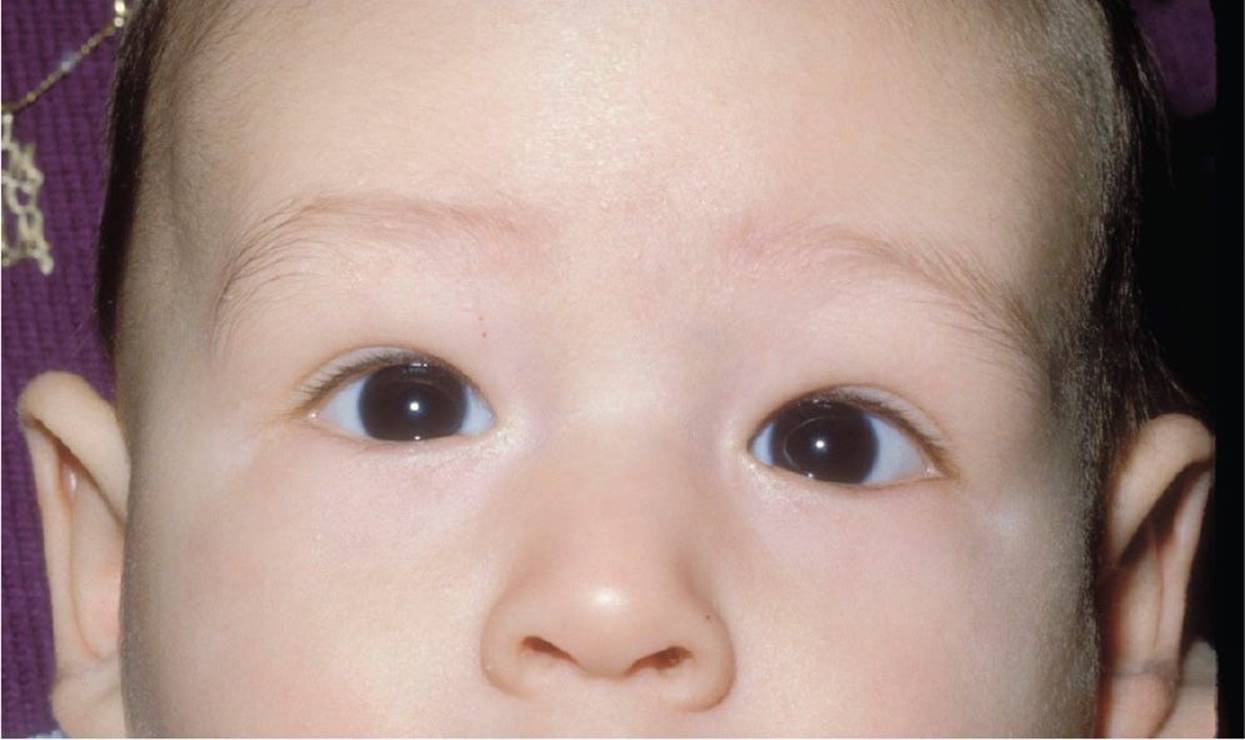
Figure 16-6 Pseudostrabismus. Apparent crossing of the eyes due to the wide nasal bridge and epicanthal folds. (Courtesy of Leonard B. Nelson, MD.)

Figure 16-7 Left third cranial nerve palsy. Note the inability to elevate, depress, or move the left eye toward the nose. (Courtesy of Leonard B. Nelson, MD.)

Figure 16-8 Left fourth cranial nerve palsy. Note the left hypertropia. (Courtesy of Leonard B. Nelson, MD.)

Figure 16-9 Bilateral sixth nerve palsy. Inability to abduct or turn either eye to the side. (Courtesy of Leonard B. Nelson, MD.)
DIFFERENTIAL DIAGNOSIS


Other Diagnoses to Consider
• Children with cerebral palsy, developmental delay, hydrocephalus, or any other abnormality of the brain may develop strabismus.
• Children who are born premature, especially of a very low birth weight, may develop strabismus.
• Brown syndrome (also known as superior oblique tendon sheath syndrome)
• Hydrocephalus
• Intracranial mass
• Möbius syndrome (palsies of the cranial nerves VI and VII; limb and craniofacial anomalies)
• Myasthenia gravis
When to Consider Further Evaluation or Treatment
• Regardless of whether a misalignment is detected by an examiner, if the parents state that they notice a misalignment that does not resolve by or presents after 3 months of age, the child should be referred to an ophthalmologist.
• If a misalignment of the eyes is detected by any of the above tests for strabismus, the child should be referred to an ophthalmologist.
• An abnormal face turn or head tilt that cannot be accounted for by a structural abnormality of the neck should be referred to an ophthalmologist.
• If a child is noted to consistently close one eye, the child should be referred to an ophthalmologist.
SUGGESTED READINGS
Aronson S, Bridge C, Brunner RT, et al, eds. Preschool Vision Screening for Healthcare Professionals. Chicago, IL: Prevent Blindness America; 2005.
Committee on Practice and Ambulatory Medicine, Section on Ophthalmology. American Association of Certified Orthoptists, American Association for Pediatric Ophthalmology and Strabismus, American Academy of Ophthalmology. Eye examination in infants, children, and young adults by pediatricians. Pediatrics. 2003;111(4 Pt 1):902–907.
Nelson LB, Olitsky SE. Harley’s Pediatric Ophthalmology. 6th ed. Philadelphia, PA: Lippincott Williams & Wilkins; 2013.
Olitsky SE, Nelson LB. Pediatric Clinical Ophthalmology. London, UK: Manson Publishing; 2012.