
Approach to the Problem
Swelling of the external ear may be a concerning symptom to parents. Most causes of ear swelling are benign. Insect bites, for example, are a common cause of ear swelling in pediatric patients. However, the swelling seen with insect bites and other benign entities may mimic other diseases, such as cellulitis, perichondritis, and mastoiditis, all of which require immediate attention. Otitis externa can become diffuse and cause external ear swelling with an appearance similar to cellulitis. Blunt trauma to the ear results in swelling and discoloration of the auricle, pinna, or both. Mastoiditis, an acute bacterial infection, causes swelling and erythema of the pinna and posterior auricular swelling and tenderness.
Key Points in the History
• Pruritus, associated with swelling and erythema, is the typical presentation of an insect bite to the ear.
• A previous history of ear piercing or laceration to the ear lobe should raise the suspicion for a keloid. Patients with keloids will often have a history of keloids on other parts of their body.
• Recent ear pain with or without drainage in conjunction with posterior auricular swelling, fever, or both may indicate mastoiditis.
• The duration of symptoms often helps to distinguish an insect bite from cellulitis. Swelling and erythema resulting from an insect bite occur suddenly, whereas the swelling, tenderness, and redness of cellulitis may gradually develop.
• A history of active or recent, localized acute otitis externa may result in cellulitis of the auricle or diffuse otitis externa.
• A history of paroxysmal ear burning, redness, and swelling may indicate otomelalgia (red ear syndrome).
Key Points in the Physical Examination
• Trauma, which may present as an auricular hematoma, and cellulitis typically present as swelling of the pinna and auricle, whereas mastoiditis presents as swelling and redness of the posterior auricular (e.g., in the area of the mastoid) and auricular areas.
• Forward displacement of the pinna usually indicates mastoiditis, although diffuse otitis externa or a posterior auricular insect bite may cause ear displacement when significant associated swelling is present.
• A rubbery, fleshy mass that extends beyond the wound margins indicates keloid formation.
• Erythema, swelling, warmth, and tenderness of the auricle usually indicate cellulitis. If there is no tenderness in association with the swelling and redness, an insect bite is more likely than cellulitis.
• Pain elicited with traction on the pinna and/or pressure on the tragus is associated with otitis externa.
• A bluish discoloration of the auricle accompanied by swelling suggests trauma. Petechial lesions on top of or inside the pinna are highly suspicious for an intentional injury that may be the result of pinching and pulling the pinna as seen with boxing or child physical abuse.
• Erythema and tenderness of the overlying skin and perichondrium suggest perichondritis.
|
PHOTOGRAPHS OF SELECTED DIAGNOSES |

Figure 18-1 Cellulitis. Note the erythema and swelling. (Courtesy of Kathleen Cronan, MD.)

Figure 18-2 Insect bite. Ear protrusion and swelling in a healthy child with a papule on the posterior ear demonstrating an insect bite to the ear. (Courtesy of Kathleen Cronan, MD.)

Figure 18-3 Mastoiditis. A protruding ear with evidence of acute otitis media, indicating mastoiditis. Frontal view. (Courtesy of Paul S. Matz, MD.)
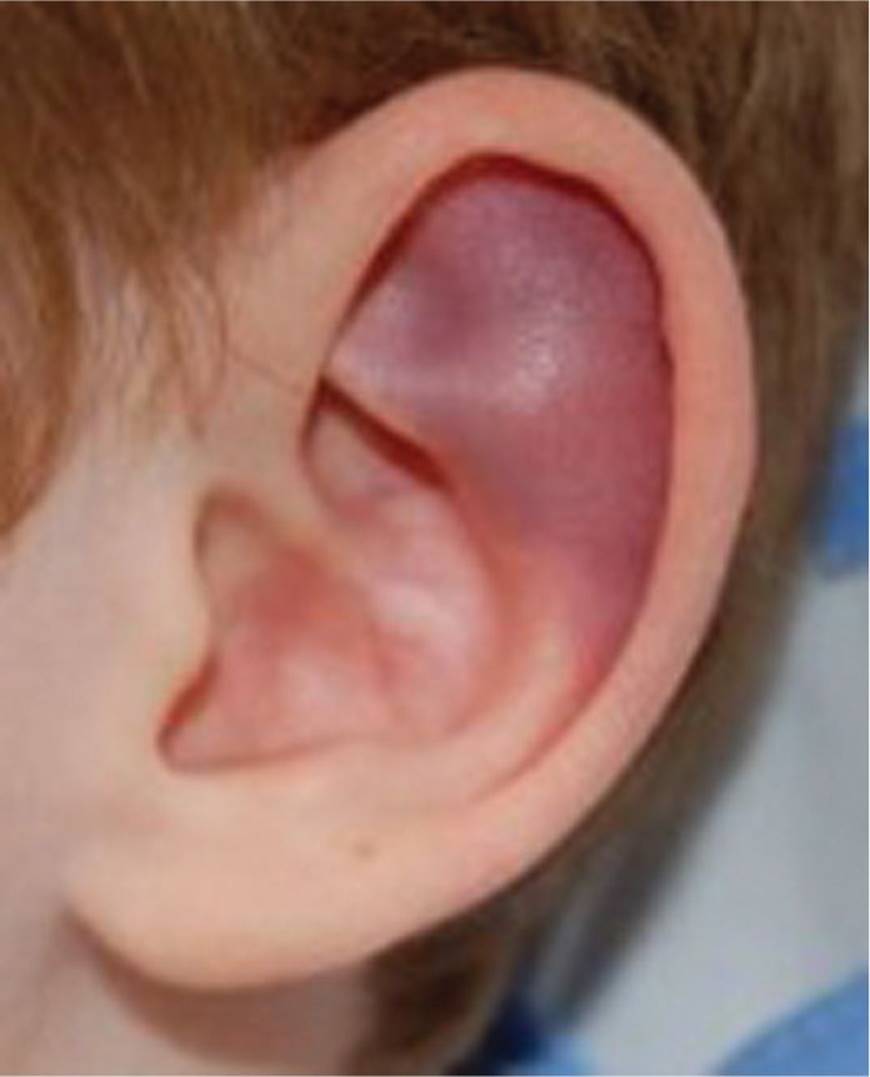
Figure 18-4 Auricular hematoma. This resulted from a direct blow to the ear. (Courtesy of Kathleen Cronan, MD.)

Figure 18-5 Keloid. Rubbery mass at the site of ear piercing is compatible with a keloid. (Courtesy of Steven P. Cook, MD.)

Figure 18-6 Perichondritis. Erythema and swelling of the pinna are consistent with perichondritis. (Used with permission from Handler SD, Myer CM. Atlas of Ear, Nose and Throat Disorders in Children. Ontario: BC Decker; 1998:12.)

Figure 18-7 Infected ear-piercing site. Pustule with drainage at ear-piercing site, indicating infection. (Courtesy of Ellen Deutsch, MD.)

Figure 18-8 Ramsay Hunt syndrome. Vesicles in external auditory canal demonstrating Ramsay Hunt syndrome. (Courtesy of Steven D. Handler, MD, MBE.)
DIFFERENTIAL DIAGNOSIS

Other Diagnoses to Consider
• Malignant otitis externa
• Chilblains (pernio)
• Xanthomatosis
• Relapsing polychondritis
• Henoch–Schönlein purpura involving the ear lobe and pinna
• Ramsay Hunt syndrome or herpes zoster oticus
When to Consider Further Evaluation or Treatment
• Medical evaluation should be sought if ear swelling is accompanied by fever or ill appearance.
• Suspected cellulitis requires oral antibiotic treatment.
• Swelling from insect bites usually resolves with antihistamines and local treatment, such as ice or cold compresses.
• Mastoiditis requires urgent evaluation by an otolaryngologist.
• If the external ear is pale or ecchymotic following trauma and there is suspicion for an underlying hematoma, surgical evaluation is required to determine the need for emergent evacuation of the hematoma.
• Keloids may improve after monthly, intralesional injection of triamcinolone suspension by a dermatologist or plastic surgeon.
• Perichondritis requires systemic antibiotics and removal of all ear jewelry. Cartilage is susceptible to rapid destruction by bacterial infection; therefore, prompt treatment is essential.
• Otomelalgia usually resolves with the application of cool compresses and in some cases migraine headache medications.
SUGGESTED READINGS
Arnett AM. Pain-earache. In: Fleisher GR, Ludwig S, Henretig FM, eds. Textbook of Pediatric Emergency Medicine. 6th ed. Philadelphia, PA: Lippincott Williams & Wilkins; 2010:455–460.
Handler SD, Myer CM. Atlas of Ear, Nose and Throat Disorders in Children. Ontario: BC Decker, Inc.; 1998:12.
Kliegman R, Behrman RE, Jenson HB, et al. Nelson’s Textbook of Pediatrics. 19th ed. Philadelphia, PA: Elsevier Saunders; 2011:2630–2631.
Long S. Principles and Practice of Pediatric Infectious Disease. 4th ed. Philadelphia, PA: Elsevier Saunders; 2012:220–222.
Paller A, Mancini A. Vascular disorders of infancy and childhood. In: Hurwitz Clinical Pediatric Dermatology: A Textbook of Skin Disorders of Childhood and Adolescence. 4th ed. Philadelphia, PA: Elsevier Saunders; 2011:295.