
Goran Augustin1, 2
(1)
Department of Surgery Division of Gastrointestinal Surgery, University Hospital Center Zagreb, Zagreb, Croatia
(2)
School of Medicine University of Zagreb, Zagreb, Croatia
Abstract
Changed attitudes to pregnancy have resulted in women involving themselves increasingly in social, commercial, and professional activities virtually throughout their pregnancies, thus exposing themselves to a risk of accidental injury similar to that in the nonpregnant population. Pelvic ligamentous laxity and the protuberant abdomen of pregnancy contribute to instability of gait, predisposing the pregnant woman to falls especially with progression of pregnancy. The prominent abdomen, especially toward term, becomes vulnerable to any form of trauma, and it has been suggested that minor accidental injury is more common during pregnancy than at any other time in adult life. A study from 2008 estimated that injuries resulting in an emergency department visit occurred in 3.7 % of pregnancies [1]. A reported 0.3 % of pregnant women require hospital admission because of trauma [2, 3] or less than 1 % of all trauma admissions in Australia [4]. Unintentional injuries are the leading cause of death among 18–34-year-old women in the United States and account for more than 8.6 million emergency department visits each year among adult women [5].
10.1 General Considerations
10.1.1 Incidence
Changed attitudes to pregnancy have resulted in women involving themselves increasingly in social, commercial, and professional activities virtually throughout their pregnancies, thus exposing themselves to a risk of accidental injury similar to that in the nonpregnant population. Pelvic ligamentous laxity and the protuberant abdomen of pregnancy contribute to instability of gait, predisposing the pregnant woman to falls especially with progression of pregnancy. The prominent abdomen, especially toward term, becomes vulnerable to any form of trauma, and it has been suggested that minor accidental injury is more common during pregnancy than at any other time in adult life. A study from 2008 estimated that injuries resulting in an emergency department visit occurred in 3.7 % of pregnancies [1]. A reported 0.3 % of pregnant women require hospital admission because of trauma [2, 3] or less than 1 % of all trauma admissions in Australia [4]. Unintentional injuries are the leading cause of death among 18–34-year-old women in the United States and account for more than 8.6 million emergency department visits each year among adult women [5].
In the past, most causes of maternal death were obstetric and due to a lack of prenatal care and inadequate assistance during delivery. Because of improved medical services, hospital deliveries, and reduced parity, a significant reduction in maternal mortality is noted. On the other hand, although there have been dramatic improvements in the management and treatment of medical and obstetric conditions, fetal mortality has not been reduced because of a rise in non-obstetric causes (mostly MVAs).
Motor vehicle accidents (MVAs) are becoming an increasingly common cause of trauma in pregnancy and in such cases fetal death may be due to maternal shock or damage to the uterus or placenta. However, when a pregnant woman is involved in an accident, her injuries rarely involve the uterus. The pregnant trauma victim may present the casualty officer with problems seldom seen in other trauma cases, such as placental abruption, premature labor, and a ruptured uterus. If casualty department staff is aware of these complications, it is unlikely that their attention will be diverted from the pregnancy to the other more familiar injuries. Griswold and Collier have shown that MVAs are responsible for about 50 % of non-penetrating abdominal wounds and that the trauma is often severe and associated with other injuries [6].
Although trauma in pregnancy is uncommon, it is the leading non-obstetric cause of maternal mortality. Approximately 6–7 % of all pregnant women experience some sort of physical trauma in the United States and it accounts for 20 % of maternal mortality [2, 7–11]. Significant trauma occurs to approximately 8 % of pregnant women.
The etiology of maternal trauma is most often MVAs (55 %), followed by falls (22 %), assaults (22 %), and burns (1 %) [10, 12]. Younger gravid patients are at a higher risk for trauma than older ones [13]. Penetrating injuries constitute a greater proportion of injuries at inner-city centers [14, 15]. Fetal deaths have a different etiology: MVAs (82 %), gunshot wounds (6 %), and falls (3 %), with maternal death accounting for 11 % of the fetal deaths [16]. Reports show that 10–30 % of women are exposed to significant physical abuse during pregnancy, with an associated 5 % rate of fetal death [17–24].
The pattern of serious injuries in pregnant women is different from that of nonpregnant trauma patients: injuries to the abdomen are more common than injuries to the head and chest. The possibility of domestic violence should be considered, especially where the injuries are inconsistent with their alleged cause. The risk to the pregnancy in “minor” or noncatastrophic trauma is still significant, with preterm labor occurring in 8 %, placental abruption in 1 %, and fetal death in 1 %. For those with major trauma, maternal mortality is about 9 % [2], and the fetal death rate is 20 % or greater. About 5 % of fetal injuries occur without injury to the mother. When compared to nonpregnant trauma patients, pregnant women are younger, less severely injured, and more likely to be African-American or Hispanic. Twenty percent of pregnant trauma patients tested positive for drugs or alcohol in one study. In one series, 19–24 % of trauma patients delivered when they required hospitalization for an injury. Unfortunately, significant numbers of pregnant women who are injured have elevated blood levels of alcohol or illegal drugs. These substances contribute to automobile accidents as well as low birth weights.
10.1.2 Risk Factors
According to the literature, major risk factors for maternal trauma include [22, 25–30]:
· Young age (<25 years)
· African-American or Hispanic race
· Illicit drugs, alcohol, or smoking
· Domestic violence
· Noncompliance with proper seat belt use
· Epilepsy or other seizures
· Overweight and obesity
· Work outside the home
· Low socioeconomic status
The impact of mind-altering substances is significant. Ikossi et al. presented data from the American College of Surgeons National Trauma Data Bank, which revealed that 19.6 and 12.9 % of pregnancy-related traumas were associated with the use of illicit drugs or alcohol, respectively [22]. One institutional study showed intoxicants use in up to 45 % of the pregnant population involved in MVAs [28]. Intoxication, as anticipated, also contributes to a significantly lower use of restraints while driving when compared with sober patients (22 % vs. 46 %, respectively) [28].
Mothers who reported an injury during pregnancy were more likely to be aged <18 years versus 18–29 years and less likely to be aged ≥30 years. They were more likely to use alcohol during pregnancy, to smoke during pregnancy, to have epilepsy, and to be employed than mothers who did not report an injury [31]. The distribution by trimesters is more or less equal (Fig. 10.1).
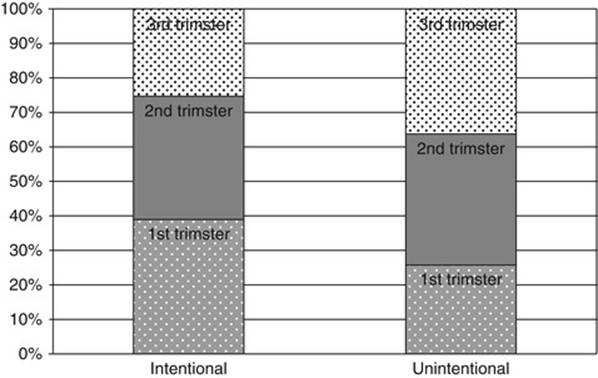
Fig. 10.1
Timing of injuries during pregnancy reported by mothers of control infants, by intention. National Birth Defects Prevention Study, 1997–2005 [30]
However, knowledge of characteristics specifically associated with injury among pregnant women can be used to help identify women who may be at higher risk for experiencing an injury during pregnancy and can potentially inform the development of prevention programs for women to reduce the risk of injury during pregnancy. Many of these characteristics have been associated with adverse pregnancy outcomes, such as alcohol with fetal alcohol syndrome, smoking with orofacial defects [19] and preterm delivery [32], and obesity with neural tube defects [33] and Cesarean delivery [34]. Therefore, efforts to modify these exposures may have multiple positive impacts. For example, prevention of alcohol use during pregnancy could both reduce the fetus’ direct risk from the alcohol exposure and reduce the risks of maternal injuries, which can also adversely affect pregnancy outcome. It is recommended that all pregnant women be screened for alcohol use at their first prenatal visit [35] and screening questionnaires developed specifically for women are available [36]. Physician guidance has been demonstrated as an effective tool for reducing alcohol use [36].
10.1.3 Prevention
Despite advances in trauma management, the fetal and maternal mortality rates after traumatic injury have not declined. Because current management has little effect on mortality, prevention is a key to increasing maternal and fetal survival. MVAs and domestic violence are common preventable causes of trauma in pregnancy. Although, MVAs are responsible for most severe maternal injuries and fetal losses from trauma [9, 37–40]. Pregnant women have low rates of seat belt use [2, 26, 38, 41]. Proper seat belt use is the most significant modifiable factor in decreasing maternal and fetal injury and mortality after MVAs [11, 42, 43]. Seat belt-restrained women who are in MVAs have the same fetal mortality rate as women who are not in MVAs, but unrestrained women who are in crashes are 2.8 times more likely to lose their fetuses [17]. More on the subject can be found in section 10.2. Prenatal care must include three-point seat belt instruction [22, 44–46]. The lap belt should be placed under the gravid abdomen, snugly over the thighs, with the shoulder harness off to the side of the uterus, between the breasts and over the midline of the clavicle [43]. Seat belts placed directly over the uterus can cause fetal injury [47]. Airbags should not be disabled during pregnancy [43, 47]. Because many women are unaware of the potential for placental abruption without evidence of maternal injury, pregnant patients should be instructed to seek care immediately after any blunt trauma. Screening of younger patients is particularly important, because they have higher rates of MVAs and domestic violence [17, 48]. Resource materials in waiting rooms and restrooms allow patients to gather information without confrontation [26].
10.1.4 Anatomic and Physiological Changes in Pregnancy Relevant to Trauma
The possibility of pregnancy should be considered in all female trauma patients of reproductive age. Pregnancy causes anatomic and physiological changes involving nearly every organ system in the body, making the treatment of a pregnant trauma patient complex [49–51]. Some of the anatomic and physiological changes in pregnancy that are relevant to trauma are presented in Table 10.1 [52].
Table 10.1
Anatomic and physiological changes in pregnancy relevant to trauma
|
Organ system |
Changes relevant to trauma |
|
Uterus |
First trimester: intrapelvic organ protected by the bony pelvis |
|
Second trimester: becomes an abdominal organ; the fetus is cushioned by a relatively large amount of amniotic fluid |
|
|
Third trimester: the uterus is large and thin walled |
|
|
Blood |
Increase in plasma volume greater than in RBC results in a decreased HCT |
|
Cardiovascular system |
Increase in plasma volume and decrease in vascular resistance of the uterus and placenta cause an increase in cardiac output |
|
Increase in the cardiac rate |
|
|
Second trimester: decrease in both systolic and diastolic blood pressure |
|
|
Respiratory system |
Increased tidal volume and minute ventilation |
|
Hypocapnia in late pregnancy |
|
|
Decreased residual volume |
|
|
GI system |
Gastric emptying time is prolonged |
|
Third trimester: the bowel is pushed upward and lies mostly in the upper abdomen |
|
|
Other systems |
Dilatation of the renal calyces, pelvis, and ureters |
|
The pituitary gland increases in size |
|
|
The symphysis pubis and the sacroiliac joints widen |
RBC red blood cell, HCT hematocrit, GI gastrointestinal
These changes, by altering the signs and symptoms of injury, may influence the interpretation of the physical examination as well as laboratory results of traumatized pregnant women. This may affect the approach and the response to resuscitation [50, 51, 53]. During the first trimester of pregnancy, the uterus is confined and protected by the bony pelvis. It remains an intrapelvic organ until around the 12th week of gestation, when it rises and becomes an abdominal one. In the second trimester the small fetus remains cushioned by a relatively large amount of amniotic fluid. By the third trimester the uterus is large and thin walled [54]. The uterus and its contents have increased susceptibility to injury (penetration, rupture, placental abruption, and premature rupture of membranes). Some of the characteristics causing this increased susceptibility include the difference in elasticity between the uterus and placenta, which causes the uteroplacental interface to be subject to sheer forces, and may lead to placental abruption [55]. Plasma volume increases throughout pregnancy and plateaus (peaks at the 34th week) at about 34 weeks of gestation. A smaller increase in the number of red blood cells results in a decreased hematocrit [51, 54]. The placental vasculature is maximally dilated, yet it is very sensitive to catecholamine stimulation [51, 54–56]. An acute decrease in the intravascular volume may result in a significant increase in the uterine vascular resistance. This could cause a reduction in fetal oxygenation, even though the maternal vital signs can stay within normal range [9, 51, 53, 55–57].
There are hemodynamic changes that are noted during pregnancy and that are relevant when dealing with injured pregnant patients. An increase in cardiac output is noted after 10 weeks of gestation that is due to the increase in plasma volume and the decrease in vascular resistance of the uterus and placenta. During the third trimester the uterus and placenta receive 20 % of cardiac output. A gradual increase in the cardiac rate, maximizing in the third trimester, must be considered when evaluating the tachycardic response to hypovolemia. In the second trimester there is a decrease in both systolic and diastolic blood pressure. Turning the patient to the left lateral decubitus position may, in some women, prevent hypotension [51, 54, 58]. Increased levels of progesterone in pregnancy are thought to increase tidal volume and minute ventilation. Hypocapnia is common in late pregnancy. The diaphragm elevates causing decreased residual volume. Maintaining adequate arterial oxygenation is important in the resuscitation of injured pregnant patients because of increased oxygen consumption during pregnancy [51]. The cardiovascular changes during pregnancy may complicate the evaluation of intravascular volume, the assessment of blood loss, and the diagnosis of hypovolemic shock [59]. Maternal hemodynamic measurements may not accurately reflect the status of the uteroplacental circulation. Animal studies have demonstrated that maternal heart rate and blood pressure may remain within normal ranges during a 20 % acute blood loss or during a more gradual loss of 30–35 % of estimated total blood volume [60, 61]. Also Hoff et al. had documented the unreliability of maternal blood pressure and pulse rate in predicting fetal loss [62]. Physicians providing care to pregnant trauma victims should remember that pregnancy maximally dilates the uterine vasculature, so that autoregulation is absent, and uterine blood flow is entirely dependent on maternal mean arterial blood pressure (MAP). Pregnancy represents a state of accelerated but compensated intravascular coagulation, which has both advantages and disadvantages for the pregnant trauma victim [59]. Increased levels of coagulation factors may improve hemostasis following trauma; however, at the same time parturients remain at increased risk for thromboembolic complications during periods of immobilization. Because buffering capacity during pregnancy is diminished, pregnant trauma victims rapidly develop metabolic acidosis during periods or hypoperfusion and hypoxia.
Gastric emptying time is prolonged in pregnancy; therefore, in the emergency setting, early gastric tube decompression is important in order to avoid aspirations. In the third trimester, as the uterus enlarges, the bowel is pushed upward and lies mostly in the upper abdomen [54]. Therefore, in blunt trauma the bowel is relatively protected while the uterus and its contents (fetus, placenta) are more vulnerable. However, penetrating trauma to the upper abdomen can cause complex intestinal injury [51].
Other changes in pregnancy involving nearly every organ system in the body are important when treating a patient suffering a trauma. Physiological dilatation of the renal calyces, pelvis, and ureters is noted and should be taken into account when dealing with cases of pelvic and abdominal trauma. During pregnancy the pituitary gland increases in size. Shock can cause necrosis of the anterior pituitary gland, resulting in pituitary insufficiency. The symphysis pubis and the sacroiliac joints widen and should be considered when interpreting pelvic X-rays. In the vertex presentation, the fetal head is usually located in the pelvis and the rest of the body, above the pelvic brim. Pelvic fractures in late gestation may result in fetal head injury (skull fractures, intracranial injuries) [54, 63–65]. Differentiating between head trauma with convulsions and eclampsia (hypertension, proteinuria, and peripheral edema) as a cause for seizures is important [54].
There is an increase in the level of maternal plasma fibrinogen, as well as factors II, VII, VIII, IX, and X, and a decrease in plasminogen activator levels. This is important to remember in any trauma situation where hypercoagulability and the risk of deep venous thrombosis are already increased.
The clinician should be aware of “normal” laboratory values during pregnancy (Table 10.2). Note that it is normal to have an elevated white blood cell count, slightly elevated arterial pH, decreased serum bicarbonate level and arterial pCO2, and increased fibrinogen level. The finding of a normal nonpregnant value for pCO2 or fibrinogen in the pregnant patient is especially concerning.
Table 10.2
“Normal” laboratory values during pregnancy
|
Hematocrit |
32–42 % |
|
White blood cell count |
5,000–12,000/μl |
|
Toxicology screen |
Negative |
|
Arterial pH |
7.40–7.45 |
|
Bicarbonate |
17–22 mEq/l |
|
pCO2 |
25–30 mmHg |
|
Fibrinogen |
264–615 mg/dl |
10.1.5 The Impact of Pregnancy on Trauma Mortality
Literature regarding hormonal influences on outcomes after trauma is abundant, yet findings have been contradictory. In experimental models, relatively high estrogen (and progesterone) levels have been beneficial with respect to immunomodulatory and vasodilatory effects and ultimate outcome (survival) after traumatic injuries [66–69].
Findings in clinical publications vary widely, with some studies showing survival advantage in premenopausal women [70–72]. If a hormone-dependent survival benefit does exist, then pregnant women who have higher estrogen and progesterone levels might be expected to exhibit lower mortality compared with similarly injured nonpregnant women. Using the matching process, Preeti et al. found that pregnant trauma patients are approximately 40 % less likely to die than their nonpregnant counterparts [73]. On subgroup analysis, this survival benefit was evident in younger women, suggesting a possible additive beneficial effect of youth and pregnancy. Of interest, there was no survival benefit in pregnant women when severely injured patient subgroups were compared (ISS >15, severe head injury, severe abdominal injury, or patients in hypotensive shock), suggesting that whatever advantage that pregnancy may confer may be limited. Also of note is the trend toward increased likelihood of death in pregnant patients with severe abdominal injury, a finding which may be related to placental abruption contributing to internal hemorrhage in this subgroup [73].
A study with data from the National Trauma Data Bank for the period 1994–2001 analyzed outcomes in 1,195 pregnant trauma patients [22]. The crude mortality rate for pregnant patients who were injured in their study was 1.4 %, compared to 3.8 % for nonpregnant patients (p < 0.001). Another study using a smaller dataset found that “pregnancy does not increase maternal mortality from trauma” and that the most frequent cause of death in injured pregnant patients was head injury [37]. However, there is no proof that estrogen and progesterone are responsible for the survival advantage of pregnant patients. Probably hemodynamic changes are responsible as well as more close observation of pregnant than nonpregnant patients.
10.1.6 Major Obstetric Hemorrhage and Transfusion Protocol
10.1.6.1 Cardiopulmonary Resuscitation (CPR)
Hypovolemia will manifest as thready pulses, tachycardia, flattened neck veins, pallor, and prolonged capillary refill. If a radial pulse is palpable, the systolic blood pressure is approximately 80 mmHg. The absence of carotid and peripheral pulses indicates pulseless electrical activity and Advanced Cardiovascular Life Support (ACLS) protocols should be initiated. If there is a need to defibrillate the patient, standard ACLS voltage should be used (Fig. 10.2). There is no evidence that the fetus is harmed by the current from defibrillation [74]. External fetal monitors should be removed before delivering shocks [74]. Chest compressions should be carried out with the understanding that the maternal heart is displaced upward in the chest by the gravid uterus at advanced gestations, and this should guide hand placement [74].

Fig. 10.2
Maternal cardiac arrest algorithm [74]
The CPR should not be interrupted for the sake of giving medications because they get circulated with compressions [75]. Giving medications in pregnancy through lower extremity lines should be avoided because they may not adequately reach the maternal heart because of compression by the gravid uterus [76]. Palpable femoral pulses have not been shown to be reliable indicators of blood flow during CPR because retrograde flow in the femoral vein could mimic femoral artery pulsations [77]. The presence of a carotid pulse during CPR is also not an indicator of adequate cerebral or coronary blood flow [77]. An end-tidal CO2 monitor can be used as an indicator of adequate CPR efforts and return of spontaneous circulation [77].
10.1.6.2 Major Hemorrhage
Major obstetric hemorrhage is defined as a blood loss of ≥2,500 ml, transfusion of five units of red blood cells, or treatment of a coagulopathy [78, 79]. Transfusion of blood and blood products in trauma and major hemorrhage is changing as a result of experience in military medicine. Resuscitation in obstetric hemorrhage is similar to that in trauma as both aim to stop bleeding, maintain efficient oxygen delivery, and prevent development of the “lethal triad” of acidosis, coagulopathy, and hypothermia [80–83]. Obstetric resuscitation often starts with administration of clear intravenous fluids and packed red blood cells (pRBC), following which the use of clotting products and platelets is considered, often guided by coagulation studies that delay treatment [80]. The UK National Patient Safety Agency recommends monitoring laboratory blood tests during massive transfusion, but also that administration of blood and blood products should not be delayed while awaiting results [78, 80, 81].
Resuscitation of bleeding patients with crystalloid, colloid, and plasma-poor pRBC at the same time when clotting factors are being consumed results in the concentration of plasma coagulation factors falling to <40 % and typically occurs before 10 units of pRBC has been given [84]. Disseminated intravascular coagulopathy in obstetric hemorrhage can also occur early, especially if hemorrhage is not treated rapidly. Early treatment of massive hemorrhage after trauma using fresh frozen plasma (FFP) and pRBC in a 1:1 ratio, current practice in US and British military, is thought to improve survival [84–89]. Military guidelines for hemorrhagic shock also recommend administration of platelets in a 1:1 ratio with pRBC [85–87, 89].
Prevention of coagulopathy should be better than its treatment and requires anticipation [84]. Some authors advise that replacement of clotting factors should be made on clinical grounds, rather than based on laboratory results [85, 89, 90]. The Association of Anesthetists of Great Britain and Ireland guideline recommends early infusion of FFP (15 ml/kg) to prevent hemostatic failure and may need to be started if a senior clinician anticipates massive hemorrhage [91]. This guideline emphasizes the importance of preventing hemostatic failure because, once established, standard regimens of FFP infusion are likely to be inadequate and larger volumes will be required with greater risk to the patient and cost implications for the hospital [91].
For massive obstetric hemorrhage, a ratio of 6:4:1 for pRBC/FFP/platelets has been suggested. If bleeding continues after initial treatment, consideration should be given to increasing the amount of FFP to give a ratio of 4:4:1 [81]. Point-of-care tests can measure hemoglobin concentration and the coagulation profile and may guide blood product replacement following initial resuscitation.
Fibrinogen concentrations are also greater in pregnancy; the optimal posttransfusion fibrinogen concentration has been suggested as 1.0–2.0 g/l [80].
The high ratios of pRBC to coagulation products that are recommended for other types of trauma may therefore not be required in the obstetric patient, whereas greater replacement of fibrinogen may be necessary. There is evidence to support 1:1:1 ratios of pRBC/FFP/platelets in trauma but less so in obstetrics [80, 85–89, 92–96].
Maintenance of a platelet count of 50–100 × 109/l has been suggested although should only be used as a guide in conjunction with the patient’s clinical condition [80]. pRBC/platelet ratios of 5:2 and 5:1 have been described with good results [80, 88].
Consensus guidelines in the literature suggest that recombinant factor VIIa (rFVIIa) should be considered before hysterectomy if hemostatic failure and hemorrhage continue despite optimal blood product replacement and obstetric management [80, 82, 97, 98]. Arterial thrombosis is a potential complication of rFVIIa use but has not been reported in a case series of 15 patients [97]. Its safety in the obstetric population is unproven, and it carries a significant cost implication. Using thromboelastography and thromboelastometry to guide optimum ratios of blood product replacement during obstetric hemorrhage may be limited by time during the initial resuscitation phase, and there is limited familiarity with their use in obstetrics [78, 80, 81, 96].
10.1.7 Prehospital Issues
The initial key to survival of both mother and fetus is prehospital management. Pregnancy is considered a triage criterion for transport to a trauma center by the American College of Surgeons Committee on Trauma. Despite this recommendation, literature on the appropriate level of care in injured pregnant patients is very limited. Goodwin and Breen [99] proved in a landmark contribution in 1990 that in addition to the accepted Advanced Trauma Life Support (ATLS) guidelines (first five on the list) for transfer of patients to level I trauma centers, there are four additional:
· Glasgow Coma Score <14
· Respiratory rate <10 or >29
· Systolic blood pressure <90 mmHg
· Revised Trauma Score <11
· Anatomy or mechanism of injury
· Pulse >110
· Chest pain
· Loss of consciousness
· Third trimester gestation
These criteria are particularly useful in mass casualty triage of patients in adjunction to prehospital trauma scoring systems in order to identify those patients who would benefit most from rapid transfer to trauma centers. In general, guidelines for adult prehospital trauma care also apply to pregnant trauma victims. Upon initial assessment, emergency medical services (EMS) should follow standard protocols like extrication with spinal immobilization and resuscitation as outlined in the ATLS guidelines. The decision to intubate the patient in the field is largely unaffected by pregnancy. Unique to the gravid patient in airway management are, however, as follows:
· Increased risk of aspiration due to delayed gastric emptying and decreased lower esophageal sphincter tone in combination with intra-abdominal hypertension.
· Despite safety of rapid-sequence intubation in pregnancy, because of lower serum pseudocholinesterase levels in pregnancy, using a lower dose of succinylcholine during induction is recommended [100].
· Both depolarizing and non-depolarizing muscle relaxants cross placenta. Effects of these drugs onto CTG pattern and fetal activity might lead to a falsely non-reassuring tracing and non-indicated intervention.
In the event of delivery, the neonatologist might be faced with a flaccid, apneic infant. Hence, it is pertinent to relate any prehospital use of medication by EMS to the receiving institution and trauma team. In general, the potential catastrophic consequences of the patient losing her airway in the field or during transport usually justify acceptance of the minor risks associated with using paralytic and induction agents. Early establishment of a definite airway is usually the safest option.
Avoidance of the supine hypotension syndrome (uterocaval compression) should be paramount part of all initial resuscitative measures in pregnant trauma patients. Placing the patient on a backboard with a 15° angle to the left is a pregnancy-specific intervention that should be employed in all patients beyond 20 weeks of gestation. Abundant clinical data have proven that the significantly decreased cardiac output of up to 60 % due to uterocaval compression leads to prolonged resuscitation with increased acidosis and vasopressor requirements [101, 102]. Below 24 weeks manual left lateral displacement might be sufficient. There is 1-handed (Fig. 10.3a) and 2-handed (Fig. 10.3b) technique according to the American Heart Association Guidelines for Cardiopulmonary Resuscitation and Emergency Cardiovascular Care from 2010 [74].
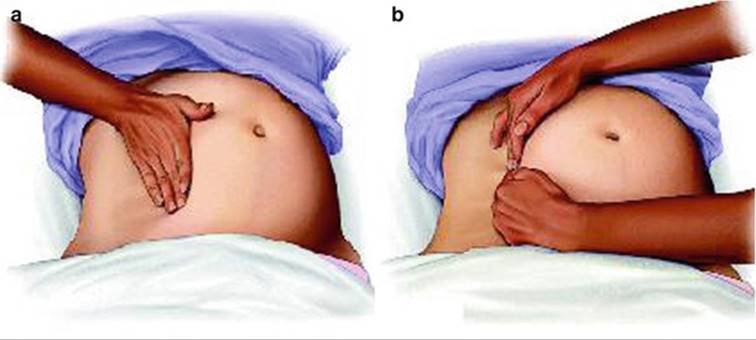
Fig. 10.3
Left lateral uterine displacement using (a) 1-handed technique and (b) 2-handed technique [74]
In gestations of >24 weeks, a 30° lateral tilt is recommended (Fig. 10.4) [74]. Although this reduces the efficacy of CPR compared to the supine position, in pregnant patient, the slightly reduced efficacy of chest compressions is outweighed by improved cardiac preload and overall cardiac output [101]. Therefore, current Eastern Association for Surgery and Trauma (EAST) guidelines now recommend a left lateral tilt of at least 15° during the initial phase of resuscitation.

Fig. 10.4
Patient in a 30° left lateral tilt using a firm wedge to support the pelvis and thorax in gestations of >24 weeks [74]
Placement of a hard backboard in the supine position might not be tolerable for third trimester gravida. The increased work of breathing due to increased diaphragmatic splinting might lead to respiratory failure. In this circumstance, transport in a 30° reversed Trendelenburg position seems acceptable [12]. As far as i.v. access routes in pregnant trauma patients are concerned, femoral access procedures should be avoided. Because of the risk of uterocaval compression, distribution of medication or fluids might be significantly altered when using the femoral route in pregnant patients.
Whenever possible, pregnant females should be transported rapidly to a designated trauma center that has the facilities for adequately managing both mother and fetus. The transfer should occur rapidly even in cases of minor trauma because of the high incidence of fetal demise even under these circumstances. Paramedics should seek information regarding pregnancy from female patients of childbearing age. A distended abdomen may be due to a gravid uterus or intra-abdominal bleeding. Pregnancy should prompt positioning of the patient in the left lateral decubitus position to avoid compression of the vena cava by the uterus and resultant hypotension. Should the emergency medical technician suspect a spinal fracture, a left lateral tilt position can be utilized. Oxygen supplementation by nasal cannula or face mask should be routine. In the event that prehospital transfusion is required, O-negative blood should be used whenever possible. Emergency medical services that still use the military antishock trousers (MAST) should be aware that it is contraindicated to inflate the abdominal portion of this device for pregnant women. Not only can this maneuver cause reduced uterine perfusion, but it also can increase the cardiac workload.
Appropriate personnel must be present or readily available at the emergency room when the emergency vehicle arrives. A team should be assembled that includes a neonatologist, anesthesiologist, trauma surgeon, sonographer, and staff radiologist. If a pelvic fracture or bleeding is suspected, a senior interventional angiographer should be notified immediately to be on standby.
10.1.8 Anesthetic Perioperative Care
The recent literature documenting obstetric, anesthetic, and surgical management of pregnant trauma victims is limited [42, 103–108]. The pregnant trauma victim presents a unique spectrum of challenges to the trauma health-care team. The surgical diagnosis may be unknown at the time of incision, as may be the nature and extent of the procedure being undertaken. The fact that pregnancy may not always be known to be present to the health-care team (at the scene of transportation accidents, in the emergency room, or in the operating room) additionally complicates the situation. Pregnancy must always be suspected (until proven otherwise) in any female trauma patient of childbearing age [103].
Vasopressors, which are very rarely indicated in trauma patients, should be avoided unless absolutely necessary because of the risk of decreasing uterine blood flow. If it is required, ephedrine should be the first choice as it preserves the uterine blood flow, but there should be no hesitation in using other vasopressors when necessary.
10.1.8.1 Head and Neck Injury
If there is an uncertainty about the integrity of the cervical spine, direct laryngoscopy should be avoided, and fiberoptic (awake fiberoptic) intubation of the trachea, if feasible (time constraints and/or equipment availability), should be considered [104]. If direct laryngoscopy is deemed necessary, an “in-line stabilization” of the head and neck by an assistant to prevent extension and rotation of the cervical spine is indicated. If awake fiberoptic intubation of the trachea is selected, it is essential to titrate analgesic and sedative drugs carefully to maintain continual meaningful verbal communication between the anesthesiologist and the patient. Respiratory depression and aspiration of stomach contents during the application of a local anesthetic agent is much less likely to occur if the patient remains awake and alert. In addition, a rational alert mother minimizes the risk of neonatal depression. Midazolam is the benzodiazepine recommended for these purposes; however, it is highly unionized and very lipophilic, and its fetal/maternal ratio is 0.76 at 15–20 min after maternal administration. However, unlike other benzodiazepines, the ratio falls rapidly. No adverse fetal effects have been reported [109].
It has been empirically established that trauma victims with a GCS ≤8 usually require intubation and mechanical ventilation for both the airway control and control of the intracranial pressure. However, trauma victims with “good” GCS can “talk and deteriorate/die” following traumatic head injury, particularly an injury associated with loss of consciousness, and delayed deterioration has been observed up to 48 h after the initial insult.
The succinylcholine-induced ICP increase has been a concern in the past, nevertheless; recent analysis of the problem has shown that the magnitude and clinical importance of this increase has been grossly exaggerated. It is currently believed that when there is an urgent need to secure an airway in the head-injured pregnant trauma victim, succinylcholine is an appropriate and safe drug, and it should be used. All of the intravenous anesthetic agents (except ketamine) cause some degree of vasoconstriction and therefore decrease in cerebral blood flow. All of the inhaled agents have some cerebral vasodilatory effect; however, their administration is usually consistent with acceptable ICP levels [110, 111].
10.1.8.2 Intra-abdominal Injuries
In abdominal trauma, liver and splenic tears increase with increasing uterine enlargement as these organs are compressed by the uterus against the rib cage [112]. The uterus itself is relatively resilient [113]. In a study from the Denver General Hospital [114], the incidence of injuries encountered at laparotomy after blunt trauma in the general population was spleen 46 % and liver 33 %, followed by the mesentery (18 %), urinary tract (9 %), pancreas (9 %), small bowel (8 %), colon (7 %), and duodenum (5 %). Seat belts and compression against vertebrae are other causative factors in injuries to bowel, pancreas, kidney, etc. Bowel injuries occur at the sites of fixation such as the duodenum, cecum, splenic flexure, and rectosigmoid. The duodenum is especially susceptible to injury. The third segment of the duodenum, because of its fixed position directly over the lumbar spine, is the most commonly injured segment of the intestinal tract [115, 116]. After the 12th week of pregnancy, trauma to the pelvic region is a serious problem because the urinary bladder has been displaced anteriorly and superiorly out of the protective bony pelvis [117].
10.1.8.3 Fetal Physiology and Assessment
Fetal Physiology
During the first week, the conceptus has not yet implanted in the uterus, making it relatively resistant to injury. Soon thereafter, the embryo attaches to the uterus via the anchoring villi. The placenta is not as elastic as the myometrium, potentially leading to shear stresses and disruption of the villi when force is applied to the uterus. The well-being of the fetus is dependent on the adequacy of the maternal blood flow to the placenta, which is mainly derived from the uterine arteries. The uterine vascular bed is a low resistance system, not capable of further dilation and devoid of autoregulation. Therefore, placental blood flow varies directly with the net perfusion pressure (uterine artery pressure-uterine venous pressure) across the intervillous space and inversely with uterine vascular resistance. When faced with maternal hypotension, in order to preserve uteroplacental perfusion in a “pressure-passive” system, a more aggressive approach to management (rapid fluid loading, vasopressor therapy, and Trendelenburg and left lateral positioning) is required compared to strategies for the nonpregnant patients. The ability of the fetus to withstand changes in uterine blood flow or oxygenation is variable. The fetus can redistribute blood flow to the most vulnerable organs, the brain and heart, but the protection afforded by this response (“the diving reflex”) is limited. Decreased placental blood flow quickly leads to fetal distress.
Fetal Assessment
The aim of fetal assessment is to detect fetal distress and reduce the risk of fetal loss. Some authors have in the past been unable to identify any significant risk factors relating to injury or patient physiology that would predict poor outcome [118, 119]. More recently, a number of risk factors for fetal loss have been identified, including penetrating uterine injuries, severe maternal head injuries, and maternal pelvic fractures, but each series identifies slightly different factors (Table 10.3) [9, 38, 53, 62, 120].
Table 10.3
Factors predicting fetal death in trauma
|
Ejection from vehicle |
|
Pedestrian injury |
|
Lack of restraints |
|
Maternal tachycardia |
|
Maternal hypotension |
|
Maternal hypoxia |
|
Maternal contractions |
|
Abnormal fetal heart rate |
|
Injury severity score >9 |
Obstetric sonogram should be performed to assess fetal viability, fetal age, and fetal well-being [12]. Evaluation of fetal trunk and extremity movement, fetal breathing activity, amniotic fluid volume, and fetal heart rate changes with fetal movement will establish fetal well-being. Any viable fetus of 24 weeks or more requires cardiotocographic (CTG) monitoring after maternal trauma. This includes patients with no obvious signs of abdominal injury. Pearlman et al. have recommended a minimum of 4 h of CTG observation to detect intrauterine pathology [118]; others recommend 6 h. This should be extended to 24 h if at any time during the first 6 h there is more than one uterine contraction every 15 min, uterine tenderness, non-reassuring fetal CTG monitoring, vaginal bleeding, rupture of the membranes, or any serious maternal injury. Rogers et al. studied 372 traumatic fetal deaths from several institutions. Sixty-one percent were in patients undergoing continuous fetal monitoring, but seven fetuses with CTG abnormalities were saved by Cesarean section [9]. Formal ultrasound of the fetus may provide important information [39], such as the presence of liver injury [121] or intracranial hemorrhage [122].
Most hospitals have limited experience in managing pregnant patients who are involved in trauma. Between 1989 and 1998, Liverpool Hospital has had six fetal deaths, of which five arrived in the resuscitation room with fetal heart sounds, or CTG evidence of viability [123]. Facilities for rapid Cesarean section must be available if fetal deaths are to be avoided. Fetal compromise is present in over 60 % of placental abruptions with a live fetus, and an immediate Cesarean section is indicated. The overall fetal mortality with placental abruption is 54 % [9]. Adequate resuscitation of the mother is absolutely vital. If maternal shock occurs, fetal mortality approaches 80 %. Fetal monitoring should be continued for 24 h for all patients with a risk factor listed in Table 10.3. Patients who enter preterm labor and those at risk of developing contractions (i.e., gestational age >35 weeks, victims of assault, and pedestrians hit by motor vehicles) should also be monitored for 24 h [38]. The recommended length of fetal monitoring can be reduced to 6 h or less in low-risk patients [38, 124]. Maternal plasma bicarbonate levels may be a predictor of outcome. Scorpio et al. found that injured mothers with fetuses who survived had a mean plasma bicarbonate level of 20.3 ± 2.2 mEq/l compared with 16.4 ± 3.0 mEq/l in those with fetal loss [40].
Restoration of both maternal and fetal circulation is the goal of adequate resuscitation. However, there are unusual situations in which exclusive attention to the mother may preclude delivery of a viable baby. Maternal revival after delivery of the fetus has been reported in perimortem circumstances, presumably due to relief of vena cava compression, or more effective cardiopulmonary resuscitation after pressure below the diaphragm is relieved, but this is rare. It is therefore suggested that there is no place for postmortem Cesarean section – only perimortem Cesarean section. If there is no response to advanced resuscitation within a few minutes, maternal cardiopulmonary resuscitation should be continued, and a Cesarean section should be performed.
In a review of 250 years of literature to 1961, Ritter found 120 successful perimortem Cesarean sections reported [125]. Strong et al. in 1989 reported that about half of the perimortem Cesarean sections in the literature had produced live infants, but the incidence of neurological squeal increases with increasing delays to delivery. The long-term survival rate of healthy infants was 15 % [126]. Perimortem Cesarean section is discussed in further sections in this chapter. Cesarean section should only be performed in the emergency department when:
· The uterine size exceeds the umbilicus.
· Evidence of fetal heart activity (Doppler or M-mode ultrasound).
· CPR for not more than 10 min.
It is important to consider the possibility of other complications of trauma in pregnancy such as amniotic fluid embolism and fetomaternal hemorrhage (which affects about 30 % of pregnant women suffering recent abdominal and/or multiple trauma) [44].
Amniotic fluid embolism is rare, but it is an important cause of disseminated intravascular coagulation and shock [127]. It was first described by Meyer in 1926 and established as a clinical entity by Steiner in 1941 [128]. Amniotic fluid embolism is almost always fatal and should be suspected in every instance of the traumatized pregnant patient who develops signs of respiratory distress with or without right heart strain and disseminated intravascular coagulation. Wider application of right-heart blood smear and searching for monoclonal antibodies against fetal mucin may provide a better indication of the prevalence of the problem.
Fetomaternal hemorrhage is the transplacental passage of fetal cells into the maternal circulation and is a unique complication of pregnancy. The reported instance is 8–30 % in traumatized pregnant women, compared with 2–8 % for nontraumatized mothers [99, 118]. Anterior placental location and uterine tenderness have been associated with an increased risk of fetomaternal hemorrhage. Complications include Rh sensitization in the mother, fetal anemia, fetal tachycardia, and fetal death. The volume of fetal blood lost after trauma can vary between 5 and 40 ml – this can represent up to 34 % of fetal blood volume. As little as 1 ml of Rh+ blood can sensitize 70 % of Rh- women [44, 129]. Therefore, all Rh- mothers who present with a history of abdominal trauma should receive a prophylactic dose of Rh immune globulin. The Kleihauer-Betke test has been used to determine the presence of fetal-maternal hemorrhage. It is semiquantitative and may alert the obstetrician to a serious hazard for the fetus even in Rh+ women.
Complete diagnostic algorithm for the injured gravida is presented on Fig. 10.5.

Fig. 10.5
Algorithm used at the University of Michigan, guiding care of the injured gravida [130]
10.2 Blunt Trauma
10.2.1 Incidence
MVAs, domestic violence, and falls are the most common causes of blunt trauma in pregnancy [2, 10, 11, 19, 26, 37–39, 53, 57, 118, 131]. In Australia, blunt trauma accounts for nearly all trauma during pregnancy (MVA, injuries to occupants 65–75 %; falls 10–20 %; motor vehicle collision, injuries to pedestrians 5–15 %; assault 1–10 %) [123, 132], whereas in the United States, penetrating injuries account for up to 10 % [2].
Different mechanisms of maternal injury occur in pregnant women with blunt abdominal trauma compared with their nonpregnant counterparts. Because the gravid uterus changes the relative location of abdominal contents, transmission of force may be altered in the pregnant abdomen [9, 55, 58, 63–65, 133]. Before 13 weeks of gestation, the uterus is protected by the bony pelvis. Fetal loss in the first trimester is not secondary to any direct uterine trauma but usually is due to maternal hypotension, with hypoperfusion of the uterus and its contents or the mother’s death. Direct fetal injury is extremely rare following blunt trauma, complicating <1 % of all significant maternal trauma. Uterine rupture following blunt trauma is also rare, occurring in 0.6 % of cases of blunt trauma during pregnancy. Pelvic fractures are specific challenges because hemorrhage from the many dilated venous tributaries can cause significant retroperitoneal blood loss.
10.2.2 Motor Vehicle Accidents
10.2.2.1 Introduction
Automobile crashes are the largest single cause of death for pregnant females and the leading cause of traumatic fetal injury mortality in the United States [107, 134]. Each year, 160 pregnant women are killed in MVAs and additional 800–3,200 fetuses are killed when the mother survives in the United States [135, 136]. According to research by the National Highway Traffic Safety Administration (NHTSA), in the United States, passengers who use seat belts in the back seat of vehicles have 44 % more chance to survive a traffic accident than those travelers who are not tied. According to the same source, in 2006, there were 81 % of passengers in cars tied with safety belt in the United States, which according to NHTSA data saved 15,383 lives. However, research also shows that 37 % of passengers died in traffic accidents, despite the fact that they were fastened by a safety belt. The reason for this is the inappropriate handling of safety belt, which can result in fatal consequences. This was in particular expressed by the least-protected groups in transport, namely, children under 12 years of age and pregnant women. For these reasons, by legal requirements, the use of additional passive safety factors was prescribed for children less than 12 years, i.e., car seat. Because of that, in the final law on road traffic, safety requires that all children under 12 years must use a child safety seat adapted to their age, unless they are transported to a place where there is a zone in the two-point binding. There is no legal framework for a pregnant woman that obliges them to undertake special measures when driving.
The crash risk for reported pregnant occupants in these data was about one half that of all women in the same age range. However, one should use caution before presuming from these data that pregnant women are at lower crash risk. Identifying pregnancy status from crash and medical records is not always easy for crash investigators because early pregnancy cases may not be known or reported. Further, many women are not interviewed directly, resulting in reliance on written records that may or may not exist, especially for events that often do not result in hospital visits. Also, the methods for determining pregnancy and the completeness and accuracy of pregnancy status in National Automotive Sampling System/Crashworthiness Data System (NASS/CDS) have not been externally validated (e.g., by matching cases forward in time to birth certificates). Furthermore, NASS/CDS coding rules state that when pregnancy status is unknown, cases are to be assigned to the “female not-reported pregnant” category [137, 138]. There is evidence from a statewide injury inpatient study that the hospitalized crash injury rate of pregnancy-associated cases is not lower compared to that of all women of reproductive age (even after length of stay adjustment) [13].
The data also lack patient follow-up with the result that little is known or tracked about nonfatal fetal crash outcomes. MVAs are probably a larger threat to fetuses than to infants due to increased crash involvement, increased vulnerability due to dependence on placental circulation for survival, vulnerability to sensitive developmental periods of risk, and perhaps comparatively less protection from the in utero environment than infants receive from safety seats. With more women driving and driving more miles today than two decades ago [139], it has been estimated that about 2 % of all live births in the United States, or 79,000 children (a rate of 26/1,000 person-years), are exposed in utero to a police-reported crash [107]. For comparison, the NHTSA reports that there are only about 23,188 infants reported in crashes each year (a rate of 6/1,000 person-years) [107].
Given the potential numbers of exposed fetuses, longitudinal research on nonfatal fetal outcomes is needed. Fetal trauma exposure has received very little attention among reproductive and environmental scientists and funding agencies. This is mainly due to the following: (1) major deficiencies in the way fetal trauma-related deaths are coded in vital statistics, (2) the lack or poor quality of pregnancy status variables and follow-up in most injury surveillance systems, (3) unfamiliarity by many reproductive health researchers with injury science and the large societal burden of injury, and (4) the difficulty of attributing adverse birth outcomes and developmental problems many months or years after trauma. However, the recent convergence of several research lines suggests reasons why this problem should receive urgent attention.
10.2.2.2 Mechanism of Maternal and Fetal Trauma
The first experimental research was on the Savannah Baboon (Papio cynocephalus), chosen because the uterine and placental anatomy is similar to that of the human. The baboon breeds well in captivity and pregnancy can be accurately diagnosed and dated. The gestational period averages 167 days and the neonate weighs 750–1,000 g at birth [140]. Physical characteristics of many automobile accidents closely agree with those used in that study [141]. The injuries observed are similar to those reported in automobile accidents involving pregnant women [142, 143]. No attempt was made to compare fetal survival between restraint systems because the number of available animals was small and because the surgical procedures resulted in fetal death in the absence of deceleration. There is a remarkable increase in uterine pressure during impact. The maximum pressure observed was approximately 10 times that observed during labor [144]. Simultaneous recordings of abdominal pressure during impact show that the uterus was not protected from rupture by an equal but opposing pressure within the surrounding abdominal cavity [145]. Nor was there a decrease in uterine pressure during impact when forward flexion was prevented by shoulder restraint or rearward-facing impact. The findings also indicate that the gravid uterus is capable of withstanding extraordinary pressures of short duration and that such pressures are produced by deceleration with or without subsequent body flexion. Maternal response to impact consisted of transient depression and bradycardia. The former resembled mild cerebral concussion. Postimpact bradycardia occurred only with violent motion of the body. Stapp and Taylor reported this phenomenon in deceleration experiments on human volunteers and attributed it to increased vagal tone secondary to acute hypertension in the carotid sinus. This effect can be abolished by atropine and occurs only when there is rapid forward motion of the head and neck [146].
In experimental crashes (Figs. 10.6 and 10.7), pregnant baboons were placed in two-point restraint in a Hyge sled accelerometer which simulates an automobile crash under conditions of rapid deceleration. At 40 km/h, a biphasic increase in intrauterine pressure is experienced. The first increase results from sudden deceleration of the pelvis, stopped by the lap belt. At the same time, the uterus continues to move forward striking the anterior abdominal wall. This results in an increase in intrauterine pressure approaching 500 mmHg. Later during this crash sequence, the upper torso of the animal is thrown forward essentially collapsing around the pregnant uterus creating a second increase in intrauterine pressure, approaching 550 mmHg. From this and other experiments with animals held by three-point restraints (lap belt and shoulder belt), it is clear that the second increase in intrauterine pressure can be eliminated by preventing the torso from collapsing around the pregnant uterus. This results in a decrease in fetal mortality from 100 to 40 % [147].

Fig. 10.6
The experimental research on the Savannah Baboon delivered the first knowledge on maternal and fetal physiology during and after motor vehicle accidents with belt restraint [140]
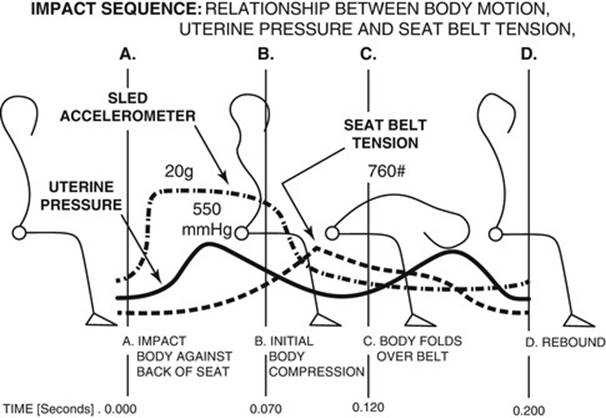
Fig. 10.7
Impact sequence (see test for details) [140]
The first important research line comes from reports by the NHTSA and others, which have shown that in the period 1975–1990, primarily because women are driving more miles, the number of fatal crashes involving female drivers has increased dramatically by 62 % [139]. This large increase in exposure may have resulted in a poorly documented trauma-induced epidemic of fetal loss, fetal injury, and adverse reproductive outcomes. While there is indirect corroborating evidence from national vital statistics data of similar increases in neonatal deaths due to maternal trauma during this time span [148], there is currently no way of confirming this because of the documentation problems mentioned above.
The second research line emerges from looking at the relationship between stress reactions and preterm labor. Although much of this work has focused on the stress of poverty, abuse, and social disparities, trauma itself is a widespread but often overlooked trigger of high levels of stress. It has recently been estimated that 9 % of survivors of serious crashes develop significant post-traumatic stress symptoms and that many other survivors have post-traumatic stress disorder-like reactions [148, 149]. In fact, MVAs may be the leading cause of post-traumatic stress disorder, providing fertile opportunities for stress/reproductive research. One thread suggests that stress either very early in pregnancy or in the 24–28th weeks of pregnancy leads to a twofold increase in the risk of autism [150]. Since autism is usually not apparent until a child is 1–3 years of age, it may be difficult to trace back to the original events. Recently, a study suggested that experiencing a stressful event during the periconceptional period was associated with increased congenital anomalies including heart and neural tube defects and cleft lips and palates [151].
The third research line comes from cohort studies of hospitalized injured pregnant women that linked to birth records. Wolf et al. reported in a 1980–1988 retrospective cohort study of seat belt use and pregnancy outcome after MVAs that unrestrained pregnant women were more likely to give birth to a low birth weight baby and more likely to give birth within 48 h after the MVA than restrained pregnant drivers [45]. One retrospective cohort study showed pregnancy outcomes from hospitalized injury of all types in Washington State in the period 1989–1997 [148]. It reported increased risks for placental abruption, low birth weight, prematurity, and fetal death.
The fourth line of research focused on the risk of fetal mortality versus infant mortality from MVAs. Drawing conclusions from a 15-state study of fetal death certificates, Weiss et al. provided evidence that fetal motor vehicle injury mortality rates were much greater than that of infants [16].
The fifth research line is not as strong because the evidence of harm does not come from population-based studies, but from several case series. An example is the report of Baethmann et al. on the effects of maternal trauma on surviving fetuses [152]. Seven mothers had MVAs; two had blunt abdominal trauma. Later clinical symptoms in the nine children included movement disorders and cerebral palsy among other findings. The causative role of maternal accidents was extremely likely in one patient and probable but “unproved” in the remaining cases. Another more cogent example is from Strigini et al. [153]. In five consecutive cases of fetal intracranial hemorrhage, the similarity of histories involving minor maternal physical trauma (three motor vehicle related and two falls), together with the absence of any known factor predisposing to fetal intracranial hemorrhage, suggested that minor trauma was at least a contributing factor to the observed pathology. Other similar but smaller case series or reports have been reported [154] raising the issue of trauma as a true teratogen (defined by the US Environmental Protection Agency as “The introduction of nonhereditary birth defects in a developing fetus by exogenous factors such as physical or chemical agents acting in the womb to interfere with normal embryonic development”). The most comprehensive study on the subject delivered the data found in Tables 10.4 and 10.5 [107].
Table 10.4
Rate calculations between women ages 15–39 in crashes by pregnancy status, National Automotive Sampling System Crashworthiness Data System, 1995–1999 [107]
|
Reported pregnancy status |
||
|
Rate calculations |
Pregnant |
Not pregnant |
|
Annualized age specific rate per 1,000 live births (using 1997 live births as denominator) |
||
|
15–19 (n = 7,478, SE = 3,265) |
15 |
NA |
|
20–24 (n = 8,230, SE = 2,187) |
9 |
NA |
|
25–29 (n = 8,850, SE = 10,048) |
8 |
NA |
|
30–34 (n = 6,164, SE = 1,737) |
7 |
NA |
|
35–39 (n = 2,088, SE = 558) |
5 |
NA |
|
All ages (n = 32,810, SE = 12,585) |
9 |
NA |
|
Annualized age specific rate per 1,000 person years (assuming pregnancy is detectable over 8 months) |
||
|
15–19 |
23 |
44 |
|
20–24 |
13 |
35 |
|
25–29 |
12 |
22 |
|
30–34 |
10 |
18 |
|
35–39 |
8 |
18 |
|
All ages |
13 |
26 |
Numbers and rates derived from weighted estimates unless otherwise stated
Table 10.5
Selected comparisons between women ages 15–39 in crashes by pregnancy status, National Automotive Sampling System Crashworthiness Data System, 1995–1999 [107]
|
Selected comparisons |
Reported pregnancy status |
|||
|
Pregnant |
Not pregnant |
|||
|
No (%) |
SE |
No (%) |
SE |
|
|
Number of cases, 1995−9 (unweighted) |
427 |
− |
11,972 |
− |
|
Annualized number of cases (weighted) |
32,810 |
12,585 |
1,251,269 |
127,522 |
|
Number (% within age group) that were drivers |
||||
|
15–19 |
5,370 (72) |
2,731 |
217,584 (55) |
38,104 |
|
20–24 |
5,482 (67) |
1,671 |
222,105 (76) |
39,222 |
|
25–29 |
5,654 (64) |
9,746 |
164,136 (81) |
10,816 |
|
30–34 |
4,438 (72) |
1,284 |
137,751 (75) |
18,767 |
|
35–39 |
1,872 (90) |
542 |
147,268 (83) |
13,939 |
|
All ages |
22,816 (70) |
11,662 |
888,843 (71) |
106,928 |
|
Treatment level (% within group) |
||||
|
No treatment |
7,908 (24) |
2,868 |
635,197 (51) |
76,723 |
|
Transport and release/treated at scene |
19,217 (59) |
10,546 |
422,593 (34) |
60,488 |
|
Hospitalized or fatal |
4,413 (14) |
1,345 |
57,857 (50 |
13,092 |
|
Other or unknown |
1,254 (4) |
750 |
135,622 (11) |
11,387 |
|
Total |
32,810 (100) |
12,585 |
1,251,270 (100) |
127,522 |
|
Police reported belt use |
||||
|
None used |
4,395 (14) |
1,696 |
158,021 (13) |
42,023 |
|
Lap and shoulder |
19,805 (59) |
10,546 |
704,799 (59) |
79,038 |
|
Lap or shoulder |
824 (3) |
391 |
29,280 (2) |
5,916 |
|
Belt used, type not specified |
5,716 (18) |
3,162 |
240,731 (20) |
155,053 |
|
Other response |
68 (0) |
59 |
1,321 (0) |
284 |
|
No police indication |
1,970 (6) |
328 |
57,585 (5) |
18,588 |
Numbers and rates derived from weighted estimates unless otherwise stated
Severe fetal injury can result from blunt trauma to the abdomen even in the absence of uterine injury, especially in advanced pregnancy. In early pregnancy the uterus is protected by the bony pelvis and by the amniotic fluid which acts as an hydraulic shock absorber, decreasing the force of the blow by transmitting it equally in all directions: later in pregnancy the fetal head is fixed in the pelvis and the buffering effect of the amniotic fluid is decreased, making the head prone to injury. Skull fractures with intracranial hemorrhage appear to be the most common injuries resulting from blunt trauma.
The importance of MVAs as a cause of pregnancy loss has been largely ignored as a public health problem. Published estimates of the number of fetal losses caused by MVAs each year in the United States range from 1,500 to >5,000 [55]. Although some estimates suggest that these estimates may be somewhat high, it seems clear that the number is significantly greater than the number of infant deaths caused by MVAs and that it probably exceeds the total number of children aged 4 years and younger died in MVAs [155].
Although many clinical protocols have been published for managing trauma during pregnancy [99, 118, 124], few studies have evaluated how to prevent fetal loss by improving safety restraint systems or vehicle design. In order to determine the pregnant occupant crash exposure, the NASS/CDS searched all crashes involving pregnant occupants between 1993 and 2003 [156]. Distribution of impact direction according to the sitting position is presented on Fig. 10.8. One major barrier to the evaluation of the effectiveness of safety improvements for pregnant occupants has been the absence of a pregnancy surrogate for crash testing. In 1996, the first pregnant crash dummy was developed as a feasibility project [157]. Although that project was an important first step in developing a pregnancy surrogate, the design has numerous limitations. In particular, the first-generation pregnant crash test dummy does not provide for assessing the likelihood of fetal loss as a result of separation of the placenta from the uterus, which is believed to be the most common cause of fetal loss from abdominal trauma. In addition, the abdomen of the first-generation pregnant crash dummy does not have a realistic external contour and is too stiff. These deficiencies are likely to cause inappropriate interactions of the pelvis and abdomen with occupant restraints and vehicle components such as the steering wheel rim (Figs. 10.9 and 10.10).

Fig. 10.8
Occupant seating position and impact direction distributions for pregnant occupants [156]
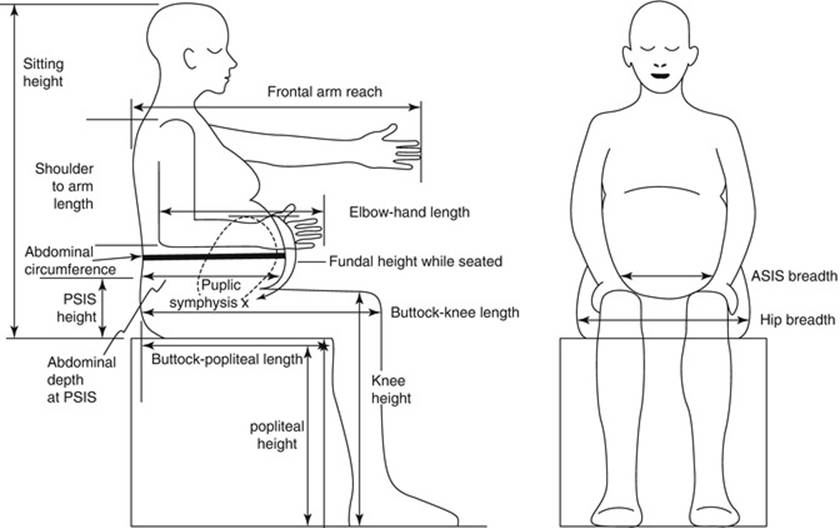
Fig. 10.9
Illustration of anthropometric measurements. ASIS anterior superior iliac spine, PSIS pubic symphysis [43]
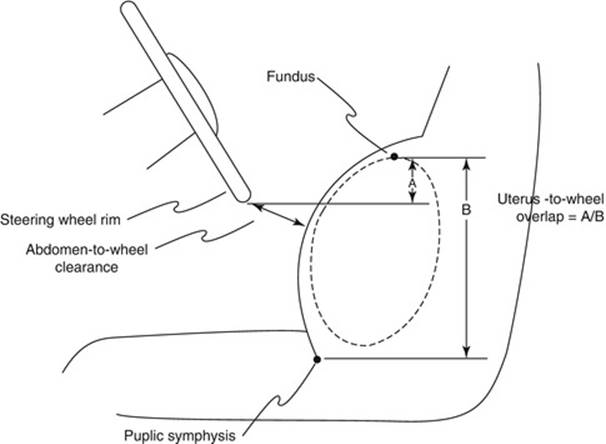
Fig. 10.10
Illustration of abdomen-to-wheel clearance and uterus-to-wheel overlap [43]
However, due to the difficulties in measuring this mechanism in the pregnant dummy, such as tissue strain and pressure, a computational model of the pregnant occupant was created [158]. This computer model has been used to evaluate frontal crashes and has shown that local uterine compression is a critical factor in predicting placental abruption [159].
10.2.2.3 The Seat Belt for the Prevention of Maternal-Fetal Injury
The seat belt was developed by Lavenne in France in 1903 for use in airplanes; it was then adopted for use in motor racing [160] and later widely introduced for occupant protection in the United States in the 1960s [161]. Studies of automobile accidents from the 1960s have shown that the major single cause of fatal injury is ejection from the vehicle [162]. When the body is ejected, injury occurs as it strikes the ground or is crushed by the vehicle. Huelke and Gikas estimated that 80 % of fatally injured automobile accident victims would have survived had they been wearing lap belts [162]. As a result of such studies, lap-type seat belts become standard car equipment in the 1970s [143].
Herbert concluded that lap belts reduce injury 35 % and diagonal belts 80 % [163]. Lister found that seat belts could reduce injuries by 51 % in England [164], and in Michigan, Huelke and Gikas predicted that 80 % of fatal accidents would have survived if they had been wearing only the lap belt [162]. Garrett and Braunstein calculated that there were 35 % fewer major, fatal injuries in seat belt wearers [165]. Lindgren and Warg [166] in Sweden studied injuries in people wearing diagonal-type belts and they concluded that this type of belt reduced by 60 % the number of major injuries that would have occurred without the use of belts. The outcome for the fetus is improved by the use of shoulder restraints. Crosby et al., in a study of 22 baboons in the third trimester of pregnancy, used an impact sled with a decelerative force of 24.5–29.0 G-force to compare the effectiveness of lap belts and shoulder harnesses [147]. They found a significant difference in the fetal death rates, which were 8 % when a shoulder harness was used and 50 % when a lap belt was used. There were no maternal deaths or instances of uterine rupture. Those investigators suggested that the improvement in fetal survival with the use of a shoulder harness was due to the greater surface area over which the decelerative force was dissipated as well as the prevention of forward flexion of the mother.
Seat belt use has been shown to reduce the risk of adverse maternal and fetal outcomes in several large population-based studies [29, 42, 45]. In 1983, the American College of Obstetricians and Gynecologists(ACOG) issued a recommendation that the three-point restraint system (that places the lap belt under the abdomen and across the upper thighs and the shoulder belt between the breasts) should be used by pregnant occupants for maximum protection of the mother and fetus [167].
The three-point restraint system (that places the lap belt under the abdomen and across the upper thighs and the shoulder belt between the breasts) should be used by pregnant occupants. American College of Obstetricians and Gynecologists, 1983
Using the seat belt prevents hitting the windshield with the head and the chest cage in the steering wheel. When a vehicle attacks a barrier with a speed that is realistic in the road traffic, the vehicle in a short time will void its speed and the untied traveler will continue to move in almost the same direction and speed; during the mentioned attack – inside the vehicle – serious or fatal injury can occur. The safety belt is designed to keep the human body in the seat during the crash, meaning that it does not allow the body to strike inner parts of the vehicle or ejection of the body from the vehicle under the influence of created forces. Safety belts are most effective in frontal collisions or when a vehicle attacks the barrier. Researchers have shown that under the crash speed of about 50 km/h, the front is shortening by 50 cm, and a significant part of the load is taken by seat belts. In the sidelong collisions the safety belts are much less efficient, and such collision leads to injuries of the head while hitting the side glass.
There currently are four principal configurations of seat belts in automotive use: the lap belt, the single diagonal belt, the three-point (or combination of lap and diagonal), and the double parallel combination of lap and double shoulder harness (Fig. 10.11).
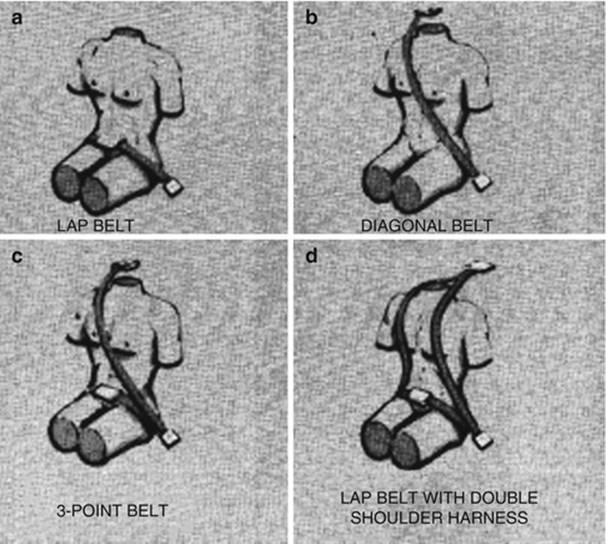
Fig. 10.11
Four basic restraint systems currently used in automotive vehicles [143]. (a) A 2–point belt attaches at its two endpoints. (b) A “sash” or shoulder harness is a strap that goes diagonally over the vehicle occupant’s outboard shoulder and is buckled inboard of his or her lap. (c) A 3–point belt is a Y–shaped arrangement, similar to the separate lap and sash belts, but unitized. Like the separate lap-and-sash belt, in a collision the 3–point belt spreads out the energy of the moving body over the chest, pelvis, and shoulders. (d) Lap belt with double shoulder harness is improved 3–point belt which further spreads out the energy of the moving body over larger body area
Lap belt refers to a single belt across the anterior aspect of the pelvic structure; seat belt refers to any combination of lap and torso restraint. There are numerous variations of the types, such as five-point, double vertical belts without lap belt, and shoulder belts with inertia reels. Diagonal seat belts that run over the shoulder cause injuries that are primarily confined to the upper part of the trunk such as bruised chest, fractured ribs or sternum, and lacerated liver. There are fewer head and neck injuries with this type of belt than with the lap type. Injuries to the pelvis, lumbar spine, and abdomen are found with the lap-type belt. Bone injuries consist of fracture of the pubis, separation of joints, and compression fracture of the lumbar spine, the so-called fulcrum fracture [168]. The use of a lap belt alone may allow enough forward flexion and subsequent uterine compression to rupture the uterus. If the lap belt is worn too high, the force of the impact is transmitted directly to the uterus and likewise may rupture it [169].
It was shown that the three-point belt and the four-point belt were superior in protecting the pregnant occupant by reducing the movement toward the far-side door and therefore eliminating the head-strike potential. However, this resulted in some force being applied through the abdomen and therefore it increased the risk of fetal injury. This is an acceptable trade-off given the most important factor in saving the fetus’ life is keeping the mother alive. The reason that the four-point belt is better than the three-point belt with respect to abdominal loading is that some of the overall load is applied through the mother’s neck and therefore less is applied to the abdomen in order to restraint her for the same given crash speed. The belt contact loads through the neck were below published injury thresholds [156]. Overall, the results indicate for all frontal and side impacts that it is safest for the pregnant occupant to ride in the passenger seat while wearing a three-point belt, or four-point belt if possible, and utilizing the frontal airbag when appropriate [158]. Study by Klinich et al. found that the odds of adverse fetal outcome, including fetal loss, preterm delivery, placental abruption, and uterine laceration, after an MVA were 4.5 times higher among women who were not properly restrained compared with those who were properly restrained at the time of the crash [170].
The Seat Belt Syndrome
Distinctive injuries caused by safety belt due to traffic accidents were first described as the seat belt syndrome coined by Fish and Wright [171]. These injuries were described even before [165, 172]. They noted two cases of rupture of the pregnant uterus caused by seat (lap) belts. Rubovits in 1964 first reported the traumatic rupture of a 6-month pregnant uterus in a woman whose car was struck at 56 km/h by another vehicle head-on front quarter, when the other vehicle jumped a divider. There was avulsion of the uterine musculature at the site of the seat belt impact. This was attributed to the force of the belt at the anterior uterine wall being transmitted to the fetus, which was then blasted through the left uterine wall [145]. This was fatal to the fetus. As in the case reported above, absence of sign of shock or intraperitoneal hemorrhage precluded diagnosis for 2 days. Therefore, the disadvantages of using seat belts are most often related to injuries that it can cause during a collision. Previous researches [173] have shown that injuries caused by the seat belt are most likely as follows:
· Abdominal organ damage
· Bowel rupture
· Abdominal wall injuries
· Ruptured liver
· Blood vessel trauma
· Chest trauma
· Fractured sternum
· Myocardial contusion
· Spine fractures
There are countries like Japan where the pregnant women while driving are exempted of use of the belt [107] due to possibility of fetal injury during sudden braking. It is important that pregnant women wear their seat belt to prevent secondary collision with interior structures of the vehicle or sudden ejection, to dissipate the force of an impact [174], and to provide both the mother and the fetus with maximum protection. But the seat belt must also be worn correctly to prevent potential significant harm to both the mother and fetus. Women are reported to be at an increased risk for intra-abdominal injuries or uterine rupture if restraints are improperly positioned at the time of collision [175]. In 1992, ACOG recommended that all women receive seat belt counseling from prenatal care providers [176]. Nevertheless, many pregnant women report uncertainty about the safety and use of seat belts during pregnancy [177] and lack of information regarding proper seat belt use and its role in protecting the fetus [178]. If women regularly and correctly wear their seat belts, prenatal counseling on seat belt use during pregnancy would not be an important public health issue, but that is not the case. A 2004 study of women attending prenatal clinics by McGwin et al. reported that only about 45 % always wear their seat belts (both before and during their current pregnancy) even though 72.5 % of subjects were able to demonstrate the proper way to wear a seat belt [178]. In addition, only 58 % thought that seat belts would have a positive effect if they were in a MVA during pregnancy, 34 % were unsure of the effect, and 8 % thought the seat belt would cause them to get hurt [178]. When asked if a seat belt would help protect their baby in the event of a crash, only 55.3 % of the women thought that the seat belt would help, 10.7 % said it would do harm, and 34 % were unsure [178]. The women who thought a seat belt would help protect them were significantly more likely to report always wearing a seat belt versus the women who were unsure or thought negatively of the seat belt (84.4 % vs. 64.6 %) [178]. Considering this finding, it seems that knowledge and belief in the effectiveness of the seat belt could help motivate women to use a seat belt. Therefore, prenatal care providers should take the opportunity that prenatal visits provide to educate women on the importance of proper use of seat belts during pregnancy to protect both the mother and fetus and the hazards of crashes during pregnancy [179], as well as clear up any misconceptions that a woman may have about seat belt use. However, several questions remain. For instance, what percentage of women are actually receiving seat belt use counseling, how many wear their seat belts during pregnancy, and how many report being hurt in a MVA?
Seat Belt Use Counseling
In summary, reported prenatal care provider counseling for seat belt use occurred in 48.7 % of prenatal visits; women aged 20–29, nonwhite, Hispanic ethnicity, and less educated were the most likely to report being counseled on seat belt use; women who were 30 or older and had a greater than high school education were more likely to report always wearing seat belts in the last trimester; and on average, 2.3 % of respondents reported being hurt in a “car accident” during pregnancy. Women less than 20 years old, of black race, and less educated were the most likely to report being hurt in a crash during pregnancy. It is encouraging that this study determined that black women are the most likely to report being counseled on seat belt use during pregnancy, because this study also determined that black women were more likely to report being hurt in a crash. To further support this finding, from 2001 to 2005, black women of reproductive age (15–44) were more likely to be involved in a nonfatal MVA than white women [180]. Although there are groups of women who are more at risk for experiencing a crash during pregnancy, it has been demonstrated that less than half of women always wear their seat belt (including before and during pregnancy) [178]. For this reason, all women should be counseled on the importance of seat belt use and how to properly wear a seat belt during pregnancy regardless of age, race, ethnicity, or education. Extrapolating from the reported Pregnancy Risk Assessment Monitoring System (PRAMS) rates in 2001 to the US population, it is estimated that at least 92,500 pregnant women (rate = 2.3/100 live births) are hurt in MVAs each year in the United States. This finding is important because it is one of the few such estimates available from population-based multi-state data sources. The only previous estimate came from analysis of crashes reported by the NASS/CDS from the period 1955 to 1999 [107]. The latter reported only about 33,000 pregnancy-related crashes (not injuries) annually. The current PRAMS data portrays the magnitude of the level of underreporting in the NASS data system, because by definition, pregnancy status is 100 % complete in PRAMS. The findings regarding seat belt counseling were similar to the findings of earlier studies. The percentages of women who reported being counseled were 48.7 % in 22 PRAMS states, 53 % in 14 PRAMS states during 1997 and 1998 [181], and 48 % in 19 PRAMS states in 2000 [179]. The consistently low prevalence of seat belt use counseling during pregnancy suggests that this issue has not yet been properly addressed. Interventions needs to be put in place to ensure that women are educated and counseled on the importance of and proper use of a seat belt during pregnancy. Prenatal counseling is a time where topics related to the health of the mother and the baby are discussed and proper seat belt use should be included. It is important to note that the literature is not unanimous on whether prenatal counseling is the best way to increase the use and proper use of seat belts during pregnancy. It is particularly important among those women identified as being more at risk for adverse pregnancy outcomes (young women who smoke, do not begin prenatal care during the first trimester, and have not completed high school).
One issue with seat belt counseling during pregnancy is that some women have been reported to forget some of the topics that were discussed during prenatal counseling, including seat belt use. Tyroch et al. did a follow-up survey in pregnant women after their initial prenatal visit and showed that 73 % of the women did not recall having received advice on seat belt use even though they received brief counseling by a clinician and a pamphlet on seat belt use during pregnancy during their initial visit [182].
The authors suggested that new teaching methods such as audiovisual aids, mannequins, or having women demonstrate proper seat belt use to the health-care provider may increase knowledge retention [182]. However, among the population in general, some research suggests educational initiatives have been ineffective at increasing seat belt use when compared with successful legislative and enforcement efforts [183].
On the other hand, several studies have reported positive effects due to prenatal counseling. For instance, Pearlman and Philips administered a survey to women who consecutively presented for their first prenatal visit and readministered the survey at their second visit (28–32 weeks gestation) to assess the attitudes toward and usage of lap and shoulder belts. The authors showed that women who received seat belt use instructions were more likely to use restraints and properly identify restraint position than those who received no information [184]. Similar findings were reported by Johnson et al. for pregnant women who recalled being advised on correct placement [160]. Thus, studies show that education by prenatal care providers increases the number of pregnant women correctly using seat belts [46, 160, 184]. Therefore, instruction by health-care providers is an important component to solving the problem of incorrect seat belt placement [160] and lack of use among pregnant women. This study is not without several limitations due to the way that PRAMS collects data. The first limitation is potential misclassification. Since it has been shown that some women forget about counseling [182], it is possible that some women are misclassified as never having received prenatal counseling on seat belt use in the PRAMS data, when in fact they did. Another limitation is potential recall bias due to the fact that PRAMS collects data from women within 2–6 months postpartum. This means that some women are asked to recall counseling information and topics that were provided or discussed potentially over a year before the data were collected and those who had uneventful pregnancies may be less likely to remember specific counseling topics. However, this is a common limitation with retrospective studies, and as discussed, perhaps a more impressionable counseling approach would increase the number of women who use and correctly use their seat belts during pregnancy and consequently are better able to recall counseling. Future research is needed to determine the effectiveness of different educational strategies [173].
Another limitation of this study is that out of the 22 states in this study, only Maryland and Vermont collected data on seat belt use during pregnancy and the data they collected is only for the last three months of pregnancy. This limits the generalizability of the seat belt use data not only for women in those two states but also to only women in their third trimester of pregnancy. Seat belt use might change as a woman’s pregnancy advances due to the growing abdomen and increasing level of discomfort, but with incomplete and limited PRAMS data on seat belt use throughout pregnancy, these practices cannot be adequately measured. Nevertheless, the sample from these two states was large enough to provide useful results on these issues and can show other states the usefulness of adding these variables to their PRAMS surveys.
Comparison of Belted and Unbelted Pregnant Women
There is only one study by Hyde et al. with comparison of belted and unbelted pregnant population during MVAs with short- and long-term follow-up [42]. The main findings are that nearly 3 % of births linked to MVAs during pregnancy and that pregnant women in crashes in which the mother wore her seat belt were not significantly more at risk for adverse fetal outcomes than pregnant women not in crashes. Pregnant women who did not wear seat belts during a crash were more likely to have:
· Low birth weight infant
· Excessive maternal bleeding
· 3× higher incidence of fetal death
Authors found that 2.8 % of all live births in the state were from mothers who were exposed to a driver-related MVA during pregnancy. Considering the absence of data on nondrivers and nonreported crashes, this suggests that in Utah more than 3 % of all live births are from mothers exposed to a MVA. The only other study known to estimate the rate of MVA exposure during pregnancy reported it as 1 % based on investigator reports from the NASS/CDS and was thought to have underestimated [107]. Although belt use has been shown to be effective in reducing morbidity and mortality for the mother and the fetus when comparing belted and unbelted pregnant women [45, 147, 185], this study extends these findings by showing that belted pregnant women in crashes were not significantly more at risk for adverse fetal outcomes than pregnant women not in crashes. No other studies have compared crash-related pregnancy outcomes with a noncrash population. Schiff et al. [186] found that, compared with uninjured pregnant women, injured pregnant women were at increased risk of several adverse outcomes, including placental abruption, prematurity, low birth weight, fetal distress, and fetal death. However, Schiff et al. only included women who had been hospitalized for their injuries and delivered during their hospital stay, which would indicate an overall greater severity of injuries than the study by Hyde et al. Because the Schiff et al. study also focused on all injuries, and not just MVA, the authors were not able to control for severity-reducing countermeasures such as seat belt use. Lack of seat belt use has previously been associated with low birth weight by Wolf et al. [45], who also documented an increased risk of delivery within 48 h of the crash. There is no increased risk of immediate delivery. Unbelted pregnant women were nearly three times more likely to experience fetal death than belted pregnant women in crashes. Even though the small numbers of fetal deaths in the study by Hyde et al. limited the ability to more completely describe the effect of MVA risks on fetal death, the crude OR of 2.8 was an indication that the unrestrained pregnant women were much more likely to lose their fetus in a MVA than restrained women. Wolf et al. [45] found no statistically significant increase in the risk of fetal death associated with lack of seat belt use, despite their larger parameter estimate (4.1 vs. 2.8). Another population-based study [185], published over 40 years ago, reported that lap belt use was associated with a reduction in maternal death and maternal injury, but there was no association with fetal loss. The authors concluded, however, that lap belts were preferable to no restraint. The majority of fetal deaths (51 %) were linked to crashes that occurred during the first trimester, even though all of the fetal deaths occurred during the second and third trimesters. This may be a result of the fact that first trimester crashes have up to 36 weeks to result in a fetal death, whereas the other trimesters have correspondingly less time to do so. Essentially, there was a longer exposure period of gestation in which fetal deaths could occur, whether or not those fetal deaths were related to the crash. Another possibility is that the last trimester may be offset by an increased likelihood of these infants being born through trauma- or physician-induced labor, which may have resulted in deaths not recorded in the fetal death file. Finally, the finding may suggest that the first trimester represents a sensitive period of fetal development and vulnerability to crashes but that the fetal deaths do not occur (or are not noticed) until a few weeks later in development. Further research is warranted to better determine how gestational age impacts fetal death due to crashes. Also there is increased risk of fetal death for unbelted crashes that occur during the later weeks of gestation. When comparing gestational age and the time of fetal death, the unbelted group had sharp increases of fetal deaths between 31 and 38 weeks’ gestation. This may be indicative of a period of increased vulnerability to fetal death from MVA among unbelted drivers. One might believe that this increase is a result of more crashes during the third trimester. However, linkage of all births involving unbelted MVA showed that only 25 % of crashes occurred during the third trimester, the lowest percentage of any trimester. On the other hand, 55 % of fetal deaths among the unbelted group linked to third trimester crashes. Therefore, this pattern is probably a result of something different than increased crash risk. These findings have implications for health providers as well as researchers involved with crash dummy development. For instance, crash dummy testing has mainly focused on the 28–30-week gestational age period for designing the physiological characteristics of a pregnant woman and the fetus [43, 157]. It is important to design dummies representing a few weeks later in gestation to more appropriately target the population that may be at the greatest risk for fetal death. Despite substantial research on the protective value of seat belts, many women still do not wear them during pregnancy. Previous research indicates that the leading reasons for lack of seat belt use during pregnancy include forgetting, discomfort or inconvenience, no seat belt available, and fear that seat belts may cause injury to the fetus or mother [187]. It is worth noting that some countries exempt pregnant women from seat belt laws, which may be promulgating misconceptions about seat belt use during pregnancy. Studies also show that many women are simply unaware of the correct usage and positioning of seat belts [160, 167].
Factors associated with low seat belt compliance – younger age, lower education, lower socioeconomic status, seating location (passengers), and longer annual distance traveled – are also important factors during pregnancy [188–193]. Seat belt use during pregnancy has gone unnoticed in Japan because expectant mothers are exempted from seat belt legislated requirements [194]. Compared with seat belt use before pregnancy, seat belt use during pregnancy was reduced for both drivers and front-seat passengers. This trend is contrary to the finding in California that seat belt compliance significantly increased during pregnancy (79 % before pregnancy vs. 86 % during pregnancy) [182]. A study in New Mexico, where seat belt use was generally low, found that seat belt use increased from 27 to 42 % during pregnancy [187]. If concerns associated with the gestation period dissuade maternal seat belt use, then gestation period would be a major determinant for nonrestraint use during pregnancy. However, a recent study in the United States reported that trimester status has relatively little effect on seat belt use [107].
It is interesting to note that seat belt use was consistently higher among drivers than front-seat passengers despite discomfort of the steering wheel. Since front-seat passengers are less likely to wear seat belts than drivers among the general population (88.1 % for drivers vs. 75.2 % for front-seat passengers) [195], it is possible that the same trend would be seen in pregnant women. A large majority of the respondents in studies in the United Kingdom and the United States, where pregnant women are encouraged to continue wearing seat belts, reported that seat belt use is beneficial for both pregnant women and their fetuses [160, 182]. In contrast, only one-third of respondents acknowledged this. Seat belt use was less among pregnant women who knew of the current exemption (Tables 10.6 and 10.7) [196].
Table 10.6
Reported seat belt use before pregnancy and current use among 880 pregnant women in Japan, shown by gestation period; results in absolute numbers and % [196]
|
Location/seatbelt use |
<20 weeks |
20–29 weeks |
30 weeks + |
|||
|
Before |
Current |
Before |
Current |
Before |
Current |
|
|
Driver’s seat |
||||||
|
Always |
172 (82.3) |
129 (62.3) |
211 (83.4) |
127 (51.4) |
229 (78.4) |
108 (37.9) |
|
Often |
14 (6.7) |
22 (10.6) |
17 (6.7) |
30 (12.1) |
31 (10.6) |
32 (11.2) |
|
Sometimes |
19 (9.1) |
34 (16.4) |
22 (8.7) |
42 (17.0) |
29 (9.9) |
58 (20.4) |
|
Never |
4 (1.9) |
22 (10.6) |
3(1.2) |
48 (19.4) |
3(1.0) |
87 (30.5) |
|
Front passenger’s seat |
||||||
|
Always |
164 (76.3) |
118 (55.1) |
190 (72.0) |
108 (41.4) |
208 (67.3) |
89 (29.2) |
|
Often |
19 (8.8) |
35 (16.4) |
24 (9.1) |
36 (13.8) |
45 (14.6) |
26 (8.5) |
|
Sometimes |
25 (11.6) |
33 (15.4) |
41 (15.5) |
57 (21.8) |
42 (13.6) |
81 (26.6) |
|
Never |
7 (3.3) |
28 (13.1) |
9 (3.4) |
60 (23.0) |
14 (4.5) |
109 (35.7) |
Total number (in driver’s seat) is not equal to the number of pregnant women (with driver’s license) due to missing data
Seat belt use before pregnancy was not significantly different across gestation periods, whereas the difference in current use was significant across gestation periods
Table 10.7
Number and proportion of pregnant women who reduced seat belt use after pregnancy, shown by gestation period (%) [196]
|
Location |
20 weeks |
20–29 weeks |
30 weeks |
|
Driver’s seat |
25.7 |
41.1 |
55.6 |
|
Front passenger’s seat |
27.4 |
45.2 |
58.9 |
None reported that their obstetricians had given this information perhaps because Japanese obstetrics textbooks do not address this issue. In other industrialized countries, obstetricians take an important role in disseminating maternal seat belt use information and pregnant women who reported receiving this information were more likely to wear seat belts and do so correctly [160, 184]. Daily car users were less likely to wear seat belts despite their longer exposure to the risk of traffic injuries. This suggests that frequent car use may lower risk perception [188, 191]. The limitation of Japanese study [196] is that authors did not examine whether pregnant women wear seat belts correctly, and it is likely that incorrect use is similar to that reported elsewhere [160, 182, 184]. Current recommendations still support the use of three-point restraints (i.e., lap and shoulder belt) for all pregnant women [197, 198]. The lap belt should be placed as low as possible, beneath the bulge of the uterus, and the shoulder belt should lie to the side of the uterus and run between the breasts and over the midportion of the clavicle (Fig. 10.12).
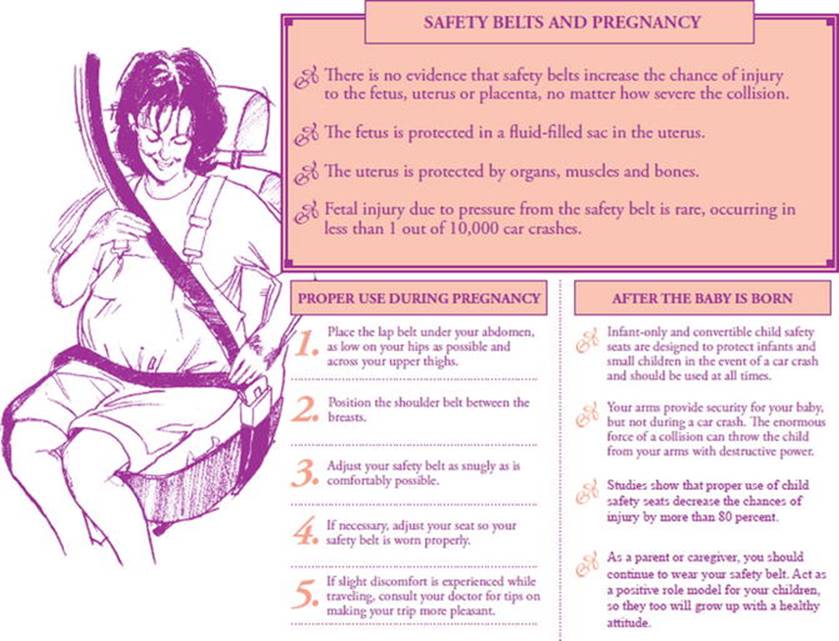
Fig. 10.12
Leaflet about proper position of seat belt in pregnancy (Ohio Department of Public Safety)
The Airbag as a Passive Factor of Safety of Road Vehicles
The airbag is passive safety system of vehicles, which is nowadays more and more found in standard equipment of vehicles. In a crash, the airbag is opened by means of sensors within 30–50 ms and is rapidly filled with gas, usually nitrogen, to softly await the body of passengers and in that way to absorb inertial force of the body. Airbag for driver and passenger should protect against head injuries and chest in the frontal crash. For the full effect, airbags should works in combination with safety belts that are tied at three points. In the collision of the head and upper body, the airbag must not constitute a strong barrier to maintain constant pressure. The body hitting the bag pushes gas filling through the exhaust openings from the airbag. The basic elements of the airbag are:
· Bag of multilayered composites based on polyamide
· Gas generator
· Contact board with an initiative capsule
· The electronic control unit with a sensor system
To ensure active filling of the airbag, the two sensors are mainly built in a vehicle, in a bumper, and in the divider between the engine parts and space for passengers. Sensor system, a few milliseconds after impact, transmits an electronic signal that activates the initial capsule with approximately 8 g of plastic explosives. The explosion lits the initial mixture in the generator gas, whose combustion releases nitrogen to fill the airbag. The airbag is, after inflated and depreciated the impact of driver, blown out, and the whole cycle takes about 150 ms. Due to the cases when the electronic trigger did not worked at the time of the accident, the mechanical activation of the airbag has been introduced. The negative effect of opening the airbag and a loud burst with strength of 140–160 dB should not pose a threat to human hearing because the impact of vehicle alone into another vehicle or object creates a louder noise.
The biggest imperfection of airbags is their ability to activate when they are simply not expected. Except with failure in the system that may cause the opening of the airbag, there is a risk that the airbag opens in collisions when a vehicle has low speed and airbag is not needed to absorb the body impact to the steering wheel. In such cases, due to low speed, the body does not come into contact with the interior of the vehicle because of its small inertia forces, but it reinforces the seat belt in the vehicle seat. If the airbag is activated, in such cases, it can cause head and chest injuries, which would not emerged if the airbag is not activated.
Such injuries are especially dangerous for pregnant women because they can cause death of the fetus. Such phenomena are trying to be solved in a way that airbags do not open up to a certain vehicle speed or up to specific vehicle body deformation. The European cars are built with two types of airbags:
· 35 l “eurobag”
· 67 l “bull size”
Although the “euro” airbag adds significantly to the safety, measurement results conducted on the dummies in crash tests showed significantly less stress in the critical part of the cervical vertebrae and smaller injuries when using a large “bull-size” airbag. Newer-generation airbags like the French SRP system (System de Retenue Programmee) function in a way that they are programmed to strain safety belts with pyrotechnic strainer that work in combination with the new generation of airbags. These bags can bend from top to bottom and sideways, which allow regular distribution of tensions in the chest, and have specially calibrated valve that regulates the throughput power and exhaust of gas. Such combined protection proved to be much more successful than previous ways of functioning, so chest injuries are 70 % less.
10.2.2.4 Maternal Pelvic Trauma
Despite the occurrence of pelvic and acetabular fractures among women of childbearing age, literature specifically addressing patients who sustained pelvic or acetabular fractures in pregnancy is scarce. In a recent review, Leggon et al. [199] examined 101 cases of pelvic fractures (11 acetabular and 89 pelvic) in pregnant women. Overall, maternal mortality was 9 % and fetal mortality 35 %. Automobile-pedestrian collisions had a statistically higher maternal mortality rate than pregnant women involved in vehicular collisions which had a statistically significant trend toward a higher fetal mortality rate, as compared to falls. Most maternal deaths occurred from associated injuries, in particular from acute hemorrhage [199]. Injury severity influences both maternal and fetal outcomes. Increasing injury severity (minor to moderate to severe) and associated injuries significantly increased both maternal and fetal death rates. Direct injury to placenta, uterus, or fetus accounted for fetal deaths in 52 %, while maternal hemorrhage (with or without maternal death) accounted for 36 % of the non-surviving fetus. These observations are similar to predictors of fetal death after severe trauma in pregnancy in general. Predictors of fetal death in trauma in pregnancy include automobile-pedestrian collisions [38], motorcycle collisions [38], lack of restraints [38], maternal ejection during trauma [38, 57], and increased injury severity score (ISS) [57, 200].
The close association between concomitant abdominal and pelvic injuries and fractures of the acetabulum or pelvis reflects the kinetic injury dissipated with the initial impact. Reported incidences of associated injuries in series of pregnant patients with pelvic fractures include the following rates: abdomen, 42 % (bladder 13 %, kidney 6 %, liver 6 %, spleen 5 %, urethra 5 %); closed-head injury, 37 %; thorax, 25 %; and most frequently, additional orthopedic injuries (fractures) in 48 % of patients with pelvic fractures [200]. Overall, outcome of patients with pelvic fractures in pregnancy due to blunt trauma correlates with the severity of associated injuries and physiological derangement on admission rather than with characteristics, or the type, of pelvic fracture. Occurrence of pelvic fractures in young patients requires transmission of significant amounts of kinetic energy and should therefore be regarded as an index injury mandating a thorough search for other occult visceral injuries.
Fetal Injury
Pelvic trauma in the third trimester of pregnancy should alert the trauma surgeon and obstetrician of direct injuries to the fetus. If the mother survives, fetal loss occurs in the majority of cases because of placental abruption, while direct injury to the fetus in the absence of uterine injury is a relatively infrequent event [197]. Direct injury of the fetus is usually associated with trauma occurring late in pregnancy and most commonly involves fracture of the fetal skull [197]. This is especially likely during the third trimester when the fetal head is engaged low in the pelvis trapped between the anterior pelvic ring and the sacrum. The vast majority of in utero skull fractures have been related to severe maternal injury involving pelvic fractures [201]. Fetal skull fractures should be regarded as an index injury for severe maternal trauma. Vice versa, multiple pelvic fractures in pregnant women require a thorough sonographic and radiographic examination of the uterus and fetus.
10.2.3 Falls
Falls accounted for more than half of classifiable reported maternal injuries during pregnancy, and about 3 % of all mothers reported at least one fall during pregnancy. Falls are also the leading cause of nonfatal injury among women of childbearing age (15–44 years) in the United States, although they account for only 20 % of nonfatal injuries among this more general population [202]. Falls may be a more common mechanism of injury during pregnancy, particularly in the second and third trimesters, because of [203]:
· Weight gain
· Shift in the center of gravity to accommodate the expanding uterus
· Increased joint mobility experienced during pregnancy
Increased levels of relaxin result in softer ligaments, cartilage, and cervix allowing the tissues to spread during delivery. The pubis symphysis – cartilage joining the pubic bones – and sacroiliac joint, where the hips attach to the spine, become unstable during pregnancy to aid delivery. The occurrence of falls becomes more likely as pregnancy progresses, with nearly 43 % of reported falls occurring during the third trimester [204, 205]. Although extensive clinical guidelines exist for physician counseling about the importance of fall prevention in the elderly (American Geriatrics Society, British Geriatrics Society), clinical guidelines for counseling about fall prevention for pregnant women are limited to warnings against strenuous physical activities with high risk for falls, such as horseback riding and skiing. In the injury descriptions, falls during pregnancy most often occurred during normal daily activities.
10.2.4 Social Violence
Throughout the world, many studies have been performed to assess the prevalence of domestic violence in pregnancy. The reported rates of abuse vary significantly, from 5.4 to 27.7 % [206–211]. This reflects both a genuine diversity in the occurrence of violence and in definitions of abuse used by researchers. The prevalence of interpersonal violence during pregnancy ranged from approximately 2.0 % in Australia, Cambodia, Denmark, and the Philippines to 13.5 % in Uganda among ever-pregnant, ever-partnered women; half of the surveys estimated prevalence to be 3.9–8.7 %. Prevalence appeared to be higher in African and Latin American countries relative to the European and Asian countries surveyed. In most settings, prevalence was relatively constant in the younger age groups (15–35 years), and then appeared to decline very slightly after age 35 [212]. Parker et al. noted that as many as 20.6 % of pregnant teenagers and 14.2 % of pregnant adult women were physically abused during pregnancy [213]. Interpersonal violence has been emphasized as an etiology of trauma only during the past few decades. Sexual or physical abuse occurs in up to 17–32 % of pregnancies, and 60 % of those abused reported multiple episodes of abuse [26, 214]. In one study 75 % of the women who were hospitalized twice during the same pregnancy had domestic abuse as the cause of the trauma. It was also noted that one patient was seen for trauma from a domestic violence encounter during two separate pregnancies [215]. Abuse often begins or escalates during pregnancy or the immediate postpartum period. Most often the abuser is known to the patient, frequently her husband or partner. In addition to acute trauma during pregnancy, it should be noted that probably these women are exposed to repeating violence. Because many women seek medical attention only when they become pregnant, health-care providers of pregnant women play a crucial role in discriminating women who are abused. Because the woman has her unborn child’s safety in mind, she may be more motivated to seek assistance and she may speak more freely during pregnancy. Among 15 studies addressing pregnancy outcomes and exposure to violence, five have reported a positive association between intimate partner violence and low birth weight or preterm birth [216–220]. Rates of low birth weight among battered women were 1.5–2.5 times higher [216–218] than those among nonbattered women, and rates of preterm birth were 2.5–4 times higher [216–218, 221]. Among 10 studies reporting no association of abuse with adverse pregnancy outcomes, one did not report outcomes separately for women exposed to verbal and physical abuse [222]. Others lacked sufficient power to address most pregnancy outcomes assessed [223–226]. One study ascertained exposure status through a mailed survey [227], whereas the others interviewed study subjects. A number of studies have reported increased rates of low birth weight, reduction in mean birth weight, or preterm labor in bivariate analyses, but the associations became nonsignificant when adjusted for use of tobacco and other substances [228–231], only one being population based [227].
Pregnant patient presenting with blunt trauma not from traffic should be examined in detail for the signs of older trauma which could lead to chronic violence.
Adverse pregnancy outcomes after minor trauma occur at a rate 1–5 % [232]. Because more than 90 % of all injuries to pregnant women are the result of minor trauma, most pregnancy losses associated with trauma occur in cases of minor trauma [233]. The rate of fetal mortality after maternal blunt trauma is 3.4–38.0 % [2, 9, 26, 37, 38, 53, 57, 120, 234], mostly from placental abruption, maternal shock, and maternal death (Table 10.1) [2, 16, 37, 38, 40, 234–238]. Fetal loss can occur even when the mother has incurred no abdominal injuries [37, 53]. Among pregnant trauma victims, head injury and hemorrhagic shock account for most deaths [239, 240]. Serious injuries do not result in a higher mortality rate in pregnant women compared with nonpregnant women. However, splenic and retroperitoneal injuries and hematomas are more frequent in pregnant victims of blunt abdominal trauma due to increased vascularity during pregnancy. Conversely, bowel injury is less frequent [133, 239]. Regardless of the apparent severity of injury in blunt trauma, all pregnant women should be evaluated in a medical setting [2].
As previously stated domestic violence occurs in up to 25 % of pregnant women [17, 48], but physicians detect only 4–10 % of cases [26]. It is important for physicians to screen all patients for domestic violence and to be familiar with the community resources for helping patients who experience domestic abuse [17]. As with any trauma patient, the entire body needs to be examined, looking for hidden injuries under clothes, makeup, jewelry, or wigs. Injuries range from cuts, bruises, and black eyes to miscarriage, bony injuries, splenic and liver trauma, partial loss of hearing or vision, and scars from burn or knife wounds. Injuries to the breast, chest, and abdomen are more common in battered women, as are the presence of multiple old and current injuries. Defensive injuries are common. For example, fractures, dislocations, and contusions of the wrist and lower arms result from attempts to fend off blows to the chest or face. Injuries inconsistent with the patient’s explanation of the mechanism of injury should also raise suspicion of abuse. The presence of these patterns of injury should raise concern about abuse during evaluation in the emergency room (Table 10.8).
Table 10.8
Warning signs of domestic abuse [17]
|
Mixture of old and new injuries |
|
Characteristic injuries (multiple soft tissue injuries, fingernail scratches, cigarette and rope burns, areas usually covered by clothes – breast, chest, abdomen, genitals) |
|
History of prior domestic abuse |
|
Isolating behavior of partner |
|
Behavior of patient: depressed, poor eye contact, fearful, withdrawn |
|
Pregnant patient: trauma to breast and abdomen; no prenatal care; unexplained spontaneous abortion, miscarriage, or spontaneous labor |
|
Family income below $10,000/year |
10.2.5 Obstetric Consequences of Blunt Trauma
10.2.5.1 Mode of Delivery
Pelvic Fractures
The recommended method of delivery for pelvic fractures during pregnancy depends on the presence of initial fetal and maternal distress, the degree of fetal maturity, the maternal injury severity, the displacement of the pelvic or acetabular fracture, and the eventual course of labor. Because these fractures tend to heal within 8–12 weeks, vaginal delivery should not be contraindicated after fractures that occurred earlier in pregnancy. Pubic ramus fractures adjacent to the urethra or bladder, severe lateral compression fractures, and acute fractures of the pelvis with marked displacement may be relative indications for Cesarean delivery if labor starts in a viable pregnancy. In the recent review by Leggon et al., vaginal delivery was successful in 75 % of pelvic fractures that occurred in the third trimester [199].
10.2.5.2 Placental Abruption
Incidence
Over 70 % of fetal losses following blunt abdominal trauma result from placental abruption [54, 55, 133, 232, 241]. Studies suggest that the incidence of abruption is approximately 5 % [118, 185, 239]. Clinically evident placental abruption occurs in up to 40 % of severe blunt abdominal trauma and in 3 % of minor trauma with direct uterine force [239, 241]. In 1942, VanSante reported a case in which blunt trauma to the maternal abdomen resulting from a fall off a stepladder was followed by spontaneous delivery of a stillborn infant and a placenta showing a clean laceration through both the fetal and the maternal surface at the area of insertion of the umbilical cord [242].
Pathophysiology
The mechanism of placental abruption resulting from trauma is based on the fundamental differences in tissue characteristics between the uterus and the placenta. The uterus consists of a significant proportion of elastic fibers whereas the placenta is largely devoid of elastic fibers. Thus, when an external deforming force is applied to the uterus, its inherent plasticity allows deformation. At the same time, the placenta cannot undergo similar deformation and a shearing effect is created at the uteroplacental interface. It is also thought that concomitant increases in amniotic fluid pressures propagate this shearing effect, further separating the placenta from the underlying decidua. Experiments have been conducted on pregnant baboons, which were subjected to decelerative forces (~20G) typical of MVAs [243]. Such forces produce very high intrauterine pressures (~550 mmHg).
Because most blunt abdominal trauma occurs to the anterior uterine wall, one would expect that if the mechanism of separation were just displacement from the striking object, the risk of abruptio placentae would be greater when the placental location is anterior. However, the pathophysiological mechanism of separation just described does not explain the finding that an anterior placental location does not appear to be a risk factor for abruptio placenta resulting from trauma [118]. Two alternative possibilities should be considered. Firstly, the contained mass within the amniotic fluid (i.e., the fetus) can either strike the placenta in any location and thus create a potential shear or, alternatively, pull the placenta by transmitting force via the umbilical cord. A second possibility that could explain the lack of importance of placental location on the likelihood of abruptio placentae is that traumatic deformation may set up a fluid wave within the uterus. In this case, a force striking the anterior uterine wall would cause elongation and narrowing of the uterus as the contained amniotic fluid is non-compressible. The fluid wave would then “rebound” and expand horizontally causing a shortening and widening of the uterus. Again, because of the fundamental tissue differences between the uterus and placenta, a shearing effect of this interface could occur completely independent of placental location [55, 133]. Placental abruption risk is independent of whether placental location is anterior or posterior.
Clinical Presentation
Traumatic placental abruption may occur even when there are few other signs of trauma. Clinical findings may include vaginal bleeding, abdominal cramps, uterine tenderness, amniotic fluid leakage, and maternal hypovolemia out of proportion to visible bleeding. Only 35 % of clinically significant placental abruptions had vaginal bleeding [99]. Up to 2,000 ml of blood can accumulate in the uterus, and this can be a cause of maternal shock. In a patient with intrauterine hemorrhage, the uterus may be larger than normal for gestational age. Changes in fetal cardiotocography, such as bradycardia, loss of beat-to-beat variation, or sinusoidal patterns, may also indicate placental injury, fetal hypoxia, or fetal blood loss.
10.2.5.3 Placental Tear
History and Incidence
Traumatic laceration of the placenta following blunt abdominal trauma is even more infrequent than placental abruption. The first case published was by VanSante in 1942 when he reported a case in which blunt trauma to the maternal abdomen resulting from a fall off a stepladder was followed by spontaneous delivery of a stillborn infant and a placenta showing a clean laceration through both the fetal and the maternal surface at the area of insertion of the umbilical cord [242]. In 1969, Peyser and Toaff reported a similar case following a MVA in which a radial tear involved the whole thickness of the placenta; the fetus subsequently bled to death in utero [244]. Spontaneous laceration of a placental vein resulting in intra-amniotic hemorrhage has also been described [245]. The uterus, umbilical cord, and fetus were completely intact in all of these cases and in the two patients reported by Stuart et al. [246].
Pathophysiology
There are two mechanisms of placental injury. The placental injury may be mediated by either a contrecoup or a direct force depending on the location of placental implantation and the direction of abdominal injury/deceleration. Following disruption of the placental circulation, the fetus bleeds to death in utero.
Contrecoup Mechanism
If the placenta is implanted posteriorly in the uterus and deceleration starts, a contrecoup mechanism similar to that in closed-head injuries occurs. Although the initial decelerative force is applied to the anterior abdominal and uterine walls, the incompressible amniotic fluid immediately anterior to the fetus would have retarded the forward movement of the fetus. The sudden anterior force to the uterus momentarily causes the posterior uterine wall and the placenta to move away from the fetus, the result being a “vacuum” between the fetus and the posterior wall. When the anterior decelerative force was no longer applied to the uterus, the posterior wall would have stopped moving and the vacuum would have caused the fetus to be projected against the placenta on the posterior uterine wall. In this situation the amniotic fluid, instead of acting as a buffer for the fetus, is operating as a vehicle for fetal movement, allowing sufficient mobility for a contrecoup injury of the placenta. This is analogous to injury of the occipital region of the brain following a frontal blow, when the cerebrospinal fluid acts as the vehicle for contrecoup movement of the brain.
Direct Placental Injury
When the placenta is implanted anteriorly in the uterus, the initial decelerative force applied to the anterior uterine wall causes the fetus to be propelled forward. The amniotic fluid, though incompressible, allows the fetus to travel forward with sufficient momentum to apply a sudden force to the surface of the placenta implanted on the anterior uterine wall, causing a “bursting” or irregular laceration of the fetal surface of the placenta (Fig. 10.13).
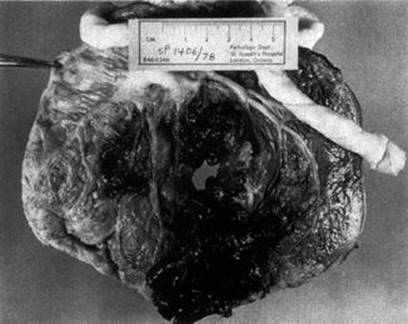
Fig. 10.13
Approximately 3 cm from the insertion of the umbilical cord was an elliptical laceration of the placenta through both the fetal and the maternal surfaces; it measured 6.5 × 2.8 cm. The cotyledons were intact, but there were masses of clot adherent to the fetal surface. Microscopically the placenta and the umbilical cord were normal [246]
10.2.5.4 Preterm Labor
The true incidence of preterm labor following trauma during pregnancy is not known. It appears to be under 5 % [99, 118]. Traumatic injury to the uterus may result in destabilization of lysosomal enzymes that can initiate prostaglandin production. This is the mechanism presumed to cause preterm labor associated with trauma. Another possibility is that trauma may cause preterm premature rupture of membranes and preterm birth. Administration of slow-released progesterone should be considered in all women with contractions after trauma in pregnancy to decrease the rate of preterm birth and the risks of prematurity [247].
10.2.5.5 Fetal Injury
Direct Fetal Injury
Direct fetal injuries and fractures complicate less than 1 % of severe blunt abdominal trauma in pregnant women, since the maternal soft tissue, uterus, and amniotic fluid absorb energy and diminish the force delivered to the fetus. Most cases, with severe injuries, occur during late pregnancy [133, 239]. Cranial injuries are the most frequently reported category of direct fetal injury after blunt abdominal trauma. Fetal brain and skull injuries may be more common in cases with fetal head engagement in which maternal pelvic fractures occur [142, 248]. Deceleration injury to the unengaged fetal head may also occur [63–65, 133, 239]. Isolated fractures of the mandible, the clavicle, the vertebrae, and all the long bones have been reported [249]. In these direct injuries either the maternal abdominal wall is struck by a blunt instrument or the maternal abdomen strikes the car’s dashboard, steering wheel, or other area. Such injuries may not be diagnosed at the time of the accident, and the pregnancy may well continue to term in the absence of concomitant placental or uterine injuries. Intrauterine fetal fractures may spontaneously heal in utero, as evidenced by callus formation at the fracture site [249].
Indirect Injury of the Fetal Viscera
Indirect injury of the fetal viscera – that is, injury in the absence of external evidence – has been reported, but one can only speculate on the mechanism of injury. Connor and Curran reported a case in which the fetus suffered hepatic, renal, and adrenal contusions and hemorrhage without showing external evidence of trauma [250]. They suggested that the injury was due to rapid compression and impact of the organs during deceleration, but whether it resulted from a contrecoup effect within their attachments or was secondary to a shearing force within the organs could only be conjectured [251].
10.2.5.6 Uterine Rupture
Uterine rupture can be spontaneous (see Chap. 16) or is a rare complication of blunt abdominal trauma, complicating about 0.6 % of traumatic events during pregnancy [239]. The first published paper found was by Lazard and Kliman from 1936 [252]. Authors proposed classification of traumatic uterine rupture:
· Complete, through the entire uterine wall, with complete or partial extrusion of the uterine contents into the abdominal cavity.
· Incomplete, where the rupture is not through the entire uterine wall. As to location, the tear may be in the upper or in the lower uterine segment, usually the upper when due to external trauma.
Incidence
In a review of the literature, by Estor and Pueck (referred to by Jaroschka, Medizinische Klinik, 1929), up to and including 1929, 40 cases were found. Additional cases in the 1930s were described by Orthner [253], Lazard and Kliman [252], Ruder and Moore [254], and Smilow [255].
Etiopathogenesis
Traumatic Uterine Rupture
While a trauma of sufficient force may cause a rupture in a healthy uterus, the presence of a weakened point caused by preceding disease, such as hyaline degeneration of muscle fibers resulting from multiparity, previous curettages, placenta previa, intramural fibroids, etc., would undoubtedly increase the probability of rupture resulting from external violence.
Orthner gives the following explanation of the mechanics of the injury [253]: as to whether the blow or the resultant fall is the principal factor, one can assume that whichever is of the greater intensity is the chief factor, i.e., with a slight blow and a fall from a great height, the latter is the main factor; with a severe blow and a short fall to the floor, the blow in all probability is to blame. It is not possible, as a rule, to determine the kind and direction of the force from the location of the uterine rupture, as this usually occurs by contrecoup.
The rupture is always the result of a sudden increase of the intrauterine pressure, caused by the sudden compression of the abdominal contents. In accordance with the laws of hydrodynamics, this pressure spreads equally in all directions in the uterine cavity filled with amniotic fluid. The tear occurs at the weakest point of the uterine wall. At the end of pregnancy, that point is at the fundus, which, moreover, lacks the protection of the bony pelvis. In many cases it appears that the placental site is especially weak because of the increased vascularity.
The site of rupture bears a direct relationship to the site where direct traumatic or contrecoup forces are applied mostly involving the uterine fundus (Fig. 10.14), although other locations and degrees of uterine rupture from other causes have also been reported [133, 239, 256]. This is because amniotic fluid transmits high pressures efficiently; “blast injuries” can follow blunt trauma, resulting in rupture of the uterine fundus mostly.

Fig. 10.14
Ruptured uterus. Transverse rupture on the posterior surface of the fundus after falling down on steps [252]
Fetal Injury
Traumatic uterine rupture is commonly associated with fetal injury. In extreme situations (mother hit by a truck) the fetus was found on mother’s thigh (Fig. 10.15). Coutts explain two possible mechanisms [257]:
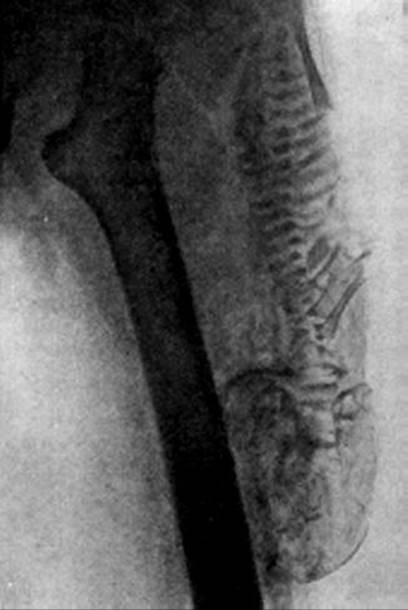
Fig. 10.15
A vertical incision was made on the upper anterior surface of the right thigh, extending up to the groin, and the fetus was found lying just under cover of the skin and superficial fat [257]
1.
2.
Clinical Presentation
The classic description of uterine rupture includes the following: severe uterine pain and tenderness, profound shock, palpation of fetal parts outside the uterus, and vaginal bleeding. These complex findings, however, often are not present [258–260]. Consequently, the diagnosis is often delayed or not considered at all. Uterine blood flow increases from nongravid rate of 60 cm3/min up to 600 cm3/min at term [239]. A loss of blood volume such as that seen with trauma is compensated in part by an increase in uterine vascular resistance and decreased uterine blood flow [57]. Hemodynamic stability in the mother, therefore, is maintained at the expense of uterine blood flow, putting the fetus at risk [40, 197]. As a consequence, fetal distress may be the first indicator of unsuspected maternal hemorrhage. The presence of maternal hypotension is a late and ominous sign.
Treatment
The diagnosis of uterine rupture warrants immediate surgical intervention. As to therapeutic procedure, much depends on the location of the rupture and the degree of injury (Table 10.9). Total abdominal hysterectomy is considered the operative intervention of choice, although subtotal hysterectomy or simple suture repair may be reasonable alternatives [258, 260, 262]. If it occurs in the fundus, a repair of the laceration is quick and is done with less shock. If the tear is located in the lower segment, transverse hysterectomy is indicated. Palliative measures must be considered and might be lifesaving, such as the application of the Momberg belt or clamping the uterine arteries through the cervix until the patient can be relieved of shock and prepared for surgery.
Table 10.9
(Pregnant) uterus injury scale [261]
|
Gradea |
Description of injury |
AIS-90 |
|
I |
Contusion or hematoma (without placental abruption) |
2 |
|
II |
Superficial laceration (<1 cm) or partial placental abruption <25 % |
3 |
|
III |
Deep laceration (≥1 cm) in second trimester or placental abruption 25–50 % |
3 |
|
Deep laceration (≥1 cm) in third trimester |
4 |
|
|
IV |
Laceration involving uterine artery |
4 |
|
Deep laceration (≥1 cm) with >50 % placental abruption |
4 |
|
|
V |
Uterine rupture |
4 |
|
Second trimester |
5 |
|
|
Third trimester |
4–5 |
|
|
Complete placental abruption |
aAdvance one grade for multiple injuries up to grade III
Prognosis
Uterine rupture tends to occur only in the most serious accidents involving direct abdominal trauma. This event can be catastrophic for both the mother and her unborn fetus, especially when there is a delay in the diagnosis, since initial symptoms may be variable. With traumatic rupture, fetal mortality approaches 100 % and maternal mortality close to 10 % with most maternal deaths due to concurrent injuries [124, 239, 263, 264]. At first glance, it is striking that most of the patients reported have survived. However, a reason for the survival is to be found in the fact that the blood vessels constrict and thus the bleeding rapidly diminishes or even stops entirely. The uterine contents (the placenta, the amniotic sac, etc.) are immediately emptied into the abdominal cavity, whereupon the uterus contracts as it would following Cesarean section. Since the blood supply at the midline (where the rupture usually occurs) is scanty, these contractions of the uterine muscle practically stop the bleeding. This consideration suggests that in cases where the placenta is inserted more toward the parametrial region, where the contractibility is less and the blood vessels are much larger, the trauma would result in fatal exsanguination.
10.2.5.7 Fetal-Maternal Hemorrhage
Fetal-maternal hemorrhage (FMH) occurs four to five times more frequently in injured pregnant women than in uninjured controls, and the volume of transfused blood is also greater in injured women [44, 99, 118, 133]. A direct correlation between the incidence of FMH and the severity of maternal injury has not been demonstrated [55, 239]. Pearlman et al. [118] found that neither the severity of injury nor the presence of uterine activity was predictive of FMH. However, an anteriorly positioned placenta and the presence of uterine tenderness did correlate with FMH. Complications of FMH include rhesus (Rh) sensitization in the mother, neonatal anemia, cardiac arrhythmias in the fetus, and fetal death from exsanguination [239]. The Kleihauer-Betke acid elution assay is one method used to detect FMH and should be considered in every woman, in order to determine the Rh immune globulin dose necessary to be administered to women who are Rh- and suffered a massive transfusion [54, 55, 118, 239]. The amount of FMH sufficient to sensitize Rh- mothers is far below the level detected by most laboratories. In a study by Pak et al., none of the patients had a positive Kleihauer-Betke test result, which indicated the absence of significant FMH [215]. This differs dramatically from 8 % to 30.6 % FMH rates reported by other investigators [44, 99, 239]. This difference in the rate is likely due to the fact that the study by Pak et al. included only those with noncatastrophic trauma, whereas other studies included patients with catastrophic trauma. Although Mostello et al. [265] suggest that the Kleihauer-Betke test is not indicated in the Rh+ woman without symptoms, quantification of FMH is still recommended for all patients with abdominal trauma regardless of their Rh status by several other studies [44, 99, 118]. Until more sensitive diagnostic tools for detection of placental abruption and subsequent FMH are available to the obstetrician, continued use of the commonly available screening tests for all pregnant women who have abdominal trauma is recommended.
10.2.5.8 Traumatic Rupture of Membranes
Rupture of membranes (ROM) secondary to trauma in pregnancy is seldom an isolated injury. A thorough search for concomitant injuries is mandatory and prolonged continuous fetal monitoring strongly advocated. In the absence of maternal or fetal compromise, management is usually not different from spontaneous ROM.
10.2.5.9 Urinary Bladder Rupture
If bladder rupture is suggested by clinical findings (e.g., severe abdominal pain, board-like rigidity of the anterior abdominal wall, blood on the external meatus, gross hematoma) or by radiologic findings (e.g., pelvic ring disruption, obliteration of pelvic fat planes), then a cystogram with a maximally distended bladder and a post-evacuation film, as a minimum, should be obtained. To do this procedure, one may place in a retrograde fashion at least 250–300 ml of contrast material into the urinary bladder as much as the alert patient will tolerate. If an upper abdominal contrast-enhanced CT evaluation is necessary, some radiologists may be tempted to perform a CT cystogram instead of a routine cystogram. Goldman and Wagner consider this inadequate because the bladder may not be completely distended with contrast material [266]. Furthermore, oral contrast material should be given for bowel opacification to obtain an adequate abdominal CT study. However, this contrast material may obscure and confuse the findings if a subsequent plane-film cystogram is needed. The one exception is the potentially unstable patient, where the contrast should be diluted to 5 % and instilled into the bladder before any CT cuts are obtained. Air can be used as a substitute bladder contrast agent.
10.2.5.10 Traumatic Rectus Sheath Hematoma
There is a case with suspected blunt abdominal trauma during pregnancy with verified rectus sheath hematoma after delivery. Therefore, it is not known whether the cause is abdominal trauma or the process of delivery with straining itself [267]. Possible mechanism is that during distension of the abdominal wall in pregnancy causes elongation of the inferior epigastric artery. Blunt trauma to that region possibly causes further distension of inferior epigastric artery beyond its elastic modulus making it prone to tears and lacerations. Rectus sheath hematoma is described in detail in Sects. 11.6 and 11.6.8 in Chap. 11.
10.2.6 Diagnosis
10.2.6.1 Laboratory Findings
· Base deficit (BD) >−6 has probability ≥95 % for the absence of intra-abdominal bleeding.
· BD ≤−6 and increased pulse rate indicate that there is a markedly enhanced risk for intra-abdominal bleeding.
Decreased BD and/or increased pulse rate was highly sensitive for detecting patients with internal bleeding [268–270], although both of these research focused on BD and one of them [268] chose a BD of ≤−4. BD ≤−6 had sensitivity of approximately 88.2 % compared with ultrasonography, 76.5 % [270]. The latter is due to the fact that ultrasonography is not likely to detect most retroperitoneal or pelvic injuries [271]. However, ultrasonography has a positive predictive value of approximately 100 % and nearly equal negative predictive value with BD for detecting free fluid [272]. Finally, BD correlates well with blood transfusion and laparotomy requirements (68.4 % of patients with BD ≤−6 indicated for blood transfusion compared with only 1.2 % of patients with BD >−6 and 57.9 % of patients with BD ≤−6 indicated for laparotomy compared with only 1.2 % of patients with BD >−6). Therefore, patients with blunt abdominal trauma whose BD is ≤−6 are more prone to laparotomy and blood transfusion [270, 273]. The same results and conclusions are confirmed in pregnant women who we often do not want to expose to radiation. All of these patients whose BDs were ≤−6 had intra-abdominal bleeding and undergone blood transfusion. This fact shows the importance of BD in pregnant patients [270]. A normal BD does not exclude intra-abdominal injury in blunt trauma patients, but the presence of a BD ≤−6 should be considered a strong indication for abdominal evaluation. The results of the study demonstrated that a BD of ≤−6 has high sensitivity and specificity for detecting free intraperitoneal fluid in patients with blunt abdominal trauma, as well as a high transfusion requirement and laparotomy in these patients.
Placental Abruption
There has been a great interest in using laboratory markers in aiding the diagnosis of placental abruption. Elevated D-dimer levels and fibrin-split products (FSP) are early markers for accelerated fibrinolysis in beginning disseminated intravascular coagulopathy (DIC). Although often found to be elevated in cases of placental abruption, most studies failed to demonstrate clinical usefulness as a screening test [41, 274]. Although placental abruption is frequently found in association with FMH, screening for fetal blood cells in the maternal circulation with Kleihauer-Betke tests has a low specificity and is currently for this purpose not recommended [10, 47].
10.2.6.2 Focused Abdominal Ultrasound for Trauma
Focused abdominal sonography for trauma (FAST) performed by radiologists, sonographers, trauma surgeons, and emergency physicians is an important method of evaluating patients with blunt trauma worldwide and has been extensively studied. Previous investigators have reported sensitivities for the detection of free fluid with this method that ranges 42–100 % [271, 275–279]. Goodwin et al. reported a sensitivity of 83 % in their retrospective study of 208 pregnant patients, although they did not directly compare sonography results in pregnant patients with those in nonpregnant patients [19]. One explanation for the marked number of false-negative results is that FAST is performed relatively early in the resuscitation process, at a time when hemoperitoneum may not have accumulated to a detectable amount. In the study from 2004 [279], a marked number of false-negative results (27.5 %) were observed in patients with bowel and mesenteric injuries; this finding is consistent with findings of previous studies involving both sonography and CT [280].
Miller et al. [278] suggested that all hemodynamically stable patients who have sustained blunt abdominal trauma should undergo CT scanning rather than FAST to prevent the possible underdiagnosis of intra-abdominal injury. This may be a difficult concept to apply in the assessment of pregnant patients because the risk of teratogenesis from CT radiation exposure, however minor, may be unacceptable. Further consideration should be given to the gestational age of the fetus, because radiation exposure in early pregnancy would have a more deleterious effect than radiation exposure in later pregnancy [281]. In one series at a large trauma center [119], only 7 % of pregnant patients with trauma underwent CT scanning; this is comparable to the 8.2 % of patients who underwent it in the study by Richards et al. [279]. It appears that the decision to perform a CT examination is arbitrary and may depend on the presence of equivocal objective findings that might result in an unnecessary laparotomy.
Although not as sensitive as CT, FAST has a distinct advantage over CT in the rapid triage of unstable patients with blunt trauma who cannot safely travel to the CT suite. Detection of free fluid and/or parenchymal abnormality in this setting results in safer and faster disposition to the operating room than could be accomplished with either CT or diagnostic peritoneal lavage. If no free fluid is detected, the patient may be transferred to the labor and delivery area for fetal monitoring and potential delivery. With this method, the possibility of teratogenesis from the ionizing radiation at CT and the risk of an allergic reaction to intravenous CT contrast material are avoided. In the future, sonography performed with contrast material may be a viable alternative to CT. In one small, blinded study with 15 patients with abdominal trauma that involved comparing CT with power Doppler, there were no false-positive or false-negative examination results in the Doppler arm [282].
Pelvic Free Fluid
Physiological free fluid (FF) in the pelvis of normal women was first described by Novak in 1922 [283]. Since then, many have investigated the characteristics, etiology, and typical volume of physiological FF. Varying amounts of FF have been detected during the menstrual cycle, with the greatest volume detected during ovulation [284–286]. This FF is presumed to serve the teleological purpose of transporting the ovum by wave motion [285–287]. Prevalence of transient physiological FF on transabdominal ultrasonography in reproductive women has been estimated to range from 36 % to 40 %. The estimated mean volume ranges from 5 to 21 ml [284–286, 288–293]. This phenomenon has been attributed to:
· Fluid secondary to follicular rupture [284]
· Ovarian fluid exudation secondary to increased capillary permeability under the influence of estrogen [284, 289]
· Blood secondary to retrograde menstruation [294]
The amount of peritoneal FF seemed to decrease significantly after the peak, near menstruation [284, 289]. In study by Ormsby et al. [295], detection of FF in (a) both the abdomen and pelvis had the highest association with intra-abdominal injury, followed by (b) FF isolated to abdomen, then (c) isolated to pelvis, and the least is (d) when there was no FF. Sirlin et al. [296] have reported that FF most often occurs at the site of organ injury and also within the pelvis. Another study of women of reproductive age, in which 8 % were pregnant, compared the FF location to injury rate [297]. The conclusion was that there was no difference in injury rate between those with isolated pelvic FF and those without FF and that isolated pelvic FF was not likely to be associated with intra-abdominal injury. These findings differ from Ormsby et al. in that isolated pelvic FF had a statistically significant higher injury rate than those without FF in pregnant and nonpregnant women. The discrepancy between previous findings by Sirlin et al. [297] and findings by Ormsby et al. regarding isolated pelvic FF among nonpregnant patients may be due to several factors. Sirlin et al. had only 8 % of pregnant patients. In study by Ormsby et al. [295], there was a larger sample size with 16 % of pregnant women. Physiological FF is detected mostly during ovulation and a few days after ovulation in 36–40 % of nonpregnant women, according to previous studies [285, 286]. Therefore, outside of their ovulation period, these women would not be likely to have sonographically detectable amounts of physiological FF. Unfortunately, authors did not query the menstrual history of their study subjects. Therefore, it is impossible to know if there were a greater percentage of women who were anovulatory and/or were in a time period of their menstrual cycle when physiological FF is less likely to be seen.
Transabdominal sonography is less sensitive than transvaginal sonography in detecting pelvic FF [290, 293, 298, 299]. Von Kuenssberg Jehle et al. [300], in their study on the sensitivity of the pelvic view on transabdominal ultrasound imaging for the detection of FF, administered intraperitoneal fluid directly to both male and female patients until the fluid was identified on pelvic view. They reported that the mean minimal volume of fluid detectable by pelvic ultrasound by the examiner and reviewer was 157 and 129 ml, respectively, with the lowest volume detected by examiner to be 73 ml. This is much larger than the average 7–21 ml of physiological fluid aspirated from the cul-de-sac of women [284, 288–293]. Thus, any trace FF in the pelvis on FAST exam in the setting of blunt abdominal trauma may indicate the FF level is not physiological. It might then be more difficult to attribute pelvic FF detected by FAST of women who are anovulatory or using oral contraceptives as physiological, since the average volume is much smaller in these patients [284, 289].
Transvaginal sonography is more sensitive in detecting FF in the cul-de-sac [290, 293, 298, 299]. Although more likely to detect small volumes of pelvic FF, it is impractical, as it would be difficult to perform in the active trauma resuscitation setting. Furthermore, trauma patients undergoing FAST do not always have the benefit of having a completely full bladder. Therefore, FAST would not be expected to reliably detect small amounts of FF that would be detected during a detailed comprehensive transvaginal ultrasound examination. Of interest, there were three patients in the study by Ormsby et al. who had ruptured ectopic pregnancies, one of whom had FF isolated to the pelvis and the other two cases with FF in both the pelvis and abdomen. Additionally, of the 53 total patients with isolated FF in the pelvis, 87 % underwent further tests (CT, exploratory laparotomy, and/or diagnostic peritoneal lavage) compared to the 49 % with isolated FF in the pelvis in the study by Sirlin et al. [297]. This may also explain the difference between these two studies. In pregnant patients, small amounts of pelvic FF may be missed due to a mass effect of the enlarging uterus [301]. It was previously described that ultrasound was less sensitive for detection of intra-abdominal injury in pregnant versus nonpregnant female patients [279]. In that study authors did not address the perplexing problem of isolated FF detected in the pelvis of traumatized female patients. However, Sirlin et al. [296] did address the question of location of FFs in this patient population. Another possible explanation of missed pelvic FF is adequate bladder distention during ultrasound. Sirlin et al. [297] have noted that using a full bladder technique increased detection of pelvic FF that is of minimal amount and often physiological. One study has reported that a significant cause for missing pelvic FF was the bladder not being distended enough to provide an adequate acoustic window [302]. Patients with blunt abdominal trauma often have a Foley catheter, which decompresses the bladder. Without a full bladder as an acoustic window, FF in the pelvis may be overlooked with transabdominal ultrasound. This may explain why some patients had false-negative FAST in the group without FF in the study by Ormsby et al. Of the nine false-negative cases in pregnant patients, 67 % were due to placental abruption. It has previously been reported that ultrasound is not sensitive for detection of placental abruption [303]. For these patients, careful clinical correlation such as gestational age, significant vaginal bleeding, fetal distress, and/or severe abdominal pain should be made. If placental abruption were excluded for the group comparison, pregnant patients in a group without FF would have an injury rate of 1 % with no change for the group where the fluid was isolated to pelvis. Also, as Sirlin et al. [297] used a full bladder, this could explain why their detection of FF in trace amounts was probably physiological. Without a full bladder, only larger amounts of FF would be detected. These amounts may be more significant than small amounts of fluid.
Isolated pelvic FF was the second most common true-positive fluid accumulation pattern observed in the study by Richards et al. [279]. The ability to distinguish between physiological FF and FF resulting from injury has been addressed in a previous study: Sirlin et al. [297] reported isolated FF in the cul-de-sac in 56 patients, and only two had injuries, but they made no distinction between pregnant and nonpregnant patients. Their conclusion was that isolated FF in the pelvis was likely to be physiological and not due to injury. In another study, 54 % of the false-positive US examinations in pregnant and nonpregnant patients combined revealed isolated FF in the pelvis [279]. Also of interest in the same study are the three patients with undiagnosed ectopic pregnancies that ruptured after their traumatic events. The incidence of ectopic pregnancy has steadily increased over the past 3 decades, and these patients are seen more frequently in the acute care setting [304]. Transvaginal US has been the imaging study of choice for detecting ectopic pregnancy, but less is known regarding transabdominal US for this indication [305]. US assessment of FF in the three patients in the study by Richards et al. [279] revealed isolated pelvic FF in two patients and FF in the Morison pouch and the pelvis in one patient. On the basis of these findings, isolated FF in the pelvis cannot necessarily be discounted as being physiological in the pregnant patient. Sirlin et al. [296] analyzed the results of 2693 US examinations for blunt abdominal trauma and determined that FF present in the left upper quadrant, in both upper quadrants, or diffusely was significantly associated with splenic injuries. In one study, all pregnant patients with splenic injuries had FF in the left upper quadrant [279].
The dynamics of flow in the abdomen are of interest in that FF tended to flow from the left to the right upper quadrant rather than down the left paracolic gutter into the pelvis. One explanation for this may be that hemorrhage from the spleen first accumulates in the left and then progresses to the right upper quadrant because the phrenocolic ligament acts as a relative barrier to the movement of fluid to the left gutter [306]. It also appears that fluid from the right upper quadrant flowed down the right paracolic gutter rather than toward the left upper quadrant, perhaps because of the gravity dependence of the right paracolic gutter and pelvis. In the study by Richards et al. [279], the most common pattern of FF accumulation in pregnant patients with fetuses of all gestational ages was a pattern of accumulation in the left and right upper quadrants and the pelvis (Figs. 10.16 and 10.17). However, US depicted pelvic FF in pregnant patients in the third trimester, and the sensitivity of focused abdominal US for trauma was the highest for patients who were in the first trimester of pregnancy. One possible explanation for this may be that the compression of intra-abdominal structures, specifically the paracolic gutters, by the expanding uterus may make it more difficult to detect FF in the paracolic gutters and pelvis [307].
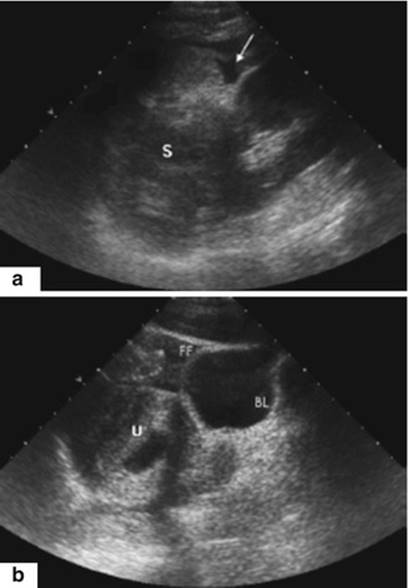
Fig. 10.16
Images in a 22-year-old woman in the first trimester of pregnancy who had sustained blunt abdominal trauma and subsequent splenic laceration in a motor vehicle collision. After US was performed, the patient was taken immediately to the operating room for laparotomy. (a) Longitudinal US image of left upper quadrant reveals perisplenic free fluid (arrow) and abnormal-appearing splenic parenchyma (S). (b) Longitudinal US image of pelvis shows free fluid (FF) superior to the bladder (BL) and gravid uterus (U) [279]
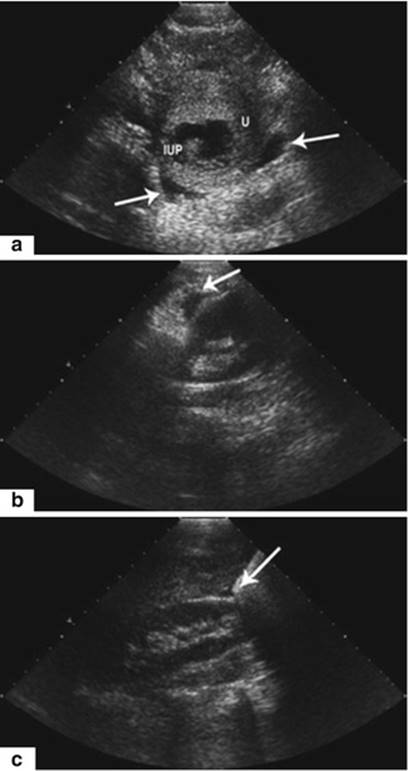
Fig. 10.17
A 19-year-old pregnant female in her first trimester involved in a high-speed motor vehicle accident with spleen laceration. (a) Transverse scan of the pelvis with empty bladder shows early intrauterine pregnancy and bilateral free fluid (FF) (arrows) adjacent to the uterus. (b) Transverse scan of the left upper quadrant demonstrates FF (arrow). (c) Longitudinal scan of the right upper quadrant demonstrates FF (arrow) in the hepatorenal fossa. IUP intrauterine pregnancy, U uterus [295]
It has been suggested in the past that the fetus is well protected against injury from blunt trauma because it is encased in a fluid-filled structure [308]. It was shown that intra-abdominal injuries in pregnant patients were most common to the spleen or placenta, necessitating precipitous delivery or resulting in fetal demise [279]. Thus, the shear forces present in even low-force injuries such as falls cannot be discounted, and it is recommended that US, as well as fetal monitoring for patients whose fetuses are past 20 weeks’ gestation, should routinely be used in pregnant patients with trauma. Continuous fetal monitoring is more sensitive but is less specific than US for the detection of placental abruption [118].
Spleen
The spleen (Fig. 10.18) and liver are most likely to be damaged in later stages of pregnancy, as they are displaced by the expanded uterus closer to the chest wall. Although there are no guidelines on the management of specific injuries in the pregnant patient, there is experience with successful nonoperative management of stable patients in the gravid state [310]. With concomitant head injury, intervention with either embolization or splenectomy is recommended (see Chap. “9” where further discussion is found in Sect. 9.1). This approach is designed to prevent hypotension and instability, which would worsen the prognosis of their head injury. Likewise, one could argue that the risk to the viable fetus from ongoing hemodynamic instability may warrant adopting a more aggressive approach in the management of traumatic injuries in the mother.
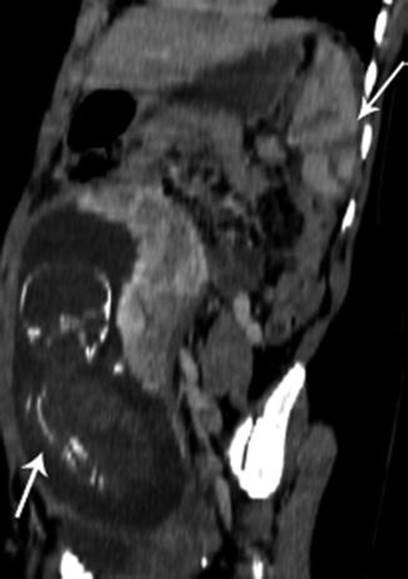
Fig. 10.18
An oblique sagittal reformatted CT scan image showing traumatic splenic laceration (right arrow) and the 26-week fetus (left arrow) [309]
Placental Abruption
Ultrasound examination of the pregnant abdomen to detect FF is much more useful than clinical examination. The sensitivity of sonography to identify post-traumatic abruption is only 40–50 % [41, 118]. Therefore, the absence of visualization of subchorionic hemorrhage or a retroplacental clot (Figs. 10.19 and 10.20) on ultrasonography in the presence of clinical symptoms like abdominal pain mandates further continuous fetal monitoring with a low threshold to intervene should signs of fetal distress appear.

Fig. 10.19
Placental abruption. Emergency ultrasound performed in the trauma bay reveals presence of anechoic pockets representing hematoma separating the placenta (P) from the myometrium (M) [309]

Fig. 10.20
Placental abruption. A 21-week pregnant patient. A heterogeneous collection is seen interposed between the placental edge (P) and the myometrium (M). The collection lifts the placental edge away from the underlying myometrium [309]
10.2.6.3 Cardiotocography
Ultimately, complete placental separation and fetal demise will occur as the process of placental abruption continues. Depending on the size of the initial clot, placental abruption might not be infrequently asymptomatic in its early stages. Owing to the high thromboplastin concentration in the surrounding trophoblastic tissue, local DIC is likely to develop leading to expansion of the clot. With expansion of the retroplacental clot, uterine activity will usually emerge. With more than eight registered contractions per hour and in the absence of reassuring fetal monitoring, there is a 25 % chance of finding placental abruption in pregnant women after blunt abdominal trauma [118].
10.2.7 Treatment
10.2.7.1 Observation
There is much controversy regarding the optimum duration of observation needed in the gravid woman who has had any form of trauma. The controversy results from the fact that the frequency and onset of adverse outcomes are uncertain. This uncertainty has led to the development of many different protocols for the management of the pregnant patient with trauma. Over three-quarters of women were admitted for only 1 day following MVA. Although the optimal length of time necessary to monitor women in hospital with minor or no obvious injuries following a MVA cannot be determined in one study, it would suggest that 1 day is sufficient in most cases, without any adverse impact on complication rates [3].
The management of pregnant trauma patients may be assisted if we stratify injured women into four groups [54]. The first is comprised of injured women who are unaware that they are pregnant. Since routine radiographic studies have the greatest teratogenic potential in early pregnancy, a pregnancy test should be obtained from all trauma patients of reproductive age. The second group is pregnant women of less than 24–25 weeks of gestation where the primary focus is aimed solely at the mother, since the fetus has not yet reached the border of viability. The third group consists of pregnant women at a gestational age beyond the border of viability. For this group, monitoring, support, and clinical consideration are aimed at two patients, the mother and fetus. The fourth group is comprised of severely injured women who present in a perimortem state. In these patients early Cesarean section may facilitate maternal resuscitation and increases the chance of fetal survival.
10.2.7.2 Radiologic Interventional Techniques
Classified as zone 3 of the retroperitoneum, hemorrhage into the pelvis is difficult to control operatively and is usually managed with interventional embolization if pelvic fracture is not present that mandates fixation (see section “Pelvic fracture treatment”) which, apart from bone stabilization, also stabilizes retroperitoneal hematoma. The radiation dose required for interventional radiologic procedure(s), however, can be prohibitive.
10.2.7.3 Surgical Treatment
Initial Stabilization
A systematic approach to initial stabilization and management should be used after blunt trauma in pregnant women (Fig. 10.21) [37, 38, 47].

Fig. 10.21
Algorithm for the management of the pregnant woman after blunt (abdominal) trauma. Algorithm combined from the algorithms proposed by Grossman [20] and Muench et al. [311]; KBKleihauer-Betke test, FHT fetal heart tones, EFM electronic fetal monitoring, PTL preterm labor
Rapid maternal respiratory support is critical; anoxia occurs more quickly in advanced pregnancy as functional residual capacity may be significantly reduced, leading to more rapid respiratory decompensation, particularly with chest trauma so supplemental oxygen should be administered early (Fig. 10.21) [312–314].
Evaluation of the fetus should begin only after the mother has been stabilized. Supplemental oxygen and intravenous fluids are administered initially and are continued until hypovolemia, hypoxia, and fetal distress resolve [47]. These measures maximize uterine perfusion and oxygenation for the fetus [47]. In animal studies, improvement in fetal partial pressure of arterial oxygen or fetal heart rate is slower with the use of saline or lactated Ringer’s solution than with blood replacement attesting to the importance of restoring oxygen-carrying capacity as well as blood volume [57, 61, 315].
Because of the increased blood volume late in pregnancy, the mother may not show typical signs of hypovolemia, even with loss of a large volume of blood (up to 2,000 ml). However, uterine perfusion still may be compromised.
Uterine blood flow may decrease by up to 30 % before the mother demonstrates clinical signs of shock. Therefore, blood transfusion should be initiated when significant blood loss has occurred or is suspected.
It is important to recognize that significant blood loss can occur in the uterine wall or retroperitoneal space without external bleeding. After 20 weeks of gestation, the uterus may compress the great vessels when a pregnant woman is supine. This compression can cause a decrease of up to 30 mmHg in maternal systolic blood pressure, a 30 % decrease in stroke volume [312], and a consequent decrease in uterine blood flow [47]. Manual deflection of the uterus laterally or placement of the patient in the lateral decubitus position avoids uterine compression [47].
Secondary Assessment
After initial stabilization, other maternal injuries are evaluated, and fetal heart tones are assessed by Doppler or ultrasonography. If fetal heart tones are absent, resuscitation of the fetus should not be attempted. There were no fetal survivors in a series of 441 pregnant trauma patients with initially absent fetal heart tones [234]. When fetal heart tones are present, gestational age is determined by fundal height, history, Leopold’s maneuvers, or ultrasonography [234]. Ultrasonography is the most accurate method of determining gestational age. Determination of fetal viability is subject to institutional variation: an estimated gestational age of 24–26 weeks and an estimated fetal weight of 500 g are commonly used thresholds of viability. Only viable fetuses are monitored [234], because no obstetric intervention will alter the outcome with a previable fetus. The findings of the physical examination in the pregnant woman with blunt trauma are not reliable in predicting adverse obstetric outcomes [10, 118]. Pregnancy induces physiological changes in women (Table 10.3) [313, 314]. For example, maternal blood pressure does not accurately reflect uterine perfusion or fetal injury [37, 40, 120, 235, 236], because pregnant women can lose up to 30 % (2,000 ml) of their blood volume before vital signs change. Blood transfusions should be administered according to standard guidelines, but the mother’s Rh status must be considered. If it is unknown, Rh- blood should be administered. Invasive hemodynamic monitoring should be considered early during resuscitation to ensure adequate volume resuscitation [47]. Compared with nonpregnant persons who experience trauma, pregnant women have a higher incidence of serious abdominal injury but a lower incidence of chest and head injuries [2]. Maternal pelvic fractures, particularly in late pregnancy, are associated with bladder injury, urethral injury, retroperitoneal bleeding, and fetal skull fracture [47]. After 12 weeks of gestation, the maternal uterus and bladder are no longer exclusively pelvic organs and are more susceptible to direct injury [43]. Skull fracture is the most common direct fetal injury, with a mortality rate of 42 % [37]. Altered mental status or severe head injury after trauma in a pregnant woman is associated with increased adverse fetal outcomes [57]. Placental abruptions usually occur from 16 weeks of gestation onward [43]. Some signs of placental abruption, including spontaneous rupture of membranes, vaginal bleeding, and uterine tenderness, are infrequent after trauma [2, 39, 41, 118]. Although associated with maternal and fetal morbidity [53, 237], these signs are only 52 % sensitive and 48 % specific for adverse fetal outcomes [10].
Pelvic Fracture Treatment
Current guidelines are recommended in the hemodynamically unstable, nonpregnant patient who sustained severe pelvic trauma and has no other identifiable source of bleeding (patients with negative diagnostic peritoneal lavage and/or FAST examination) control of pelvic or retroperitoneal hemorrhage via embolization of pelvic vessels during angiography, in particular of the hypogastric arteries [316]. Although successful pregnancies after prior occlusion of both hypogastric arteries have been described, there are no reports on the safety and efficacy of angioembolization for acute pelvic hemorrhage in pregnant patients.
Pelvic and acetabular fracture surgery in pregnancy is performed infrequently [199, 201, 317, 318]. Acetabular fracture treatment was reported in 83.3 % (10/12), with skeletal traction and open reduction and internal fixation performed equally frequent [199]. Unstable fractures of the pelvic ring can be safely treated with open and percutaneous osteosynthetic techniques resulting in favorable pregnancy outcome [201, 317, 318]. A report by Loegters et al. from 2005 describes the operative treatment of a vertical unstable fracture of the posterior pelvic ring using a low-exposure technique and imaging restricted to the posterior ring [318]. External fixation of unstable pelvic fractures in pregnant patients has been described as a viable option with good outcomes [310].
Damage Control Surgery
Damage control surgery is defined as rapid termination of an operation after control of life-threatening bleeding and intestinal spillage, followed by correction of physiological abnormalities which precedes definitive management of initial injuries [319]. It is best defined as creating a stable anatomic environment to prevent the patient from progressing to an unsalvageable metabolic state when patients are more likely to die from metabolic failure than from failure to complete organ repair [320]. This modern strategy involves a staged approach to multiply injured patients. Damage control surgery is designed to avoid or correct the lethal triad of hypothermia, acidosis, and coagulopathy during or before definite injury management. The concept of abbreviated laparotomy was first described by Stone in 1983 [321]. Any laparotomy was terminated with temporizing measures when coagulopathy was noted. These involved packing of the abdominal cavity in the majority of the cases to stop bleeding and scheduled return to the operating room. The term “damage control” was popularized by Rotondo and Schwab, who in 1993 outlined a three-phase approach to patients with major abdominal injuries [322]. Phase one consisted of control of hemorrhage and contamination with rapid techniques of intra-abdominal packing and stapling intestinal ends, followed by temporary abdominal closure. Phase two in the ICU addressed restoration of a physiological environment, in particular temperature, coagulation, and optimization of oxygen delivery. Phase three occurred, usually within 24–36 h, with removal of abdominal packs, restoration of intestinal continuity, and definitive surgery with abdominal closure. The concept of damage control was expanded further in 2001 by Johnson who added a fourth phase at the beginning called “ground zero” [323]. The principles of “ground zero” damage control include rapid transport to hospital and early decision making to facilitate hemorrhage control, prevention of hypothermia, and utilization of massive transfusion protocols. Since the early 1990s, several series have consistently demonstrated superior survival rates of patients with blunt and penetrating trauma in whom principles of damage control surgery had been employed. Damage control surgery should be considered in the following:
· Multi-system trauma with major abdominal injury
· Compound pelvic fracture with associated abdominal injury
· High-velocity gunshot or abdominal blast injury
· Penetrating abdominal injury with systolic blood pressure (SBP) <90 mmHg
Choosing the right patient for damage control is challenging. Awareness of potential triggers to initiate damage control is vital. Preemptive decision making to implement damage control should occur early rather than at a delayed point when the patient is in extremis. Accepted clinical and laboratory parameters for the application of principles of damage control surgery are the following:
· Hypotension: SBP <90 mmHg
· Hypothermia: T <34 °C
· Coagulopathy: activated partial prothrombin time (aPPT) >60 s
· Acidosis: pH <7.2 or arterial base deficit (BE) ≥8
· Major intra-abdominal vascular injury
· Associated need for management of extra-abdominal life-threatening injury (e.g., concomitant thoracic injuries)
Reports on damage control surgery in pregnancy are rare and mostly limited to liver injuries. In one of the few and largest studies to date, Smith reviewed 35 cases of hepatic rupture in pregnancy [324]. Most cases were spontaneous occurrences complicated by HELLP syndrome. The maternal survival rate with packing and drainage was 82 % compared to 25 % in patients undergoing lobectomy. Delivery by Cesarean section was carried out in nearly all cases. In case the patient required second packing due to persistent major hemorrhage from the liver at re-laparotomy, selective embolization during hepatic angiography was carried out at the conclusion of the second procedure [324]. Other more recent reviews are anecdotal case reports or case series describing successful management of liver injuries with a planned staged approach (abbreviated laparotomy and scheduled return to the operating room) [325–327]. Pregnancy should not influence the decision to employ principles of damage control in severely injured woman. In fact, hypotension, coagulopathy, and acidosis, all which show or develop in pregnant woman at a later state, ask for a more proactive approach.
Although not addressed in the recent literature, one of the main controversies of damage control surgery in the pregnant woman concerns the timing of delivery. Since most authorities agree on the fact that delivery of the fetus in maternal extremis should be part of resuscitation because of recruitment of the uteroplacental blood volume to the maternal circulation, delivery of a term or near-term fetus should be regarded as part of the damage control approach. The situation in the severely preterm infant is more complex. Assuming that damage control surgery is exclusively employed in catastrophic abdominal or thoracic injuries with ongoing bleeding, one would accept that the hemodynamic instability of the mother in these situations mandates the use of all possible resuscitative efforts including Cesarean delivery of a premature fetus. However, that delivery of a preterm fetus is not always mandatory in the setting of damage control surgery shows a recent report by Aboutanos et al. [328]. A fetal gestation could be safely prolonged after 28 weeks of gestation.
10.2.7.4 Obstetric Management
Fetal Monitoring
Continuous electronic fetal monitoring after trauma is the current standard of care with viable fetus [9, 38]. Monitoring is initiated as soon as possible after maternal stabilization [38, 47, 234] because most placental abruptions occur shortly after trauma [2]. Occasional uterine contractions are the most common finding after trauma in pregnant women [2, 10, 39, 118]. These occasional contractions are not associated with adverse fetal outcomes [2, 38] and resolve within a few hours in 90 % of cases [118]. The occurrence of ≥8 uterine contractions per hour for more than 4 h, however, is associated with placvental abruption [118]. With placental abruptions after trauma, there is a 67–75 % rate of fetal mortality [2, 53]. If significant placental abruption occurs, a viable fetus should be delivered immediately. In an analysis [329] of case fatality rates among pregnant women who had placental abruption subsequent to trauma, 69 % of fetal deaths were prevented by Cesarean delivery. Bradycardia or repetitive late decelerations unresponsive to intrauterine resuscitation also require immediate delivery of the fetus if the mother is stable [234]. The ideal duration for electronic fetal monitoring is unclear [10, 26, 37, 38]. A widely used protocol, as outlined in Fig. 10.21 [37, 38, 47], is based on a prospective study [118] of 60 patients at >20 weeks of gestation. This protocol has a sensitivity of 100 % for predicting adverse outcomes within 4 h. In this prospective study 70 % of patients required more than 4 h of fetal monitoring because of continued contractions (≥4/h), abnormal laboratory values, or vaginal bleeding, but all of the patients discharged at the end of 4 or 24 h had similar outcomes compared with noninjured control patients. If fetal tachycardia is present or a nonstress test is nonreactive, monitoring usually is continued for 24 h, but no studies exist to support or refute this practice. Some experts recommend prolonged electronic fetal monitoring in patients with high-risk mechanisms of injury. These high-risk mechanisms include automobile versus pedestrian and high-speed MVAs [38]. No evidence supports the use of routine electronic fetal monitoring for more than 24 h after noncatastrophic trauma [10]. Continuous electronic fetal monitoring is more sensitive in detecting placental disruption than ultrasonography, intermittent monitoring, an acid elution test (Kleihauer-Betke test to assess the amount of fetal blood in the maternal serum), or physical examination [38]. However, continuous fetal monitoring prevents few perinatal deaths [10]. It is most useful for determining reassuring fetal status and appropriate discharge [10]. Abnormal tracings (found in 3.1 % of pregnant women with traumatic injury) are not reliable in predicting adverse fetal outcomes (sensitivity 62 %, specificity 49 %) [2, 10, 330]. In contrast, a normal tracing has a negative predictive value of 100 % when combined with a normal physical examination [10].
Blunt abdominal trauma includes the possibility of the injury of every organ and description of surgical treatment would be too long. The treatment of the injuries of every organ is described elsewhere in the book.
Tocolytics (Preterm Labor)
The use of tocolytic agents for the treatment of preterm labor is controversial. Limited information exists regarding the use of tocolysis after blunt abdominal trauma. Pearlman et al. discourage any use of tocolysis in the patient with trauma on the basis of their study of 85 women [118]. In their series there were no cases of placental abruption seen among women with contractions at a frequency of <1 uterine contraction every 10 min. In that population almost 20 % of women with frequent contractions had placental abruption [118]. Because regular uterine activity after a traumatic event could result from uterine contusion or placental abruption and these two diagnoses are indistinguishable from each other, they recommend that tocolysis not be attempted [118]. In the study by Pak et al. of noncatastrophic abdominal trauma in pregnancy, tocolytic agents were instituted in cases of persistent contractions after the maternal and fetal testing results were evaluated and found to be reassuring [215]. For patients with abdominal trauma, betamimetic tocolytic agents are not recommended. Betamimetic tocolytic agents cause maternal and fetal tachycardia, and they can mask the clinical signs of hypovolemia in both the mother and the fetus, leading to a delay in institution of the appropriate intervention. Therefore, magnesium sulfate is the tocolytic agent of choice. The preterm birth group received more magnesium sulfate tocolysis than did the term birth group (31 % vs. 7 %, respectively). However, there were no differences in the gestational age at abdominal trauma and the interval between trauma and delivery between groups. Recently cervical length, as measured by transvaginal ultrasonography, was found to be useful in predicting preterm birth [331]. In the study by Pak et al., authors did not measure serial cervical length with transvaginal ultrasonography. All patients who later delivered preterm had a closed and no effaced cervix at the time of abdominal trauma [215].
Magnesium sulfate decreases respiratory efforts and, in high doses, may lead to hypotension, respiratory collapse, or cardiac arrhythmias. Terbutaline and other β2-adrenergic agonists cause cardiac stimulation leading to increased oxygen consumption, tachycardia, and hypotension. Such vital sign changes mimic those seen in occult hemorrhage, mandating scrutinous monitoring. Indomethacin affects platelet function and is contraindicated in patient with head injury or occult bleeding. Calcium channel blockers may produce hypotension.
10.2.8 Prognosis
10.2.8.1 Blunt Injury in General
Trauma, however, does appear to increase the rate of fetal loss and placental abruption over baseline rates in pregnant women. The actual rate of spontaneous fetal loss in the general population of pregnant women is not known. In the past, estimates have ranged 10–15 %. More recent studies that take into account early spontaneous abortions with values between 20 and 62 % [332, 333]. However, Simpson et al. reported a fetal loss of only 3 % subsequent to confirmation of a live fetus at 8 weeks’ gestation [334]. Similar results have been reported by others [335, 336]. Fetal loss occurred in 4–61 % in pregnant trauma patients, depending on mechanism and severity of injury [15, 37, 185, 337–339]. Surgery for trauma has not been associated with an increased rate of fetal loss [47].
Although fetal-maternal hemorrhage occurs in 30.6 % of pregnant women with trauma compared with 8.2 % of pregnant women without trauma, and the amount of fetal-maternal hemorrhage is four times as large on average in cases of trauma, these two patient groups have similar outcomes [118]. Evidence of disseminated intravascular coagulation requires immediate intervention because it is associated with poor fetal outcomes [9, 235]. In a retrospective study [40] of 76 % patients with blunt trauma, the maternal bicarbonate level at admission was found to be predictive of fetal outcomes.
In one series [337] of 103 cases of blunt trauma in pregnancy, 24 % sustaining a major injury died. Major injury in this series was defined as documented shock at time of admission, skull fracture, cerebral contusion or intracerebral hemorrhage, spinal column fracture and/or injury, chest injury necessitating thoracotomy or tube thoracostomy, injury of the abdominal viscera or genitourinary tract treated operatively, or a pelvic fracture. Crosby and Costiloe [185] reported a 7 % maternal mortality in serious automobile injuries and a 14 % injury rate in surviving mothers. Head injury is the most common cause of maternal death, followed closely by abdominal injuries [340].
The main cause of fetal death is maternal death. Maternal shock due to major trauma has an 80 % fetal mortality rate [112, 337]; therefore, an all-out effort must be made to sustain maternal life for survival of the fetus.
10.2.8.2 Motor Vehicle Accidents
MVA in pregnancy is associated with a perinatal death rate of approximately 3–6/100,000 live births in high-income countries [341]. Injury severity, associated abdominal and pelvic trauma, and gestational age during a MVA have been shown in part to predict pregnancy outcomes after MVA [342]. MVAs during pregnancy caused 1.4 maternal fatalities per 100,000 pregnancies and a fetus/neonate mortality rate of least 3.7/100,000 pregnancies. The incidence of maternal major injury was 23/100,000 pregnancies [341].
During the MVA admission, the majority of women who had no adverse outcomes were admitted for 1 day and were discharged home undelivered. However, for those requiring delivery (≥20 weeks of gestation) during the MVA admission, the rate of pregnancy complications was significantly higher than women who did not have a MVA during pregnancy. Over a quarter had a placental abruption, and over half delivered <37 weeks of gestation [3]. The fetal/neonatal outcomes in the pregnancies that are delivered during the MVA admission, either spontaneously or in the context of a pregnancy complication such as a placental abruption, were poor. About a third ended in a perinatal death. Whereas some of these perinatal deaths would have been as a result of spontaneous preterm birth, the high rate of Cesarean section (61.1 %) in the group who delivered during the MVA admission suggests a significant number underwent emergency delivery for maternal or fetal indications (e.g., placental abruption or abnormal fetal heart rate pattern on cardiotocography). The low overall perinatal death rate of 1.4 %, during the admission immediately following a MVA in pregnancy ≥20 weeks, is reassuring [3]. What is also reassuring is that for women who did not require delivery during the MVA admission, the rate of pregnancy and delivery complications, as well as perinatal deaths, was the same as for women who had not had a MVA during pregnancy [3].
Elliott reported 39 cases of MVA trauma sustained in pregnancy [142]. Eight women died and each had multiple injuries. The primary cause of death was uncontrollable hemorrhage, and the author suggested that the increased vascularity associated with pregnancy accounted for the large number of deaths due to hemorrhage. In one study from Saudi Arabia pregnancy loss was significantly greater in older, non-urban, employed women and in women with family income >6,000 Saudi riyals (>1,600 US$). It appears as new prognostic factor and higher family income could be a proxy for the presence of high-powered, luxury cars, which may encourage fast driving [343].
Seat Belt Use
Studies conducted in the period 1989–2001, in the State of Washington (Table 10.10), have shown that pregnant women (nonsevere, n = 309; severe, n = 84) who were not tied with a seat belt have three times higher possibility of infant death and it is two times more likely to have complications during pregnancy than women who were tied at the time of accident [29].
Table 10.10
Types of injuries, by women hospitalized for a motor vehicle accident in Washington State, 1989– 2001 [29]
|
Injury classification |
Nonsevere injury (%) |
Severe injury (%) |
|
Fractures, dislocations, sprains |
53.4 |
81.0 |
|
Intracranial injuries |
9.7 |
25.0 |
|
Internal injury of chest |
0 |
26.2 |
|
Internal injury of abdomen |
2.9 |
20.2 |
|
Internal injury of pelvis |
1.0 |
2.4 |
|
Open wound |
17.5 |
41.7 |
|
Blood vessel injury |
0.3 |
3.6 |
|
Superficial, contusion, crushing injury |
53.4 |
26.2 |
|
Nerve and spinal cord injuries |
0.3 |
1.2 |
Airbag Use
By analyzing the available research (Table 10.11), it is obvious that activation of the airbag during traffic accidents caused higher percentage of preterm childbirth and fetal mortality. These results indicate that the airbag negatively affects pregnant women during traffic accidents, but because of the large differences in the number of pregnant women (three times more when an airbag was not activated than it was), which were included by research, the possibility of certain deviation is included which reduces differences in the impact of airbag to pregnant women. It is possible to conclude that the airbag has no negative impact on pregnant women during traffic accidents. It should be noted that, in this analysis, there was no available data on how many of the pregnant women involved in traffic accidents were tied with the safety belt. For vehicles that have airbags (mainly the front seats), in order to absorb the shock of activating the airbag in the body of pregnant women, the seat should be set back as much as possible, preferably a seat can be partially lowered.
Table 10.11
Obstetrics and Gynecology, Washington State (2002–2005): maternal and perinatal outcomes associated with airbag deployment among pregnant women in a motor vehicle accident [344]
|
Airbag (%) |
No airbag (%) |
|
|
Maternal outcome |
||
|
Preterm labor |
15.7 |
10.3 |
|
Placental abruption |
2.0 |
1.6 |
|
Cesarean delivery |
31.9 |
21.6 |
|
Cesarean delivery |
26.8 |
24.1 |
|
Perinatal outcome |
||
|
Gestational age <37 week |
11.1 |
10.0 |
|
Birth weight <2,500 g |
8.7 |
8.2 |
|
Small for gestational age |
11.6 |
9.8 |
|
Meconium at delivery |
6.5 |
5.7 |
|
Fetal distress |
5.6 |
6.0 |
|
Respiratory distress |
2.5 |
1.6 |
|
Fetal death |
1.0 |
0.3 |
Pelvic Trauma
Pelvic fractures can be particularly difficult to manage and life threatening to the mother and the fetus and are the most common injury resulting in fetal death with rate as high as 25–35 % [199, 340]. Mortality rates of women who sustained pelvic trauma in pregnancy were not affected by the fracture classification (simple vs. complex), the fracture type (acetabular vs. pelvic), the trimester of pregnancy, or the era studied by the review of literature [199, 200].
10.2.8.3 Repeated Blunt Abdominal Trauma
The rate of emergency room visit for blunt abdominal trauma was 5.4/1,000 deliveries encompassing 270 pregnant women with one or more noncatastrophic abdominal trauma during the second and third trimesters due to traffic accidents, falls, and assaults. There is only one study with an analysis of repeated blunt abdominal trauma with only 1.9 % (5/270) of women that sustained more than one blunt but direct blow to the abdomen due to falls during the second and third trimesters [345]. The time between the events ranged 1–4 weeks. The median hospitalization time per admission was 2 days, while all five patients together stayed in the hospital for 27 days in total during pregnancy. Extension to more than 24 h surveillance was exclusively due to preterm uterine contractions after the incident. Preterm contractions were noted in 60 % (3/5) of patients and one of which delivered at 34 weeks. Repeated blunt abdominal trauma occurs rarely in gestation. No premature rupture of membranes, pregnancy and does not warrant clinical management vaginal bleeding, placental abruption, intrauterine growth different from that for single-event cases. Restriction or antepartum death was encountered. The time between the last trauma and the delivery ranged 2–10 weeks. All patients delivered spontaneously. One patient, an epileptic woman, suffered from an increase of partial seizures with disturbances of motor function. Lack of compliance with the prescribed antiepileptic drug regimen could not be ruled out contributing to the rationale for the four extended hospital stays of that patient following the seizures. The Kleihauer-Betke test was positive in that patient only after multiple trauma events and negative in the rest of the patients including patient who delivered preterm after two trauma events 1 week apart.
Repeated blunt abdominal trauma is rare but could induce preterm uterine contractions and labor. Delayed severe complications such as placental abruption have been reported as rather infrequent after noncatastrophic abdominal trauma due to fall [41, 124] and did not appear to be a more prominent issue after a second such event with a time lag of 1 week or more as in these series of five cases [345]. The Kleihauer-Betke test was not useful as a predictor of early or delayed complications after repeated blunt abdominal trauma but should be performed in all D-negative trauma patients to determine the appropriate dosage of D-immunoglobulin to be administered (300 mg/30 ml fetal blood transfused). After a visit, careful evaluation following repeated abdominal trauma and costly routine hospitalization for 24 h or more appears to be dispensable as in single-event cases [41]. Patients without premature uterine contractions or abdominal tenderness and with normal findings in the clinical evaluation, in the screening ultrasound, and in the continuous 4 h nonstress test may safely be sent home along with instructions for a proper follow-up in the outpatient clinic.
10.3 Penetrating Trauma
10.3.1 Incidence
Of all abdominal traumas in pregnancy, penetrating trauma is present in 9–16 % [346, 347] with predominantly gunshot wound in excess of 70 % of cases [347] and stab wounds around 20 %. The incidence of maternal visceral injury during penetrating injuries is 19–38 % in five series [348]. Penetrating trauma in pregnancy, generally due to gunshot or stabbing, has a different injury pattern to blunt trauma. The size of the uterus in pregnancy makes it the most likely organ to be injured, followed by the fetus and placenta. The gravid uterus may act to protect the abdominal viscera – only 18 % of women with gunshots sustain visceral injury [349]. Buschbaum explains this on the basis that the uterine muscle acts as a buffer to absorb missile energy and so prevent injury to the viscera beyond the uterus [350]. Although the gravid uterus protects other viscera, stabbings into the upper abdomen can cause serious injury, especially to compressed loops of bowel or to the overlying diaphragm. The latter is particularly dangerous in pregnancy if unrecognized, because of the possibility of subsequent bowel strangulation, which has much higher mortality rates in pregnancy (25–60 %) than in the nonpregnant patient (16–20 %) [243].
10.3.1.1 Gunshot Wounds to Uterus
The first report of a gunshot wound to the uterus is from the 1600s by Ambrose Pare and the first recorded case of gunshot wound of the pregnant uterus appeared in 1845 [351]. A subsequent review, 10 years later, uncovered a total of 45 reports since 1845 [352]. In 1968, there were 16 additional cases, for a total of 61 in the world literature [249], and several more during the last several decades [353, 354].
10.3.1.2 Stab Wounds to the Uterus
Reported instances of uterine stab wounds during pregnancy are even rarer. There are 4 reports up to 1961 by Guadagnini (1930), Badia and Charlton (1940), Wright et al. (1954), and Bochner (1961) [355–357] (Table 10.12).
Table 10.12
Data of reported cases of stab wounds of the pregnant uterus [357]
|
Author |
Year |
Pregnancy (months) |
Time before delivery |
Mode of delivery |
Fetal weight (g) |
Fetal outcome |
|
Guadagnini |
1930 |
8 ½ |
Several hours |
Spontaneous vaginal |
Unknown |
Stillborn |
|
Badia and Charlton [355] |
1940 |
7 |
Term |
Spontaneous vaginal |
2,280 |
Live |
|
Wright et al. [356] |
1954 |
4 ½ |
Term |
Spontaneous vaginal |
2,810 |
Live |
|
Bochner [357] |
1961 |
7 |
38 days |
Induced vaginal |
900 |
Stillborn |
10.3.2 Clinical Presentation
Clinical presentation depends on the number, extension, and type of organs involved. During examination entrance and exit wound (if exist) should be noted (Fig. 10.22). These can predict the bullet path and possible intra-abdominal injuries. If the uterus is damaged, continued or intermittent vaginal bleeding can be found [359]. Traumatic anhydramnios may be caused by a leak due to rupture of membranes with vaginal drainage or into the peritoneal cavity with penetrating wounds of the uterus. The latter can be strongly suspected with the presence of FF in the abdomen and pelvis.

Fig. 10.22
Maternal entry gunshot wound healing [358]
10.3.3 Diagnosis
10.3.3.1 Laboratory Findings
After trauma occurs in a pregnant woman, complete blood count, blood type, and Rh status should be determined. Additional blood tests may be indicated in patients with more severe injuries.
Previously the Kleihauer-Betke test was used to determine whether fetal blood has entered the maternal circulation (fetomaternal transfusion). Fetal red blood cells containing fetal hemoglobin are identified by erythrosine staining; maternal red blood cells remain unstained (ghost cells). The Kleihauer-Betke test can be helpful in Rh- mothers to roughly quantify the volume of maternal-fetal hemorrhage. All Rh- patients with a positive test should be treated with Rh- immune globulin (300 μg initially and a positive test should be repeated in 24–48 h to investigate continuing fetomaternal hemorrhage). In Rh- pregnant women, administration of Rho(D) immune globulin (Rho-GAM) is unnecessary after insignificant superficial injury confined to an extremity. After any other trauma, the immune globulin should be administered within 72 h to all Rh- women, including those who are at less than 12 weeks of gestation and those who have minimal injuries [47]. One dose (300 μg) of the immune globulin is sufficient in 90 % of cases of FMH, because most FMH are less than 30 ml of blood [47]. Additional dose of 300 μg for each 30 ml of estimated fetomaternal hemorrhage is administered to reduce the risk of isoimmunization. Therefore, Kleihauer-Betke test is unnecessary [41, 47, 53, 360], unless a FMH needs to be quantified for accurate dosing of the immune globulin [10, 47]. A Kleihauer-Betke test is not predictive of fetal outcome [10, 41, 47, 53, 118].
In urban medical centers, 13 % of pregnant patients admitted for trauma have detectable levels of alcohol, and 12 % have positive toxicology screening results [57]. Therefore, alcohol levels and toxicology should be obtained during diagnostic workup.
10.3.3.2 Radiography
Fetal Radiation Exposure
Patients and physicians commonly are concerned about fetal exposure to radiation, but adverse effects are unlikely at less than 5–10 radiation-absorbed doses (rads) [47, 236, 361, 362]. Less than 1 % of trauma patients are exposed to more than 3 rads (Table 10.13) [39, 47, 360, 362, 363]. However, the risk to the fetus of a 1 rad (1,000 mrad) exposure, approximately 0.003 %, is >1,000 times smaller than the spontaneous risks of malformations, abortions, or genetic disease. Intrauterine exposure to 10 rad does not appear to cause a significant increase in congenital malformations, intrauterine growth retardation, or miscarriage but is associated with a small increase in the number of childhood cancers. Poor growth, mental retardation, central nervous system defects, and microcephaly are the most common adverse events associated with extremely large doses of fetal radiation [236, 361]. The relative risk (RR) of childhood cancers is greatest when a fetus is exposed to radiation in the first trimester (RR 3.19) and is especially high when exposure occurs before 8 weeks of gestation (RR 4.60) [360]. In a study of 19,889 children exposed to radiation in utero and 35,753 children without such exposure, radiation exposure was not found to be linked to childhood cancer [364]. In another study of 39,166 children with in utero radiation exposure, a lower rate of leukemia was found among the exposed children than in the age-matched general population [365]. When the results of these and four other studies were combined, the overall RR of in utero radiation was not statistically different from that of the general population [360]. After 15 weeks of gestation, fetuses are unlikely to be affected by radiation [360, 361]. Fetal doses from identical procedures vary among pregnant women and are lower in obese women [366].
Table 10.13
Radiation exposure for the unshielded uterus in various imaging studies
|
Imaging study |
Uterine radiation dose (rad) |
|
Plain film radiography |
|
|
Abdomen (AP) |
0.133–0.92 |
|
Abdomen (PA) |
0.064–0.33 |
|
Cervical spine |
Undetectable |
|
Chest (AP) |
0.0003–0.0043 |
|
Chest (PA) |
<0.001 |
|
Femur (AP) |
0.0016–0.012 |
|
Hip (AP) |
0.01–0.21 |
|
Pelvis (AP) |
0.142–2.2 (mean 0.2) |
|
Full spine (AP) |
0.154–0.527 |
|
Lumbar spine (AP) |
0.031–4.0 |
|
Thoracic spine (AP) |
<0.001 |
|
Computed tomography |
|
|
Upper abdomen |
3.0–3.5 |
|
Entire abdomen |
2.8–4.6 |
|
Head |
<0.05 |
|
Pelvis |
1.95–5.0 |
|
Thorax |
0.01–0.59 |
Use of Intravenous Iodinated Contrast
Intravenous iodinated contrast crosses the placenta and is therefore classified as a US Food and Drug Administration category B drug. Its known risk is free iodine uptake by the fetal thyroid gland early in pregnancy, with the potential risk of inducing a hypothyroid state. Animal studies with intravenous iodinated contrast have shown no fetal risk, but no controlled studies on pregnant women have been performed and theoretic risks remain [367].
Roentgenogram
Roentgenogram of the abdomen can show pneumoperitoneum if the shallow viscera are injured through visceral wall. Also bullet or fragments of the bullet (Figs. 10.23 and 10.24) can be found.
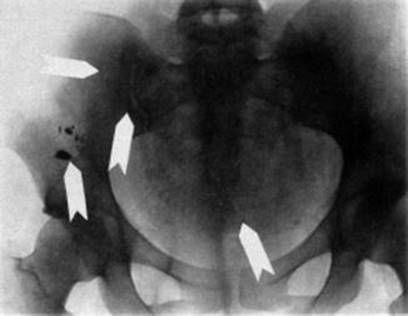
Fig. 10.23
A small fetus lying transversely across the pelvis and metallic fragments adjacent to the right iliac bone [359]

Fig. 10.24
Bullet inside the uterine cavity and the fetal head in vertex position [358]
10.3.3.3 Ultrasonography
Maternal Status
Ultrasonography misses 50–80 % of placental abruptions [38, 118, 237, 368], but rapidly and safely determines fetal heart tone, placental location, gestational age, and amniotic fluid index [41, 313]. Ultrasound examination is particularly helpful with maternal tachycardia, when the fetal and maternal heart rates may be difficult to distinguish with Doppler. Based on limited data, most obstetric ultrasonography results that are obtained after trauma are normal [39, 41, 53, 118, 215]. Few fetuses survive when ultrasonography detects evidence of fetal trauma (Fig. 10.25a) [39, 41, 53, 118, 215]. The benefit of a biophysical profile after trauma is unknown [215]. The accuracy of ultrasonography greatly depends on operator experience and maternal body habitus. Maternal pulsation can mimic fetal bradycardia or cause fetal movement, leading to unnecessary emergency deliveries in cases of fetal demise. Ultrasonography commonly is used to reassure the mother after noncatastrophic trauma, but this practice has not been studied.
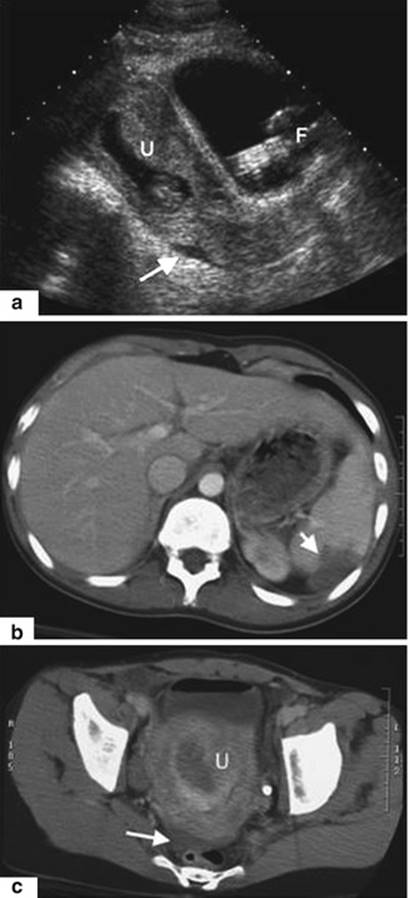
Fig. 10.25
Images in a 20-year-old woman in the first trimester of pregnancy who was involved in a high-speed motor vehicle accident that resulted in splenic laceration that was managed without intervention. (a) Longitudinal US image of pelvis shows free fluid (arrow) in cul-de-sac and an intrauterine (U) pregnancy. A Foley catheter (F) is present within the bladder. (b) Transverse helical CT scan of abdomen shows laceration (arrow) in posterior aspect of spleen but no substantial free fluid. (c) Transverse CT scan of pelvis shows an enlarged uterus (U) with gestational sac and free fluid (arrow) in the cul-de-sac [279]
Fetal Status
Doppler flow measurements of the umbilical artery may reveal high placental resistance associated with intrauterine growth retardation [369]. Oligo- or anhydramnios in this setting would raise suspicions of a diagnosis of placental insufficiency. All fetal organs should be examined and evaluated (Fig. 10.26).
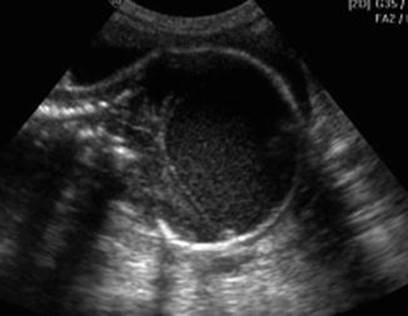
Fig. 10.26
Ultrasonographic finding demonstration of fetal intracranial hemorrhage after maternal physical abuse [370]
10.3.3.4 Abdominal CT Scan
It is used when the ultrasound examination is not diagnostic and unequivocal. The risk and benefits should be weighed on every pregnant patient. Sometimes abdominal ultrasound shows free intraperitoneal fluid without obvious cause, and if the primary cause of the FF dictates the indication for the operation, CT is performed (Fig. 10.25b, c).
10.3.3.5 Peritoneal Lavage
If needed, open diagnostic peritoneal lavage, in which the peritoneum is visualized directly, or fistulogram is safe and accurate in pregnant women and was previously used more in the conservative management of stable lower abdominal penetrating injury during pregnancy before the era of modern imaging techniques [7, 37, 47, 133, 371].
The complete diagnostic algorithm is presented on Fig. 10.27.
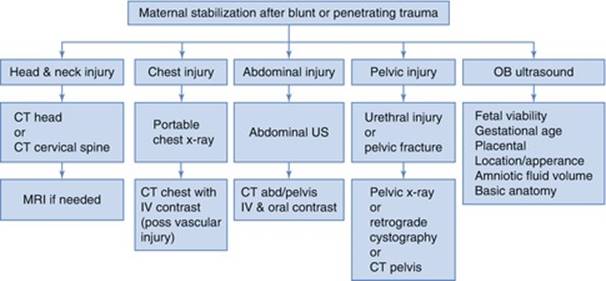
Fig. 10.27
Diagnostic imaging options for maternal blunt and penetrating trauma patients [311]
10.3.4 Treatment
10.3.4.1 General Principles
Liberal administration of oxygen and fluids when the bicarbonate level is low improves tissue perfusion and fetal oxygenation [37, 40].
Tetanus Prophylaxis
Tetanus is a rare, potentially fatal disease caused by the anaerobe Clostridium tetani. Wounds that are crushed, devitalized, or contaminated with dirt or rust are considered to be tetanus prone. Open fractures, punctures, and abscesses are also associated, but severity of the wound does not determine the risk. All wounds should be cleaned and debrided if necessary. Tetanus toxoid should be given if the last booster was more than 10 years prior. If a vaccination history is unknown, tetanus toxoid can be considered when convenient. If the last immunization was >10 years ago, then tetanus immune globulin should be given. The tetanus toxoid dose is 5 IU i.m., while tetanus immune globulin prophylaxis dosing is 250 or 500 units i.m. (in opposite extremity to tetanus toxoid) [47].
10.3.4.2 Gunshot Wounds
Proposals for management of such patients vary widely. In 1941, Bost indicated that the uterus should be emptied by Cesarean section, at almost any stage of pregnancy [372]. Eckerling and Teaff in 1950 stated categorically that the injured gravid uterus must be emptied by Cesarean section, irrespective of the viability of the fetus, and particularly if the injured woman was in labor [373]. Their rationale was to avert the possibility of a ruptured uterus with labor and also to spare the injured patients of the additional heavy physical strain of labor and delivery, during the early postoperative period.
Conservative Treatment
Traditionally the presence of penetrating abdominal trauma necessitates surgical exploration. Mandatory explorative laparotomy for all gunshot wounds to the abdomen has been challenged first by Shaftan [374]. Accumulating data suggests a more selective approach [133, 353, 371, 375] but high-velocity gunshot wounds to the abdomen universally require exploratory laparotomy, given the high likelihood of intra-abdominal injury to the mother.
A distinction is made between upper and lower abdominal penetrating wounds. In general, explorative laparotomy for all upper abdominal wounds is advocated. A major reason is that compression of bowel into the upper abdomen increases the likelihood of visceral injury. Another reason is that diaphragmatic lacerations must be ruled out [371]. Awwad et al. [353] suggested conservative management of anterior abdominal entry wounds below the level of the uterine fundus. Iliya et al. [376] found a low incidence of life-threatening injury in pregnant patients and proposed the following criteria for conservative management:
· Fetus is dead.
· Entrance wound is below the level of the fundus.
· Bullet is radiographically shown to be in the uterus.
· Maternal evaluation is reassuring.
· Hematuria or proctorrhagia must be absent.
Medications
Regular contractions may signify placental abruption. Administration of tocolytics could compromise the fetus by delaying the diagnosis of placental abruption and consequently delaying delivery [Evidence level B] [118, 215].
Surgical Treatment
Kobak and Hurwitz recommended that all such patients should be subjected to immediate laparotomy as in the case of any patient with a gunshot wound of the abdomen [377]. The subsequent treatment depends upon several factors. If the fetus is dead or previable and the uterine damage is not extensive, the uterus may be sutured and a vaginal delivery allowed. The uterus is capable of a satisfactory, normal labor if the wound is small and well repaired, without danger of rupturing. Extensive uterine damage would be an indication for Cesarean section or possibly hysterectomy. Bowel perforation at that time did not carry higher mortality because all patients underwent laparotomy and all bowel lesions were repaired.
Obstetric Management
Carugno et al. noted that labor, whether spontaneous or induced, was almost always well tolerated by wounded patients as also confirmed by others [358]. On the other hand, if the fetus is viable (i.e., ≥28 weeks or ≥1,000 g) and alive, immediate abdominal delivery is the treatment of choice [377–379]. Goff and Muntz favor prompt Cesarean section delivery of viable fetuses that survive the initial injury after maternal stabilization, with the aim of reducing the risk of delayed intrauterine death from occult trauma to the fetus or placental bed [380]. Browns et al. suggest that Cesarean section is absolutely indicated if the fetus is alive and near term, if the diagnosis of placenta hemorrhage is made or suspected, and if maternal injury necessitates laparotomy [381].
If there is an indication for Cesarean section, the baby should also be examined and all injuries noted. Figure 10.28 shows the newborn with superficial wound 8 cm long over his left scapula. The extremities of the wound were healed, but its central portion was open for a distance of about 2.5 cm and was filled with healthy granulation tissue. There was no evidence of skeletal injury. Figure 10.29 shows similar case with the superficial wound over scapula due to gunshot wound to the pregnant abdomen.
Fig. 10.28
Photograph of newborn infant showing superficial wound over the left scapula [359]

Fig. 10.29
Superficial wounds on baby’s left scapular area and left shoulder (arrows) [358]
10.3.4.3 Stab Wounds
Conservative Management
Most stab wounds without maternal hard signs, such as hypotension, evisceration, hemorrhage, or peritonitis, can be managed nonoperatively (Fig. 10.30). Local wound exploration and diagnostic laparoscopy are other options to diagnose intra-abdominal injury resulting from a low-velocity stab wound.
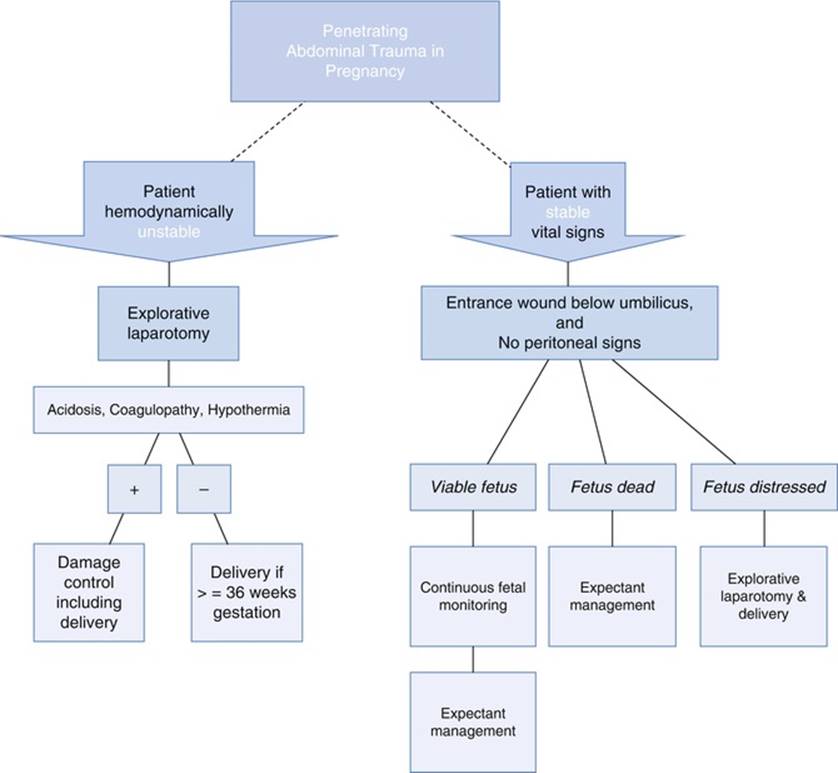
Fig. 10.30
Treatment algorithm for penetrating abdominal trauma in pregnancy [382]
Obstetric Management
Fetal trauma after stabbing injuries to the uterine cavity occurred in 93 % (13/14) of such cases reported by Sakala and Kort, and 47 % (9/19) of fetuses died after stabbings to the maternal abdomen [371]. Kaloo et al. therefore recommend that third trimester fetuses subjected to stabbing injuries should therefore be delivered promptly [383].
Brief observation (4–6 h external fetal monitoring):
· Maternal trauma is minor.
· Mother is hemodynamically stable.
· Primary evaluation negative.
· FAST-US negative for intra-abdominal fluid.
· No obstetric complaints.
· <6 contractions per hour.
· Class I FHR pattern.
· Normal examination and laboratory data.
Prolonged observation (24–48 h EFM):
· Multiple or severe maternal injuries.
· Mother hemodynamically unstable.
· Obstetric symptoms are present (bleeding, ROM).
· >6 contractions per hour during first 4–6 h.
· Abnormal FHR pattern or deceleration on CTG.
· Abnormal examination (e.g., fundal tenderness).
· Abnormal laboratory data (e.g., +KB, abnormal fibrinogen).
Surgical Treatment
Treatment algorithm for penetrating abdominal trauma is presented on Fig. 10.30. Surgical exploration for an abdominal penetrating wound is not an absolute indication for the removal of the fetus from an uninjured uterus. The performance of a Cesarean section significantly increases blood loss and operative time. The risk of precipitating labor after explorative laparotomy is negligible, if proper care is taken [375]. Emptying an uninjured uterus is justified only if the uterine size limits either adequate abdominal exploration or repair of extrauterine injuries or in the presence of non-reassuring fetal status. It should be stressed that Cesarean sections may have beneficial effects on maternal resuscitation due to elimination of the low-resistance uteroplacental circulation [7, 54]. In patients with fetal death, it is advisable to afford delivery by induction of labor rather than uterine evacuation at the time of laparotomy [133, 371, 375]. In the rare occurrence of patients who present in the perimortem state with a viable fetus, Cesarean section should be considered (see next section “Emergency cesarean section”).
10.3.4.4 Emergency Cesarean Section
Emergency Cesarean section performed at >25 weeks of gestation for specific indications following trauma is associated with 45 % fetal survival and 72 % maternal survival [234].
Cardiac Arrest and Perimortem Cesarean Section
The difficulty in performing cardiopulmonary resuscitation in pregnant women in the third trimester is that the uterus is in the supine position and occludes the vena cava. Cardiopulmonary resuscitation is described in detail in Sect. 10.1.6 . Optimization of cardiac output and perfusion of the uterus via left thoracotomy and open cardiac massage along with emergency Cesarean section should be considered. By the time the mother has suffered a cardiac arrest from trauma, the fetus has already experienced severe hypoxia. Cesarean delivery may be indicated if it can be performed within 5–15 min after loss of pulse in the mother perhaps even later, if fetal vital signs persist. Cardiopulmonary resuscitation must be continued until delivery is accomplished. Delivery has also been reported to allow successful maternal resuscitation. The decision to proceed with postmortem delivery must be made quickly by the traumatologist and obstetrician; hemostasis and antisepsis become secondary issues. Neonatologists must be available.
Perimortem Cesarean section rarely is required [234] but is an ethically difficult decision for emergency medicine resuscitation teams. The procedure covers emergency delivery during the ongoing maternal cardiopulmonary resuscitation where the mother has no sign of recovery afterward with or without infant survival [384].
Historically, the first data about perimortem Cesarean section was the Roman decree (Lex Cesare, or law of Caesar). The purpose of this ancient law was based on religious rituals rather than attempts for survival of either the newborn or mother. According to the law of Caesar, the unborn infants should be separated from their mothers’ bodies after death. Some infants did survive. It was reported that several mythological and ancient historical figures had been born in this fashion, including the Greek physician Asklepios [125]. The first modern approach to perimortem Cesarean deliveries was reported by Katz et al. in 1986 [312, 385]. Up to 2011 there were 38 case reports of perimortem Cesarean section published and the most common causes of maternal arrests included trauma, pulmonary embolism, cardiac causes, sepsis, and eclampsia [385, 386]. Perimortem Cesarean section is an extremely emotional and often futile exercise and should only be considered for gestations >24 week. If the mother has had cardiopulmonary resuscitation for >4–5 min, perimortem Cesarean section is unlikely to result in a viable normal infant. Therefore, although supporting data are limited, consideration should be given to performing emergency Cesarean delivery after 4 min of cardiopulmonary arrest, both to increase the chances of fetal survival and to aid effective maternal resuscitation (Fig. 10.31) [47, 312]. In cases of emergency center thoracotomy, recall that the aorta is often cross-clamped, further adding to the time of uterine hypoperfusion and decreasing the likelihood of a favorable outcome [25].

Fig. 10.31
Clinical algorithm for emergency Cesarean section and perimortem Cesarean section. The pregnant trauma patient is assessed for fetal heart tone (FHT) and estimated gestational age (EGA). If FHT is present and EGA is ≥26 weeks, fetal monitoring is required. Fetal or maternal distress mandates emergency Cesarean section. Perimortem Cesarean section is performed if cardiopulmonary resuscitation is in progress [234]
Perimortem Cesarean section must not be delayed for ultrasonography. Before making the abdominal incision, the surgeon must ensure that fundal height is several fingerbreadths above the umbilicus, ensuring adequate gestational age. The appropriate incision for a perimortem Cesarean section is from the xyphoid to the symphysis pubis through all layers of the abdominal wall and peritoneum. When the uterus is identified, a vertical uterine incision is made, and if the placenta is anterior, it should be incised as well. To deliver the infant, the gynecologist/surgeon opens the uterus, clamps and cuts the cord, and begins infant resuscitation. Efforts at maternal resuscitation should continue simultaneously, as there are reported cases of maternal survival after the delivery of the infant [387].
Before 23 weeks’ gestational age, delivery of the fetus may not improve maternal venous return. Therefore, aggressive maternal resuscitation is the only indicated intervention [311]. Even a case of perimortem Cesarean section after 7 min of unsuccessful maternal cardiopulmonary resuscitation is published with the delivery of the newborn with Apgar 0. The newborn was intubated; ventilation and external chest compressions were started. After 5 min of neonatal cardiopulmonary resuscitation, cardiac activity was regained and improvement in skin color observed. There is no data about further newborn progress except that it was in neonatal intensive care unit with uncertain neurologic outcome [386].
Salvageable Infant
The most important finding is the definition of a subgroup of infants who are potentially salvageable. In this group of patients, defined by an estimated gestational age ≥26 weeks and the presence of fetal heart tones (FHTs), the survival rate was 75 %. Survival was independent of maternal distress but clearly related to the presence of fetal monitoring and early recognition of fetal distress. There were no survivors in fetuses having no FHTs. This supports the premise that fetal viability is directly related to the presence or absence of FHTs on admission. As such, the presence of FHTs is a simple, rapid, reproducible, and profoundly important marker of fetal viability. The recommendation is that the Doppler assessment of FHTs is a component of the primary survey performed on trauma patients during the third trimester of pregnancy. This should be accomplished simultaneously with the assessment of maternal circulatory integrity during the ABCs of the trauma resuscitation [388]. If FHTs are absent, the pregnancy should be ignored and treatment directed solely at maternal survival.
Data from leading neonatal centers in the nontraumatic setting show that survival of infants born from 23 to 25 weeks’ gestation increases with each additional week of gestation [389, 390]. However, the overall neonatal survival rate for infants born during this early gestational period remains less than 40 % [234]. Of those who survived, 6–40 % have moderate to serious disabilities and many have neurobehavioral dysfunction and poor spontaneous school performance [391].
As noted previously, high admission FHR values may be expected for patients arriving at the ED soon after the start of maternal hemorrhage. Furthermore, obstetric practice in the nontraumatic setting has documented baseline FHR to be less predictive of fetal stress than baseline variability and periodic change assessment of the FHR [392]. Lack of knowledge of baseline FHR prior to trauma and the wide variability (20/min) of FHR under normal physiological conditions [393] further degrade the predictive utility of admission FHRs.
Although it is ideal to inform the prospective parents regarding fetal outcome and the financial and emotional consequences of profound prematurity, this is not possible in the trauma setting where the patients are often critically ill or sedated, families are unavailable, and the decision-making process is obscure. Consequently, it is recommendation that fetal viability in the trauma patient should be defined at age 26 weeks. This recommendation changes the previous recommendations in the literature from 28 weeks [394], because 80 % of infants with an estimated gestational age of 26–28 weeks survived in series by Morris et al. [234]. This study also shows that even in the most profoundly injured mother, manifested by an ISS >25, fetal survival was 78 %. This same critically ill population had a maternal survival rate of only 44 %, illustrating the need for emergency Cesarean section at the first indication of fetal distress. Recognition of fetal distress is critical. In this study, fetal distress was defined as a FHR < 100, prolonged deceleration for more than 60 s, or recurrent late decelerations. Although maternal survival in the presence of a <16 was 100 %, fetal survival was only 73 % [234], supporting previously published reports that even minor maternal injury can result in death of the fetus [259]. Of more concern was the finding that 60 % of these infant deaths occurred in mothers with minor injury and delayed Cesarean sections in the presence of fetal distress. This may well represent delayed recognition of fetal distress or delayed Cesarean section in a misguided belief that the intrauterine environment is superior to delivery.
ACOG has published guidelines on performing Cesarean sections for mothers in extremis following medical disasters, i.e., amniotic fluid embolism, cardiac arrest, etc. (www.acog.org). These could be extrapolated to similar physiological insults to a pregnant trauma patient. Fetal survival rates of 70 % have been reported for fetuses of at least 25 weeks of gestation who are delivered within 5 min of maternal death [312]. Incidentally, these authors revisited their 1986 recommendations in 2005 and documented 38 cases of perimortem Cesarean section with all fetuses surviving initially but 4 dying of complications from prematurity and anoxia [385]. All mothers survived except for one, who died of complications of her amniotic fluid embolism.
Gunshot Wounds
Algorithm is somewhat different in gunshot wounds. While exploration is the management of choice in bullet wounds of the abdomen, Cesarean section is not mandatory and indications are listed in the Table 10.14 [395]:
Table 10.14
Indications for emergent Cesarean section in gunshot wounds of the abdomen in pregnancy
|
Surgical |
|
Pregnant uterus mechanically limits exploration or surgical repair |
|
Fetal |
|
Hemorrhage |
|
Interference with fetal-maternal exchange |
|
Infection |
Since infants have been born alive with soft tissue and visceral injuries, the hazards of prematurity must be weighed against the potential benefits of operation to the injured premature infant delivered by Cesarean section. When fetal weight approaches 2,500 g, these hazards are greatly diminished. Vaginal delivery, even in the immediate postoperative period, has been shown to have no deleterious effect on the mother [373, 377, 378].
Conservatism could be exercised in the management of the uterine wounds, since pregnancies have followed repair of extensive traumatic wounds [352, 373, 377].
10.3.5 Prognosis
10.3.5.1 Maternal Outcome
The maternal mortality rate from gunshot and stab injuries to the abdomen is less than that of nonpregnant women, due to the protective effect of the uterus [133, 353, 371, 375, 380]. The gravid uterus during late pregnancy acts to shield other abdominal viscera as well as to displace and compress the small bowel. The uterus also diminishes the velocity of a missile and thereby decreases its ability to penetrate other organs. The musculature of the pregnant uterus is relatively dense and most of the traumatic force is transmitted to the muscle. Moreover, the amniotic fluid and the fetus also contribute to slowing the bullet. Hence, injury to other organs is relatively rare [375].
The mortality rate of abdominal gunshot wounds in general population is proportional to the number of organs injured [396–398]. Associated injury occurred in only 24 % [377], 27 % [352], and 38 % [399] of the victims in three series of gunshot wounds of the pregnant uterus. Maternal mortality rate is 7–10.5 % [347, 400]. Half of these maternal deaths were due to severe head injury, the result similar to other previous reports [15, 185, 337]. Six patients were admitted with evidence of shock resulting in 4 maternal and 4 fetal deaths (66.6 %) [400]. The penetrating trauma group had a longer hospital length of stay (7 ± 9 vs. 4 ± 8) as compared to the blunt trauma group [347].
Thirty-three cases of gunshot wounds of the pregnant uterus were reported by Kobak and Hurwitz during 1845–1954 [377]. There were three maternal deaths, all of which occurred before 1912. Fetal mortality was 55 % among those patients who were judged to have a viable fetus at the time of injury. There were 15 vaginal deliveries among the 33 cases reported, in all of which labor commenced within a few hours up to 17 days after the accident.
10.3.5.2 Fetal Outcome
Pregnancy loss was significantly greater in women in the second trimester of pregnancy compared to the first trimester. Some studies have reported that the second trimester represented the most vulnerable period for all types of fetal trauma because the gravid uterus ascends out of the bony pelvis in the cephalad direction to reach the level of the umbilicus by 24 weeks; here the gravid uterus may sustain direct traumatic injury. In the third trimester, the fetus is well protected by the amniotic fluid [24, 343, 401]. However, in both gunshot and stab wounds, as pregnancy progresses, the fetus presents a larger target and is more likely to sustain injury [133, 353, 371, 375, 380]. Usually, the fetus has a worse prognosis than the mother, with an injury rate of 59–80 % and a perinatal mortality rate of 41–71 % [348, 402, 403]. The perinatal mortality for the years 1957–1967 was 71 % [399], unchanged from the period 1845 to 1964 [352]. This figure is considerably higher than the 59 % of infants who sustained intrauterine injury or damage to the cord and placenta in the series in the years after 1967 [399]. In the period 1845–1954, fetal mortality was 55 % among those patients who were judged to have a viable fetus at the time of injury [377]. In the same period the fetal mortality among those who had vaginal deliveries was 66 %; among those who had abdominal deliveries, it was 46 %.
According to some reports, fetal injuries are in range of 60–90 % and gunshot wounds commonly lead to fetal death, with a perinatal mortality of up to 70 % [133, 350, 375]. Fetal trauma after stabbing injuries to the uterine cavity occurred in 93 % (13/14) of such cases reported by Sakala and Kort with fetal mortality of 47 % [371]. Others found fetal mortality rate of 73 % after penetrating maternal abdominal trauma [347].
Maternal Injuries and the Risk of Birth Defects
Few studies have examined the association between maternal injuries and birth defects. A 1969 case-control study reported an increased incidence of birth defects among women who experienced “accidents” (not further defined) in the first trimester [404] and noted that defects of the central nervous system (CNS), in particular, appeared to be associated with experiencing an accident in early pregnancy. Limited data from more recent case-series studies also suggest that maternal trauma may be associated with CNS damage in the fetus, especially hydrocephaly [152, 153, 405]. The results stratified by intention suggest that three of the associations observed when all injuries were considered, those for longitudinal limb deficiency, gastroschisis, and hypoplastic left heart syndrome, might be driven by intentionally inflicted injuries [30]. The majority of the intentional injuries reported in National Birth Defects Prevention Study were the result of intimate partner abuse and these types of injuries could be more stressful for the mother. Associations have been observed between maternal stress during pregnancy and several birth defects, including conotruncal heart defects [151, 406], neural tube defects [151, 407, 408], and orofacial clefts [151, 407, 409]. Periconceptional injuries were associated with interrupted aortic arch type B, atrioventricular septal defect, pulmonary atresia, tricuspid atresia, hypoplastic left heart syndrome, anorectal atresia/stenosis, longitudinal limb deficiency, and gastroschisis. Associations with longitudinal limb deficiency, gastroschisis, and hypoplastic left heart syndrome were stronger for intentional injuries. This analysis was hypothesis generating, with many associations tested. Further research is warranted [30].
Although any maternal injury during pregnancy could be stressful for a woman, stress due to intimate partner violence could be both acute (during an attack) and chronic, from being in an abusive relationship. Intentional injuries are also related to many other factors that might cause or be related to other causes of birth defects. In an analysis of the National Birth Defects Prevention Study control mothers, we observed a higher prevalence of alcohol and cigarette use during pregnancy among women who reported an intentional injury [31]. Alcohol use and cigarette use during pregnancy are associated with increased risk for birth defects [410, 411].
References
1.
Weiss HB, Sauber-Schatz EK, Cook LJ. The epidemiology of pregnancy-associated emergency department injury visits and their impact on birth outcomes. Accid Anal Prev. 2008;40:1088–95.PubMed
2.
Shah KH, Simons RK, Holbrook T, et al. Trauma in pregnancy: maternal and fetal outcomes. J Trauma. 1998;45:83–6.PubMed
3.
Vivian-Taylor J, Roberts CL, Chen JS, Ford JB. Motor vehicle accidents during pregnancy: a population-based study. Br J Obstet Gynecol. 2012;119:499–503.
4.
Caldwell E, Sugrue M, Johansson K, et al. South Western Sydney Area Health Service Regional Trauma Registry Report on 5 years, 1995 to 1999. Sydney: SWSAHS; 2000.
5.
Mack KA. Fatal and nonfatal unintentional injuries in adult women, United States. J Womens Health. 2004;13:754–63.
6.
Griswold RA, Collier HS. Blunt abdominal trauma. Int Abstr Surg. 1961;112:309–29.PubMed
7.
Kuhlmann RD, Cruikshank DP. Maternal trauma during pregnancy. Clin Obstet Gynecol. 1994;37:274–93.PubMed
8.
Vaizey CJ, Jacobson MJ, Cross FW. Trauma in pregnancy. Br J Surg. 1994;81:1406–15.PubMed
9.
Rogers FB, Rozycki GS, Osler TM, et al. A multi-institutional study of factors associated with fetal death in injured pregnant patients. Arch Surg. 1999;134:1274–7.PubMed
10.
Connolly AM, Katz VL, Bash KL, et al. Trauma and pregnancy. Am J Perinatol. 1997;14:331–6.PubMed
11.
Jacob S, Bloebaum L, Shah G, Varner MW. Maternal mortality in Utah. Obstet Gynecol. 1998;91:187–91.PubMed
12.
Lavery JP, Staten-McCormick M. Management of moderate to severe trauma in pregnancy. Obstet Gynecol Clin North Am. 1995;22:69–90.PubMed
13.
Weiss HB. Pregnancy associated injury hospitalizations in Pennsylvania, 1995. Ann Emerg Med. 1999;34:626–36.PubMed
14.
Timms MR, Boyd CR, Gongaware RD. Blunt and penetrating trauma during pregnancy: four cases. J Med Assoc Ga. 1985;74:158–61.PubMed
15.
Timberlake GA, McSwain Jr NE. Trauma in pregnancy: a 10-year perspective. Am Surg. 1989;55:151–3.PubMed
16.
Weiss HB, Songer TJ, Fabio A. Fetal deaths related to maternal injury. J Am Med Assoc. 2001;286:1863–8.
17.
Guth AA, Pachter HL. Domestic violence and the trauma surgeon. Am J Surg. 2000;179:134–40.PubMed
18.
Esposito TJ. Trauma during pregnancy. Emerg Med Clin North Am. 1994;12:167–99.PubMed
19.
Goodwin H, Holmes JF, Wisner DH. Abdominal ultrasound examination in pregnant trauma patients. J Trauma. 2001;50:689–94.PubMed
20.
Grossman NB. Blunt trauma in pregnancy. Am Fam Physician. 2004;70:1303–10.PubMed
21.
Harvey MG, Troiano NH. Trauma during pregnancy. NAACOGS Clin Issu Perinat Womens Health Nurs. 1992;3:521–9.PubMed
22.
Ikossi DG, Lazar AA, Morabito D, et al. Profile of mothers at risk: an analysis of injury and pregnancy loss in 1,195 trauma patients. J Am Coll Surg. 2005;200:49–56.PubMed
23.
Henderson SO, Mallon WK. Trauma in pregnancy. Emerg Med Clin North Am. 1998;16:209–28.PubMed
24.
Kuczkowski KM. Trauma during pregnancy: a situation pregnant with danger. Acta Anaesthesiol Belg. 2005;56:13–8.PubMed
25.
Mattox KL, Goetzl L. Trauma in pregnancy. Crit Care Med. 2005;33(10 Suppl):S385–9.PubMed
26.
Poole Jr GV, Martin JN, Perry KG, et al. Trauma in pregnancy: the role of interpersonal violence. Am J Obstet Gynecol. 1996;174:1873–8.PubMed
27.
Hoyert DL. Maternal mortality and related concepts. National center for health statistics. Vital Health Stat 3. 2007;33:1–20.PubMed
28.
Patterson SK, Snider CC, Meyer DS, et al. The consequences of high-risk 62:1015–20.
29.
Schiff MA, Holt VL. Pregnancy outcomes following hospitalization for motor vehicle crashes in Washington state from 1989 to 2001. Am J Epidemiol. 2005;161:503–10.PubMed
30.
Tinker SC, Reefhuis J, Dellinger AM, Jamieson DJ. Maternal injuries during the periconceptional period and the risk of birth defects, National Birth Defects Prevention Study, 1997–2005. Paediatr Perinat Epidemiol. 2011;25:487–96.PubMed
31.
Tinker SC, Reefhuis J, Dellinger AM, Jamieson DJ. Epidemiology of maternal injuries during pregnancy in a population-based study, 1997–2005. J Womens Health. 2010;19:2211–8.
32.
Shah NR, Bracken MB. A systematic review and metaanalysis of prospective studies on the association between maternal cigarette smoking and preterm delivery. Am J Obstet Gynecol. 2000;182:465–72.PubMedCentralPubMed
33.
Rasmussen SA, Chu SY, Kim SY, et al. Maternal obesity and risk of neural tube defects: a metaanalysis. Am J Obstet Gynecol. 2008;198:611–9.PubMed
34.
Khashan AS, Kenny LC. The effects of maternal body mass index on pregnancy outcome. Eur J Epidemiol. 2009;24:697–705.PubMed
35.
American Academy of Pediatrics, American College of Obstetricians and Gynecologists. Guidelines for perinatal care, 6th ed. Elk Grove Village: AAP/Washington, DC: ACOG; 2007.
36.
American College of Obstetricians and Gynecologists. ACOG committee opinion No. 422: at-risk drinking and illicit drug use: ethical issues in obstetric and gynecologic practice. Obstet Gynecol. 2008;112:1449–60.
37.
Esposito TJ, Gens DR, Smith LG, et al. Trauma during pregnancy. A review of 79 cases. Arch Surg. 1991;126:1073–8.PubMed
38.
Curet MJ, Schermer CR, Demarest GB, et al. Predictors of outcome in trauma during pregnancy: identification of patients who can be monitored for less than 6 hours. J Trauma. 2000;49:18–25.PubMed
39.
Drost TF, Rosemurgy AS, Sherman HF, et al. Major trauma in pregnant women: maternal/fetal outcome. J Trauma. 1990;30:574–8.PubMed
40.
Scorpio RJ, Esposito TJ, Smith LG, Gens DR. Blunt trauma during pregnancy: factors affecting fetal outcome. J Trauma. 1992;32:213–6.PubMed
41.
Dahmus M, Sibai B. Blunt abdominal trauma: are there any predictive factors for abruption placentae or maternal-fetal distress? Am J Obstet Gynecol. 1993;169:1054–9.PubMed
42.
Hyde LK, Cook LJ, Olson LM, et al. Effect of motor vehicle crashes on adverse fetal outcomes. Obstet Gynecol. 2003;102:279–86.PubMed
43.
Pearlman MD, Klinich KD, Schneider LW, et al. A comprehensive program to improve safety for pregnant women and fetuses in motor vehicle crashes: a preliminary report. Am J Obstet Gynecol. 2000;182:1554–64.PubMed
44.
Rose PG, Strohm MT, Zuspan FP. Fetomaternal haemorrhage following trauma. Am J Obstet Gynecol. 1985;153:844–7.PubMed
45.
Wolf ME, Alexander BH, Rivara FP, et al. A retrospective cohort study of seatbelt use and pregnancy outcome after a motor vehicle crash. J Trauma. 1993;34:116–9.PubMed
46.
Taylor AJ, McGwin Jr G, Sharp CE, et al. Seatbelt use during pregnancy: a comparison of women in two prenatal care settings. Matern Child Health J. 2005;9:173–9.PubMed
47.
ACOG Educational Bulletin. Obstetric aspects of trauma management. Number 251, September 1998. American College of Obstetricians and Gynecologists. Int J Gynaecol Obstet. 1999;64:87–94.
48.
Hedin LW, Janson PO. Domestic violence during pregnancy. The prevalence of physical injuries, substance use, abortions and miscarriages. Acta Obstet Gynecol Scand. 2000;79:625–30.PubMed
49.
Shah AJ, Kilcline BA. Trauma in pregnancy. Emerg Med Clin North Am. 2003;21:615–29.PubMed
50.
Coleman MT, Trianfo VA, Rund DA. Nonobstetric emergencies in pregnancy: trauma and surgical conditions. Am J Obstet Gynecol. 1997;177:497–502.PubMed
51.
Fisher M, Rivkind AJ. Trauma in pregnancy. Harefuah. 2004;143:733–6, 765.PubMed
52.
Weintraub AY, Leron E, Mazor M. The pathophysiology of trauma in pregnancy: a review. J Matern Fetal Neonatal Med. 2006;19:601–5.PubMed
53.
Baerga-Varela Y, Zietlow SP, Bannon MP, et al. Trauma in pregnancy. Mayo Clin Proc. 2000;75:1243–8.PubMed
54.
Tsuei BJ. Assessment of the pregnant trauma patient. Injury. 2006;37:367–73.PubMed
55.
Pearlman MD. Motor vehicle crashes, pregnancy loss and preterm labor. Int J Gynaecol Obstet. 1997;57:127–32.PubMed
56.
Corsi PR, Rasslan S, de Oliveira LB, et al. Trauma in pregnant women: analysis of maternal and fetal mortality. Injury. 1999;30:239–43.PubMed
57.
Kissinger DP, Rozycki GS, Morris Jr JA, et al. Trauma in pregnancy. Predicting pregnancy outcome. Arch Surg. 1991;126:1079–86.PubMed
58.
Morris S, Stacey M. Resuscitation in pregnancy. Br Med J. 2003;327:1277–9.
59.
Chulu A, Kuczkowski KM. Anaesthetic management of the parturient with massive peripartum haemorrhage and fetal demise. Anaesthesia. 2003;58:933–4.PubMed
60.
Baker DP. Trauma in the pregnant patient. Surg Clin North Am. 1982;62:275–89.PubMed
61.
Romney SL, Gabel PV, Takeda Y. Experimental hemorrhage in late pregnancy. Am J Obstet Gynecol. 1963;87:636–49.PubMed
62.
Hoff WS, D’Amelio LF, Tinkoff GH, et al. Maternal predictors of fetal demise in trauma during pregnancy. Surg Gynecol Obstet. 1991;172:175–80.PubMed
63.
Bowdler N, Faix RG, Elkins T. Fetal skull fracture and brain injury after a maternal automobile accident. A case report. J Reprod Med. 1987;32:375–8.PubMed
64.
Evrard JR, Sturner WQ, Murray EJ. Fetal skull fracture from an automobile accident. Am J Forensic Med Pathol. 1989;10:232–4.PubMed
65.
Haiti R, Ko K. In utero skull fracture: case report. J Trauma. 1996;41:549–52.
66.
Mendelsohn ME, Karas RH. The protective effects of estrogen on the cardiovascular system. N Engl J Med. 1999;340:1801–11.PubMed
67.
Knoferl MW, Diodato MD, Angele MK, et al. Do female sex steroids adversely or beneficially affect the depressed immune responses in males after trauma-hemorrhage? Arch Surg. 2000;135:425–33.PubMed
68.
Angele MK, Schwacha MG, Ayala A, Chaudry IH. Effect of gender and sex hormones on immune responses following shock. Shock. 2000;14:81–90.PubMed
69.
Kuebler JF, Jarrar D, Bland KI, et al. Progesterone administration after trauma and hemorrhagic shock improves cardiovascular responses. Crit Care Med. 2003;31:1786–93.PubMed
70.
Deitch EA, Livingston DH, Lavery RF, et al. Hormonally active women tolerate shock-trauma better than do men. A prospective study of over 4000 trauma patients. Ann Surg. 2007;246:447–55.PubMedCentralPubMed
71.
George RL, McGwin G, Metzger J, et al. The association between gender and mortality among trauma patients as modified by age. J Trauma. 2003;54:464–71.PubMed
72.
Haider AH, Efron DT, Haut ER, et al. Mortality in adolescent girls vs boys following traumatic shock. An analysis of the National Pediatric Trauma Registry. Arch Surg. 2007;142:875–80.PubMed
73.
John PR, Shiozawa A, Haut ER, et al. An assessment of the impact of pregnancy on trauma mortality. Surgery. 2011;149:94–8.PubMed
74.
Vanden Hoek TL, Morrison LJ, Shuster M, et al. Part 12: cardiac arrest in special situations: 2010 American Heart Association guidelines for cardiopulmonary resuscitation and emergency cardiovascular care. Circulation. 2010;122(18 Suppl 3):S833–8.
75.
American Heart Association Guidelines for Cardiopulmonary Resuscitation and Emergency Cardiovascular Care. Management of cardiac arrest. Circulation. 2005;112:IV-58–66.
76.
Dildy G, Belfort M, Saade G, et al. Critical care obstetrics. 4th ed. Malden: Blackwell Publishing; 2004. p. 691.
77.
American Heart Association Guidelines for Cardiopulmonary Resuscitation and Emergency Cardiovascular Care. Monitoring and medications. Circulation. 2005;112:IV-78–83.
78.
Wise A, Clark V. Strategies to manage major obstetric haemorrhage. Curr Opin Anaesthesiol. 2008;21:281–7.PubMed
79.
Brace V, Kernaghan D, Penney G. Learning from adverse clinical outcomes: major obstetric haemorrhage in Scotland, 2003–05. Br J Obstet Gynecol. 2007;114:1388–96.
80.
Mercier JF, Bonnet MP. Use of clotting factors and other prohemostatic drugs for obstetric hemorrhage. Curr Opin Anaesthesiol. 2010;23:310–6.PubMed
81.
Burtelow M, Riley E, Druzin M, et al. How we treat: management of life-threatening primary postpartum haemorrhage with a standardized massive transfusion protocol. Transfusion. 2007;47:1564–72.PubMed
82.
Mercier FJ, Van de Velde M. Major obstetric haemorrhage. Anesthesiol Clin. 2008;26:53–66.PubMed
83.
Mukherjee S, Arulkumaran S. Post-partum haemorrhage. Obstet Gynaecol Reprod Med. 2009;19:121–6.
84.
Ketchum L, Hess JR, Hiippala S. Indications for early fresh frozen plasma, cryoprecipitate, and platelet transfusion in trauma. J Trauma. 2006;60:S51–8.PubMed
85.
Jansen O, Thomas R, Loudon A, Brooks A. Damage control resuscitation for patients with major trauma. Br Med J. 2009;338:1436–40.
86.
Holcomb JB, Jenkins D, Rhee P, et al. Damage control resuscitation: directly addressing the early coagulopathy of trauma. J Trauma. 2007;62:307–10.PubMed
87.
Borgman MA, Spinella PC, Perkins JG, et al. The ratio of blood products transfused affects mortality in patients receiving massive transfusions at a combat support hospital. J Trauma. 2007;63:805–13.PubMed
88.
Gunter OL, Au BK, Isbell JM, et al. Optimizing outcomes in damage control resuscitation: identifying blood product ratios associated with improved survival. J Trauma. 2008;65:527–34.PubMed
89.
Kirkman E, Watts S, Hodgetts T, et al. A proactive approach to the coagulopathy of trauma: the rationale and guidelines for treatment. J R Army Med Corps. 2008;153:302–6.
90.
Hodgetts TJ, Mahoney PF, Kirkman E. Damage control resuscitation. J R Army Med Corps. 2007;153:299–300.PubMed
91.
Working Party Association of Anaesthetists of Great Britain and Ireland (AAGBI). Guidelines. Blood transfusion and the anaesthetist: management of massive haemorrhage. Anaesthesia. 2010;65:1153–61.
92.
Sperry JL, Ochoa JB, Gunn SR, et al. An FFP:PPRBC transfusion ratio ≥1:1.5 is associated with a lower risk of mortality after massive transfusion. J Trauma. 2008;65:986–93.PubMed
93.
Malone DL, Hess JR, Fingergut A. Massive transfusion protocols around the globe and a suggestion for a common massive transfusion protocol. J Trauma. 2006;60:S91–6.PubMed
94.
MacLeod JBA, Lynn M, McKenney MG, et al. Early coagulopathy predicts mortality in trauma. J Trauma. 2003;55:39–44.PubMed
95.
Brohi K, Singh J, Heron M, Coats T. Acute traumatic coagulopathy. J Trauma. 2003;54:1127–30.PubMed
96.
Sihler KC, Napolitano LM. Massive transfusion: new insights. Chest. 2009;136:1654–67.PubMed
97.
Bomken C, Mathai S, Biss T, et al. Recombinant activated factor VII (rFVIIa) in the management of major obstetric haemorrhage: a case series and a proposed guideline for use. Obstet Gynecol Int. 2009;2009:364843.PubMedCentralPubMed
98.
Welsh A, McLintock C, Gatt S, et al. Guidelines for the use of recombinant activated factor VII in massive obstetric haemorrhage. Aust N Z J Obstet Gynaecol. 2008;48:12–6.PubMed
99.
Goodwin T, Breen M. Pregnancy outcome and fetomaternal hemorrhage after non-catastrophic trauma. Am J Obstet Gynecol. 1990;162:665–71.PubMed
100.
Schneider R. Muscle relaxants. In: Walls R, editor. Emergency airway management. Philadelphia: Lippincott Williams Wilkins; 2000. p. 121–8.
101.
Rees GA, Willis BA. Resuscitation in late pregnancy. Anaesthesia. 1988;43:347–9.PubMed
102.
Kasten GW, Martin ST. Resuscitation from bupivacaine-induced cardiovascular toxicity during partial inferior vena cava occlusion. Anesth Analg. 1986;65:341–4.PubMed
103.
Kuczkowski KM, Ispirescu JS, Benumof JL. Trauma in pregnancy: anesthetic management of the parturient with multiple gunshot wounds to the gravid uterus and fetal injury. J Trauma. 2003;54:420.PubMed
104.
Kuczkowski KM. Peripartum anaesthetic management of a parturient with spinal cord injury and autonomic hyperreflexia. Anaesthesia. 2003;58:823–4.PubMed
105.
Kuczkowski KM, Fouhy SA, Greenberg M, Benumof JL. Trauma in pregnancy: anaesthetic management of the pregnant trauma victim with unstable cervical spine. Anaesthesia. 2003;58:822.PubMed
106.
Schiff MA, Holt VL. The injury severity score in pregnant trauma patients: predicting placental abruption and fetal death. J Trauma. 2002;53:946–9.PubMed
107.
Weiss HB, Strotmeyer S. Characteristics of pregnant women in motor vehicle crashes. Inj Prev. 2002;8:207–10.PubMedCentralPubMed
108.
Rachana C, Suraiya K, Hisham AS, et al. Prevalence and complications of physical violence during pregnancy. Eur J Obstet Gynecol Rep Biol. 2002;103:26–9.
109.
Kuczkowski KM, Reisner LS, Benumof JL. Airway problems and new solutions for the obstetric patient. J Clin Anesth. 2003;15:552–63.PubMed
110.
Barker SJ. Anesthesia for trauma. Anesth Analg Suppl. 2003;96:1–6.
111.
Warner DS. Neuroanesthesia 2000. Anesth Analg. 2000;90:1238–40.PubMed
112.
Milos MJ. Obstetric and gynecologic trauma. In: McCort JJ, Mindeizum RE, editors. Trauma radiology. New York: Churchill Livingstone; 1990. p. 231–9.
113.
Haycock CE. Blunt trauma in pregnancy. In: Haycock CE, editor. Trauma and pregnancy. Littleton: PSG; 1985. p. 34–43.
114.
McAnena OJ, Moore EE, Marx JA. Initial evaluation of the patient with blunt abdominal trauma. Surg Clin North Am. 1990;70:495–515.PubMed
115.
DeMars JJ, Bubrich MP, Hitchcook CR. Duodenai perforation in blunt trauma. Surgery. 1979;86:632–5.PubMed
116.
Kelly G, Norton L, Moore C, Eisenman B. The continuing challenge of duodenal injuries. J Trauma. 1978;18:160–6.PubMed
117.
Doan-Wiggins L. Trauma in pregnancy. In: Benrubi GI, editor. Obstetrics and gynecologic emergencies. Philadelphia: Lippincott; 1994. p. 57–76.
118.
Pearlman MD, Tintinelli JE, Lorenz PR. A prospective controlled study of the outcome after trauma during pregnancy. Am J Obstet Gynecol. 1990;162:1502–10.PubMed
119.
Esposito TJ, Gens DR, Smith LG, Scorpio R. Evaluation of blunt abdominal trauma occurring during pregnancy. J Trauma. 1989;29:1628–32.PubMed
120.
Theodorou DA, Velmahos GC, Souter I, et al. Fetal death after trauma in pregnancy. Am Surg. 2000;66:809–12.PubMed
121.
Share JC, Pursley D, Teele RL. Unsuspected hepatic injury in the neonate - diagnosis by ultrasonography. Pediatr Radiol. 1990;20:320–2.PubMed
122.
Fries MH, Hankins GDV. Motor vehicle accident associated with minimal maternal trauma but subsequent fetal demise. Ann Emerg Med. 1989;18:301–4.PubMed
123.
Sugrue M, Kolkman KA. Trauma during pregnancy. Aust J Rural Health. 1999;7:82–4.PubMed
124.
Williams JK, McClain L, Rosemurgy AS, Colorado NM. Evaluation of blunt abdominal trauma in the third trimester of pregnancy: maternal and fetal considerations. Obstet Gynecol. 1990;75:33–7.PubMed
125.
Ritter JW. Postmortem cesarean section. J Am Med Assoc. 1961;175:715–6.
126.
Strong Jr TH, Lowe RA. Perimortem cesarean section. Am J Emerg Med. 1989;7:489–94.PubMed
127.
Judich A, Kuriansky J, Engelberg I, et al. Amniotic fluid embolism following blunt abdominal trauma in pregnancy. Injury. 1998;29:475–7.PubMed
128.
Steiner PE, Lushbaugh CC. Maternal pulmonary embolism by amniotic fluid as a cause of obstetric shock and unexpected deaths in obstetrics. J Am Med Assoc. 1941;117:1245–340.
129.
Mollison PL. Clinical aspects of Rh immunization. Am J Clin Pathol. 1973;60:287–301.PubMed
130.
Romero VC, Pearlman M. Maternal mortality due to trauma. Semin Perinatol. 2012;36:60–7.PubMed
131.
Greenblatt JF, Dannenberg AL, Johnson CJ. Incidence of hospitalized injuries among pregnant women in Maryland, 1979–1990. Am J Prev Med. 1997;13:374–9.PubMed
132.
Sugrue ME, O’Connor MC, D’Amours SK. Trauma during pregnancy. ADF Health. 2004;5:24–8.
133.
Van Hook JW. Trauma in pregnancy (obstetric emergencies). Clin Obstet Gynecol. 2002;45:414–24.PubMed
134.
Attico NB, Smith III RJ, Fitzpatrick MB. Automobile safety restraints for pregnant women and children. J Reprod Med. 1986;31:187–92.PubMed
135.
Klinich KD, Schneider LW, Eby B, et al. Seated anthropometry during pregnancy. 1999a. UMTRI-99-16.
136.
Klinich KD, Schneider LW, Moore JL, Pearlman MD. Investigations of crashes involving pregnant occupants. Annu Proc Assoc Adv Automot Med. 2000;44:37–55.PubMedCentralPubMed
137.
US Department of Transportation, National Highway Traffic Safety Administration. National Center for Statistics and Analysis, National Automotive Sampling System. 1997.
138.
Crashworthiness Data System. Data collection coding and editing manual. Washington, DC: US Department of Transportation, NHTSA; 1997.
139.
Haapaniemi P. Women’s highway deaths on the rise. Traffic Saf. 1996;96:6–11.
140.
Crosby WM, Snyder RG, Snow CC, Hanson PG. Impact injuries in pregnancy. I: experimental studies. Am J Obstet Gynecol. 1968;101:100–10.PubMed
141.
Hilton BC. Proceedings, 10th Stapp Car Crash conference. New Mexico: Hollomon AFB: 1966, p. 124.
142.
Elliott M. Vehicular accidents and pregnancy. Aust N Z J Obstet Gynaecol. 1966;6:279–86.PubMed
143.
Snyder RG, Crosby WM, Snow CC, et al. Seat belt injuries in impact. Proceedings, sesquicentennial. Symposium on the prevention of highway injury, Highway Safety Institute, Ann Arbor, 19–21 Apr 1967.
144.
Smith RN, Crosby WM. Unpublished observations on labor in the baboon.
145.
Rubovits FE. Traumatic rupture of the pregnant uterus from seat belt injury. Am J Obstet Gynecol. 1964;90:828–9.PubMed
146.
Stapp JP, Taylor ER. Space cabin landing impact vector effects on human physiology. Aerosp Med. 1964;35:1117–33.PubMed
147.
Crosby WM, King AI, Stout CC. Fetal survival following impact: improvement with shoulder harness restraint. Am J Obstet Gynecol. 1972;112:1101–6.PubMed
148.
Schiff M, Holt V, Daling J. Pregnancy-associated injury hospitalizations: maternal and fetal outcomes. Paediatr Perinat Epidemiol. 2001;15:A29.
149.
Kessler RC, Sonnega A, Bromet E, et al. Posttraumatic stress disorder in the National Comorbidity Survey. Arch Gen Psychiatry. 1995;52:1048–60.PubMed
150.
Beversdorf D. Stress during pregnancy linked to autism. San Diego: Society for Neuroscience; 2001.
151.
Carmichael SL, Shaw GM. Maternal life event stress and congenital anomalies. Epidemiology. 2000;11:30–5.PubMed
152.
Baethmann M, Kahn T, Lenard HG, et al. Fetal CNS damage after exposure to maternal trauma during pregnancy. Acta Paediatr. 1996;85:1331–8.PubMed
153.
Strigini FA, Cioni G, Canapicchi R, et al. Fetal intracranial hemorrhage: is minor maternal trauma a possible pathogenetic factor? Ultrasound Obstet Gynecol. 2001;18:335–42.PubMed
154.
Mancini J, Lethel V, Hugonenq C, et al. Brain injuries in early foetal life: consequences for brain development. Dev Med Child Neurol. 2001;43:52–5.PubMed
155.
Fingerhut LA, Annest JL, Baker SP, et al. Injury mortality among children and teenagers in the United States, 1993. Inj Prev. 1996;2:93–4.PubMedCentralPubMed
156.
Duma SM, Moorcroft DM, Gabler HC, et al. Analysis of pregnant occupant crash exposure and the potential effectiveness of four-point seatbelts in far side crashes. Annu Proc Assoc Adv Automot Med. 2006;50:187–98.PubMedCentralPubMed
157.
Pearlman MD, Viano D. Automobile crash simulation with the first pregnant crash test dummy. Am J Obstet Gynecol. 1996;175:977–81.PubMed
158.
Moorcroft DM, Duma SM, Stitzel JD, Duma GG. Computational model of the pregnant occupant: predicting the risk of injury in automobile crashes. Am J Obstet Gynecol. 2003;189:540–4.PubMed
159.
Duma SM, Moorcroft DM, Stitzel JD, Duma GG. Evaluating pregnant occupant restraints: the effect of local uterine compression on the risk of fetal injury. Annu Proc Assoc Adv Automot Med. 2004;48:113–4.
160.
Johnson HC, Pring DW. Car seatbelts in pregnancy: the practice and knowledge of pregnant women remain causes for concern. Br J Obstet Gynecol. 2000;107:644–7.
161.
Graham JD. Auto safety: assessing America’s performance. Dover: Auborn House Publishing Company; 1989. p. 221.
162.
Huelke DF, Gikas PW. Ejection – the leading cause of death in automobile accidents. Proceedings, 10th Stapp Car Crash conference. New Mexico: Holloman AFB; 1966. p. 156–81.
163.
Herbert DD. Med J Aust. 1964;1:61.PubMed
164.
Lister RD, Milsom BM. Car seat belts: an analysis of the injuries sustained by car occupants. Practitioner. 1963;191:332–40.PubMed
165.
Garrett JW, Braunstein PW. The seat belt syndrome. J Trauma. 1962;2:220–38.PubMed
166.
Lindgren S, Warg E. Seat belts and accident prevention. Practitioner. 1962;188:467–73.PubMed
167.
Hammond TL, Mickens-Powers BF, Strickland K, Hankins GD. The use of automobile safety restraint systems during pregnancy. J Obstet Gynecol Neonatal Nurs. 1990;19:339–43.PubMed
168.
Howland WJ, Curry JL, Buffington CB. Fulcrum fractures of the lumbar spine. J Am Med Assoc. 1965;93:240–1.
169.
Matthews CD. Incorrectly used seat belt associated with uterine, rupture following vehicular collision. Am J Obstet Gynecol. 1975;121:1115–6.PubMed
170.
Klinich KD, Flannagan CA, Rupp JD, et al. Fetal outcome in motor-vehicle crashes: effects of crash characteristics and maternal restraint. Am J Obstet Gynecol. 2008;198:e451–9.
171.
Fish J, Wright RH. The seat belt syndrome - does it exist? J Trauma. 1965;5:746–50.PubMed
172.
Kulowski J, Rost WB. Intra-abdominal injury from safety belt in auto accident. Arch Surg. 1956;73:970–1.
173.
Sirin H, Weiss HB, Sauber-Schatz EK, Dunning K. Seat belt use, counseling and motor-vehicle injury during pregnancy: results from a multi-state population-based survey. Matern Child Health J. 2007;11:505–10.PubMed
174.
Schoenfeld A, Ziv E, Stein L, et al. Seat belts in pregnancy and the obstetrician. Obstet Gynecol Surv. 1987;42:275–82.PubMed
175.
Astarita DC, Feldman B. Seat belt placement resulting in uterine rupture. J Trauma. 1997;42:738–40.PubMed
176.
American Academy of Pediatrics Committee on Fetus and Newborn, The American College of Obstetricians and Gynecologists (ACOG) Committee on Obstetric Practice. Guidelines for perinatal care. 5th ed. Washington, DC: ACOG; 2002.
177.
McGwin G, Willey P, Ware A, et al. A focused educational intervention can promote the proper application of seat belts during pregnancy. J Trauma. 2004;56:1016–21.PubMed
178.
McGwin Jr G, Russell SR, Rux RL, et al. Knowledge, beliefs, and practices concerning seat belt use during pregnancy. J Trauma. 2004;56:670–5.PubMed
179.
Beck LF, Gilbert BC, Shults RA. Prevalence of seat belts during pregnancy. Am J Obstet Gynecol. 2005;192:580–5.PubMed
180.
Center for Disease Control and Prevention National Center for Injury Prevention and Control. Atlanta, GA 30333, USA.
181.
Petersen R, Connelly A, Martin SL, Kupper LL. Preventive counseling during prenatal care: Pregnancy Risk Assessment Monitoring System (PRAMS). Am J Prev Med. 2001;20:245–50.PubMed
182.
Tyroch AH, Kaups KL, Rohan J, et al. Pregnant women and car restraints: beliefs and practices. J Trauma. 1999;46:241–5.PubMed
183.
Passman C, McGwin Jr G, Taylor AJ, Rue III LW. Seat belt use before or after motor vehicle trauma. J Trauma. 2001;51:105–9.PubMed
184.
Pearlman MD, Philips ME. Safety belt use during pregnancy. Obstet Gynecol. 1996;88:1026–9.PubMed
185.
Crosby WM, Costiloe JP. Safety of lap-belt restraint for pregnant victims of automobile collisions. N Engl J Med. 1971;284:632–6.PubMed
186.
Schiff MA, Holt VL, Daling JR. Maternal and infant outcomes after injury during pregnancy in Washington State from 1989 to 1997. J Trauma. 2002;53:939–45.PubMed
187.
Schiff M, Kasnic T, Reiff K, Pathak D. Seat belt use during pregnancy. West J Med. 1992;156:655–7.PubMedCentralPubMed
188.
Reinfurt D, Williams A, Wells J, et al. Characteristics of drivers not using seat belts in a high belt use state. J Safety Res. 1996;27:209–15.
189.
Nelson DE, Bolen J, Kresnow M. Trends in safety belt use by demographics and by type of state seat belt law, 1987 through 1993. Am J Public Health. 1998;88:245–9.PubMedCentralPubMed
190.
Begg DJ, Langley JD. Seat-belt use and related behaviors among young adults. J Safety Res. 2000;31:211–20.
191.
Chliaoutakis JE, Gnardellis C, Drakou I, et al. Modelling the factors related to the seatbelt use by the young drivers of Athens. Accid Anal Prev. 2000;32:815–25.PubMed
192.
Lerner EB, Jehle DVK, Billittier IV AJ, et al. The influence of demographic factors on seatbelt use by adults injured in motor vehicle crashes. Accid Anal Prev. 2001;33:659–62.PubMed
193.
Steptoe A, Wardle J, Fuller R, et al. Seatbelt use, attitudes, and changes in legislation: an international study. Am J Prev Med. 2002;23:254–9.PubMed
194.
Japan Automobile Federation (JAF). Driving during pregnancy. JAF Mate. 2001;39:26–7.
195.
Japan Automobile Federation (JAF). Seatbelt use data by prefectures. 2002; http://www.jaf.or.jp/e/.
196.
Ichikawa M, Nakahara S, Okubo T, Wakai S. Car seatbelt use during pregnancy in Japan: determinants and policy implications. Inj Prev. 2003;9:169–72.PubMedCentralPubMed
197.
Stafford PA, Biddinger PW, Zumwalt RE. Lethal intrauterine fetal trauma. Am J Obstet Gynecol. 1988;159:485–9.PubMed
198.
Automobile passenger restraints for children and pregnant women. ACOG Technical Bulletin number 151, January 1991. Int J Gynaecol Obstet. 1992;37:305–8.
199.
Leggon RE, Wood GC, Indeck MC. Pelvic fractures in pregnancy: factors influencing maternal and fetal outcomes. J Trauma. 2002;53:796–804.PubMed
200.
Parreira JG, Coimbra R, Rasslan S, et al. The role of associated injuries on outcome of blunt trauma patients sustaining pelvic fractures. Injury. 2000;31:677–82.
201.
Pape HC, Pohlemann T, Gansslen A, et al. Pelvic fractures in pregnant multiple trauma patients. J Orthop Trauma. 2000;14:238–44.PubMed
202.
Web-based Injury Statistics Query and Reporting System (WISQARS);Centers for Disease Control and Prevention, Atlanta, GA, USA. 2009.
203.
Cunningham G, Hauth J, Leveno K, et al., editors. Williams’ obstetrics. 22nd ed. New York: McGraw Hill; 2005.
204.
Dunning K, LeMasters G, Levin L, et al. Falls in workers during pregnancy: risk factors, job hazards, and high risk occupations. Am J Ind Med. 2003;44:664–72.PubMed
205.
Schiff MA. Pregnancy outcomes following hospitalisation for a fall in Washington State from 1987 to 2004. Br J Obstet Gynaecol. 2008;115:1648–54.
206.
McDonnell E, Holohan M, Reilly MO, et al. Acceptability of routine enquiry regarding domestic violence in the antenatal clinic. Ir Med J. 2006;99:123–4.PubMed
207.
Ahmed S, Koenig MA, Stephenson R. Effects of domestic violence on perinatal and early childhood mortality: evidence from North India. Am J Public Health. 2006;96:1423–8.PubMedCentralPubMed
208.
Kaye DK, Mirembe FM, Bantebya G, et al. Domestic violence during pregnancy and risk of low birth weight and maternal complications: a prospective cohort study at Mulago Hospital, Uganda. Trop Med Int Health. 2006;11:1576–84.PubMed
209.
Kataoka Y, Yaju Y, Eto H, Horiuchi S. Domestic violence against women during pregnancy. Jpn J Public Health. 2005;52:785–95.
210.
Johnson JK, Haider F, Ellis K, et al. The prevalence of domestic violence in pregnant women. BJOG. 2003;110:272–5.PubMed
211.
Yanikkerem E, Karadas¸ G, Adigüzel B, Sevil U. Domestic violence during pregnancy in Turkey and responsibility of prenatal healthcare providers. Am J Perinatol. 2006;23:93–103.PubMed
212.
Devries KM, Kishor S, Johnson H, et al. Intimate partner violence during pregnancy: analysis of prevalence data from 19 countries. Reprod Health Matters. 2010;18:158–70.PubMed
213.
Parker B, McFarlane J, Soeken K. Abuse during pregnancy: effects on maternal complications and birth weight in adult and teenage women. Obstet Gynecol. 1994;84:323–8.PubMed
214.
McFarlane J, Parker B, Soeken K, et al. Assessing for abuse during pregnancy; severity and frequency of injuries and associated entry into prenatal care. J Am Med Assoc. 1992;267:3176–8.
215.
Pak LL, Reece EA, Chan L. Is adverse pregnancy outcome predictable after blunt abdominal trauma? Am J Obstet Gynecol. 1998;179:1140–4.PubMed
216.
McFarlane J, Parker B, Soeken K. Abuse during pregnancy: associations with maternal health and infant birth weight. Nurs Res. 1996;45:37–42.PubMed
217.
Curry M, Perrin N, Wall E. Effects of abuse on maternal complications and birth weight in adult and adolescent women. Obstet Gynecol. 1998;92:530–4.PubMed
218.
Fernandez F, Krueger P. Domestic violence: effect on pregnancy outcome. J Am Osteopath Assoc. 1999;99:254–6.PubMed
219.
Shumway J, O’Campo P, Gielen A, et al. Preterm labor, placental abruption, and premature rupture of membranes in relation to maternal violence or verbal abuse. J Matern Fetal Med. 1999;8:76–80.PubMed
220.
Bullock L, McFarlane J. The birth-weight battering connection. Am J Nurs. 1989;89:1153–5.PubMed
221.
Martin S, Mackie L, Kupper L, et al. Physical abuse of women before, during, and after pregnancy. J Am Med Assoc. 2001;285:1581–4.
222.
O’Campo P, Gielen A, Faden R, Kass N. Verbal abuse and physical violence among a cohort of low-income pregnant women. Wom Health Iss. 1994;4:29–37.
223.
Berenson AB, Wiemann CM, Wilkinson GS, et al. Perinatal morbidity associated with violence experienced by pregnant women. Am J Obstet Gynecol. 1994;170:1760–6.PubMed
224.
Dye T, Tolliver N, Lee R, Kenney C. Violence, pregnancy and birth outcome in Appalachia. Paediatr Perinat Epidemiol. 1995;9:35–47.PubMed
225.
Jagoe J, Magann E, Chauhan P, Morrison J. The effects of physical abuse on pregnancy outcomes in a low risk population. Am J Obstet Gynecol. 2000;182:1067–9.PubMed
226.
Grimstad H, Schei B, Back B, Jacobsen G. Physical abuse and low birthweight: a case-control study. Br J Obstet Gynaecol. 1997;104:1281–7.PubMed
227.
Cokkinides V, Coker A, Sanderson M, et al. Physical violence during pregnancy: maternal complications and birth outcomes. Obstet Gynecol. 1999;93:661–6.PubMed
228.
Amaro H, Fried L, Cabral H, Zuckerman B. Violence during pregnancy and substance use. Am J Public Health. 1990;80:575–9.PubMedCentralPubMed
229.
Schei B, Samuelsen S, Bakketeig L. Does spousal physical abuse affect the outcome of pregnancy? Scand J Soc Med. 1991;19:26–31.PubMed
230.
Webster B, Chandler J, Battistutta D. Pregnancy outcomes and health care use: effects of abuse. Am J Obstet Gynecol. 1996;174:760–7.PubMed
231.
Campbell J, Torres S, Ryan J, et al. Physical and nonphysical partner abuse and other risk factors for low birth weight among full term and preterm babies. Am J Epidemiol. 1999;150:714–26.PubMed
232.
Pearlman MD. Evaluation and treatment of the gravida and fetus following trauma during pregnancy. Obstet Gynecol Clin North Am. 1991;18:371–81.PubMed
233.
Pearlman MD. Management of trauma during pregnancy. Female Patient. 1996;21:79–98.
234.
Morris Jr JA, Rosenbower TJ, Jurkovich GJ, et al. Infant survival after cesarean section for trauma. Ann Surg. 1996;223:481–91.PubMedCentralPubMed
235.
Ali J, Yeo A, Gana TJ, McLellan BA. Predictors of fetal mortality in pregnant trauma patients. J Trauma. 1997;42:782–5.PubMed
236.
Bochicchio GV, Napolitano LM, Haan J, et al. Incidental pregnancy in trauma patients. J Am Coll Surg. 2001;192:566–9.PubMed
237.
Reis PM, Sander CM, Pearlman MD. Abruptio placentae after auto accidents. A case-control study. J Reprod Med. 2000;45:6–10.PubMed
238.
Marcin JP, Pollack MM. Triage scoring systems, severity of illness measures, and mortality prediction models in pediatric trauma. Crit Care Med. 2002;30(11 Suppl):S457–67.PubMed
239.
Pearlman MD, Tintinalli JE, Lorenz RP. Blunt trauma during pregnancy. N Engl J Med. 1990;323:1609–13.PubMed
240.
Knuppel RA, Hatangadi SB. Acute hypotension related to hemorrhage in the obstetric patient. Obstet Gynecol Clin North Am. 1995;22:111–29.PubMed
241.
Lane PL. Traumatic fetal deaths. J Emerg Med. 1989;7:433–5.PubMed
242.
VanSante TJ. En geval van intra-uterine placentaverscheuring door ietsel. Ned Tijdschr Geneeskd. 1942;86:2848.
243.
Jacobson M, Mitchell R. Trauma to the pregnant abdomen in pregnancy. S Afr J Surg. 1983;21:71–3.PubMed
244.
Peyser MR, Toaff R. Traumatic rupture of the placenta. A rare cause of fetal death. Obstet Gynecol. 1969;34:561–3.PubMed
245.
Tuggle AQ, Cook WA. Laceration of a placental vein: an injury possibly inflicted by the fetus. Am J Obstet Gynecol. 1978;131:220–1.PubMed
246.
Stuart GC, Harding PG, Davies EM. Blunt abdominal trauma in pregnancy. Can Med Assoc J. 1980;122:901–5.PubMedCentralPubMed
247.
Dodd JM, Flenady V, Cincotta R, Crowther CA. Prenatal administration of progesterone for preventing preterm birth. Cochrane Database Syst Rev. 2006;1:CD004947.
248.
Parkinson EB. Perinatal loss due to external trauma to the uterus. Am J Obstet Gynecol. 1964;90:30–3.PubMed
249.
Buchbaum HJ. Accidental injury complicating pregnancy. Am J Obstet Gynecol. 1968;102:752–69.
250.
Connor E, Curran J. In utero traumatic intra-abdominal deceleration injury to the fetus - a case report. Am J Obstet Gynecol. 1976;125:567–9.PubMed
251.
Reginald PW, Siddall-Allum JN, Hughes JH, Kaler S. Splenic rupture in utero following a road traffic accident. Case report. Br J Obstet Gynaecol. 1991;98:318–9.PubMed
252.
Lazard EM, Kliman FE. Traumatic rupture of the uterus in advanced pregnancy. Calif West Med. 1936;45:482–5.
253.
Orthner. Munch Med Wochenschr. 1933.
254.
Ruder GS, Moore CG. Traumatic rupture of an early pregnant uterus. Am J Obstet Gynecol. 1935.
255.
Smilow FA. Spontaneous rupture of uterus at sixth month of pregnancy. Am J Obstet Gynecol. 1935.
256.
Rowe TF, Lafayette S, Cox S. An unusual fetal complication of traumatic uterine rupture. J Emerg Med. 1996;14:173–6.PubMed
257.
Coutts D. Foetus removed from mother’s thigh following rupture of the uterus. Proc R Soc Med. 1936;29:308–12.PubMedCentral
258.
Schrinsky DC, Benson RC. Rupture of the pregnant uterus: a review. Obstet Gynecol Surv. 1978;33:217–32.PubMed
259.
Agran PF, Dunkle DE, Winn DG, et al. Fetal death in motor vehicle accidents. Ann Emerg Med. 1987;16:1355–8.PubMed
260.
Eden RD, Parker RT, Gall SA. Rupture of the pregnant uterus: a 53-year review. Obstet Gynecol. 1986;68:671–4.PubMed
261.
Moore EE, Jurkovich GJ, Knudson MM, et al. Organ injury scaling VI: extrahepatic biliary, oesophagus, stomach, vulva, vagina, uterus (non-pregnant), uterus (pregnant), fallopian tube, and ovary. J Trauma. 1995;39:1069–70.PubMed
262.
Golan A, Sandbank O, Rubin A. Rupture of the pregnant uterus. Obstet Gynecol. 1980;56:549–54.PubMed
263.
Van Enk A, Van Zwam W. Uterine rupture. A seat belt hazard. Acta Obstet Gynecol Scand. 1994;73:432–3.PubMed
264.
Onwudiegwu U, Okonofua FE, Omole-Ohonsi A. Rupture of the gravid uterus following a road traffic accident. Int J Gynecol Obstet. 1990;33:273–4.
265.
Mostello DJ, Jacobson RL, Siddiqi TA. Surveillance after noncatastrophic trauma in the pregnant patient: how much is enough? In: Proceedings of the tenth annual meeting of the Society of Perinatal Obstetricians; Houston; 23–27 Jan 1990.
266.
Goldman SM, Wagner LK. Radiologic management of abdominal trauma in pregnancy. Am J Roentgenol. 1996;166:763–7.
267.
Maxwell AF. Spontaneous hematoma of the abdominal wall in women – report of cases. Calif West Med. 1929;30:407–10.
268.
Dunham CM, Watson LA, Cooper C. Base deficit level indicating major injury is increased with ethanol. J Emerg Med. 2000;18:165–71.PubMed
269.
Davis JW, Mackersie RC, Holbrook TL, Hoyt DB. Base deficit as an indicator of significant abdominal injury. Ann Emerg Med. 1991;20:842–4.PubMed
270.
Mofidi M, Hasani A, Kianmehr N. Determining the accuracy of base deficit in diagnosis of intra-abdominal injury in patients with blunt abdominal trauma. Am J Emerg Med. 2010;28:933–6.PubMed
271.
Pearl WS, Todd KH. Ultrasonography for the initial evaluation of blunt abdominal trauma: a review of prospective trials. Ann Emerg Med. 1996;27:353–61.PubMed
272.
Amoroso TA. Evaluation of the patient with blunt abdominal trauma: an evidence based approach. Emerg Med Clin North Am. 1999;17:63–75.PubMed
273.
Davis JW, Parks SN, Kaups KL, et al. Admission base deficit predicts transfusion requirements and risk of complications. J Trauma. 1996;41:769–74.PubMed
274.
Nolan TE, Smith RP, Devoe LD. A rapid test for abruptio placentae: evaluation of a D-dimer latex agglutination slide test. Am J Obstet Gynecol. 1993;169:265–9.PubMed
275.
McGahan JP, Richards J, Gillen M. The focused abdominal sonography for trauma scan: pearls and pitfalls. J Ultrasound Med. 2002;21:789–800.PubMed
276.
Brown MA, Casola G, Sirlin CB, et al. Blunt abdominal trauma: screening in 2,693 patients. Radiology. 2001;218:352–8.PubMed
277.
Richards JR, Schleper NH, Woo BD, et al. Sonographic assessment of blunt abdominal trauma: a 4-year prospective study. J Clin Ultrasound. 2002;30:59–67.PubMed
278.
Miller MT, Pasquale MD, Bromberg WJ, et al. Not so fast. J Trauma. 2003;54:52–60.PubMed
279.
Richards JR, Ormsby EL, Romo MV, et al. Blunt abdominal injury in the pregnant patient: detection with ultrasound. Radiology. 2004;233:463–70.PubMed
280.
Richards JR, McGahan JP, Simpson JL, Tabar P. Bowel and mesenteric injury: evaluation with emergency US. Radiology. 1999;211:399–403.PubMed
281.
Friedman WN, Rosenfield AT. Computed tomography in obstetrics and gynecology. J Reprod Med. 1992;37:3–18.PubMed
282.
Nilsson A, Loren I, Nirhov N, et al. Power Doppler ultrasonography: alternative to computed tomography in abdominal trauma patients. J Ultrasound Med. 1999;18:669–72.PubMed
283.
Novak J. Uber Ursache and Bedeutung des physiologischen Ascites beim Weibe. Zentralbl Gynaekol. 1922;46:854.
284.
Donnez J, Langerock S, Thomas K. Peritoneal fluid volume and 17 beta-estradiol and progesterone concentrations in ovulatory, anovulatory, and postmenopausal women. Obstet Gynecol. 1982;59:687–92.PubMed
285.
Davis JA, Gosink BB. Fluid in the female pelvis: cyclic patterns. J Ultrasound Med. 1986;5:75–9.PubMed
286.
Hall DA, Hann LE, Ferrucci Jr JT, et al. Sonographic morphology of the normal menstrual cycle. Radiology. 1979;133:185–8.PubMed
287.
Bissell D. Observation on the cyclical pelvis fluid in the female: a preliminary report. Am J Obstet Gynecol. 1931;24:271–2.
288.
Crain JL, Luciano AA. Peritoneal fluid evaluation in infertility. Obstet Gynecol. 1983;61:159–64.PubMed
289.
Koninckx PR, Renaer M, Brosens IA. Origin of peritoneal fluid in women: an ovarian exudation product. Br J Obstet Gynaecol. 1980;87:177–83.PubMed
290.
Nichols JE, Steinkampf MP. Detection of free peritoneal fluid by transvaginal sonography. J Clin Ultrasound. 1993;21:171–4.PubMed
291.
Schellpfeffer MA. Sonographic detection of free pelvic peritoneal fluid. J Ultrasound Med. 1995;14:205–9.PubMed
292.
Rezai N, Ghodgaonkar RB, Zacur HA, et al. Cul-de-sac fluid in women with endometriosis: fluid volume, protein and prostanoid concentration during the periovulatory period – days 13 to 18. Fertil Steril. 1987;48:29–32.PubMed
293.
Steinkampf MP, Blackwell RE, Younger JB. Visualization of free peritoneal fluid with transvaginal sonography. A preliminary study. J Reprod Med. 1991;36:729–30.PubMed
294.
Halme J, Hammond MG, Hulka JF, et al. Retrograde menstruation in healthy women and in patients with endometriosis. Obstet Gynecol. 1984;64:151–4.PubMed
295.
Ormsby EL, Geng J, McGahan JP, Richards JR. Pelvic free fluid: clinical importance for reproductive age women with blunt abdominal trauma. Ultrasound Obstet Gynecol. 2005;26:271–8.PubMed
296.
Sirlin CB, Casola G, Brown MA, et al. Patterns of fluid accumulation on screening ultrasonography for blunt abdominal trauma: comparison with site of injury. J Ultrasound Med. 2001;20:351–7.PubMed
297.
Sirlin CB, Casola G, Brown MA, et al. US of blunt abdominal trauma: importance of free pelvic fluid in women of reproductive age. Radiology. 2001;219:229–35.PubMed
298.
Rosen DJ, Ben-Nun I, Arbel Y, Altara MM, et al. Transvaginal ultrasonographic quantitative assessment of accumulated cul-de-sac fluid. Am J Obstet Gynecol. 1992;166:542–4.PubMed
299.
Mendelson EB, Bohm-Velez M, Joseph N, Neiman HL. Gynecologic imaging: comparison of transabdominal and transvaginal sonography. Radiology. 1988;166:321–4.PubMed
300.
Von Kuenssberg JD, Stiller G, Wagner D. Sensitivity in detecting free intraperitoneal fluid with the pelvic views of the FAST exam. Am J Emerg Med. 2003;21:476–8.
301.
Nyberg DA, Laing FC, Jeffrey RB. Sonographic detection of subtle pelvic fluid collections. Am J Roentgenol. 1984;143:261–3.
302.
McGahan JP, Rose J, Coates TL, et al. Use of ultrasonography in the patient with acute abdominal trauma. J Ultrasound Med. 1997;16:653–62.PubMed
303.
Glantz C, Purnell L. Clinical utility of sonography in the diagnosis and treatment of placental abruption. J Ultrasound Med. 2002;21:837–40.PubMed
304.
Zane SB, Kieke BA, Kendrick JS, Bruce C. Surveillance in a time of changing health care practices: estimating ectopic pregnancy incidence in the United States. Matern Child Health J. 2002;6:227–36.PubMed
305.
Rochester D, Panella JS, Port RB, et al. Ectopic pregnancy: surgical-pathologic correlation with US. Radiology. 1987;165:843–6.PubMed
306.
Meyers MA. Intraperitoneal spread of infection. In: Meyers MA, editor. Dynamic radiology of the abdomen: normal and pathologic anatomy. New York: Springer; 1994. p. 55–113.
307.
Ma OJ, Mateer JR, DeBehnke DJ. Use of ultrasonography for the evaluation of pregnant trauma patients. J Trauma. 1996;40:665–8.PubMed
308.
Fildes J, Reed L, Jones N, et al. Trauma: the leading cause of maternal death. J Trauma. 1992;32:643–5.PubMed
309.
Puri A, Khadem P, Ahmed S. Imaging of trauma in a pregnant patient. Semin Ultrasound CT MRI. 2012;33:37–45.
310.
Feliciano DV, editor. Trauma. New York: McGraw Hill Medical; 2008.
311.
Muench MV, Canterino JC. Trauma in pregnancy. Obstet Gynecol Clin North Am. 2007;34:555–83, xiii.PubMed
312.
Katz VL, Dotters DJ, Droegemueller W. Perimortem cesarean delivery. Obstet Gynecol. 1986;68:571–6.PubMed
313.
Marx JA, Hockberger RS, Walls RM, Adams J, editors. Rosen’s emergency medicine: concepts and clinical practice. 5th ed. St. Louis: Mosby; 2002. p. 256–7.
314.
DeCherney AH, Pernoll ML, editors. Current obstetric & gynecologic diagnosis & treatment. 8th ed. Norwalk: Appleton & Lange; 1994. p. 147–8, 246–7, 429.
315.
Greiss FC. Uterine vascular response to hemorrhage during pregnancy. Obstet Gynecol. 1966;27:549–54.PubMed
316.
DiGiacomo JC, Bonadies JA, Cole FJ, et al. Practice management guidelines for hemorrhage in pelvic fracture: the EAST Practice Management Guidelines Work Group. The Eastern Association for the Surgery of Trauma 2005.
317.
Dunlop DJ, McCahill JP, Blakemore ME. Internal fixation of an acetabular fracture during pregnancy. Injury. 1997;28:481–2.PubMed
318.
Loegters T, Briem D, Gaztka C, et al. Treatment of unstable fractures of the pelvic ring in pregnancy. Arch Orthop Trauma Surg. 2005;125:204–8.PubMed
319.
Schreiber MA. Damage control surgery. Crit Care Clin. 2004;20:101–18.PubMed
320.
Sugrue M, D’Amours SK, Joshipura M. Damage control surgery and the abdomen. Injury. 2004;35:642–8.PubMed
321.
Stone HH, Strom PR, Mullins RJ. Management of the major coagulopathy with onset during laparatomy. Ann Surg. 1983;197:532–5.PubMedCentralPubMed
322.
Rotondo M, Schwab C, McGonigal M, et al. Damage control: an approach for improved survival in exsanguinating penetrating abdominal injury. J Trauma. 1993;35:375–82.PubMed
323.
Johnson J, Gracias V, Gupta R, et al. Hepatic angiography in patients undergoing damage control laparatomy. J Trauma. 2002;52:1102–6.PubMed
324.
Smith Jr LG, Moise Jr KJ, Dildy GA, et al. Spontaneous rupture of liver during pregnancy: current therapy. Obstet Gynecol. 1991;77:171–5.PubMed
325.
Muench MV, Baschat AA, Dorio PJ, et al. Successful pregnancy outcome after splenic artery embolization for blunt maternal trauma. J Trauma. 2004;56:1146–8.PubMed
326.
Merchant SH, Mathew P, Vanderjagt TJ, et al. Recombinant factor VIIa in management of spontaneous subcapsular liver hematoma associated with pregnancy. Obstet Gynecol. 2004;103:1055–8.PubMed
327.
Reck T, Bussenius-Kammerer M, Ott R, et al. Surgical treatment of HELLP syndrome-associated liver rupture – an update. Eur J Obstet Gynecol Reprod Biol. 2001;99:57–65.PubMed
328.
Aboutanos SZ, Aboutanos MB, Malhotra AK, et al. Management of a pregnant patient with an open abdomen. J Trauma. 2005;59:1052–5.PubMed
329.
Rasmussen S, Irgens LM, Bergsjo P, Dalaker K. Perinatal mortality and case fatality after placental abruption in Norway 1967–1991. Acta Obstet Gynecol Scand. 1996;75:229–34.PubMed
330.
Biester EM, Tomich PG, Esposito TJ, Weber L. Trauma in pregnancy: normal Revised Trauma Score in relation to other markers of maternofetal status - a preliminary study. Am J Obstet Gynecol. 1997;176:1206–12.PubMed
331.
Iams JD, Goldenberg RL, Meis PJ, et al. The length of the cervix and the risk of spontaneous premature delivery. N Engl J Med. 1996;334:567–72.PubMed
332.
Miller JF, Williamson E, Glue J, et al. Fetal loss after implantation: a prospective study. Lancet. 1980;2:554–6.PubMed
333.
Whittaker PG, Taylor A, Lind T. loss in unsuspected pregnancy healthy women. Lancet. 1983;1:1126–7.PubMed
334.
Simpson JL, Mills JL, Holmes LB, et al. Low fetal loss rates after ultrasound: proved viability in early pregnancy. J Am Med Assoc. 1987;258:2555–7.
335.
Stabile I, Campbell S, Grudzinskas JG. Ultrasonic assessment of complications during first trimester of pregnancy. Lancet. 1987;2:1237–40.PubMed
336.
MacKenzie WE, Holmes DS, Newton JR. Spontaneous abortion rate in ultrasonographically viable pregnancies. Obstet Gynecol. 1981;71:81–3.
337.
Rothenberger D, Quattiebaum FW, Perry JF, et al. Blunt maternal trauma: a review of 103 cases. J Trauma. 1978;18:173–9.PubMed
338.
Fort AT, Harlin RS. Pregnancy outcome after noncatastrophic maternal trauma during pregnancy. Obstet Gynecol. 1970;35:912–5.PubMed
339.
Pepperell RJ, Rubenstein E, McIsaac IA. Motor car accidents during pregnancy. Med J Aust. 1977;1:203–5.PubMed
340.
Lavin Jr JP, Polsky SS. Abdominal trauma during pregnancy. Clin Perinatol. 1983;10:423–38.PubMed
341.
Kvarnstrand L, Milsom I, Lekander T, et al. Maternal fatalities, fetal and neonatal deaths related to motor vehicle crashes during pregnancy: a national population-based study. Acta Obstet Gynecol Scand. 2008;87:946–52.PubMed
342.
Aboutanos MB, Aboutanos SZ, Dompkowski D, et al. Significance of motor vehicle crashes and pelvic injury on fetal mortality: a five-year institutional review. J Trauma. 2008;65:616–20.PubMed
343.
Al Mulhim AS, Balaha MH, Tudiver F. Predictors of fetal demise after trauma in pregnant Saudi Arabian women. East Mediterr Health J. 2012;18:432–8.PubMed
344.
Schiff MA, Mack C, Kaufman RP, et al. The effect of air bags on pregnancy outcomes in Washington State: 2002–2005. Obstet Gynecol. 2010;115:85–92.PubMed
345.
Runnebaum IB, Holcberg G, Katz M. Pregnancy outcome after repeated blunt abdominal trauma. Eur J Obstet Gynecol Reprod Biol. 1998;80:85–6.PubMed
346.
Aniulene R, Proseviciūte L, Aniulis P, Pamerneckas A. Trauma in pregnancy: complications, outcomes, and treatment. Medicina (Kaunas). 2006;42:586–91.
347.
Petrone P, Talving P, Browder T, et al. Abdominal injuries in pregnancy: a 155-month study at two level 1 trauma centers. Injury. 2011;42:47–9.PubMed
348.
Buchsbaum HJ. Penetrating injury of the abdomen. In: Buchsbaum HJ, editor. Trauma in pregnancy. Philadelphia: WB Saunders; 1979. p. 82–142.
349.
Mighty H. Trauma in pregnancy. Crit Care Clin. 1994;10:623–33.PubMed
350.
Buschbaum HJ. Diagnosis and management of abdominal gunshot wounds during pregnancy. J Trauma. 1975;15:425–31.
351.
Reichard (mentioned in Colombat de L’Isere). Diseases alle special hygielle of females. Philadelphia: Lea; 1845.
352.
Martins CP, Garcia OM. Ferimentos do utero gravido por arma de fogo. All Bras Ginec. 1964;58:229.
353.
Awwad JT, Azar GB, Seoud MA, et al. High velocity penetrating wounds of the gravid uterus: review of 16 years of civil war. Obstet Gynecol. 1994;83:259–64.PubMed
354.
Ward HR, van Deurzen DF, van Dongen PW. Gunshot uterine rupture: a case report. Eur J Obstet Gynecol Reprod Biol. 1998;80:279–81.PubMed
355.
Badia PD, Charlton A. Stab wound of a seven month pregnant uterus. N Y State J Med. 1940;40:1797–9.
356.
Wright CH, Posner AC, Gilchrist J. Penetrating wounds of the gravid uterus. Am J Obstet Gynecol. 1954;67:1085–90.PubMed
357.
Bochner K. Traumatic perforation of the pregnant uterus. Report of two cases. Obstet Gynecol. 1961;17:520–2.
358.
Carugno JA, Rodriguez A, Brito J, et al. Gunshot wound to the gravid uterus with non-lethal fetal injury. J Emerg Med. 2008;35:43–5.PubMed
359.
Geggie NS. Gunshot wound of the pregnant uterus with survival of the fetus. Can Med Assoc J. 1961;84:489–91.PubMedCentralPubMed
360.
Doll R, Wakeford R. Risk of childhood cancer from fetal irradiation. Br J Radiol. 1997;70:130–9.PubMed
361.
Berlin L. Radiation exposure and the pregnant patient. Am J Roentgenol. 1996;167:1377–9.
362.
North DL. Radiation doses in pregnant women. J Am Coll Surg. 2002;194:100–1.PubMed
363.
Damilakis J, Perisinakis K, Voloudaki A, Gourtsoyiannis N. Estimation of fetal radiation dose from computed tomography scanning in late pregnancy: depth-dose data from routine examinations. Invest Radiol. 2000;35:527–33.PubMed
364.
Diamond EL, Schmerler H, Lilienfeld AM. The relationship of intra-uterine radiation to subsequent mortality and development of leukemia in children. A prospective study. Am J Epidemiol. 1973;97:283–313.PubMed
365.
Court Brown WM, Doll R, Hill RB. Incidence of leukemia after exposure to diagnostic radiation in utero. Br Med J. 1960;5212:1539–45.
366.
Osei EK, Faulkner K. Fetal doses from radiological examinations. Br J Radiol. 1999;72:773–80.PubMed
367.
Patel SJ, Reede DL, Katz DS, et al. Imaging of pregnant patient for nonobstetric conditions: algorithm and radiation dose considerations. Radiographics. 2007;27:1705–22.PubMed
368.
Aitokallio-Tallberg A, Halmesmaki E. Motor vehicle accident during the second or third trimester of pregnancy. Acta Obstet Gynecol Scand. 1997;76:313–7.PubMed
369.
Dornan JC, Harper A. Where are we with Doppler? Br J Obstet Gynaecol. 1994;101:190–1.PubMed
370.
Brown HL, Luley T. Trauma in pregnancy. Emerg Med Crit Care. 2008;26–8.
371.
Sakala EP, Kort DD. Management of stab wounds to the pregnant uterus: a case report and a review of the literature. Obstet Gynecol Surv. 1988;43:319–24.PubMed
372.
Bost TC. Gunshot wound of the pregnant uterus. South Med J. 1941;34:1040.
373.
Eckerling B, Teaff R. Obstetrical approach to abdominal war wounds in late pregnancy. J Obstet Gynaecol Br Emp. 1950;57:747–9.PubMed
374.
Shaftan GW. Indications for operation in abdominal trauma. Am J Surg. 1960;99:657–64.PubMed
375.
Franger AL, Buchsbaum HJ, Peaceman AM. Abdominal gunshot wounds in pregnancy. Am J Obstet Gynecol. 1989;160:1124–8.PubMed
376.
Iliya FA, Hajj SN, Bauchsbaum HJ. Gunshot wounds of the pregnant uterus: report of two cases. J Trauma. 1980;20:90–2.PubMed
377.
Kobak AJ, Hurwitz CH. Gunshot wounds of the pregnant uterus: review of the literature and two case reports. Obstet Gynecol. 1954;4:383–91.PubMed
378.
Beattie JF, Daly FR. Gunshot wound of the pregnant uterus. Am J Obstet Gynecol. 1960;80:772–4.PubMed
379.
White Jr WH. Gunshot wound of the gravid uterus; report of a case. J S C Med Assoc. 1962;58:82–4.PubMed
380.
Goff B, Muntz H. Gunshot wounds to the gravid uterus. J Reprod Med. 1990;35:436–8.PubMed
381.
Browns K, Bhat R, Jonasson O, Vidyasagar D. Thoracoabdominal gunshot wound with survival of a 36-week fetus. J Am Med Assoc. 1977;237:2409–10.
382.
Rudlof U. Trauma in pregnancy. Arch Gynecol Obstet. 2007;276:101–17.
383.
Kaloo P, Ludlow J, Dickinson JE, Smith N. Self-inflicted penetrating abdominal injury in pregnancy. Aust N Z J Obstet Gynaecol. 2000;40:468–70.PubMed
384.
Whitten M, Irvine LM. Postmortem and perimortem caesarean section: what are the indications? J R Soc Med. 2000;93:6–9.PubMedCentralPubMed
385.
Katz V, Balderston K, DeFreest M. Perimortem cesarean delivery: were our assumptions correct? Am J Obstet Gynecol. 2005;192:1916–21.PubMed
386.
Guneysel O, Yesil O, Ozturk TC, Cevik SE. Perimortem caesarean section following maternal gunshot wounds. J Res Med Sci. 2011;16:1089–91.
387.
DePace NL, Betesh JS, Kotler MN. ‘Postmortem’ cesarean section with recovery of both mother and offspring. J Am Med Assoc. 1982;248:971–3.
388.
American College of Surgeons. Advanced Trauma Life Support course book. Chicago: ACS; 1990.
389.
Hack M, Taylor HG, Klein N, et al. School-age outcomes in children with birth weights under 750 g. N Engl J Med. 1994;331:753–9.PubMed
390.
Allen MC, Donohue PK, Dusman AE. The limit of viability - neonatal outcome of infants born at 22 to 25 weeks’ gestation. N Engl J Med. 1993;329:1597–601.PubMed
391.
American College of Obstetricians and Gynecologists, Committee on Obstetric Practice. Perinatal care at the threshold of viability. Pediatrics. 1995;96:974–6.
392.
Depp R. Clinical evaluation of fetal status. In: Scott JR, DiSaia PJ, Hammond CB, Spellacy WN, editors. Obstetrics and gynecology. 6th ed. Philadelphia: JB Lippincott Co; 1990. p. 315–34.
393.
Parer JT. Fetal heart rate. In: Creasey RK, Resnick R, editors. Maternal-fetal medicine: principles and practice. 2nd ed. Philadelphia: WB Saunders Co; 1989. p. 314–43.
394.
Carlson E. Emergency C-section. Ann Emerg Med. 1983;12:410–1.PubMed
395.
Buchsbaum HJ, Caruso PA. Gunshot wound of the pregnant uterus. Case report of fetal injury, deglutition of missile, and survival. Obstet Gynecol. 1969;33:673–6.PubMed
396.
Gumbert J, Waitt PM, Taylor FW. Gunshot wounds of the abdomen: evaluation of treatment. Surgery. 1966;59:376–80.PubMed
397.
Wilson H, Sherman R. Civilian penetrating wounds of the abdomen. I. Factors in mortality and differences from military wounds in 494 cases. Ann Surg. 1961;153:639–49.PubMedCentralPubMed
398.
Dawidson I, Miller E, Litwin MS. Gunshot wounds of the abdomen. A review of 277 cases. Arch Surg. 1976;111:862–5.PubMed
399.
Buchsbaum HJ. Accidental injury complicating pregnancy. Am J Obstet Gynecol. 1968;102:752–69.PubMed
400.
Srinarmwong C. Trauma during pregnancy: a review of 38 cases. Thai J Surg. 2007;28:138–42.
401.
Rudra A, Ray A, Chatterjee S, et al. Trauma in pregnancy. Indian J Anaesth. 2007;51:100–5.
402.
Gonik B, Foley MR. Intensive care monitoring of the critically ill pregnant patient. In: Creasy R, Resnik R, editors. Maternal-fetal medicine: principles and practice. Philadelphia: WB Saunders; 2004. p. 925–51.
403.
Sandy 2nd EA, Koerner M. Self-inflicted gunshot wound to the pregnant abdomen: report of a case and review of the literature. Am J Perinatol. 1989;6:30–1.PubMed
404.
Richards ID. Congenital malformations and environmental influences in pregnancy. Br J Prev Soc Med. 1969;23:218–25.PubMedCentralPubMed
405.
Leroy-Malherbe V, Bonnier C, Papiernik E, et al. The association between developmental handicaps and traumatic brain injury during pregnancy: an issue that deserves more systematic evaluation. Brain Inj. 2006;20:1355–65.PubMed
406.
Adams MM, Mulinare J, Dooley K. Risk factors for conotruncal cardiac defects in Atlanta. J Am Coll Cardiol. 1989;14:432–42.PubMed
407.
Carmichael SL, Shaw GM, Yang W, et al. Maternal stressful life events and risks of birth defects. Epidemiology. 2007;18:356–61.PubMedCentralPubMed
408.
Suarez L, Cardarelli K, Hendricks K. Maternal stress, social support, and risk of neural tube defects among Mexican Americans. Epidemiology. 2003;14:612–6.PubMed
409.
Hansen D, Lou HC, Olsen J. Serious life events and congenital malformations: a national study with complete follow-up. Lancet. 2000;356:875–80.PubMed
410.
Clarren SK, Alvord Jr EC, Sumi SM, et al. Brain malformations related to prenatal exposure to ethanol. J Pediatr. 1978;92:64–7.PubMed
411.
Honein MA, Rasmussen SA, Reefhuis J, et al. Maternal smoking and environmental tobacco smoke exposure and the risk of orofacial clefts. Epidemiology. 2007;18:226–33.PubMed