
Goran Augustin1, 2
(1)
Department of Surgery Division of Gastrointestinal Surgery, University Hospital Center Zagreb, Zagreb, Croatia
(2)
School of Medicine University of Zagreb, Zagreb, Croatia
17.1 History and Incidence
No tumor, no torsion. Barozzi, 1907
No uterine abnormality, no torsion. Robinson and Duvall, 1931
17.1.1 History
The earliest report of this condition in pregnancy was made by an Italian veterinarian Columbi in 1662 [1]. Almost 200 years later, in 1863, Virchow reported the first case of torsion of nongravid uterus in a human observed at postmortem examination [2]. In 1876 this abnormality was described in a living woman for the first time by Labbe [3, 4].
17.1.2 Incidence
Nesbitt and Corner reviewed this subject in 1956 and found only 107 cases in the world’s literature [5]. Jensen, during the long period between 1876 and 1992, found 212 cases [6]. Between 1996 and 2006, Wilson et al. found 38 cases [7]. A Medline search revealed only 46 cases reported since 1985 and none with a rotation ≥270° [8]. Therefore, there are less than 300 cases published in the last 150 years.
The majority is found in the third trimester [7]. The earliest reported age for uterine torsion during pregnancy is in the 6th gestational week; the latest is in the 43rd week. The majority of the torsions diagnosed at term are noted during the first stage of labor. There are only several cases in the puerperium [9, 10].
17.2 Etiopathogenesis
Uterine torsion is defined as rotation of the uterus on its long axis ≥45°. In most cases, the degree of torsion is approximately 180o [1]. However, there are two cases published with rotation of 540° which was associated with uterine necrosis [1, 11]. Torsion of the gravid uterus is extremely rare [12–14] but is more common than in nongravid uterus. The uterus in its normal state has little motility and is firmly held in place by the broad ligaments and the uterosacral ligaments. These widely distributed supports resist any tendency to torsion. But, for example, a large heavy fibroid of the subperitoneal type attached near the fundus of the uterus and well above the pelvic brim may rotate and exert traction on the uterus. It has inertia and a wide field of movement, and the more spherical its shape, the more easily it can rotate.
Physiological dextrorotation occurs commonly in pregnancy being the normal orientation of the myometrium fibers. In approximately 80 % of cases, dextrorotation is present and levorotation in the other 20 % [1]. A minor degree of rotation of the uterus is common but insignificant, especially in pregnancy, and is not sufficient to obstruct the blood supply in the normal uterus [15]. Pregnancy exaggerates the congenital and physiological rotations and obliquities of the normal uterus. Changes due to pregnancy play an important role, but the phenomenon is more common in nulliparous women (Fig. 17.1), while Jensen states that maternal age and parity seem to play no part in causing the torsion [6]. According to Rabbiner, a kyphotic pelvis is an occasional cause of torsion of the pregnant uterus [17].
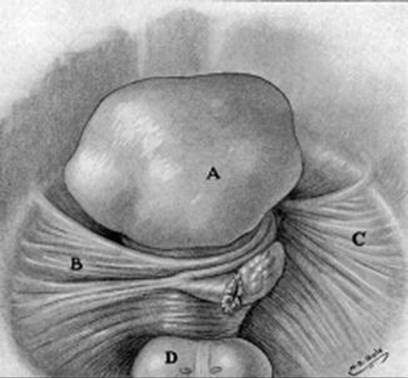
Fig. 17.1
Posterior view of the uterus. (A) Fibroid situated upon the fundus of the uterus; (B) left broad ligament (wrapped around body of the uterus); (C) right broad ligament; (D) rectum [16]
When the leiomyoma is sessile, torsion of the uterus occurs at the same time as that of the leiomyoma [16]. The point of torsion of the uterus occurs usually at the level of the uterine isthmus [16]. If the torsion of pregnant uterus occurs to such an extent that the uterine circulation is arrested, venous engorgement ensues (Fig. 17.2).
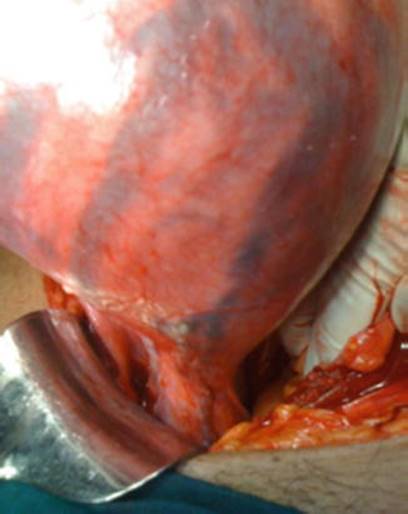
Fig. 17.2
Untwisted 180° levorotated gravid uterus with venous engorgement [18]
The presence of a uterine tumor was once believed to be the main etiological factor in the development of torsion of the uterus, and in 1907 Barozzi made the statement “no tumor, no torsion” [19]. Robinson and Duvall in 1931 modified that statement to “no uterine abnormality, no torsion,” and they presented the hypothesis that uterine rotation in the absence of gross disease was due to a developmental asymmetry of the myometrium [20]. However, in 1935, Reis and Chaloupka reviewed the literature and found 15 cases of torsion of the uterus unassociated with any uterine abnormalities [21]. MRI studies proved that defective isthmic healing after lower uterine segment Cesarean section may result in suboptimal restoration of normal cervical length [22]. This may result in an elongated cervix with structural weakness and angulation in the isthmic region and may predispose to torsion of the uterus. Nicholson et al. [23] showed an X-shaped configuration of the upper vagina instead of H-shaped, but the plane should be at the level of the vagina on abdominal MRI [24]. In approximately 20 % of cases of uterine torsion, no causative factor is apparent. It has also been suggested that peristaltic movements of the sigmoid colon may cause uterine torsion [16]. The causative factors mentioned by Nesbitt and Corner in their review of the condition are listed in Table 17.1.
Table 17.1
Causes of torsion of the gravid uterus [5]
|
Cause |
% |
|
Uterine myomas |
31.8 |
|
Uterine anomalies, especially bicornuate uterus |
14.9 |
|
Pelvic adhesions |
8.4 |
|
Ovarian cysts |
7.0 |
|
Abnormal presentation and/or fetal anomalies |
4.6 |
|
Abnormalities of the spine or pelvis |
2.8 |
|
No discoverable cause |
30.5 |
A recent review of published cases from 1966 to 2006 has not shown this to be the case, but rather uterine torsion occurs during a normal pregnancy and within a typical pelvis [8]. Authors claim that the common risk factors reported in association with uterine torsion are often nonspecific and therefore not always useful in heralding this uncommon complication of pregnancy.
17.3 Clinical Presentation
17.3.1 Symptomatology
17.3.1.1 Pregnancy
In general, symptoms are related to the degree and duration of torsion and may be designated as acute, subacute, chronic, or intermittent. The presentation of the patient may be in spectrum ranging from asymptomatic to mild abdominal pain and cramping to shock and maternal death. In about 11 % of cases, torsion is asymptomatic [5]. The main clinical features are pain, shock, intestinal and urinary symptoms, obstructed labor, and secondary vaginal bleeding. In many cases the clinical features exacerbate progressively, resulting in a diagnosis of “acute abdomen.” Rarely does torsion of pregnant uterus occur to such an extent that the uterine circulation is arrested leading to acute maternal symptoms and also threaten fetal survival. Thus, it is usually associated with placental abruption. Pyrexia found on two puerperal torsions was due to degeneration of red fibroids that caused uterine torsion [9, 10].
The presenting symptoms depend upon the degree of rotation and are listed in Table 17.2.
Table 17.2
Presenting symptoms of torsion of the gravid uterus [5]
|
Symptoms |
% |
|
Pain |
95 |
|
Shock |
8–27 |
|
Intestinal obstruction |
11–27 |
|
Urinary symptoms |
9–12 |
|
Bleeding |
6–13 |
|
Obstructed labor |
14–29 |
|
Asymptomatic |
6 |
Urinary symptoms include urgency, frequency, nocturia, oliguria, and hematuria. According to Siegler and Silverstein, there is, up to 1948, no instance of this condition having been diagnosed preoperatively [25]. Often it presents as an acute abdominal crisis, and differential diagnosis is presented in Table 17.3.
Table 17.3
Differential diagnosis of torsion of the gravid uterus [1, 12]
|
Ectopic pregnancy |
|
Abdominal hemorrhage |
|
Torsion of a pelvic tumor |
|
Peritonitis |
|
Obstructed labor |
|
Placental abruption |
|
Concealed accidental hemorrhage |
|
Tonic uterine contraction |
|
Degenerating fibromyomata |
|
Acute hydramnion |
17.3.1.2 Puerperium
The clinical presentation of puerperal uterine torsion is nonspecific and may differ from the symptoms of torsion in pregnancy. Symptoms at presentation could suggest an adnexal torsion or other colicky abdominal pain. The most common symptom is abdominal pain varying from mild abdominal tenderness to symptoms of an acute abdomen, making diagnosis difficult. In the puerperium a significant decrease of postpartum discharge (lochia) as well as a sudden complete stop of vaginal bleeding and discharge several days after delivery is highly suggestive of uterine torsion [26].
17.3.2 Physical Examination
On abdominal examination, the round ligament is palpably stretched across the maternal abdomen.
On pelvic examination, the uterine artery is perceived as pulsating anteriorly; on per speculum examination, the vagina and/or the cervical canal is distorted. Jensen described four pathognomonic clinical findings in cases of uterine torsion [6]:
· The round ligament palpably stretching across the abdomen
· The uterine artery pulsating anteriorly on vaginal examination
· Twisting of the vagina and/or the cervical canal with the urethra displaced laterally
· Twisting of the rectum
17.4 Diagnosis
Preoperative diagnosis of uterine torsion is difficult to establish. In most cases, the diagnosis is made intraoperatively.
The diagnosis can be confounded by other diagnoses, such as abnormal fetal heart rate [2, 4, 22, 27–30], failure to progress in labor [27, 29, 31, 32], or suspected placental abruption [4].
Radiologically, gas in the uterine cavity – on plain radiographs and CT scanning – has been described as a feature of uterine torsion in a nongravid patient but probably can be applied to gravid uterus also [33].
Ultrasound is not specific for this kind of diagnosis. In some cases, if previous ultrasound scans revealed fibroids that have changed position, torsion of a myomatous uterus may be suspected [33]. It can be detected by MRI if the equipment and personnel are present in emergency departments. The first case of uterine torsion detected by MRI is by Nicholson et al. in 1995 [23].
17.5 Treatment
17.5.1 Surgical Treatment of Uterine Torsion
17.5.1.1 Detorsion
The only therapy for a successful maternal and fetal outcome is laparotomy and correction of the torsion (Figs. 17.3 and 17.4). Whether any procedures should be performed to fix the uterus in the usual anatomic position is uncertain.
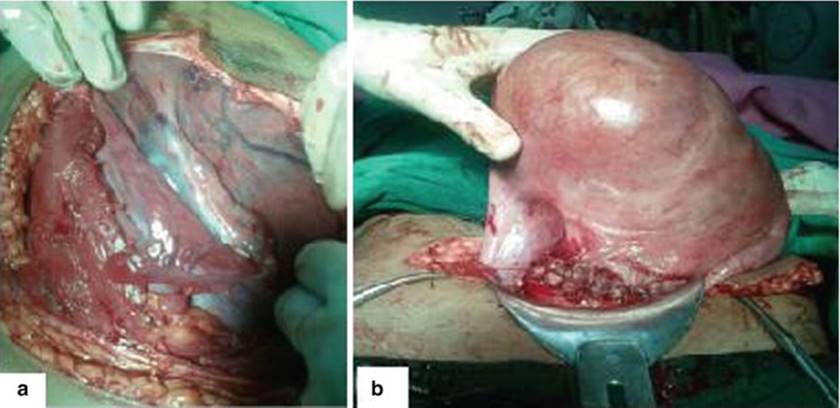
Fig. 17.3
(a) posterior wall uterus with left adnexa turned to right; (b) detorsioned uterus with myoma after suturing [34]
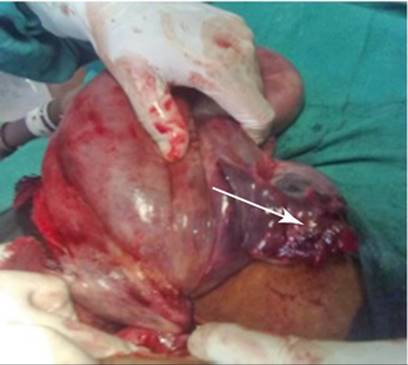
Fig. 17.4
Uterine torsion of 720°. Left ovary and tube enlarged congested free swinging (arrow) [35]
17.5.1.2 Hysterotomy
If detorsion is impossible, the posterior approach is used with a transverse incision. After deliberate posterior transverse Cesarean hysterotomy, the round ligament plication may prevent recurrent torsion in the immediate puerperium [24, 36]. Incorporating into routine practice the palpation of round ligaments at the time of Cesarean section would most likely prevent inadvertent hysterotomy at sites other than the anterior lower segment [7].
17.5.1.3 Hysterectomy
If the uterus is not viable or in women who are past the reproductive age or do not desire more pregnancies, hysterectomy is indicated [37]. It is, however, very difficult to determine whether the ischemic injury affecting the uterus is reversible or not, especially because puerperal torsion is a rare pathologic condition [26].
17.5.2 Obstetric Management
Obstetric decisions depend on the gestational age. At or near term (beyond 34 weeks), Cesarean section is the procedure of choice. At an earlier stage (before 23–24 weeks), the causative factor should be corrected if present or if possible and the pregnancy be allowed to continue to term. In the interval between the limit of fetal viability at 23–24 weeks’ gestation and the 34th week or in the rare instance when the diagnosis is securely established by MRI or another study before a laparotomy and signs and symptoms are not compelling, the best management is unclear. If the abdomen has been opened and the uterus successfully rotated into the anatomic position, apparently relieving the torsion, the gynecologist must balance the unknown risk of a maternal and/or fetal complication if the delivery is not accomplished against the immediate risk of substantial prematurity.
17.6 Prognosis
17.6.1 Maternal Outcome
17.6.1.1 Maternal Mortality
The overall maternal mortality rate associated with torsion of the gravid uterus is about 13 % and is directly related to the duration of the gestation. Under 5 months it is 0 %, whereas at term it reaches 18.5 % [2, 6, 17]. Maternal mortality rate is also directly related to the degree of twisting. In 1951, it was 7.4 % in torsions of 90–180° and increased to 50 % when the rotation is 180– 360° [38]. These findings were confirmed by Jensen [6]. Jensen stated that in the period 1960–1992, there is only one maternal death [6]. After 1976, maternal mortality was 0 % [23].
17.6.1.2 Future Pregnancy
There are no evidence-based recommendations for women who have had a uterine torsion and who wish to have future pregnancies. The risk of uterine rupture with a prior posterior lower segment incision compared with the risk following an anterior lower segment incision remains unknown. In the absence of evidence, Wilson et al. recommend a Cesarean section for any subsequent deliveries. Theoretically, a repeated Cesarean section is safer because it avoids the possibility of a labor-associated uterine rupture [7].
17.6.2 Perinatal Outcome
The limited number of cases reported and the lack of accuracy of some clinical records make this figure difficult to estimate with precision. It has been noted that the perinatal mortality increases with the degree of rotation, and whereas it ranges 20–24 % in cases in which the uterus is rotated from 90 to 180°, it may reach as high as 75 % in cases of rotation in excess of 180°. This fetal mortality rate of 18 % in cases from 1996 to 2006 (38 cases) [7] is higher than that reported by Jensen (212 cases) in the period 1876–1992 (12 %) [6].
References
1.
Piot D, Gluck M, Oxorn H. Torsion of the gravid uterus. Can Med Assoc J. 1973;109:1010–1.PubMedCentralPubMed
2.
Koh KS, Bradford CR. Torsion of the pregnant uterus. Can Med Assoc J. 1977;117:501.PubMedCentralPubMed
3.
Jovanovic D, Del Granado A, Stiller A. Torsion of the gravid uterus: a review and a case. J Reprod Med. 1972;8:81–4.PubMed
4.
Biswas MK, Summers P, Schultis SA, et al. Torsion of the gravid uterus. A report of two cases. J Reprod Med. 1990;35:194–7.PubMed
5.
Nesbitt RE, Corner GW. Torsion of the human pregnant uterus. Obstet Gynecol Surv. 1956;11:311–32.PubMedCrossRef
6.
Jensen JG. Uterine torsion in pregnancy. Acta Obstet Gynecol Scand. 1992;71:260–5.PubMedCrossRef
7.
Wilson D, Mahalingham A, Ross S. Third trimester uterine torsion: case report. J Obstet Gynaecol Can. 2006;28:531–5.PubMed
8.
Dalal Sachin J, Pandit Suchitra N, Rao SB. Asymptomatic levotorsion of a gravid uterus. J Obstet Gynecol India. 2007;57:259–60.
9.
Trillat P, Michon L, Dargent M. Bull Soc Obstet Gynec Paris. 1932;21:713.
10.
Chalmers JA. Torsion of the puerperal uterus associated with red degeneration of a fibromyoma. Br Med J. 1954;2:138.PubMedCentralPubMedCrossRef
11.
Daw E, Saleh N. Massive infarction of the uterus and appendages caused by torsion. Postgrad Med J. 1980;56:297–8.PubMedCentralPubMedCrossRef
12.
Shedden AG. Axial rotation of pregnant uterus. Br Med J. 1940;1:808–10.CrossRef
13.
Corr JE. Axial torsion of the gravid uterus in two successive pregnancies. Am J Obstet Gynecol. 1948;46:749–51.
14.
Day H. Torsion of the pregnant uterus. N Engl J Med. 1935;213:605.CrossRef
15.
Jeffecote TNA. Principles of Gynaecology. 3rd ed. London: Butterworths; 1972. p. 360.
16.
Hawes CH. Acute axial torsion of the uterus. Ann Surg. 1935;102:37–40.PubMedCentralPubMedCrossRef
17.
Rabbiner B. Torsion of the pregnant uterus in patients with kyphotic pelvis. Treatment Am J Obstet Gynecol. 1935;30:136.
18.
Gohil A, Meenaxi P. Torsion of gravid uterus managed by obstetric hysterectomy with the fetus in situ. J Obstet Gynecol India. 2012;63(4):279–81.
19.
Barozzi J. Manuel de Gynecologie Pratique. Paris: Vigot Fréres; 1907.
20.
Robinson AL, Duvall HM. Torsion of the pregnant uterus. J Obstet Gynaecol Br Commonw. 1931;38:55–84.CrossRef
21.
Reis RA, Chaloupka AJ. Axial torsion of a full term pregnant uterus. J Am Med Assoc. 1935;104:2080.CrossRef
22.
Duplantier N, Begneaud W, Wood R, Dabezies C. Torsion of gravid uterus associated with maternal trauma. A case report. J Reprod Med. 2002;47:683–5.PubMed
23.
Nicholson WK, Coulson CC, McCoy MC, Semelka RC. Pelvic magnetic resonance imaging in the evaluation of uterine torsion. Obstet Gynecol. 1995;85(5 Pt 2):888–90.PubMedCrossRef
24.
Pelosi 3rd MA, Pelosi MA. Managing extreme uterine torsion at term: A case report. J Reprod Med. 1998;43:153–7.PubMed
25.
Siegler SL, Silverstein KM. Torsion of a pregnant uterus with rupture. Am J Obstet Gynecol. 1948;55:1053–7.PubMed
26.
Cipullo LM, Milosavljevic S, van Oudgaarden ED. Uterus didelphys: report of a puerperal torsion and a review of the literature. Case Rep Obstet Gynecol. 2012;2012:190167.PubMedCentralPubMed
27.
Smith CA. Pathologic uterine torsion: A catastrophic event in late pregnancy. Am J Obstet Gynecol. 1975;123:32–3.PubMed
28.
Nielsen TF. Torsion of the pregnant human uterus without symptoms. Am J Obstet Gynecol. 1981;141:838–9.PubMed
29.
Visser AA, Giesteira MV, Heyns A, Marais C. Torsion of the gravid uterus. Case reports. Br J Obstet Gynaecol. 1993;90:87–9.CrossRef
30.
Bakos O, Axelsson O. Pathologic torsion of the pregnant uterus. Acta Obstet Gynecol Scand. 1987;66:85–6.PubMedCrossRef
31.
Cook KE, Jenkins SM. Pathologic uterine torsion associated with placental abruption, maternal shock, and intrauterine fetal demise. Am J Obstet Gynecol. 2005;192:2082–3.PubMedCrossRef
32.
El-Taher SS, Hussein IY. Unexpected torsion of the gravid uterus. J Obstet Gynaecol. 2004;24:177.PubMedCrossRef
33.
Davies JH. Case report: Torsion of a nongravid nonmyomatous uterus. Clin Radiol. 1998;53:780–2.PubMedCrossRef
34.
Deshpande G, Kaul RPM. A case of torsion of gravid uterus caused by leiomyoma. Case Rep Obstet Gynecol. 2011;2011:206418.PubMedCentralPubMed
35.
Bissa U, Shyam KR. Complete axial torsion of gravid uterus by 720o. J Dent Med Sci. 2013;7:12–5.
36.
Albayrak M, Benian A, Ozdemir I, et al. Deliberate posterior low transverse incision at cesarean section of a gravid uterus in 180 degrees of torsion: a case report. J Reprod Med. 2011;56:181–3.PubMed
37.
Acharya M, Mohapatra PC. Acute axial torsion of gravid uterus by 360 degrees – A rare case report and an unpredictable complication of pregnancy. J Dent Med Sci. 2013;3:4–6.
38.
Wrubel NN, Greenberg MV, Beilly JS. Interstitial pregnancy with torsion of pregnant uterus and spontaneous amputation of adnexa and round ligament. NY State J Med. 1951;51:2533.