
Goran Augustin1, 2
(1)
Department of Surgery Division of Gastrointestinal Surgery, University Hospital Center Zagreb, Zagreb, Croatia
(2)
School of Medicine University of Zagreb, Zagreb, Croatia
Abstract
Uterine fibroids, also known as leiomyomas or myomas, are the most common uterine neoplasms. They are benign tumors of smooth muscle origin, with varying amounts of fibrous connective tissue [1]. Fibroids usually arise in the myometrium but may occasionally be found in the cervix, broad ligament, or ovaries [1, 2]. They are multiple in up to 84 % of women [3]. Fibroids have been reported to occur in up to 70 % of women by the age of 50 years [4] and are especially common in black women, who also often have more severe disease [4, 5]. These benign tumors are hormone dependent, responding to both estrogen and progesterone [6]; they often increase in size during pregnancy and usually decrease in size after menopause. Early age at menarche and obesity are risk factors for the development of fibroids, likely due to the increased exposure to estrogen [7].
18.1 Classification and Histopathological Features
18.1.1 Considerations in the General Female Population
Uterine fibroids, also known as leiomyomas or myomas, are the most common uterine neoplasms. They are benign tumors of smooth muscle origin, with varying amounts of fibrous connective tissue [1]. Fibroids usually arise in the myometrium but may occasionally be found in the cervix, broad ligament, or ovaries [1, 2]. They are multiple in up to 84 % of women [3]. Fibroids have been reported to occur in up to 70 % of women by the age of 50 years [4] and are especially common in black women, who also often have more severe disease [4, 5]. These benign tumors are hormone dependent, responding to both estrogen and progesterone [6]; they often increase in size during pregnancy and usually decrease in size after menopause. Early age at menarche and obesity are risk factors for the development of fibroids, likely due to the increased exposure to estrogen [7].
18.1.2 Classification
Uterine fibroids in the general female population are classified according to their location as submucosal, intramural, or subserosal [1]. Submucosal fibroids are the least common type, accounting for just 5 % of all fibroids [8], but they are the most likely to be symptomatic since they project into the endometrial cavity. Submucosal fibroids can occasionally become pedunculated and prolapse into the cervical canal or vagina [9]. Intramural fibroids are the most common type, but they are usually asymptomatic; however, they may cause infertility due to compression of the Fallopian tubes. Subserosal fibroids project exophytically into the abdomen or pelvis and can also become pedunculated, which may be confused with ovarian tumors. Pedunculated subserosal fibroids can undergo torsion and consequent infarction and thus be a cause of severe abdominal pain [8, 10]. Large fibroids often degenerate as they outgrow their blood supply. The various types of degeneration include hyaline, myxoid, cystic, and red degeneration [8, 11, 12]. Calcification tends to occur following necrosis [12].
Although the majority of fibroids are benign, it is thought that some uterine leiomyosarcomas arise in a subset of fibroids [13]. Only about 0.23–0.7 % of apparently benign uterine fibroids turn out to be leiomyosarcomas on pathologic examination [14, 15]. Most leiomyosarcomas arise de novo. A leiomyosarcoma can be difficult to distinguish from a benign fibroid, and this possibility should always be considered in a patient with a rapidly growing uterine fibroid. Although red degeneration of a uterine myoma during pregnancy is managed nonoperatively, it is included in this discussion because of its ability to mimic a surgical emergency. A uterine myoma (or fibroid) is a benign tumor composed of smooth muscle. These tumors can exist within the wall of the uterus (intramural), within the uterine cavity (submucosal), underneath the serosa (subserosal), or attached to the uterine serosa by a stalk (pedunculated). As a myoma enlarges, it can outgrow its blood supply and undergo degeneration (muscular infarction), which occurs in up to 15 % of pregnant women who have myomas [16].
18.2 Incidence
Uterine leiomyomas occur in 1.6–2 % of pregnancies [17]. According to Spencer from 1920, pregnancy is complicated by fibromyomata in 0.6 % of cases [18]; Monro Kerr and Chassar Moir found the incidence to be 0.8 %. In the series from 1930 to 1954, out of a total of 69,656 deliveries, there were 245 fibromyomata or approximately 0.35 % [19]. Some authors claim that the incidence of uterine fibroids during pregnancy is decreasing especially of larger sizes because these are removed before pregnancy or if indicated hysterectomy is made. Others claim that it is increasing because many women are delaying childbearing. Red degeneration (necrobiosis) is particularly liable to occur during pregnancy. Browne had an incidence of 17.3 % in a series of 121 cases. In a series of 189 cases, necrobiosis occurred in 15.8 and 82 % were primipara [19].
18.2.1 Natural History of the Disease
During pregnancy, 15–30 % of myomas get enlarged due to increased estrogen and progesterone levels but most of them shrink during puerperium [20].
18.3 Clinical Presentation
Although leiomyomas during pregnancy usually remain asymptomatic, they may have complications which are symptomatic. The most common complication of uterine myomas during pregnancy is abdominal pain. The process of degeneration usually begins when the fibroid grows so large that the nearby blood vessels can no longer supply it with oxygen and nutrients. As the cells of the fibroid die, they are often replaced by collagen. This type of degeneration is called hyaline degeneration. Degeneration in fibroids may be hyaline (the most common), myxomatous, cystic, fatty, hemorrhagic, or malignant in nature. The type of degenerative change seems to depend on the degree and rapidity of the onset of vascular insufficiency. The pain is often severe and localized to the site of the fibroid, usually somewhere in the pelvic area. The severe pain associated with fibroid degeneration often lasts for 2–4 weeks. Degeneration of uterine myoma can lead to a complaint of sudden, severe abdominal pain. In addition, unlike with torsion of an ovarian mass, there is no direct correlation between the size of the myoma and the degree of pain. Gastrointestinal manifestations could be present such as nausea, vomiting, and diarrhea due to obstructive pressure of myomas on bowel.
18.3.1 Physical Examination
Physical examination will often reveal an exquisitely tender abdomen with signs of localized peritoneal irritation. There is tenderness over the mass attached to the uterus. Vomiting and dehydration for red degeneration is self-limiting.
18.4 Diagnosis
The ultrasound appearance of a degenerating myoma consists of a well-circumscribed uterine mass composed of echodense and echolucent areas (Fig. 18.1).
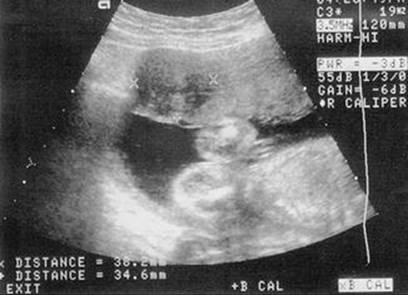
Fig. 18.1
Ultrasound of degenerating uterine fibroid at the uterine fundus (marked with calipers) [21]
Because a degenerating uterine myoma does not require surgery and has characteristic sonographic findings, it is important to consider ultrasound examination in any pregnant patient in whom emergent abdominal surgery is being contemplated. In cases which would require myomectomy during pregnancy, the addition of Doppler evaluation is recommended. A sharp drop in residence index in Doppler means an indication of some degree of necrosis [22]. The Doppler is a helpful modality to decide whether to perform myomectomy or not during pregnancy [22].
Magnetic resonance imaging (MRI) can be safely used during pregnancy to evaluate adnexal masses (Fig. 18.2). But only two of 71 cases were evaluated by MRI [23, 24].

Fig. 18.2
T2-weighted image of MRI findings of a 27-year-old 12-week pregnant woman shows an 8 × 7 × 6 cm cystic and solid mass with septa. (a) sagittal view; (b) coronal view [23]
18.5 Treatment
18.5.1 Emergent Presentation
Despite an often dramatic presentation, the optimal treatment for a degenerating uterine myoma is a short course of analgesics. Pain will often improve dramatically soon after treatment is initiated. The local release of prostaglandins from a degenerating fibroid can also stimulate uterine contractions and premature labor, so prompt consultation with an obstetrician/gynecologist is strongly advised when this complication is identified.
Sometimes genuine doubt with a right-sided fibroid low in the iliac fossa mimicking appendicitis forces the surgeon to do a laparotomy. The severity of symptoms and suspicion of malignant mass or torsion are key in deciding upon indication for emergent operation. If in doubt, laparotomy or laparoscopy should be done to exclude other causes of acute abdomen.
Once the real condition is apparent, usually the abdomen should be closed with no attempt at myomectomy, a particularly bloody operation at this stage of pregnancy.
Kim and Lee recommend cyst aspiration rather than myomectomy in a myoma with cyst degeneration and pain [23]. Occasionally a well-pedunculated fibroid may be easy to remove, but no attempt should be made to dissect out sessile or buried tumors.
There has been only one successful case of a gasless laparoscopic myomectomy [25]. In this case, it could be difficult to differentiate a complex ovarian mass from cystic degeneration of the myoma.
18.5.2 Elective Presentation
Treatment depends upon the location of the tumor, but unless it is cervical, there may be no more difficult question to answer. Four options are available:
· Hysterectomy
· Abortion with removal of the tumor subsequently
· Myomectomy with or without removing the fetus
· Progress of pregnancy and meeting emergencies if they arise
18.6 Prognosis
18.6.1 Maternal Outcome
18.6.1.1 Maternal Mortality
In all published cases, mortality was 0 %.
18.6.1.2 Maternal Morbidity
There was one large prospective study. Among 15,579 women registered at the prenatal clinic, severe abdominal pain was seen in 16 patients; in 13 cases myomectomy was done. Twelve cases had live birth; 13 cases had no blood transfusion and other complications [26].
18.6.2 Neonatal Outcome
In 71 cases, only two pregnancies were terminated after myomectomy [27, 28], and two cases had preterm labor and preterm delivery, respectively [26, 29]. One case had intrauterine growth retardation [27]. In one large prospective study, in 13 cases myomectomy was done, and there were 12 cases of live births [26]. These series show excellent neonatal survival in the range of 92–97 %.
References
1.
Prayson RA, Hart WR. Pathologic considerations of uterine smooth muscle tumors. Obstet Gynecol Clin North Am. 1995;22:637–57.PubMed
2.
Erdemoglu E, Kamaci M, Bayram I, et al. Primary giant leiomyoma of the ovary – case report. Eur J Gynaecol Oncol. 2006;27:634–5.PubMed
3.
Cramer SF, Patel A. The frequency of uterine leiomyomas. Am J Clin Pathol. 1990;94:435–8.PubMed
4.
Baird DD, Dunson DB, Hill MC, et al. High cumulative incidence of uterine leiomyoma in black and white women: ultrasound evidence. Am J Obstet Gynecol. 2003;188:100–7.PubMedCrossRef
5.
Marshall LM, Spieglman D, Barbieri RL, et al. Variation in the incidence of uterine leiomyoma among premenopausal women by age and race. Obstet Gynecol. 1997;90:967–73.PubMedCrossRef
6.
Rein MS, Barbieri RL, Friedman AJ. Progesterone: a critical role in the pathogenesis of uterine myomas. Am J Obstet Gynecol. 1995;172:14–8.PubMedCrossRef
7.
Walker PA. A case of torsion of the fallopian tube in pregnancy. J Obstet Gynaecol Br Commonw. 1962;69:117–8.CrossRef
8.
Murase E, Siegelman ES, Outwater EK, et al. Uterine leiomyomas: histopathologic features, MR imaging findings, differential diagnosis and treatment. Radiographics. 1999;19:1179–97.PubMedCrossRef
9.
Paganeas E, Kier R, McCauley TR, McCarthy S. Submucosal uterine leiomyomas: diagnosis of prolapse into the cervix and vagina based on MRI imaging. Am J Roentgenol. 1992;159:555–8.
10.
Roy C, Bierry G, El Ghali S, et al. Acute torsion of uterine leiomyoma: CT features. Abdom Imaging. 2005;30:120–3.PubMedCrossRef
11.
Ueda H, Togashi K, Konishi I, et al. Unusual appearances of uterine leiomyomas: MR imaging findings and their histopathologic backgrounds. Radiographics. 1999;19:131–5.CrossRef
12.
Okizura H, Sugimura K, Takemori M, et al. MR detection of degenerating uterine leiomyomas. J Comput Assist Tomogr. 1993;17:760–6.CrossRef
13.
Walker CL, Stewart EA. Uterine fibroids: the elephant in the room. Science. 2005;308:1589–93.PubMedCrossRef
14.
Parker WH, Fu YS, Berek JS. Uterine sarcoma in patients operated on for presumed leiomyoma and rapidly growing leiomyoma. Obstet Gynecol. 1994;83:414–8.PubMed
15.
Leibsohn S, d’Ablaing G, Mishell DR, Schlaerth JB. Leiomyosarcoma in a series of hysterectomies performed for presumed uterine leiomyomas. Am J Obstet Gynecol. 1990;162:968–76.PubMedCrossRef
16.
Rice JP, Kay HH, Mahony BS. The clinical significance of uterine leiomyomas in pregnancy. Am J Obstet Gynecol. 1989;160:1212–6.PubMedCrossRef
17.
Bhatla N, Dash BB, Kriplani A, Agarwal N. Myomectomy during pregnancy: a feasible option. J Obstet Gynaecol Res. 2009;35:173–5.PubMedCrossRef
18.
Spencer RH. Tumours complicating pregnancy, labour and the puerperium. London: Harrison and Sons; 1920.
19.
Roques F. Pregnancy complicated by tumours. Proc R Soc Med. 1955;48:5–12.PubMedCentralPubMed
20.
Coronda GD, Marshall LM, Schwartz SM. Complications in pregnancy labour and delivery with uterine leiomyomas: a population based study. Obstet Gynecol. 2000;95:764–9.CrossRef
21.
Challoner K, Incerpi M. Nontraumatic abdominal surgical emergencies in the pregnant patient. Emerg Med Clin North Am. 2003;21:971–85.PubMedCrossRef
22.
Gojnic M, Pervulov M, Mostic T, Petkovic S. Doppler ultrasound as an additional parameter for the evaluation of myomas and the indication of myomectomy during pregnancy. Fetal Diagn Ther. 2004;19:462–4.PubMedCrossRef
23.
Kim TH, Lee HH. How should painful cystic degeneration of myomas be managed during pregnancy? A case report and review of the literature. Iran J Reprod Med. 2011;9:243–6.
24.
Wittich AC, Salminen ER, Yancey MK, Markenson GR. Myomectomy during early pregnancy. Mil Med. 2000;165:162–4.PubMed
25.
Melgrati L, Damiani A, Franzoni G, et al. Isobaric (gasless) laparoscopic myomectomy during pregnancy. J Minim Invasive Gynecol. 2005;12:379–81.PubMedCrossRef
26.
Lolis DE, Kalantaridou SN, Makrydimas G, et al. Successful myomectomy during pregnancy. Hum Reprod. 2003;18:1699–702.PubMedCrossRef
27.
Majid M, Khan GQ, Wei LM. Inevitable myomectomy in pregnancy. J Obstet Gynaecol. 1997;17:377–8.PubMedCrossRef
28.
De Carolis S, Fatigante G, Ferrazzani S, et al. Uterine myomectomy in pregnant women. Fetal Diagn Ther. 2001;16:116–9.PubMedCrossRef
29.
Mollica G, Pittini L, Minganti E, et al. Elective uterine myomectomy in pregnant women. Clin Exp Obstet Gynecol. 1996;23:168–72.PubMed