
Alan Saunder, Caroline Dowling, Ken Farrell, Mark Frydenberg
8.1 Introduction
History
Groin or scrotal lumps are the most common symptoms of inguinoscrotal pathology. Pain is a variable, sometimes the sole, symptom. Severe persistent pain and local tenderness suggest ischaemia (from torsion or strangulation) or inflammation under tension. Local pain is not, however, a constant symptom of strangulation, which can be silent with few local manifestations, especially in femoral hernia.
Many patients present with a groin lump following a lifting strain at work. Risk factors for hernia, apart from manual exertion, include chronic cough and obstructive airways disease, chronic bladder neck obstruction, constipation and abdominal distension from ascites (Box 8.1). Larger hernias are usually of longer standing and may produce a confluent inguinoscrotal lump. Benign scrotal lumps are common and must be differentiated from hernias and malignancies.
Box 8.1
Risk factors for inguinal hernia
Lifting strain at work
Chronic bronchitis with cough
Chronic urinary obstruction
Constipation
Abdominal distension from ascites
Poor nutrition and old age (direct hernia)
Physical examination
Both sides must always be examined and contrasted. Multiple and bilateral lesions are very common, so no step in the local examination should be omitted. Inguinal and femoral hernial orifices and, in males, the cord, testis and epididymis, must be checked on both sides. Finally the femoral vessels and inguinal lymph node areas are examined.
Examination: patient standing
The examination conveniently starts with the patient standing and unclothed below the waist so that any hernias are made more prominent. In anxious, apprehensive or modest individuals it may be helpful in gaining the patient’s confidence to begin the examination while the patient is supine. Examination with the patient standing must not be omitted, however, as some hernias are only diagnosable in this position and swellings of venous origin disappear completely on lying down.
The region is inspected with the examiner sitting facing the patient, who is then asked to cough or to perform a Valsalva manoeuvre. Any lumps are noted, as are their position in relation to skin creases, bony prominences and other landmarks (Fig 8.1). Lumps are provisionally catalogued as inguinal, scrotal or inguinoscrotal. Any expansile impulse is observed and its direction noted.
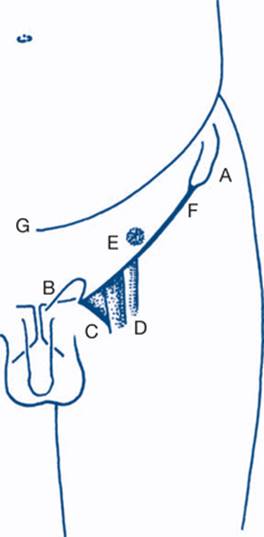
Figure 8.1 Surgical anatomy of the groin
A: anterior superior iliac spine; B: external ring; C: femoral canal; D: femoral artery and vein; E: internal ring; F: inguinal ligament; G: abdominal crease
Two conditions of venous origin become immediately obvious on standing and can only be diagnosed in this position (Fig 8.2).
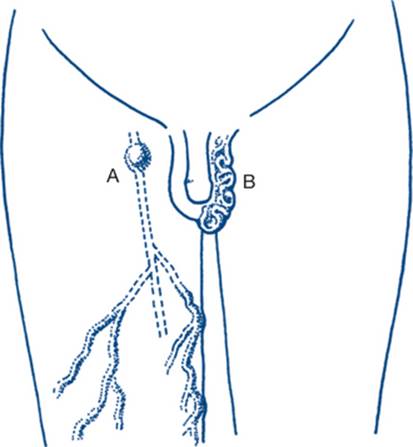
Figure 8.2 Examination: patient standing
A: saphena varix; B: varicocele
They should be checked first by considering the question: Is a varicocele or saphena varix present?
Varicoceles are usually easy to identify. They present as tortuous, soft, subcutaneous worm-like vascular swellings of the scrotal neck and upper scrotum that are prominent on standing, are usually left-sided and subside rapidly on lying down. They are separate from the testis and epididymis and may extend up along the cord. A venous thrill is sometimes palpable on coughing, but the soft vascular thrill is easily distinguishable from the cough impulse of an indirect inguinal hernia and is never truly expansile. It is usually also recognisable by its prominence during a Valsalva manoeuvre.
Saphena varix is slightly more difficult to distinguish from a femoral hernia. It presents as a groin lump appearing over the saphenous opening on standing and disappearing immediately on lying down. It is usually associated with obvious visible or palpable varicosity of the long saphenous vein, may show a bluish colouration visible through the skin if large and gives a venous thrill on coughing that travels downwards along the saphenous vein.
Its continuity with the long saphenous vein is additionally demonstrated by percussion over the saphenous vein in the thigh or at the knee, which transmits an impulse to a finger held over the groin lump above (Fig 8.3).
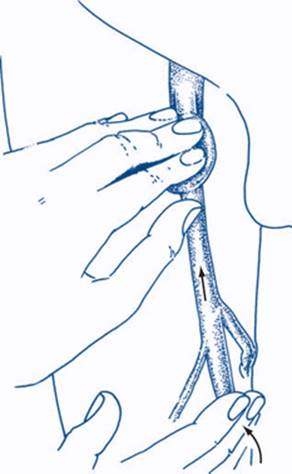
Figure 8.3 Saphena varix
Percussion over the saphenous vein in the thigh produces a transmitted impulse in the varix above.
Eight subsequent questions should be answered from inspection and palpation.
1 Is a hernia present? (Box 8.2)
An inguinoscrotal lump with an expansile impulse from above is an indirect (oblique) inguinal hernia.
Box 8.2
Typical features of a hernia
 Occurs at a site of weakness or an anatomical defect in the wall of a body cavity
Usually reducible with pressure or on lying down
Expansile cough impulse
A lump confined to the groin with an expansile impulse on coughing (bubonocele) is an inguinal or femoral hernia (once saphena varix has been excluded). The lump’s relationship to the pubic tubercle is noted, initially by inspection. Inguinal bubonoceles are predominantly medial to and mostly above the tubercle, just above the scrotal neck or extending into the labium major.
Femoral hernias are lateral or inferior to the tubercle and thus are more at the base and inner angle of the femoral triangle.
If the patient can reduce the lump, they are asked to do so and the origin of the lump is further defined. An inguinoscrotal lump that is not easily reducible is confirmed as arising either from the region of the external (superficial) inguinal ring and inguinal canal or from the femoral canal.
2 Is the hernia inguinal or femoral?
Differentiation is almost always possible by identifying whether the hernial sac emerges from the external inguinal ring above and medial to the pubic tubercle (inguinal hernia) or from the femoral canal and its opening into the thigh just above the saphenous vein, below and lateral to pubic tubercle (femoral hernia) (Fig 8.4).
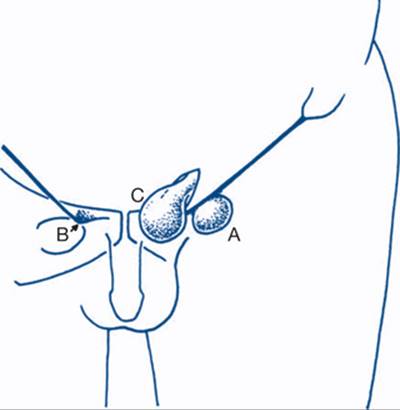
Figure 8.4 Inguinal or femoral hernia?
A: femoral hernia is sited below and lateral to the pubic tubercle (B); C: inguinal hernia appears at the external ring above and medial to the pubic tubercle
Three-finger palpation during coughing is a simple (and rather simplistic) guide to localising hernias. The examiner’s hand (of the same side as that being examined) is placed on the inguinal region with the index finger over the inguinal canal and the middle finger pulp over the external ring. These feel the obliquely or forwardly directed impulses of indirect and direct inguinal hernia respectively. The ring finger lies over the femoral canal and saphenous opening to detect a femoral hernia. The technique is suitable for males and females. With practice, the inverted V-shaped deficit in the muscle aponeurosis comprising the external inguinal ring can be identified accurately beneath the skin of the groin by the sensitive finger pulp.
More precisely, the external inguinal ring can be examined in males by invaginating the scrotum. This procedure is uncomfortable for the patient and must be performed gently and with consideration. If the hernia is not easily reducible while standing, this part of the examination is best reserved until the patient lies down. The examiner’s index finger of the same side as that being examined is placed at the lowest point of the scrotum and gently invaginates the scrotum upwards towards the ring. When sufficient slack has been invaginated so that the examining finger is in front of the pubis, the finger is pronated so that its pulp comes to lie over the external inguinal ring, with enough free play so that the finger can be gently moved without undue discomfort. It is then easy to palpate the pubic crest and the pubic tubercle at its lateral edge and to define precisely the superior and inferior crura of the external ring and the ring itself. Asking the patient to cough or to lift the head and shoulders from the couch tenses the margins of the ring and makes them easier to define. The superficial inguinal ring normally will not admit the index finger tip: if it is enlarged enough to admit the finger into the inguinal canal, an inguinal hernia is almost certainly present. The finding of an enlarged external ring in the absence of a lump is helpful in confirming the diagnosis when the patient’s history of hernia is unequivocal, but no lump is palpable or elicitable on examination. Usually the expansile impulse of the protruding sac when the patient coughs or strains is unmistakable and diagnosis of an inguinal hernia (or its exclusion) can be made with certainty. Separation of inguinal from femoral hernias is facilitated by contrasting an empty and normal inguinal ring with the femoral hernial sac emerging below and lateral to the finger.
The scrotal examination can be done in detail with the patient still standing; often it is best deferred until the patient lies down. It is important in defining scrotal masses to ascertain that one can get above the lump on palpation. A common diagnostic difficulty is when a scrotal lump coexists with an inguinoscrotal hernia. Separation of the two lumps is facilitated by lying the patient down and reducing the hernia prior to examining the scrotum.
Examination: patient supine
When the patient lies down, hernial and other lumps often spontaneously reduce. Manual reduction of hernias is also easier in this position for the patient and clinician, and the examination is much less uncomfortable for the patient.
The hernial orifices are re-examined with the patient lying down and preferably with all hernias reduced. Both external rings and both femoral canals and saphenous openings are rechecked. In the male, no matter how obese, the external inguinal ring can be examined by the sensitive finger tip through the invaginated scrotum. Both rings can be precisely calibrated and any impulse on coughing detected. In the female the external ring is not so precisely palpable. In thinner females the external ring can be palpated accurately beneath the subcutaneous fat above the pubis and only in the very obese female does palpation of the external ring pose any difficulty. The femoral canals and saphenous openings lie more deeply. They are less amenable to precise palpation and their margins cannot be accurately defined. Definition of the external inguinal ring is thus the crucial point in the differentiation of inguinal and femoral groin hernias. Reducible hernias can be separated with confidence by establishing whether they emerge from the external ring or saphenous opening. Irreducible hernias require their sacs to be traced deeply to answer the same question. Large hernias extending into the scrotum must be indirect inguinal hernias. Large femoral hernias may extend upwards above the inguinal ligament but emerge from the saphenous opening and thus lie more laterally in their inguinal extent. Direct inguinal hernias are usually reducible, but funicular direct hernias may be irreducible. The type of hernia should thus be ascertainable without difficulty in all but the very obese female.
3 Is the hernia reducible?
Groin hernias may be reducible or irreducible. Irreducibility can be due to adhesions between the contents and sac wall, the sac wall and its surrounds or to difficulties caused by a large sac and narrow neck. Irreducible hernias are more prone to complications such as strangulation.
4 Is the hernia strangulated?
Strangulation (impairment of the blood supply of the hernial contents) is a serious complication requiring urgent surgery and is more likely to occur in irreducible hernias with narrow necks. Strangulation usually is attended by symptoms of persisting pain and irreducibility over the hernia. Abdominal pain, distension, vomiting and constipation due to bowel obstruction will also be present if the sac contents include the bowel. Strangulation may, however, give no local symptoms referable to the herni, hence the importance of checking hernial orifices in all patients presenting with symptoms of bowel obstruction (Ch 7.8).
The signs of strangulation are therefore of even greater importance than the symptoms: a strangulated hernia is tense, tender, irreducible and shows no cough impulse. Irreducibility and absence of cough impulse each have causes other than strangulation; the cough impulse depends on free transfer of intra-abdominal pressure through the hernial neck and sac to the examining finger. Small hernias in large sacs (common with femoral hernias) or adhesions between sac and contents can cause the cough impulse to disappear, but the combination of these signs with a tense and tender swelling must be considered due to strangulation and is a surgical emergency.
5 Is a scrotal lump present?
The scrotum and its contents are examined in order, starting with the skin and not omitting the skin posteriorly. The skin may evidence sebaceous cysts or occasionally show thickening, sinuses or ulcers with inflammatory lesions such as filariasis and tuberculosis.
6 Can one get above the scrotal lump?
If the answer to this question is yes, then scrotal-only diagnoses should be considered. Otherwise, the swelling is considered inguinoscrotal and the most common cause is an indirect inguinal hernia.
The body of the testis, the tunica vaginalis, the epididymis and the cord back to the inguinal ring are systematically examined to determine the origins of the scrotal lump (Fig 8.5).
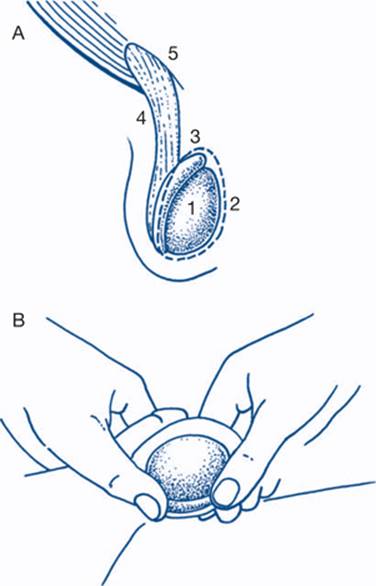
Figure 8.5 Scrotal examination
A: sequential examination of 1: testis; 2: tunica vaginalis; 3: epididymis; 4: cord; 5: superficial inguinal ring; B: palpation of epididymis
7 Is the lump arising from the testis or epididymis?
If the testis and epididymis are palpable, lumps in either of these structures can be further defined. Either may be diffusely enlarged or the site of a discrete lump and either may be associated with an acute or chronic history of swelling with or without pain.
An acutely painful swelling of the testis and epididymis suggests torsion or acute epididymo-orchitis — very often the two cannot be distinguished clinically from each other. Sometimes a testicular neoplasm can mimic an acute inflammatory swelling and present as a painful acute swelling. Occasionally, a small (<2 cm) localised tender, tense, painful acute lump on the superior pole of the testis will be recognisable as a torsion of the appendix of the testis (hydatid of Morgagni). A painlessly enlarged testis, whether a diffuse or discrete enlargement, very strongly suggests a neoplasm. A chronic haematocelepresents as a testicular lump that cannot be distinguished clinically from a neoplasm.
Discrete lesions of the epididymis are very common. Most are epididymal cysts and will be tensely or softly fluctuant and brilliantly transilluminable. Loculated cysts give a Chinese lantern effect.
Chronic solid swellings of the epididymis are usually chronic nonspecific epididymitis or less commonly due to specific infections such as tuberculosis. It may be difficult to differentiate solid discrete epididymal lumps from testicular neoplasms other than by operation. Rarely a benign epididymal tumour can be present, an adenomatoid tumour.
8 Does the lump arise from the coverings or from appendages?
Hydroceles are accumulations of liquid in the tunica vaginalis testis. When large and tense they surround the testis and epididymis from three sides, giving rise to oval or egg-shaped, fluctuant, transilluminable lumps filling the scrotum and obscuring the testis and epididymis. The site of the testis can sometimes be identified by transillumination as a dark shadow posteriorly. With smaller and less tense hydroceles the underlying testis can be palpated through the fluid. Assessment of the underlying testis and epididymis is of great importance as some hydroceles are secondary to testicular pathology (neoplasm or inflammation). In most cases, however, the testis is impalpable due to the extent of overlying fluid.
Encysted hydroceles of cord, or of the canal of Nuck in the female, give classic physical signs: a cystic spherical lump in the upper scrotum or inguinal region along the course of the cord, separate from the testis below and inguinal canal above. The lump moves freely from side to side, but longitudinal traction demonstrates its tethering to the cord and testis. A rare additional cause of a lump in the line of the cord is a lipoma or, more rarely, a liposarcoma of the cord, which is usually easily distinguishable on ultrasound as an echogenic focus as opposed to a hypoechoic fluid-filled cyst.
Differentiation of scrotal lumps can be seen to rely to a considerable extent on demonstration of the cystic nature of the lump by transillumination and fluctuation. Many solid lumps will require operation for ultimate diagnosis.
Finally, the vascular structures in both groins are checked: femoral artery, femoral and long saphenous veins and the lymph nodes.
Femoral artery aneurysm will present as a pulsatile swelling in the position of the artery over the mid-inguinal point. Venous swellings have already been mentioned.
Lymph node swellings are common. They are usually easy to diagnose from their position and consistency and the presence of a focal lesion in the drainage area. A solitary node over the lower part of the femoral canal (gland of Cloquet) can be difficult to distinguish from an irreducible or strangulated femoral hernia. Absence of tenderness is suggestive of lymph node swelling and the draining lymph node areas should be very carefully rechecked, particularly the genitalia, toes and feet, perineum and anal canal.
General examination
This includes assessment of risk factors for hernia, abdominal and chest examination in patients with suspected testicular neoplasm and examination of other lymph node areas when lymph node swellings are found.
8.2 Inguinoscrotal lumps
First categorise by careful inspection and palpation whether the lump is confined to the scrotum, is inguinoscrotal or inguinal. Remember, first determine ‘Can I get above the lump?’
Scrotal lumps
Both acute and chronic scrotal swelling have a number of causes (Fig 8.6).
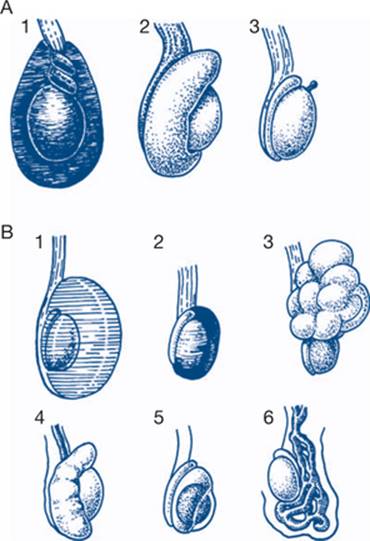
Figure 8.6 Scrotal lumps
A: acute: 1: torsion; 2: epididymo-orchitis, 3: torsion of the hydatid of Morgagni; B: chronic: 1: hydrocele; 2: haemoatocele; 3: epididymal cyst; 4: chronic epididymo-orchitis; 5: testicular neoplasm; 6: varicocele
Causes
Acute scrotal swelling
1. Torsion of testis
2. Acute epididymo-orchitis
3. Torsion of the hydatid of Morgagni
Chronic scrotal swelling
1. Hydrocele
2. Haematocele
3. Epididymal cysts
4. Chronic epididymo-orchitis
5. Testicular neoplasm
6. Varicocele
Clinical assessment, diagnostic and treatment plans
Acute scrotal swelling
1 Torsion of testis
This affects boys usually between the ages of five and 15 but occasionally young adults up to the 20s and 30s. Congenital malalignment of the testicles and mesentery is the usual predisposing cause, with a prominent intravaginal mesorchium around which torsion occurs or a horizontally lying (‘bell-clapper’) testis.
Presentation is an acutely swollen, painful, high-riding testis that is exquisitely tender, with a secondary hydrocele. Signs of surrounding inflammation and of systemic toxicity (fever, tachycardia) may be present. It is important to realise that this condition is a surgical emergency, that differentiation from acute epididymo-orchitis up to the age of 35 is difficult or impossible and that immediate exploration to confirm or exclude the diagnosis is the safest course. Special tests such as ultrasound or isotope scanning can enhance diagnosis but are time wasting and not specific or sensitive enough to override this important surgical principle. Delays in exploration and de-torsion will invariably increase the risk of ischaemia and necrosis. Often a history of previous episodes is present. Sometimes it is possible after analgesic premedication to reduce the torsion manually, but surgery should still proceed and aims to fix both testes operatively through a midline scrotal incision. The affected testis is first explored, untwisted and fixed (orchidopexy) by two or more sutures joining the tunica albuginea and dartos. If the testis is clearly necrotic orchidectomy is performed. The other testis, which often shows the same abnormality, must be fixed at the same time.
2 Acute epididymo-orchitis
Acute epididymo-orchitis presents as an acutely painful swollen testicle and epididymis. Differentiation from testicular torsion is important but often difficult. In patients aged over 45 years with an obvious cause such as bladder neck obstruction and associated urinary infection who has: urinary symptoms; signs of local inflammation maximal in the epididymis, which is diffusely enlarged and tender; and minimal testicular involvement, the diagnosis is easy and treatment is with antibiotics and periodic review. Progression of disease to fluctuation from an epididymal abscess requires drainage and occasionally later orchidectomy. Usual organisms are Gram-negative ones. Treatment with broad-spectrum intravenous antibiotics, such as amoxycillin or gentamicin, is usually required followed by a prolonged course of oral fluoroquinolone to completely clear infection that is truly involving the epididymis and testis. In less severe cases oral antibiotics may suffice without the requirement for hospital admission and intravenous therapy.
Acute epididymo-orchitis in younger adults may be venereal and specific (gonococcal) or due to nonspecific bacterial or viral infection. A history of associated urethral purulent discharge or prostatitis may be found.
Acute nonspecific epididymo-orchitis with no evidence of bacterial infection presents in young males as a tender swollen testicular swelling and is best treated by early exploration to exclude torsion, even when accompanied by systemic evidence of infection such as fever and tachycardia.
3 Torsion of the hydatid of Morgagni
An associated similar, but less severe, presentation is an acutely painful swelling at the superior pole of the testis — torsion of the hydatid of Morgagni. This can usually be diagnosed before operation and is treated by local excision of the vestige.
Chronic scrotal swellings
1 Hydrocele
A hydrocele is a collection of liquid in the tunica vaginalis testis. Hydroceles may be secondary to pathology in the underlying testis (tumour, inflammation) or idiopathic. Idiopathic hydroceles usually occur in later life and slowly and painlessly enlarge over many years. A hydrocele in a young adult with a short history should arouse suspicion of an underlying neoplasm or inflammatory lesion.
Hydroceles are also classified anatomically: as those confined within the vaginal tunica and those with a communication with the peritoneal cavity via a patent processus vaginalis (more common in the paediatric population). The latter may be precipitated as symptomatic lumps by commencement of peritoneal dialysis in children with renal injury. The therapeutic implication of the different anatomical types is important, as cure will follow simple division and excision of the communicating sac via a groin approach. Virtually all hydroceles in infancy are communicating. In young adults, most are secondary to testicular disease. In older patients, most are vaginal and idiopathic.
Physical signs are usually straightforward: a soft or tensely cystic oval swelling surrounding and obscuring the testis. The lump is fluctuant and transilluminable. The testis is difficult to palpate with very large tense hydroceles, although transillumination and palpation often identify the testis and epididymis posteriorly. Ultrasound can be used to check that the fluid is uniformly hypoechoic, and therefore likely represents clear translucent and acellular fluid consistent with an idiopathic hydrocele, and to check that the underlying testis and epididymis are normal to palpation or atrophic, which again can be corroborated on ultrasound scanning. Aspiration should be reserved for those cases in which an idiopathic hydrocele is suspected and the patient is unfit for more definitive treatment. Aspiration is associated with a high recurrence rate, and the introduction of infection, which may make subsequent repair more difficult. Any hint of abnormality of the underlying testis or any echoes within the fluid makes a secondary hydrocele likely. Treatment is then directed to the testicular pathology. Hydroceles secondary to epididymo-orchitis are treated by observation and treatment of the infection; those secondary to suspected tumour are treated by an exploration of the testis via the groin as outlined for neoplasms.
Primary hydroceles in older patients often require no treatment other than observation if they are not excessively large or uncomfortable. Larger and symptomatic swellings require operation. Jaboulay’s procedure with opening and exteriorisation of the sac lining to promote fluid absorption is usually effective, suggesting the aetiology in primary hydroceles of failure of normal absorptive capacity.
2 Haematocele
Acute local injury, such as a fall astride, can result in a painful acute haematocele, associated with local swelling and bruising. The main problem in such cases is to exclude urethral or testicular injury. The haematoma is usually treated conservatively, or evacuated if surgery is required for ruptured urethra or testis. If testicular injury has occurred it can often be managed conservatively; however, in major ruptures direct testicular repair may be required with or without orchidectomy.
Of more diagnostic difficulty is a chronic haematocele, particularly when previous injury is occult. These present as solid testicular lumps and are treated as for that problem.
3 Epididymal cysts
These present as scrotal lumps behind and above the testis and attached to it. They can range in size from 1 cm to cysts larger than the normal testis. There is never any difficulty in distinguishing the testis, which can always be identified separate to the lump. The cysts contain fluid ranging from clear to opalescent. In the latter instances nonmotile spermatozoa are identifiable (‘spermatocele’). Epididymal cysts are often bilateral, particularly the small, tense ones in the epididymal head. They are fluctuant and brilliantly transilluminable. They are seen with increasing frequency in men aged over 50 years and usually require no treatment other than reassurance. If symptomatic, which is uncommon, they can be excised.
4 Chronic epididymo-orchitis
This usually presents as a recurrent, diffuse epididymal swelling and will need antibiotic treatment. Chronic epididymo-orchitis may occasionally be tuberculous, with a firm induration of the epididymis or a localised lump. Most localised lumps will need exploration and biopsy to exclude neoplasm, unless ultrasound shows unequivocally that the lesion is in the epididymis.
5 Testicular neoplasm
All solid lumps of the testis itself should be regarded as neoplasms until proven otherwise. Testicular neoplasms in young men are commonly germ cell tumours (90–95%, seminoma and non-seminoma) and uncommonly non-germ cell tumours (sertoli and Leydig cell tumours). In older males presenting with testicular tumours, lymphoma is by far the most common tumour, with an occasional spermatocytic seminoma. Testicular neoplasms usually present as progressive painless enlargement of the testis (Fig 8.7). There may be an accompanying clear or bloodstained secondary hydrocele — occasionally this is large and the primary tumour is occult. Metastases occur most commonly to the retroperitoneal nodes and lungs but can affect any organs including bone, liver and brain. Hormonal effects of feminisation or gynaecomastia occasionally occur. Two important local variations that can cause diagnostic difficulty are:
• ‘inflammatory’ or ‘flash-fire’ presentation (the lesion mimics an acute epididymo-orchitis)
• large secondary hydrocele with occult primary.
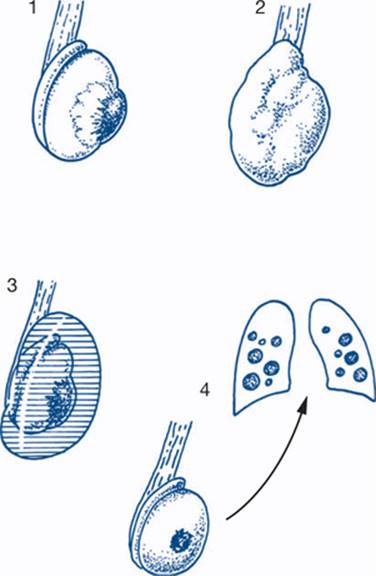
Figure 8.7 Presentation of testicular neoplasm
1: painless lump in the testis; 2: ‘flash-fire’ presentation mimicking acute epididymo-orchitis; 3: large secondary hydrocele with occult primary — especially in younger patients; 4: secondary disease from occult primary
Important principles to apply are:
• all solid scrotal lumps are assumed to be neoplasms and must be explored
• beware of hydroceles in young men, especially of recent onset.
Helpful investigations in both these instances are:
• ultrasound of the testis, which is noninvasive and can detect and diagnose underlying testicular lumps with considerable precision, together with invasion of the tunica albuginea and the degree of secondary hydrocele
• hormonal estimations and tumour markers (beta human chorionic gonadotropin, alpha fetoprotein and lactate dehydrogenase as a marker of disease burden)
• chest/abdominal and pelvic CT scanning.
These will help diagnose and stage the testicular lesion prior to operation. Whatever the state of systemic spread, local control is best obtained by confirming the diagnosis histologically and performing an orchidectomy. It is vital to explore the testis through an inguinal incision as for hernia, with delivery into the wound of the entire testis and its coverings. This avoids the hazard of disseminating the tumour surgically into the adjacent inguinal lymph node field of the scrotum, which is possible if a scrotal incision is used for preliminary biopsy.
A temporary, soft vascular clamp is placed over the cord and, if there is doubt about the diagnosis, a biopsy performed after opening the tunica. If frozen section shows a testicular neoplasm (not usually required), total orchidectomy is performed, removing the cord up to the deep inguinal ring. Benign lesions that can mimic tumours are haematocele, best treated by total orchidectomy and histological proof that the whole lesion is benign or localised inflammatory masses of epididymis and testes.
Subsequent treatment of seminoma and non-seminomatous germ cell tumour depends on staging but will involve multimodal treatment and a multidisciplinary team because radiotherapy and or chemotherapy is usually required. Local excision of metastatic tumours is occasionally undertaken for residual disease after chemotherapy. Prognosis is good for most testicular tumours, with five-year cure rates of 80–95%.
6 Varicocele
This lesion has characteristic physical findings. Presentation is usually as a scrotal swelling (rarely the swelling is painful) or during the investigation of a couple for infertility in which varicosity is an incidental finding in the male partner. Varicocele is common and is found with a frequency of 1% in the adult male population. Varicoceles are also classified as primary or secondary to abdominal pathology. A left-sided renal carcinoma rarely has an associated ‘recent onset’ varicocele that presents as the primary problem due to extension of tumour into the renal vein or vena cava, which causes gonadal vein hypertension and a varicocele. Simple varicoceles most commonly affect the left side, presumably due to the anatomical course of the testicular vein on that side joining the left renal vein. Varicoceles sometimes show a venous thrill on coughing. The cause of the lesion is thought to be incompetence or absence of the normally occurring valve at the junction of the gonadal and renal veins.
Treatment of varicocele is usually unnecessary; most patients need only reassurance. Symptomatic ones (dull discomfort, concern regarding appearance or associated infertility) are best treated by surgical ligation of the testicular veins. This is done either at the deep inguinal ring by a groin approach or in the retroperitoneum by a left-sided McBurney extraperitoneal approach and can be done laparoscopically (Fig 8.8).
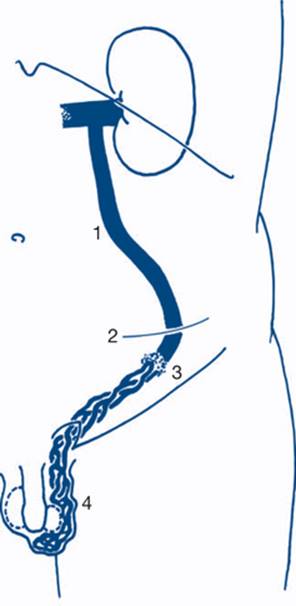
Figure 8.8 Varicocele
1: absent valves in the left testicular vein lead to venous hypertension; 2: high ligation of the testicular vein; 3: inguinal canal and deep ring; 4: varicose pampiniform plexus
In both instances the gonadal vascular pedicle has a single artery and one or two well-defined veins. These can be divided at this level without fear of testicular vascular insufficiency. Another newer method of management is venographic embolisation of the gonadal vein by performing a selective left gonadal venogram and embolising the vein using vascular coils.
Groin and inguinoscrotal lumps
Figure 8.9 depicts the common causes of inguinoscrotal lumps.
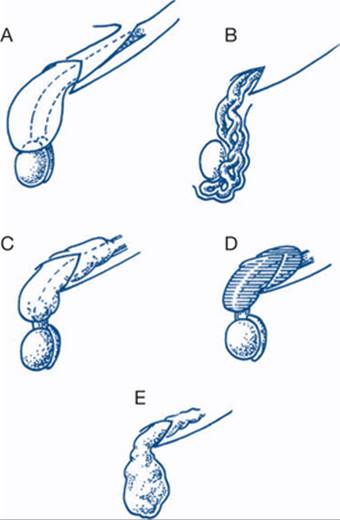
Figure 8.9 Inguinoscrotal lumps
A: inguinoscrotal hernia; B: varicocele; C: lipomatosis of the cord; D: encrysted hydrocele of the cord or canal of Nuck; E: testicular neoplasm with spread along the cord
Causes
1. Hernias: inguinal, femoral and rarer hernias
2. Saphena varix
3. Lymph node swellings
4. Less common causes
Clinical assessment and treatment plan
The differentiation of inguinal and femoral hernias is usually straightforward and has been discussed under clinical assessment (Box 8.3).
Box 8.3
Clinical features of inguinal hernia
Indirect hernia
Invariable type in infancy. Common type in young men.
Impulse felt at external ring, which is often palpably enlarged. On standing or coughing descends obliquely down the inguinal canal. When large descends into the scrotum.
After reduction the hernia can be controlled by finger pressure over the internal ring unless the defect is large.
Direct hernia
Most common in older men; bilateral small direct inguinal hernias common with COAD.
Impulse felt at external ring, which is often palpably enlarged. On standing or coughing comes forward through the external ring. Does not enter the scrotum.
The hernia reduces directly backward and is not controlled by pressure over the internal ring.
Inguinal hernias are much more common than femoral hernias and males are more commonly affected than women. Inguinal hernias may be direct or indirect (Fig 8.10).
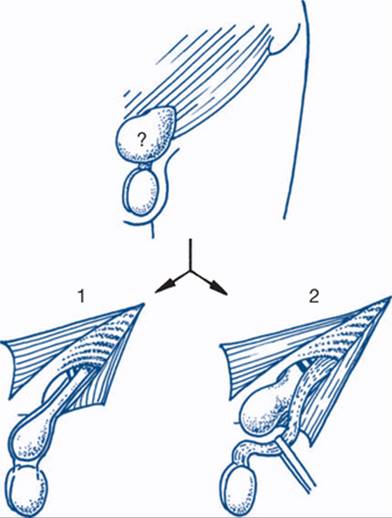
Figure 8.10 Inguinal hernia: direct or indirect?
1: indirect hernia runs within the spermatic cord through the external ring; 2: direct hernia emerges through external ring behind the cord
Indirect (oblique) inguinal hernia. The peritoneal sac originates at the deep inguinal ring and is thus carried out the external ring within the spermatic cord in males. The coverings of the sac are those of the cord and comprise a component from each layer of the parietes. Large hernias follow the cord and descend into the scrotum. At operation the neck of the sac can be followed to the deep inguinal ring. Indirect hernias can enter a congenital or acquired sac. In infants and children a congenital sac is the usual pathology. In adults the oblique sac may be either acquired or congenital.
Indirect hernias are classified anatomically as shown in Figure 8.11.
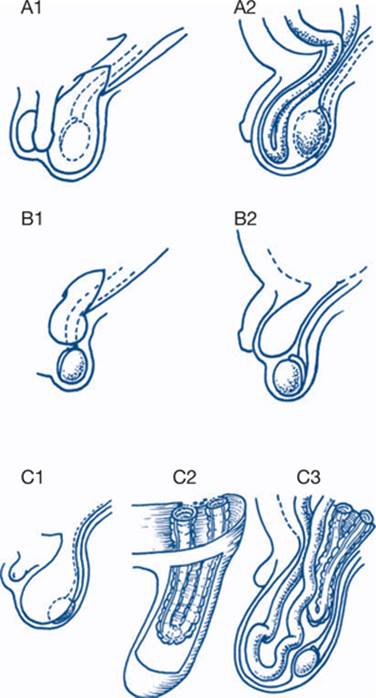
Figure 8.11 Indirect inguinal hernia
Classification A1–2: hernia magna; B1–2: funicular hernia; C1–3: sliding hernia (hernia-en-glissade). The sac consists in part of the serosal covering of the bowel, in this case sigmoid colon.
Hernia magna is a condition in which the sac is in continuity with the tunica vaginalis and thus certainly congenital. The hernial contents can descend to the bottom of the scrotum alongside the testis; strangulation is a constant danger (Fig 8.12).
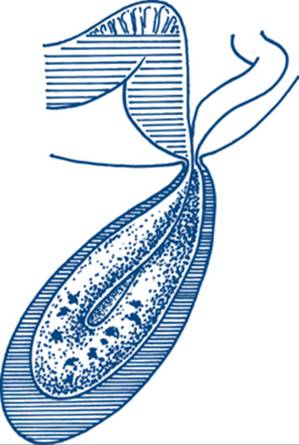
Figure 8.12 Strangulated indirect inguinal hernia
A tense, tender, irreducible hernia with loss of the cough impulse. Bowel obstruction with early vomitting, abdominal (as well as local) pain, extracellular fluid loss and systemic toxicity.
Funicular hernia, the common variety and sliding hernia (hernia-en-glissade) in which the sac in part consists of the serosal covering of bowel. Large bilateral inguinoscrotal hernias in elderly men containing bowel are often sliding inguinal hernias, with sigmoid colon on the left and caecum on the right. These hernias rarely strangulate and are usually easily reducible. The other common cause of large inguinoscrotal hernias is the hernia magna, in which strangulation is not rare. A combined direct and indirect inguinal hernia on the same side is common. This is usually only discoverable at operation and is called saddle bag or pantaloon hernia.
Hernias are also classified according to their contents. Almost any abdominal viscus may descend into an inguinal hernia: the appendix, Meckel’s diverticulum (Littré’s hernia) and so on. Strangulated hernias rarely will have the strangulated loop of bowel within the peritoneal cavity (Maydl’s hernia, hernia-en-W).
Direct inguinal hernia. These hernias virtually never descend into the scrotum. They are always acquired, the sac passing through Hesselbach’s triangle medial to the inferior epigastric vessels. They are common in elderly patients with COAD and are very often bilateral. The sac emerges from the external ring to give a globular swelling, usually presenting as a small bubonocele. The neck of the sac is more often diffuse, so strangulation is less common than with indirect inguinal hernias.
A variant of direct inguinal hernia is the direct funicular hernia (Ogilvie’s hernia), in which the defect is a small split in the fascia transveralis or conjoint tendon and the sac is oblique and funicular. These are more common in young patients after a strain and are subject to complications such as strangulation.
Femoral hernia. Femoral hernias are more common in women than men, but as inguinal hernias are very much more common than femoral hernias, the commoner of the two hernias in women is still the inguinal hernia. The sac of a femoral hernia has a recurved and sinuous course through the femoral ring and canal, saphenous opening and groin (Fig 8.13). Thus strangulation frequently occurs and is an ever-present danger in femoral hernias. The sac of a femoral hernia consists mainly of fat so the cough impulse is often less apparent than with inguinal hernias. A strangulated femoral hernia may present with bowel obstruction or septicaemia due to omental necrosis and yet have no overt symptoms referable to the hernia. The tense and tender groin lump is always apparent on careful examination but can be buried in folds of groin fat in the obese.
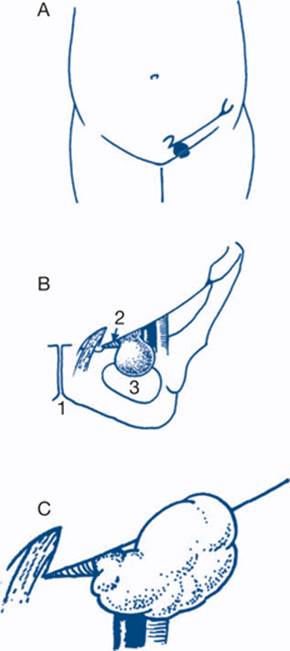
Figure 8.13 Femoral hernia
A: surface marking of femoral hernia; B: anatomy; 1: symphysis pubis; 2: lacunar ligament; 3: femoral hernia; C: large femoral hernia extending above inguinal ligament
Richter’s hernia is a variant of strangulated hernia when only part of the circumference of the bowel is entrapped and is common as a complication of femoral hernia (Fig 8.14).
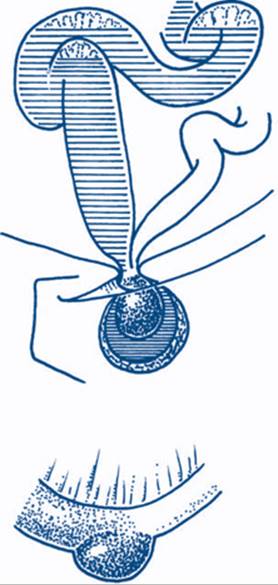
Figure 8.14 Richter’s hernia
A variant of strangulated hernia seen most commonly with a femoral hernia. Part of the circumference of the bowel is entrapped
Prevascular and lateral femoral hernia. Abnormalities of the fascial attachments of the femoral canal can cause anomalous presentations of femoral hernias anterior to the femoral artery. This may follow previous operation or injury in the area. The most common cause is a previous lymph node dissection.
Interparietal (interstitial) hernias. These hernias run between planes and are more likely to occur with recurrent hernias. Recurrent hernias after repair are usually clearly inguinal or femoral but sometimes the origins of a recurrent hernia are difficult to determine except by operation. Spigelian hernia is an interparietal hernia at the lateral rectus edge.
Management plan
All symptomatic hernias require repair. Strangulated hernias require urgent surgery. The risk of strangulation is greatest with femoral hernias, moderate with indirect inguinal hernias and least with direct inguinal hernias. Non-surgical treatment of femoral hernias is not advisable — all should be repaired. Irreducible hernias have a higher risk of strangulation and most of these require repair. Asymptomatic inguinal hernias in patients with severe associated medical conditions can be treated conservatively when the risk of repair is considered higher than that of no operation.
Surgical repair of inguinal hernias in young children can be by simple sac excision (herniotomy). In all other instances, repair should combine herniotomy with repair of the internal ring (herniorrhaphy) and of the posterior wall of the canal (hernioplasty), traditionally by some variant of the Bassini repair, with suture of conjoint tendon to inguinal ligament (Fig 8.15).
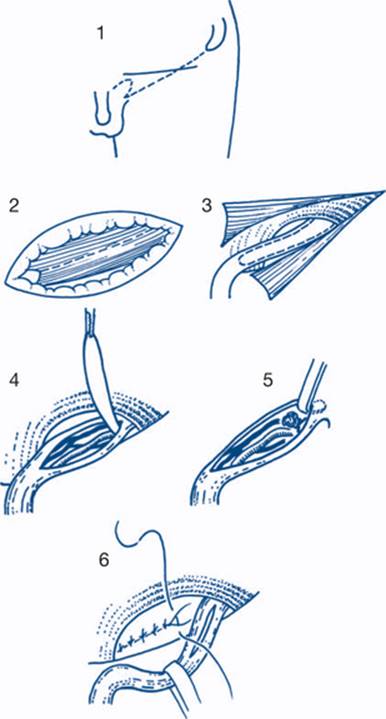
Figure 8.15 Inguinal herniorrhaphy
1, 2: exposure of the inguinal canal; 3: opening canal; 4: dissection of the hernial sac from the cord; 5: excision of the hernial sac; 6: repair of the deep ring and posterior wall of inguinal canal
However, the more common approach is to perform a tension-free posterior wall repair with prosthetic material such as a polypropylene mesh, which can be inserted by either an open approach or laparoscopically. Recurrence rates in skilled hands are of the order of 1–2%. A very large inguinoscrotal hernia in the elderly male may be treated by orchidectomy. This considerably simplifies closure and makes repair easier and recurrence less likely. In women, recurrence is low for the same reasons. Many variations of surgical repair have been described; all involve removal or reduction of the sac and buttressing the points of weakness by local, transposed or prosthetic tissues.
Repair of a femoral hernia is easier and recurrence is rare after simple approximation of inguinal ligament to the iliopectineal line to narrow the femoral ring.
Saphena varix and lymph node swellings have already been discussed (Ch 8.1 and 8.2). Other causes of groin swellings include femoral artery aneurysm, maldescent of testis, psoas abscess, encysted hydrocele of the cord (or canal of Nuck in a female), lipomatosis of the cord and, rarely, a testicular neoplasm infiltrating the cord. Careful physical examination will separate those other causes from hernias.
8.3 Abdominal wall problems
The umbilicus
Variations in umbilical shape and form are almost infinite. Clinical problems affecting the umbilicus usually take the form of a discharge, nodule or defect.
Umbilical discharge
Common causes
1. Omphalitis
2. Embryological remnants — vitelline duct, urachus
3. Intertrigo, umbilical concretions or granulomas
4. Ulcerated malignant nodule (Sister Mary Joseph’s nodule)
5. Pilonidal sinus
Clinical features and treatment plan
1 Omphalitis
This may occur in neonates prior to healing of the umbilical cicatrix.
2 Embryological remnants
These may present in infancy but are often silent until adult life.
Vitelline duct. This can persist as an umbilical polyp, sinus or fistula. A fibrous band often connects the posterior abdominal wall to a Meckel’s diverticulum. Treatment is by excision of the remnant and its connections.
Urachal duct. Urachal abnormalities may persist, leading to a vesico-umbilical fistula with urine drainage or to a chronic sinus or cyst from the umbilicus running towards bladder, to that it is connected by a fibrous cord. Excision is curative.
3 Intertrigo, umbilical concretions or granulomas
These are associated with a deep umbilical dimple or crevice and with poor hygiene.
4 Ulcerated malignant nodule (Sister Mary Joseph’s nodule)
A malignant lymph node deposit, usually secondary to a gut malignancy. The nodule may ulcerate.
5 Pilonidal sinus
This occurs in hairy individuals and is best treated by exteriorisation of the tract and removal of the hair.
Umbilical swellings and defects
Causes
1. Congenital omphalocele
2. Umbilical hernias
Clinical features and treatment plan
1 Congenital omphalocele
Exomphalos is a defect due to failure of return of the physiologic mid-gut hernia, which normally returns to the abdomen after 10 weeks’ gestation. The herniated viscera are covered with a sac of amnion. The condition is a neonatal emergency and should ideally be managed by a paediatric surgeon.
2 Umbilical hernias
Primary congenital umbilical hernias occur in infants through a defect in the umbilical ring following obliteration of the extraembryonic coelom and of the umbilical vessels. They are common (10% of term births) and the frequency increases with prematurity. Strangulation is extremely rare and most close spontaneously by the age of two years. Treatment is thus initially conservative, repair being reserved for the occasional hernia that does not close spontaneously.
Secondary (acquired) umbilical hernias are most common in middle-aged women associated with multiparity and obesity and in patients with ascites. The defect is often just above the umbilical cicatrix and the umbilical skin scar comes to lie eccentrically on the inferior aspect of the skin lump (Fig 8.16).
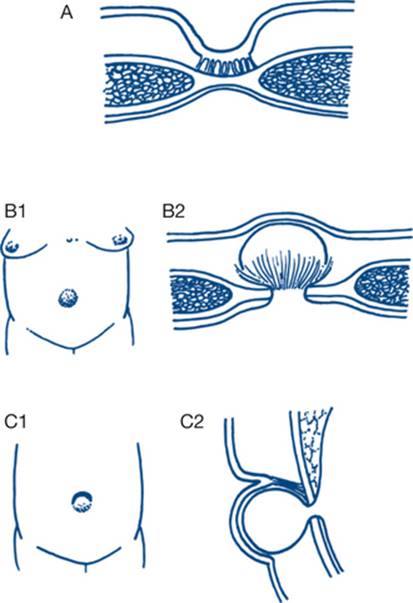
Figure 8.16 Umbilical hernia
A: the normal umbilicus lies over the linea alba with rectus abdominus muscle on either side; B: primary umbilical hernias protrude through the umbilical scar; C: acquired umbilical hernias are periumbilical so that the umbilical side of the skin dimple becomes an eccentric crescent-shaped slit.
These umbilical (or paraumbilical) hernias can grow to a large size and often contain omentum, small bowel and transverse colon. Complications of irreducibility and strangulation are quite common; most should be repaired as soon as possible after presentation. Mayo’s overlapping repair gives excellent results (Fig 8.17) for small umbilical hernias but larger ones are best repaired using prolene mesh in a tension- free fashion. Umbilical hernias can sometimes be the presenting sign of ascites from an intra-abdominal malignancy.
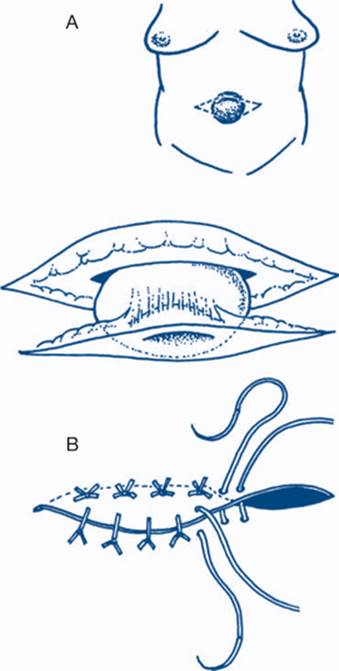
Figure 8.17 Mayo repair of large umbilical hernia
A: excision of sac; B: transverse repair using overlap
Swellings of the abdominal wall
These can involve all layers.
Causes
1. Subcutaneous and intramuscular swellings
2. Abdominal wall hernias
Clinical features and treatment plan
1 Subcutaneous and intramuscular swellings
Lipomas. Subcutaneous lipomas are very common and often multiple. Treatment is by simple excision if they are symptomatic.
Desmoid tumours. These are uncommon benign fibromatoses arising usually from the lower rectus sheath. They are slow-growing tumours of middle-aged multiparous women and should be widely excised to avoid the risk of local recurrence. They do not metastasise. They are found in association with Gardner’s syndrome (familial adenomatous colonic polyposis) and in the multiple endocrine neoplasia syndromes.
Rectus sheath haematomas. These almost invariably are found along the line of the inferior epigastric vessels and can follow minor strains such as coughing or lifting. A tender diffuse swelling that is often defined by the margins of the rectus sheath develops but can be confused with acute appendicitis if it is right-sided. Most cases now occur in patients on anticoagulants. A telltale bruise often overlies the abdominal wall swelling. If possible, operation should be avoided and spontaneous resolution awaited. Close monitoring of the anticoagulation is essential in this situation.
2 Abdominal wall hernias
Hernias are focal protrusions or malpositions of the contents of a confined space or compartment.
External hernias form localised protrusions through a defect in the abdominal wall. Groin hernias (inguinal, femoral) are the most common type. Other external abdominal hernias are umbilical hernia, incisional (ventral) hernia, epigastric hernia, Spigelian hernia and lumbar hernia (Fig 8.18).
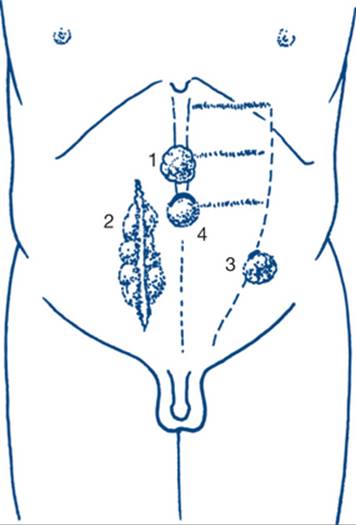
Figure 8.18 Sites of ventral hernias
1: epigastric; 2: incisional; 3: Spigelian; 4: umbilical
Internal hernias occur through defects of the internal linings relevant to the compartment or by internal entrapment. Common internal abdominal hernias are through the oesophageal hiatus, through developmental defects via the foramina of Morgagni or Bochdalek (Fig 8.19), through the obturator or sciatic foramina, through the perineal floor or through congenital or acquired intraperitoneal recesses and foramina (e.g. foramen of Winslow). Intraperitoneal entrapments most commonly follow operations (e.g. paracolostomy hernia after excision of the rectum, postgastrectomy internal hernias and postoperative adhesions). Developmental peritoneal fossae and recesses are most common around the duodenum (superior and inferior duodenal recesses, mesentericoparietal recess of Waldeyer) and appendix and caecal areas.
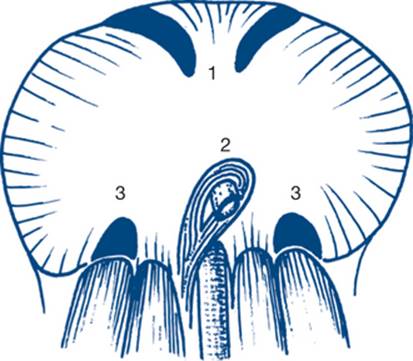
Figure 8.19 Diaphragmatic hernia
1: foramen of Morgagni — between the sternal and costal slips of the diaphragm; 2: oesophageal hiatus; 3: foramen of Bochdalek
Epigastric hernia. These are defects through a split in the linea alba, which usually occurs midway between the xiphoid and umbilicus. The hernias consist mainly of extraperitoneal fat, with or without a small peritoneal sac. They form subcutaneous lobulated swellings and are often mistaken for lipomas. A cough impulse is often absent because of their extraperitoneal origin and large component of fat. They very rarely strangulate. Repair is usually simple.
Incisional hernia. Wound infection is the most common cause of incisional hernias, which are more common in vertical incisions than in transverse ones. Incisional hernias often grow progressively and are best repaired early if symptomatic and if the patient’s general status allows. Some incisional hernias can be very large and repair may require an implanted mesh prosthesis of nonabsorbable material.
Spigelian hernia is an interstitial hernia through a defect in the linea semilunaris, usually midway between the umbilicus and pubis. It occurs at the site of the emerging neurovascular bundle and the sac does not pass through the external oblique aponeurosis. The other main type of interstitial hernia is a direct inguinal hernia extending upwards and laterally between the internal and external oblique muscles to give an inguinal hernia of aberrant position.
Lumbar hernia. The most common lumbar hernia is an incisional hernia within the scar of a nephrectomy incision or other renal operation. Other areas of potential weakness and herniation are the superior and inferior lumbar triangles. Large hernias in this region have as their upper and lower boundaries the lower ribs and iliac crest respectively, so repair usually requires a prosthetic mesh inlay.
Perineal hernia occurs through a weakness of the pelvic floor or defect in the attachment of the levator ani muscle (hiatus of Schwalbe). They are more common in women after parturition and present as vulval or perineal soft reducible swellings. The most common cause of perineal hernia is an incisional hernia in the perineal scar of an abdominoperineal resection of the rectum. These hernias are diffuse and rarely need treatment.
Rarer forms of internal hernia include:
• Obturator hernia. This rare hernia is more common in women. Patients may present with a groin lump and referred pain in the knee or more commonly the hernia is found at laparotomy for intestinal obstruction.
• Sciatic hernia. This is even rarer and may pass through the greater or lesser sciatic notches. Almost all will be found on intraperitoneal exploration as a cause of intestinal obstruction. Tuberculous psoas abscess can be a differential diagnosis.
Internal hernias are subject to the same complications of irreducibility, strangulation and obstruction as external hernias. Most will therefore present clinically as intestinal obstruction and are discovered at laparotomy. When important vessels form the margins of the neck of the sac (e.g. lesser sac hernias), great care is required to avoid damaging these. The anatomy may be complex when internal hernias occur after previous surgery. Mechanical small bowel obstruction due to entrapment of a loop of small bowel at the side of an enterostomy into an introgenic defect is a potential hazard, which has led to a variety of techniques to close these internal gaps or to render them so large as to be unlikely to obstruct.