
Iqbal S ShergiH, Ananda K Dhanasekaran, Jas S Kalsi and William J McAllister
Q. What is the embryological basis of prostate development?
A. The prostate develops between the 10th and 16th weeks of gestation from epithelial buds which branch out from the posterior aspect of the urogenital sinus to invade the mesenchyme.
Stromal-epithelial interaction is important through production of dihydrotestosterone by epithelial cells acting on mesenchymal androgen receptors.
Q. What is the blood supply to the prostate?
A. The arterial blood supply is from the branches of the inferior vesical artery. This provides the prostatic artery which divides into urethral and capsular groups of arteries. From the urethral group arise Flock’s and Badenoch’s arteries (both supply the transition zone). Flock’s arteries approach the bladder neck at 1 and 11 o’clock and Badenoch’s at 5 and 7 o’clock. The capsular branches of the prostatic artery run with the cavernosal nerves.
The venous drainage is via the periprostatic venous plexus. This also receives the deep dorsal vein of the penis and numerous vesical veins. The periprostatic venous plexus eventually drains into the internal iliac vein.
Q. Describe the lymph drainage from the prostate.
A. The lymph drainage is mainly to the obturator nodes and then the internal iliac chain.
Q. Can you describe and draw the zonal anatomy of the prostate?
A. The zonal anatomy is described using McNeal’s zones (Figure 12.1).
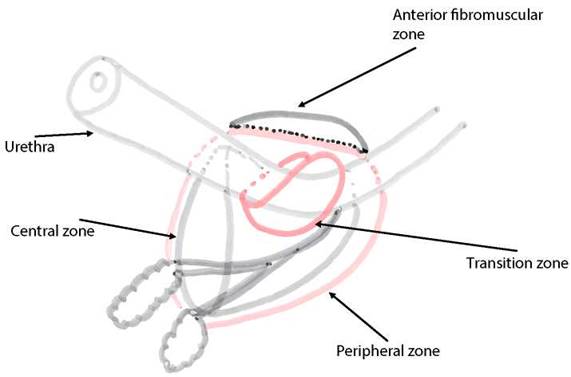
Figure 12.1 McNeal’s zones of the prostate.
Transition zone (comprises 10% glandular tissue of prostate - site of origin of benign prostatic hyperplasia)
Central zone (comprises 25% glandular tissue of prostate)
Peripheral zone (comprises 65% glandular tissue of prostate)
Anterior fibromuscular stroma